
Podcast: Download (Duration: 44:23 — 51.1MB)
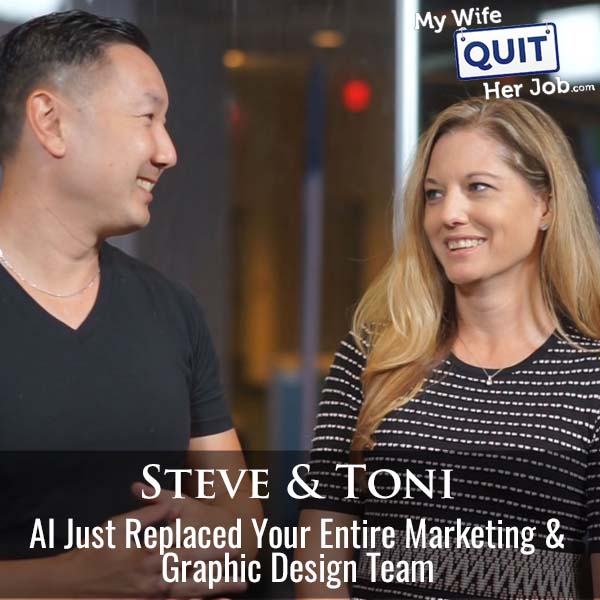
AI image generation is replacing graphic designers and marketing agencies for the middle 80% of the market, and the tipping point was the March 2025 release of OpenAI’s GPT-4o native image generation plus Google Gemini Flash 2.0. In this episode of the My Wife Quit Her Job podcast, my co-host Toni Anderson and I break down what the new tools can actually do, which parts of the graphic design job are safe, and how ecommerce owners can use AI to slash their creative budgets today.
The short version is that a competent ecommerce operator can now recreate a Facebook ad they admire, restyle it with their own product and copy, and iterate on the layout in about the time it takes to brief a designer. If you know what you want, you can produce production-quality assets without a Canva template or a designer on retainer.
Below you will find the specific workflow we walked through, the tools that matter (ChatGPT/GPT-4o, Google Gemini Flash 2.0, Midjourney, Kling), which creative jobs are safe, and where you still need a real human.
Get My Free Mini Course On How To Start A Successful Ecommerce Store
If you are interested in starting an ecommerce business, I put together a comprehensive package of resources that will help you launch your own online store from complete scratch. Be sure to grab it before you leave!
Table of Contents
Key takeaways
- OpenAI’s GPT-4o image generation (March 2025) is the first mainstream tool that can reliably restyle an existing ad, keep your product, and render legible on-brand text.
- Google Gemini Flash 2.0 is faster than GPT-4o for edits and is well suited to iterating on an existing image (change the model’s expression, swap the background).
- You can produce professional-looking Facebook ads by uploading a reference ad plus your product, then prompting for the same style with your value props.
- Top-tier graphic designers are safe. The middle 80% of the industry (self-taught Canva users, mediocre freelancers) is being priced out.
- New product photography is largely optional. Kling can animate stills, GPT-4o can insert your product into styled scenes, and H&M is already publicly using AI models.
- Never trust an AI-generated statistic without a source. Claude will fabricate hooks like “80% of parents are frustrated teaching their kids to read” and admit it made the number up when questioned.
- The long-run risk: as AI destroys the incentive to publish original content on the open web, the models will run out of fresh training data. Expect a pendulum swing back toward paywalled, human-verified sources.
What new AI image generation tools are disrupting graphic design?
The tools disrupting graphic design in 2025 are OpenAI’s GPT-4o native image generation (released late March 2025), Google Gemini Flash 2.0, and Midjourney’s ongoing releases, with Kling handling the video-animation side. Each has a different sweet spot, and using them together is what makes the workflow work.
GPT-4o is the biggest step change because it can generate legible on-image text, follow a reference image’s style, and swap in your own product without you having to art-direct pixel by pixel. Midjourney still produces the most striking artistic imagery, and Kling can animate a still photo (including old family photos, product shots, or cartoon frames) with unnerving realism.
The trade-off right now is speed. GPT-4o image generation was averaging about five minutes per image during the launch surge as OpenAI scaled capacity, versus roughly 30 seconds on Midjourney and Gemini Flash. That will normalize the way ChatGPT’s early speeds did.
How to create a Facebook ad with GPT-4o (real workflow)
To create a Facebook ad with GPT-4o, download a competitor ad you admire from the Facebook Ads Library, upload it to ChatGPT along with your product image, and prompt: “Use this style with my product. Here are my value props. I have been featured in these publications. Match the layout and font hierarchy.” GPT-4o will handle the composition, drop in credible logos, and produce a first draft you can iterate on.
I ran exactly this workflow for a Bumblebee Linens ad using a competitor’s format. I gave it the Brides, Martha Stewart Weddings, and Real Simple logos as our featured-in credentials, and it went out, grabbed matching versions of those logos, and placed them in the layout with proper font hierarchy. The first draft was 80% there.
For the last mile I opened Photoshop and nudged a couple of misaligned text blocks and changed the call-to-action button color. That is a five-minute fix, not a $250 designer round trip. As GPT-4o gets faster you will iterate inside ChatGPT itself instead.
Which graphic designers are actually at risk from AI?
The graphic designers at risk are the middle of the market: self-taught Canva users who never trained as designers, mediocre freelancers, and in-house corporate designers whose main job is executing on someone else’s brief. Top-tier creative directors and illustrators who can articulate strategy, evoke emotion, and translate an abstract concept into a distinctive visual are still safe, at least for now.
The reason the middle is exposed is simple. Most business-level design work is derivative by nature, iterating on formats and templates that already exist. That is exactly where AI is strongest, because it is trained on the entire public canon of ads, packaging, and layouts.
The reason the top is safe is that the best designers do not just execute. They interrogate the brief, spot the strategic gap, and produce work you did not know to ask for. AI cannot originate; it can only recombine what has been done.
For illustrators specifically, the AI upside is time. Hand-drawn illustration takes hours per asset. If AI can compress an illustrator’s throughput from weeks to days, the good ones will get more work, not less, because they can take on projects that were previously uneconomical.
When should you still hire a real graphic designer?
You should still hire a real graphic designer for anything that requires strategy over execution: brand identity systems, lifestyle photography direction, packaging that has to communicate emotion, and campaigns where the creative has to be genuinely original rather than derivative. If your brand’s advantage is a distinctive point of view, do not outsource that view to a tool that recombines everyone else’s work.
Lifestyle product photography is the clearest example. AI can produce a good clean product shot and can insert your product into an existing style. It cannot decide which three lifestyle scenarios will actually make a customer want to buy, or which pages of your brand story matter most to show.
Anything that involves human relationships around design (working with an influencer program, art-directing a photo shoot with a real model, building a brand system across dozens of touchpoints) is still a human job. That is not a matter of AI capability. It is a matter of the coordination and taste being the actual value.
How to use AI to replace product photography for ecommerce
To use AI to replace product photography, take a phone-quality photo of your product on a clean background, upload it to GPT-4o or a specialized product-photo tool, and prompt it to place your product in the environment you want (kitchen counter, on-model shot, styled flatlay). For apparel, either use an AI model to wear the garment or take a photo of yourself in the pose and use a masking tool to swap the person while keeping the product intact.
For animated ad assets, upload the still to Kling and prompt for the motion you want. Kling can take a static product shot or even an old family photo and produce a scarily realistic animation, which is why the industry is moving fast toward AI video ads.
H&M announced in March 2025 that they will begin using AI-generated models in their marketing, one of the first major apparel brands to say it out loud. Expect Zara, Shein, and every fast-fashion brand to follow. For small ecommerce sellers this is straightforwardly good news: you no longer need to hire a model or ship product to a photographer for basic on-model shots.
Where AI still gets it wrong (and how to catch it)
AI still gets it wrong most reliably on facts, statistics, and any claim that sounds authoritative. When Toni’s client asked Claude for a hook for a video about teaching kids to read, Claude produced “80% of parents are frustrated teaching their kids to read.” When she asked for the source, Claude admitted it had made the number up.
Never publish an AI-generated statistic without a verifiable citation. If the AI cannot produce a source URL that resolves, treat the number as if it does not exist. This applies to hooks, ad copy, blog intros, and anything that presents itself as data.
The other failure mode is taste. AI will confidently produce color pairings that clash, font choices that undercut the message, and layouts that feel technically fine but read as generic. If you do not have design intuition, AI will not give it to you. It will just make your lack of intuition faster to ship.
Why the AI training data problem will eventually reverse this trend
The training data problem is that GPT-4, Claude, and every major model already crawled the useful open web, and the next generation is increasingly being trained on regurgitated AI output, which degrades quality. Reports around GPT-5’s development suggested OpenAI was running low on fresh, high-quality human text, and that model quality can degrade when training data becomes recursively AI-generated.
Here is why this matters for ecommerce operators: right now AI can copy any Facebook ad, any product page, any landing page style because those things exist in the crawl. As original human creators disappear from the open web (blogs shutting down, YouTubers moving behind paywalls, brands locking creative behind login walls), the supply of new training material dries up.
The prediction Toni and I both landed on: within a few years, the truly novel, verifiable content will be paywalled, licensed to AI companies for a fee, or restricted to closed communities. Right now we are in the disruption phase. The counter-swing is coming.
Comparison of AI tools for ecommerce marketing (2025)
| Tool | Best for | Typical speed | Approx. cost | Weakness |
|---|---|---|---|---|
| ChatGPT (GPT-4o image gen) | Ad restyling, on-image text, product mockups | 1-5 min per image | $20/mo (Plus) | Slow during peak load |
| Google Gemini Flash 2.0 | Fast edits, changing model expression, background swap | ~30 seconds | Free / API pricing | Less strong on multi-element composition |
| Midjourney | Distinctive artistic imagery, brand hero shots | ~30 seconds | $10-60/mo | Weaker at on-image text and product accuracy |
| Kling | Animating stills into short video | 1-3 min per clip | Freemium + credits | Longer clips can drift off-model |
| Claude | Ad copy, script rewriting, prompt engineering | Instant | $20/mo (Pro) | Will fabricate stats if you do not ask for sources |
Where humans still have the advantage over AI in ecommerce
Humans still have the advantage in relationship-driven marketing, most notably influencer seeding, community building, and customer service that requires empathy. Our friend Andrea recently launched a new product in the crafting space, mailed samples to a large list of relevant influencers with no strings attached. The resulting organic posts drove real sales and a flood of inbound requests from other influencers who saw the seeding.
That process cannot be automated. It is language nuance, personal follow-up, the taste to pick the right recipients, and the patience to send free product with no expectation of return. Chinese sellers using AI to flood TikTok Shop cannot replicate the relationship layer, which is exactly where a small US brand can still win.
The takeaway: use AI to compress everything that is derivative (photos, ad variants, layout iteration, copy first drafts), and reinvest every hour it saves into the relationship and originality work that AI still cannot do.
Frequently asked questions
Is AI image generation actually good enough to replace a graphic designer for Facebook ads?
For most small and mid-sized ecommerce brands, yes. GPT-4o can produce a Facebook ad that looks professional, includes legible on-image text, credible logo placements, and a coherent visual style, using nothing more than a reference ad and your product image. You will still want a human eye on the final polish, but the base workflow no longer requires a designer.
Which is better for ecommerce, ChatGPT GPT-4o or Google Gemini Flash 2.0?
Use both. GPT-4o is stronger for generating a first-draft ad from scratch with legible text and complex layout. Gemini Flash 2.0 is faster and better for quick edits on an existing image, like changing a model’s expression, swapping a background, or trying color variants.
Can I use AI models instead of photographing real people in my clothing?
Yes, and H&M publicly announced in March 2025 that they will be using AI models in their marketing. For a small ecommerce brand you can use GPT-4o or a specialized apparel tool to render your garment on an AI model, or photograph yourself in the pose and mask-swap the person while keeping the product intact.
Will AI make product photographers obsolete?
Basic clean-background product shots and simple lifestyle scenes are already being automated, and most new small ecommerce brands do not need to hire a photographer at all. What survives is high-end brand and campaign photography, where the value is the creative direction, the physical staging, and the ability to produce a distinctive image that AI cannot recombine from the training set.
How do I stop AI from fabricating statistics in my content?
Never accept a number from Claude, ChatGPT, or Gemini without asking for a source URL and confirming the URL resolves to the claimed data. If the model cannot cite it, treat the stat as invented. Use the “deep research” mode of your model for anything that will be published, and cross-check against a primary source.
What is the best AI tool to animate a still photo for an ad?
Kling is the current standout for animating still images into short video clips. Upload the still, prompt for the motion you want (a model turning to camera, a product being lifted, a cartoon frame coming to life), and Kling will produce a short animated version. Runway and Sora are the two main alternatives.
What happens to AI image tools when the training data runs out?
Quality plateaus, or in some scenarios degrades, because models trained partly on other models’ output start amplifying their own errors. The likely outcome over the next few years is a pendulum swing: original human content moves behind paywalls or into licensing deals with AI companies, and the freely-crawlable web becomes a lower-quality signal. Ecommerce brands that own their own creative assets and customer relationships come out ahead.