

Podcast: Download (Duration: 46:21 — 53.3MB)
YouTube’s answer to TikTok Shop is two separate products that most e-commerce brands should be testing right now: shoppable YouTube ads (paid pre-roll and in-stream that shows your product feed next to the video) and YouTube Affiliate (an open-beta program that lets creators tag your products in organic videos and earn commission on sales). YouTube also runs bigger than Netflix on connected TVs and is the most under-attributed ad channel of the major platforms, which is why the Haus incrementality study of 74 top DTC brands found YouTube consistently drives far more real revenue than its in-platform ROAS suggests.
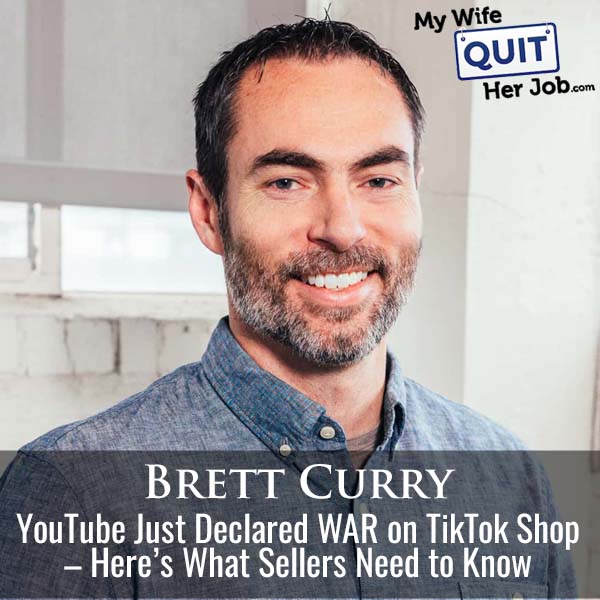
I sat down with Brett Curry, founder of OMG Commerce and a seven-time Sellers Summit speaker, to unpack all of it: how the ad math actually works, the Haus study numbers, the exact YouTube Affiliate setup inside Google Merchant Center, the creator-payout mechanics, the minimum daily budgets that make each campaign type viable, and the ideal customer profile for a brand that wants to scale on YouTube. Brett runs YouTube for eight- and nine-figure DTC brands, so the tactics are field-tested.
Below is the practical breakdown: shoppable ads vs YouTube Affiliate vs TikTok Shop, what to spend, what to measure, and how to know it is working when a Connected TV viewer never clicks.
Get My Free Mini Course On How To Start A Successful Ecommerce Store
If you are interested in starting an ecommerce business, I put together a comprehensive package of resources that will help you launch your own online store from complete scratch. Be sure to grab it before you leave!
Table of Contents
Key takeaways
- YouTube is the number-one streaming platform on Connected TVs, bigger than Hulu, Disney+, Peacock, and Prime Video combined. Netflix is number two.
- Incremental ROAS (IROAS) is the metric that matters for YouTube, not in-platform ROAS. In-platform ROAS undercounts because Connected TV impressions do not produce clicks.
- The Haus Analytics study of 190 incrementality tests across 74 DTC brands (AG1, Ridge, and others) found YouTube drives far more real revenue than its in-platform numbers show. Those brands spent roughly 30% of their Meta budget on YouTube.
- Three lift studies to run continuously on YouTube: brand lift (survey-based awareness), search lift (branded-search volume after impression), and conversion lift (holdout-group purchase difference).
- YouTube Affiliate is a new open beta inside Google Merchant Center. Creators tag your products in their organic videos, product cards appear next to the video, and the creator earns a commission you set.
- To use YouTube Affiliate you must run one of four approved affiliate integrations: the Shopify Google & YouTube app, Impact, Rakuten, or CJ (formerly Commission Junction).
- Minimum daily spend for a conversion-focused YouTube campaign is roughly $300 to $1,000 per day to feed the algorithm enough data. View-based campaigns can start at $20 to $100 per day.
- Ideal YouTube advertiser profile: high LTV or high AOV product, subscription or repeat purchase potential, and a product that lends itself to visual storytelling.
What are shoppable YouTube ads and how do they work?
Shoppable YouTube ads are pre-roll or in-stream video ads that display a product feed from Google Merchant Center directly next to the video, so viewers can click through to buy without leaving YouTube. They can be skippable or non-skippable, run on any device (mobile, desktop, or Connected TV), and pull relevant products from your Merchant Center feed based on the video content.
Two flavors matter for e-commerce. The first is a straight brand-produced ad with your product feed attached. The second uses existing creator content: you take a video a creator made about your product and turn it into a paid ad with the shoppable feed layered on.
Every shoppable YouTube ad needs a live Merchant Center feed to function. If you already run Google Shopping or Performance Max, that feed already exists.
What is incremental ROAS (IROAS) and why does it matter for YouTube?
Incremental ROAS (IROAS) is the return on ad spend from sales you would not have gotten anyway. Regular ROAS counts every conversion that follows an ad impression. IROAS only counts the conversions your ad actually caused, measured against a matched control group that did not see the ad.
The distinction is the whole game for YouTube. A big chunk of YouTube consumption happens on Connected TVs where nobody clicks, which means in-platform ROAS systematically understates results. In the Haus Analytics study Brett cited, YouTube’s real incremental impact was consistently multiples of what the platform reported.
Compare that to branded search. Turn off your branded-search Google ads and revenue barely moves because those users would have found you anyway. Branded search has low IROAS. YouTube is the opposite: it drives net-new demand that shows up in direct traffic, branded search, and Amazon.
The three YouTube lift studies to run continuously
Google offers three incrementality studies that any brand advertising on YouTube should run on a rolling basis. Together they answer the question “is this ad spend actually working” when standard click attribution cannot.
Brand lift (survey-based awareness)
Brand lift replaces some pre-roll ad slots with a short survey (“have you seen an ad for Brand X this month?”) and measures whether users exposed to your ad recognize the brand or express purchase intent at higher rates than an unexposed control group. It is most useful for large brands measuring awareness. For smaller DTC brands, it is a nice-to-have, not a must-have.
Search lift (branded-search volume)
Search lift compares branded-search volume between users who saw your ad and users who did not. This is Brett’s favorite YouTube metric because it captures the behavior a viewer actually takes after seeing an ad on Connected TV: they go search for the brand later. A meaningful search lift is one of the clearest signals that your creative is landing.
Conversion lift (holdout-group purchase difference)
Conversion lift is the closest thing to a true IROAS number. Google holds out a control group from seeing your ad and compares purchase rates between the two groups. This is how OMG Commerce measured that their YouTube campaign for Arctic Coolers (a Yeti competitor) drove a 15-25% lift in Walmart sales that they never would have seen in YouTube’s own reporting.
What is YouTube Affiliate and how is it different from TikTok Shop?
YouTube Affiliate is an open-beta program inside Google Merchant Center that lets YouTube creators tag your products in their organic videos. When a viewer clicks the tagged product and buys, the creator earns a commission you set (typically 15-30%). It is Google’s structural answer to TikTok Shop.
The mechanical difference from TikTok Shop is who owns the checkout. TikTok Shop keeps the transaction in-app and TikTok handles the money end-to-end. YouTube Affiliate sends the buyer to your Shopify store, you own the customer data, and you (through an approved affiliate platform) pay the commission. That is a win for brand equity and email list building, but it means creators face a slightly less frictionless flow.
The other structural difference is virality. TikTok Shop videos can spike from zero to viral in a week and die a week later. YouTube content compounds: a good product review can gain views for two years after it publishes. Different content, different economics.
YouTube Shoppable Ads vs YouTube Affiliate vs TikTok Shop: a comparison
| Feature | YouTube Shoppable Ads | YouTube Affiliate | TikTok Shop |
|---|---|---|---|
| Content type | Paid ads (yours or licensed creator content) | Organic creator videos with tagged products | Organic creator videos, live streams, paid ads |
| Who pays creator | N/A (agency fee for licensed content) | You do, via approved affiliate integration | TikTok handles it end-to-end |
| Checkout location | Your Shopify store | Your Shopify store | In-app on TikTok |
| Customer data ownership | You own it | You own it | TikTok owns it |
| Required integration | Merchant Center feed | Shopify Google & YouTube app, Impact, Rakuten, or CJ | TikTok Shop Seller Center |
| Creator outreach | Manual (agency-run) | Manual: search inside Merchant Center portal, then reach out externally | In-app messaging to thousands of creators |
| Best content length | 15 seconds to 3 minutes | 5-20 minutes long-form or shorts | Under 60 seconds |
| Viral timeline | N/A (paid) | Compounds over months and years | Peaks in days, dies in weeks |
| Connected TV reach | Yes (bigger than Netflix) | Yes, but click attribution is broken on CTV | Mobile-first, minimal CTV |
| Best-fit product | High LTV, high AOV, visual story | Any niche with a passionate creator community | Impulse-friendly, under $50, video-native |
How to set up YouTube Affiliate step by step
Getting a brand onto YouTube Affiliate takes about an hour if you already run Google Shopping. Here is the exact sequence.
Step 1: Confirm your Google Merchant Center feed is live
You need an active product feed in Google Merchant Center. If you are already running Google Shopping or Performance Max ads, this is done. If not, set up the feed first, then come back.
Step 2: Connect an approved affiliate integration
YouTube Affiliate requires one of exactly four approved integrations: the Shopify Google & YouTube app, Impact, Rakuten, or CJ (Commission Junction). If you are on Shopify and do not already use one of the affiliate networks, the free Google & YouTube app is the fastest path. Third-party feed tools like Data Feed Watch or Feedonomics still work for shopping, but you must add one of the four affiliate integrations on top for the affiliate program.
Step 3: Opt into the YouTube Affiliate open beta in Merchant Center
Inside Merchant Center, navigate to the YouTube Affiliate section and enable the program. Set your default commission rate. Brett recommends starting at 15-20% for most physical products and going higher (up to 30% or more) for creators you specifically want to court.
Step 4: Publish a promotion to attract creators
Merchant Center has a “promote your offer” form that pushes your commission and brand pitch to relevant creators inside the YouTube Affiliate portal. Double your standard commission for a limited window if you want faster pickup.
Step 5: Search the creator directory and build a target list
Inside the YouTube Affiliate portal you can filter creators by niche, minimum views in the last 30 days, and subscriber count. Save target lists and, for your top tier, apply a higher commission rate. Then reach out to those creators through their YouTube channel because the platform does not yet support in-app messaging (this is the biggest gap versus TikTok Shop and Google’s product team is aware).
Step 6: Turn winning creator videos into paid ads
Once a few creator videos start driving sales organically, license those clips and turn them into paid shoppable YouTube ads. This is the same playbook that works on TikTok Shop and it multiplies the return on the creators you already know are converting.
What YouTube results look like: real case studies from OMG Commerce
The numbers below come directly from Brett’s client work at OMG Commerce and give a sense of what to expect at each budget tier.
A sleep-space DTC brand ran YouTube Affiliate for about six months with minimal active promotion. Creators found the brand and started tagging products organically. Result: roughly 20 million organic views, $20,000+ in sales, about $4,000-$6,000 paid in commissions, and an effective CPM around 13-15 cents (a normal paid YouTube CPM tops out around $18). That is essentially free reach for a brand that fits the creator community.
A pickleball paddle brand used a small-budget view-focused ad strategy: $20-$100 per day targeting pickleball tutorial channels and paddle-review channels with the founder’s own review content. No direct conversions expected. The goal was branded-search lift and awareness inside a passionate niche, and that is what it delivered.
A haircare brand scaled YouTube ads to nearly $1 million per month in spend. Their internal data-science team calculated that for every direct-to-consumer sale attributed to YouTube, Amazon captured roughly two additional sales. The DTC-only ROAS looked mediocre; the real multi-channel ROAS was strong.
Arctic Coolers ran a YouTube campaign aimed at Walmart sell-through. Conversion-lift study showed a 15-25% incremental lift in Walmart sales driven by the YouTube ads. None of that revenue showed up in YouTube’s default reporting.
How much do you need to spend to make YouTube ads work?
The minimum viable spend depends entirely on the campaign type. View-based awareness campaigns work at $20-$100 per day. Conversion-focused campaigns need $300-$1,000 per day to give Google’s algorithm enough conversion data to optimize.
Set expectations up front. Give any YouTube campaign at least three months before deciding. In-platform metrics you can trust from week one are view rate (aim for 20%+ on mobile, 40-50%+ on Connected TV), click-through rate, and post-view engagement (did they subscribe or watch more of your content). The revenue signal shows up in branded search, direct traffic, and Amazon sales, not YouTube’s ROAS column.
Cost-per-conversion inside YouTube typically runs $50-$100 in-platform. Real IROAS is usually meaningfully better because of the untracked Connected TV impressions.
Who is the ideal customer for YouTube advertising?
The ideal YouTube advertiser has one of two economics working for them: high lifetime value (subscription, repeat purchase, consumable) or high average order value (higher-consideration, higher-ticket product). YouTube ads rarely produce sub-$50 cost-per-conversion, so a $20 one-time-purchase product will struggle to make the math work unless the volume is huge.
Native deodorant is the exception that proves the rule. Native is a $12 consumable, but the repeat-purchase LTV is so strong that OMG Commerce ran YouTube for them for six years and helped drive their Target, Walmart, and CVS retail sell-through.
The other requirement is visual storytelling potential. If your product does not lend itself to interesting video (specialty B2B software, most commodity supplies), YouTube is harder. If it does (apparel, tools, cooking, fitness, beauty, personal care, outdoor), YouTube is a durable channel.
Frequently asked questions
What are shoppable YouTube ads?
Shoppable YouTube ads are video ads with a live product feed from Google Merchant Center displayed directly next to the video. Viewers on mobile see products below the video; on desktop, they appear to the side. Clicks go straight to your product page for checkout. They require an active Merchant Center feed.
How is YouTube Affiliate different from TikTok Shop?
YouTube Affiliate sends buyers to your own Shopify store and you own the customer data, while TikTok Shop keeps checkout inside the app and TikTok owns the buyer relationship. Both let creators tag products in organic videos, but TikTok handles creator payouts end-to-end while YouTube Affiliate requires you to use one of four approved affiliate integrations (Shopify Google & YouTube app, Impact, Rakuten, or CJ).
What is a good commission rate on YouTube Affiliate?
A good starting commission rate on YouTube Affiliate is 15-20% for physical products, matching common influencer-marketing norms. Bump it to 25-30%+ for top-tier creators you actively want to court. Brett’s practical framing: if you accept a 2.5x ROAS on Meta (a 40% acquisition cost), a 20% commission to a converting affiliate is a bargain by comparison.
Do I need a Google Merchant Center feed for YouTube Affiliate?
Yes, YouTube Affiliate requires a live Google Merchant Center product feed. If you already run Google Shopping or Performance Max ads, this is already set up. If not, create the feed first (usually via the Shopify Google & YouTube app or a feed tool like Data Feed Watch).
What is incremental ROAS (IROAS)?
Incremental ROAS is the return on ad spend counted only for sales you would not have gotten anyway, measured against a matched control group that did not see the ad. It differs from regular ROAS, which credits every conversion that follows an ad view. IROAS is the honest measure of an ad’s true impact and matters most on channels like YouTube where click attribution understates results.
How much do I need to spend to test YouTube ads?
A view-based YouTube awareness test can start at $20-$100 per day and needs about three months to produce useful branded-search lift data. A conversion-focused campaign needs $300-$1,000 per day to give the algorithm enough conversion signal to optimize. Under those budgets, conversion-focused YouTube campaigns often fail to learn.
Can shoppable YouTube ads convert on Connected TV?
Shoppable YouTube ads on Connected TV rarely produce clicks because most TV remotes make it awkward to click a product card. QR codes and send-to-phone options exist but few viewers use them. The conversion mechanism on Connected TV is branded search and direct traffic later, which is why IROAS matters so much for CTV YouTube spend.
What kind of product performs best on YouTube ads?
The best-performing products on YouTube ads have high lifetime value (subscription, repeat purchase, consumable), high average order value (higher-consideration items), or both. The product also needs to lend itself to visual storytelling. Native deodorant works despite the low unit price because repeat-purchase LTV is very strong.
Where can I get help with YouTube ads and YouTube Affiliate?
Brett Curry runs OMG Commerce at omgcommerce.com, a full-service e-commerce agency handling YouTube ads, Google Shopping, Performance Max, and Amazon advertising for eight- and nine-figure DTC brands. He also posts regularly on LinkedIn.

