
Podcast: Download (Duration: 51:33 — 59.3MB)
The single biggest shift in ecommerce marketing right now is that AI search converts dramatically better than traditional search, even when it sends a fraction of the traffic. Neil Patel shared data from a study of 43 B2C brands doing over $10M a year: traditional organic search delivers about 27.5% of traffic and 21.5% of sales, while AI search delivers just 0.49% of traffic but 11.4% of sales.
Shoppers who arrive from ChatGPT or Perplexity have already done the research on the AI platform and are landing on your site to buy. That reframes what content is for, what blogging looks like in 2026, and where a new ecommerce brand should actually spend its first marketing dollars.
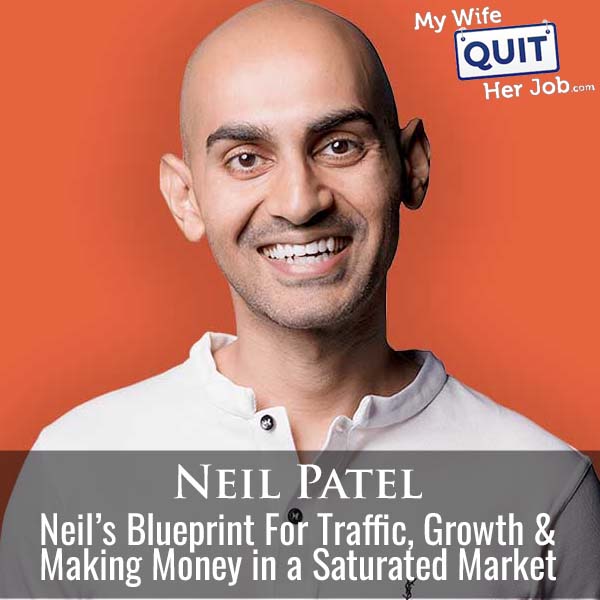
Below is the full playbook from my conversation with Neil, founder of NP Digital, Ubersuggest, and Answer the Public: how to package content for AI, why traditional search is not dead (and Google search volume is actually growing), how to run influencer ads that convert, and the specific starting point for a brand new store.
Get My Free Mini Course On How To Start A Successful Ecommerce Store
If you are interested in starting an ecommerce business, I put together a comprehensive package of resources that will help you launch your own online store from complete scratch. Be sure to grab it before you leave!
Table of Contents
Key takeaways
- AI search converts ~11.4% of sales from just 0.49% of traffic for B2C brands over $10M in revenue (NP Digital study of 43 brands).
- Blogging is not dead, but the content style is: write for humans, package for AI, and be very specific about who each product serves.
- Google still gets 13.7B+ searches a day (up from 8.5B), and AI Overviews are driving a 10% usage increase on AI-touched queries.
- For a brand new ecommerce store, start with social shopping and micro-influencer ads. Neil calls it a $7T market by 2030 and still uncompetitive.
- Real influencer ad workflow: test your own ads first with AI-generated variations, find the winning script, then pay a micro-influencer to record it.
- Numbers to plan by: reach out to 20 micro-influencers to land 1 deal; TikTok Shop response rate is roughly 5%.
- For ROAS, aim for 20% profit per sale for ecommerce (15% is workable). Some verticals need much higher.
How AI search is changing ecommerce content in 2026
AI search is the biggest shift in ecommerce marketing since mobile, and the reason is a conversion-rate gap you cannot ignore. Traditional organic search converts by sending clicks to product pages where shoppers do their research. AI search does the research on the AI platform and only sends the visitor once they have already decided.
Neil’s NP Digital data from 43 B2C brands doing $10M+ in revenue: traditional organic delivers about 27.5% of traffic and 21.5% of sales. AI search delivers 0.49% of traffic and 11.4% of sales. Per visitor, AI search buyers are worth an order of magnitude more.
The B2B numbers are even more lopsided: 19% of traffic and 11.6% of sales from traditional search, versus 0.38% of traffic and 9.7% of sales from AI search. The lesson for anyone running a store with a blog: your content strategy has to change or you get crushed.
How to write content that AI actually cites
Content in 2026 gets written for humans and packaged for AI. That means answering the research questions your buyer is asking a chatbot, being brutally specific about who the product is for, and getting to the point without novel-length paragraphs.
Take dog food. Instead of one generic “best organic dog food” post, you write “10 best dog foods for puppies,” “10 best dog foods for aging large-breed dogs,” “10 best dog foods for miniature breeds,” and so on. When a shopper asks ChatGPT “I just got a newborn dog, breed X, size Y, what dog food should I give it?” the model has specific content to pull from and your brand gets recommended.
On product pages, the same principle applies. Instead of a generic product description, write “This food is best for…” followed by explicit dog breeds, sizes, weights, and feeding amounts. AI now genuinely understands documents (it used to fake it with keywords, links, and social signals), which means talking about “puppies” gets you cited for “newborn dogs” even if you never use that exact phrase.
Is blogging dead in the age of AI?
Blogging is not dead, but blogs without a real product or service attached to them are getting crushed. Google’s recent updates have hammered pure content sites, and the AI-search conversion data explains why: the platforms send traffic to sites that can complete a transaction, not to sites that only monetize through display ads.
If you run a standalone blog, adding a product or service is now table stakes. AdSense and affiliate income alone will not survive the shift. The blogs that are holding up are the ones tied to real ecommerce stores, courses, or SaaS products.
The good news is that overall conversions on well-structured content are staying steady even as traffic patterns move around. Traffic mix may fluctuate up or down, but if your content feeds AI research and your site can close the sale, the funnel still works.
Is traditional Google search dying?
Traditional Google search is not dying, and the volume data proves it: Google used to get 8.5 billion searches a day and now gets over 13.7 billion (more than 5 trillion a year). Sundar Pichai reported at Google I/O that AI Overviews are driving a 10% usage increase on the queries that get an AI response, and Google’s 10% growth is comparable in absolute volume to all of ChatGPT.
The right way to think about the search landscape is as social media. Instagram never killed Facebook, Snapchat never killed Instagram, TikTok never killed either. Per Sprout Social, the average person actively logs into roughly 6.7 social networks a month. Search will follow the same pattern: ChatGPT, Google, Perplexity, and AI Overviews will coexist, and different queries will route to different interfaces.
The strategic implication is that you optimize for everywhere. Neil’s team calls this “search everywhere optimization” (others call it GEO). The tactics that get you ranked on page one of Google are strongly correlated with the tactics that get you mentioned by ChatGPT, so there is no meaningful trade-off between the two.
AI search vs traditional search: the ecommerce sales data
Here is the NP Digital study side by side:
| Channel | B2C traffic share | B2C sales share | B2B traffic share | B2B sales share |
|---|---|---|---|---|
| Traditional organic search | 27.5% | 21.5% | 19.0% | 11.6% |
| AI search (ChatGPT, Perplexity, AI Mode, etc.) | 0.49% | 11.4% | 0.38% | 9.7% |
The takeaway per visitor is stark. In B2C, AI search visitors convert to sales at roughly 30x the rate of traditional search visitors. That is why brand mentions in AI answers are worth optimizing for even if the raw click volume looks small.
How to measure AI search performance (brand mentions and citations)
You measure AI performance by brand mentions and citations across a defined set of prompts. Because AI responses are not deterministic (the same prompt returns different answers each time), the right method is to run each prompt 10 to 20 times and look for patterns.
Paid tools like Profound and Scrunch do this, and Neil is rolling a free version into Ubersuggest and Answer the Public in the next 30 to 45 days. Put in a URL or brand plus a keyword, and the tool identifies which prompts you are mentioned on, which you are missing, how competitors compare, sentiment, and how to get included in prompts you are absent from.
The core metric shift is from “am I ranking?” to “am I being mentioned?” You still care about ranking, but citation rate inside AI answers is the new upstream leading indicator of AI-driven sales.
What should a new ecommerce store focus on first?
For a brand new ecommerce store, start with social shopping and micro-influencer ads. Neil calls social shopping a $6 to $7 trillion market by 2030 and points out that it is still uncompetitive: most brands over-invest in high-production video when a well-known micro-influencer talking about the product converts far better.
Post the same content across every platform that allows social shopping (TikTok, Instagram, and YouTube once its social-shopping features mature). The content format is nearly identical across platforms, so the incremental effort to add a channel is minimal.
The reason to prioritize this over content is speed. Written content compounds, but it takes months. Social-shopping ads with a proven influencer script can start driving trackable revenue in days.
The micro-influencer ad workflow that actually works
Neil’s process for running profitable influencer ads is counterintuitive: test your own ads first, find the winning script, and only then pay an influencer to record it. This inverts the standard “find an influencer, hope it works” approach and dramatically improves the ROI.
The steps:
- Step 1: Generate ad variations. Use AI to draft tons of different ad scripts around your product, positioning, comparisons, and price.
- Step 2: Run your own ads. Test the variations, identify the pieces that resonate, and combine them into a stronger script.
- Step 3: Retest the combined script. Confirm it converts even if it is not yet profitable.
- Step 4: Hire a micro-influencer to record it. Their brand trust lifts your conversion rate enough to turn a marginally profitable ad into a scalable one.
For outreach, plan on reaching out to 20 micro-influencers to land 1 deal, at roughly a few thousand dollars per deal. Structure the deals as performance-based or a modest upfront fee you can afford to test. Not every response converts to a deal (pricing does not always work out), so volume of outreach is what makes the funnel work.
What ROAS should ecommerce brands actually target?
Chase profitability, not ROAS. A 7:1 ROAS on a low-margin product can still lose money, and a 2:1 ROAS on a 66% gross-margin product can be a wildly profitable business. Neil’s benchmark for ecommerce: hit at least 20% net profit per sale and scale as hard as you can. 15% is workable. Below that, you are running a hobby.
The math changes by vertical. Electronics brands with thin margins cannot survive a 2:1 ROAS. Fashion or beauty brands with 66%+ gross margins can. Look at your contribution margin per unit before you copy anyone’s ROAS benchmark.
Long-form vs short-form content for ecommerce
Long-form content converts and short-form content acquires. In NP Digital’s testing, long-form has significantly better next-day retention (people actually remember what they consumed), but short-form gets the views and gets people into the funnel.
The efficient production model is to make one long-form piece per week (a “we tested the 25 best dog foods for puppies” video or article), then chop it into five to seven short-form clips for TikTok, Reels, and Shorts. One production session, seven pieces of content, both funnel stages covered.
If you have to start with one, start with written long-form. It is easier to produce, and it is the format AI platforms are pulling from most heavily right now. Video comes next, ideally repurposed from the written work.
Educational vs “goofball” content: which works?
Educational content performs consistently and scales predictably; goofball content is high-variance. For every Dollar Shave Club or Squatty Potty, there are dozens of goofball campaigns that flopped. Educational content (comparisons, tests, “we tried 20 dog foods and here is what happened”) is what AI platforms preferentially pull from when generating research answers.
If you are a new or mid-sized brand where a failed $50K or $100K campaign hurts, run the education-first playbook. If you have enough cash to run experiments where the downside does not matter, layer the goofball content on top.
Neil Patel’s tool roadmap: Ubersuggest and Answer the Public
Ubersuggest and Answer the Public are being restructured around the “search everywhere” model. The new Answer the Public homepage will accept a query plus your domain, auto-detect your industry, and return a dashboard with four panels: AI search, traditional search, social media search, and shopping (Amazon, Walmart, etc.). Click into any panel to see keyword and prompt opportunities specific to that channel.
The AI brand-mention tracker is landing in Ubersuggest in the next 30 to 45 days at no cost, undercutting Profound and Scrunch (which charge upwards of $499/month) on the argument that ChatGPT API costs have dropped so dramatically that the incumbent pricing is no longer justified.
NP Digital also recently acquired Yodel (App Store optimization for the Apple App Store and Google Play Store) and is closing on an enterprise-focused Amazon agency. The Apple App Store alone gets around 500 million searches per day, which is a channel most ecommerce brands ignore entirely.
Why NP Digital combines services with software
The most durable model for a marketing business today is “service as a software”: an agency that uses proprietary tools to run more efficiently and passes some of the margin lift back to the client. Pure SaaS is more competitive (venture-backed players will lose money for years to get customers), and pure services runs at 10 to 20% margins with all the people problems that come with it.
The hybrid unlocks two things. It improves margins enough to reinvest in extra client value (better results, higher NPS, longer retention, higher LTV), and it makes the business stickier because the workflow is embedded in tools the client cannot easily replicate.
For most ecommerce and DTC operators, the takeaway is simpler: whichever agency or freelancer you hire, ask what proprietary tools they run and how those tools translate into better results for you specifically. That is the real differentiator now.
Frequently asked questions
How much do AI search visitors convert compared to traditional search?
For B2C brands over $10M in revenue, AI search delivers 0.49% of traffic but 11.4% of sales, versus traditional organic search at 27.5% of traffic and 21.5% of sales (NP Digital study of 43 brands). On a per-visitor basis, AI search converts roughly 30x better because shoppers have already done their research on the AI platform.
Is Google search dying because of ChatGPT?
Google search is not dying. Google went from 8.5 billion searches a day to over 13.7 billion (5 trillion+ per year), and AI Overviews are driving a 10% usage increase on queries that trigger an AI response. ChatGPT is growing quickly, but the two are coexisting the way social platforms do (average person uses roughly 6.7 networks a month).
How do I write content that gets cited by ChatGPT and Google AI?
Write for humans, package for AI. Answer specific research questions (“best dog food for aging large-breed dogs”), be explicit about who each product is for (breed, size, use case), get to the point in every paragraph, and cover the research phase in enough depth that AI can pull a full answer from your page.
What is the best marketing channel for a brand-new ecommerce store?
Social shopping with micro-influencer ads. Neil calls it a $6 to $7 trillion market by 2030 and one of the last uncompetitive channels. Post the same content across TikTok, Instagram, and any other platform with social-shopping features, and lean on micro-influencers rather than high-production video.
How do I structure an influencer marketing deal?
Test your ad script yourself first with AI-generated variations, identify what converts, then pay a micro-influencer a modest upfront fee (or a performance-based deal) to record the winning script. Plan to reach out to 20 micro-influencers to land 1 deal. Their brand trust plus your proven script is what makes the math work.
What ROAS should I target for ecommerce ads?
Chase profitability instead. Aim for at least 20% net profit per sale on ecommerce (15% is workable). A 7:1 ROAS on a low-margin electronics product can lose money, and a 2:1 ROAS on a 66% gross-margin product can be a great business. Contribution margin per unit is the real number.
Should ecommerce brands prioritize long-form or short-form content?
Make one long-form piece per week and chop it into five to seven short-form clips. Long-form drives conversion and retention (people remember it the next day). Short-form drives top-of-funnel discovery. Written long-form is the easiest starting point because AI platforms pull most heavily from written sources today.
How can I measure whether AI search is working for my brand?
Track brand mentions and citations across a defined set of prompts (10 to 20 runs per prompt to average out non-determinism). Tools like Profound, Scrunch, and the upcoming free version in Ubersuggest identify which prompts you are mentioned on, how competitors compare, and where to focus your content to get included in more answers.