
Podcast: Download (Duration: 58:44 — 67.6MB)
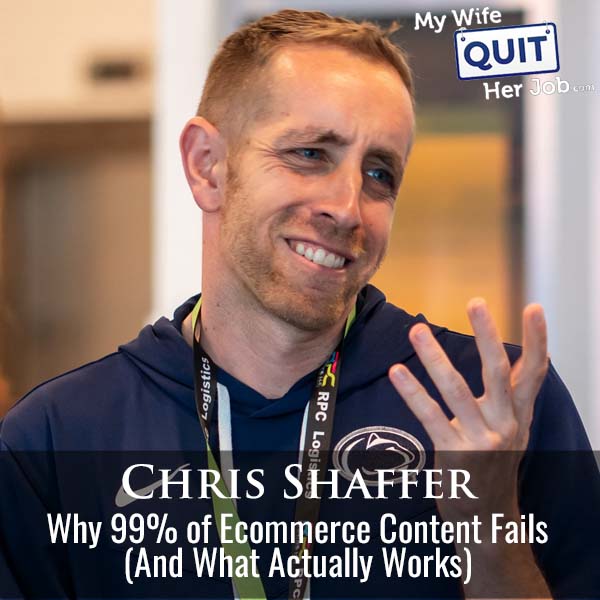
The ecommerce content strategy that actually works in 2026 is a single YouTube channel, 10-to-12-minute videos, niche-first (not product-first), story-driven, published imperfectly, and repurposed everywhere else. On this episode of the My Wife Quit Her Job podcast, I sat down with Chris Shaffer, a consultant who runs content and marketing for dozens of ecommerce brands and who has spoken at every Sellers Summit I have run. His argument is that 99% of ecommerce content fails because brands make videos about their products instead of about the people who use them.
The specific example he keeps coming back to is Black Rifle Coffee. They do not make coffee content, they make content for first responders and military.
Linus Tech Tips does not make screwdriver content, they make content for the IT-guy audience that then buys screwdrivers, apparel, and everything else. Once you flip your content from “here is my product” to “here is my audience,” the entire playbook falls into place.
Below is the full framework: why YouTube beats every other platform for ecommerce, how to find video ideas your audience is already watching using a test account, why an iPhone and a $150 DJI mic beat a $4,000 camera setup, and the story-first approach that lets even faceless brands (or a middle-aged Chinese guy selling wedding handkerchiefs, in my case) build a real channel.
Get My Free Mini Course On How To Start A Successful Ecommerce Store
If you are interested in starting an ecommerce business, I put together a comprehensive package of resources that will help you launch your own online store from complete scratch. Be sure to grab it before you leave!
Table of Contents
Key takeaways
- The single biggest ecommerce content mistake is making videos about your product. Make them for the niche your product serves: fishermen, campers, runners, first responders, brides, whoever.
- YouTube beats every other platform for ecommerce because content is evergreen. A 4-year-old video can still take off; the same TikTok goes dark in 2-4 weeks and Instagram effectively dies within hours if it does not go viral.
- Long-form (10 to 12 minutes) is the sweet spot for YouTube. You can chop a long video into TikToks, Reels, and Shorts, but you cannot chop a 60-second TikTok into a long-form video.
- The fastest way to find video topics your audience will actually watch is a test-account trick: create a fresh YouTube account, watch 3 to 5 videos from big creators in your niche, and let the recommendation feed hand you a list of proven titles.
- Production value does not matter as much as niche fit. Scott Volker and his son shot 52 videos in a 24-hour marathon using only an iPhone and a DJI mic, and viewers cannot tell the difference from a $4,000 camera.
- Ecommerce channels have a lower view-count bar because every viewer is a potential buyer. 500 to 1,000 views on a fishing-lure video is real revenue, even though a media company would call that a failure.
- Stories always beat specs. Max Miller’s Tasting History channel runs a recipe with the history of the dish woven through it, and outperforms both pure recipe channels and pure history channels because the story is the hook.
- Done beats perfect. If you kind of hate the finished video, it is probably ready to publish. You will never be happy with the first video or the hundredth video.
Where should ecommerce brands actually focus their content in 2026?
Ecommerce brands should focus almost all their content energy on one long-form video platform, and in 2026 that platform is YouTube. Written content is a diamond dozen now that AI can generate a full brand-voice blog post from a keyword input in seconds, so it should stay in the mix but not lead. Short-form video (TikTok, Reels, Shorts) is downstream from a good long-form video, which is where the ideas and the depth come from.
The reason YouTube wins is that its content is evergreen in a way no other platform is. Every video you publish accumulates views for years. If you look at any healthy YouTube channel’s monthly views, most of them are coming from the back catalog, not the videos published that month.
TikTok and Instagram are the opposite. A TikTok can hit for a couple of weeks and then drops off, and Instagram is even harsher: if a post does not hit in the first few hours, it functionally never gets seen again.
That is why Chris frames YouTube as a stock that only rises, and short-form as a series of lottery tickets.
Why brands should stop making product content and start making niche content
The single biggest failure mode Chris sees in ecommerce content is brands making video after video about their product. There is not a 12-minute video in “how to French-press coffee,” because unless you are boiling water on camera for eight minutes, the whole process takes about four.
The fix is to build content for the people who buy your product, not the product itself. Black Rifle Coffee sells coffee, but the content is for first responders and military.
Linus Tech Tips sells screwdrivers, IT-guy apparel, and merchandise, but the content is tech news, reviews, and IT-guy humor. Their live show alone has done six figures in revenue on a single stream with a single pitch line at the end.
The mental unlock is defining your niche as a group of people who identify with something or say they love something. “I am a fisherman.” “I love camping.” “I am a bride.” Once you have the identity, the content ideas become obvious.
Take a water bottle brand. If your buyers are runners, the content is about running; if they are campers, the content is about camping.
The water bottle is the thing you sell; the niche is what you talk about.
How to find YouTube video ideas your audience is already watching
The fastest way to find video topics your ecommerce audience will actually watch is a test-account trick that shortcuts weeks of keyword research. Create a brand-new Gmail address and a fresh YouTube account. Watch 3 to 5 videos from the biggest creators in your niche.
Within a handful of videos, YouTube’s recommendation algorithm figures out what you are into and starts feeding you the exact titles and topics that are already performing well in your space. Screenshot or bookmark the ones that keep showing up, and you have a proven-title list.
The reason this works is that YouTube’s algorithm is a proxy for your audience. Every other platform (Instagram, TikTok, Facebook, YouTube itself) is trying to keep you on the platform for as long as possible, which means it is designed to surface the videos your audience wants to watch. If you act like your customer, YouTube will hand you your customer’s watch list.
The output is a bucket of proven ideas like “the 15 fishing lures everybody needs to use” or “how to catch more fish for $5” that you can now put your own spin on. You are not ripping anyone off; you are riding a topic wave the audience is already on.
What production quality do you actually need for ecommerce YouTube?
Ecommerce brands routinely overestimate the production quality they need for a YouTube channel that actually converts. High-budget channels like Linus Tech Tips or Mr Beast look intimidating, so brand owners assume they need a Sony camera, an editor, and a set. They do not.
An iPhone plus a $150-ish DJI Mic 2 (Bluetooth) is enough. Scott Volker and his son ran a 24-hour marathon to produce 52 fully edited videos with thumbnails, one per week for a year, using only that setup. Viewers cannot tell the difference between that and a $4,000 rig.
What actually matters is the content itself. Niche-fit content shot on a phone will always beat generic content shot on cinema-grade cameras. Upgrade production only after you know the format works.
How to get past the “first video” fear that kills most ecommerce channels
The single hardest hurdle for ecommerce founders is recording that first video. Most people try to make it perfect in one take, fluff a word 15 seconds in, stop, start over, fluff another word, and repeat until they hate the whole exercise. Chris’s fiancee once did 20 takes of the same video because there was one word she could not pronounce, even though she says it every day.
The fix is a “one-shot” approach with mistakes left in. If you flub a word, take a breath, fix the word, and keep going. Real people say “um” and “uh.” Editing lets you trim the awkward pauses out later, but only if you keep the camera rolling long enough to have something to trim.
An even faster escape from perfectionism is to go live. On a live stream, there is no editing step: you hit go, you talk for as long as you planned, you hit stop, and the video is done.
Chris has run entire ecommerce channels on this “live show, then repurpose into videos and a podcast” workflow for years.
Should ecommerce brand YouTube videos be scripted or off-the-cuff?
Ecommerce YouTube videos should be bullet-pointed, not word-for-word scripted, with one exception. The exception is the hook (the opening 15 to 30 seconds where you tell the viewer why they should stay for the next 12 minutes), which is worth scripting tightly.
Everything after the hook should be an outline. If you know your niche, you can talk about the 15 fishing lures or the 5 email-marketing plays from bullet points more naturally than you can read them off a teleprompter. Word-for-word scripts produce stiff delivery and lock you into an exact phrasing that makes flubs feel like disasters.
The trick most founders miss is that the things you think are silly, repetitive, or obvious are exactly what your audience needs to hear. You know so much more about your niche than the average viewer that your “beginner” content is their “finally, someone explained this” moment. If you finish a video and think “who would watch this?”, that is usually the one that overperforms.
Story is the format that wins on YouTube for ecommerce
Stories always sell better than specs, and that is doubly true on YouTube for ecommerce. If you have to pick between “here are the 10 features of this product” and “here is the story of the person who bought it,” take the story every single time.
Max Miller’s Tasting History channel is the cleanest example. There are a million recipe channels on YouTube (most viewers just want the recipe, and cooking video is punished if the food does not look immaculate), and a million history channels.
Max started cooking on camera and then tells the full history of the dish across the middle of the video (his most recent one is on spotted dick, a classic English pudding with currants). Viewers watch the whole thing because they are there for the story, not the recipe.
For an ecommerce brand this maps directly. I am launching a Bumblebee Linens YouTube channel where every video is the story of one couple whose wedding handkerchief we made, told with AI-generated cartoon versions of them behind a green screen. The story is the hook, the handkerchief is the payoff, and the whole thing is producible in my home office in a single sitting.
Faceless ecommerce YouTube channels: do they work?
Faceless ecommerce YouTube channels absolutely work, as long as the storytelling replaces the on-camera presence. The trap most faceless creators fall into is turning the channel into a slideshow of product shots with a voiceover reading specs, which reads as an ad and gets zero traction.
The alternative that works is picking a single narrative frame and running it across every video: history of the object, customer stories, before/after transformations, or expert commentary layered over stock footage. If the frame is strong enough, viewers do not care whose face is on screen.
For a wedding handkerchief brand, “the story of this couple” is the frame. For a cooking-tools brand, “the history of this dish or utensil” is the frame; for a fishing-gear brand, “this fishing spot has a wild story” is the frame.
The channel becomes a story engine that happens to sell a product.
Should you launch a YouTube channel with 1 video or 15 in the bank?
You should launch a YouTube channel the moment you have one video that is 80% of what you want, not when you have 15 in the bank. The single most common question Chris gets at Sellers Summit every year is some version of “how many videos should I have before I launch,” and the honest answer is: one that is done.
You will never be happy with the first video, and you will not be happy with the hundredth. You will look back at whatever you shot six months ago and cringe. That is a healthy sign that you are getting better, and it is a terrible reason to keep delaying.
Publishing early also unlocks the one thing that improves your content faster than any other input, which is real audience feedback. Comment sections are messy, but the actual critiques (what worked, what did not, what they wish you had covered) shape the next video in a way brainstorming never can.
The one exception: batching for founders who need a buffer
The “publish immediately” rule has one honest exception. If you know that a weekly deadline will spike your anxiety and cause you to burn out, batch-produce a buffer of 3 to 5 videos before you launch, so you can take a week off without missing a week on the channel.
That is my personal workflow on the My Wife Quit Her Job channel, and it is the model I am running for the new Bumblebee Linens launch. I film 5 videos in a single sitting, keep them in the bank, and never feel forced to create under pressure. The filming itself is fast; the slow part is finding the idea and the story.
The tradeoff is that batching delays your launch date and can trigger the “make it perfect” spiral Chris warns about. If you know you have that tendency, either use live video (which removes the editing step entirely) or set a hard cap on how many videos you will batch before you go live.
How ecommerce brands should think about views vs revenue on YouTube
Ecommerce YouTube channels win on conversion, not on view counts, and that fundamentally changes what a “successful” video looks like. A media company needs 100,000 views on a video to justify the production budget. An ecommerce brand does not.
The reason is that the audience is pre-qualified. The only people watching your “15 fishing lures everybody needs” video are people who fish, which means they are the most likely people on the internet to buy your fishing lures. Even 500 to 1,000 views on a niche video is a room full of potential buyers.
That is why Chris’s brands can hit real revenue on YouTube channels where the top videos peak at 80,000 to 100,000 views. Repurposed videos that pull 10,000 to 15,000 views are still meaningful revenue because every viewer is a customer, not a media impression. Set your view expectations by your conversion economics, not by MrBeast comparables.
How to widen a niche without losing your ecommerce audience
The biggest content-strategy debate for ecommerce founders is how wide to cast the net: only the exact people who buy your product, or a broader audience with overlap. In most cases you want to go one level wider than the product, but not two.
For a kayak-bass-fishing gear brand, “fishing” content is wider than “kayak bass fishing” content and captures a broader audience that still overlaps. “Hunting wild elk in Alaska” is one level too wide and loses the fit. The test is whether the broader group contains most of your buyers, not just some.
The tactic Chris recommends is broadening the title and framing while keeping the content itself relevant. Instead of “5 effective ways to email market,” title the same video “The number one return-on-investment marketing strategy you need to pay attention to this year.” Same content, wider net, same buyers still watching.
Why YouTube recommendations matter more than YouTube search for ecommerce
YouTube views come mostly from recommendations, not from search, and that is a huge deal for how ecommerce brands should title their videos. Somewhere between 60% and 70% of all YouTube views (and possibly more) come from the homepage, sidebar, and up-next feed, not from search queries.
That means keyword-only titles are leaving views on the table. If your title reads like a search-optimized string (“Email marketing tips 2026”), YouTube’s recommendation engine has fewer signals to work with when it tries to place you in front of the right viewer. A slightly broader, more compelling framing gets picked up by both search and recommendations.
The takeaway is that you should still consider search-friendly language, and you should not let it dominate. The best-performing titles read like something a real person would click, not like a keyword-tool output.
Frequently asked questions
What is the best content platform for an ecommerce brand in 2026?
YouTube. It is the only major platform where content stays evergreen and accumulates views over years, which matters far more than the short-term reach of TikTok or Instagram. Use long-form YouTube as the source, and repurpose highlights into TikTok, Reels, and Shorts.
How long should ecommerce YouTube videos be?
10 to 12 minutes is the sweet spot for most ecommerce niches. It is long enough to tell a real story, deep enough for YouTube’s recommendation algorithm to reward, and easy to chop into shorter clips for TikTok, Reels, and Shorts. Podcasts and live shows can go longer, but 10 to 12 minutes is a safe default.
What is a “niche” for an ecommerce brand?
A niche is a group of people who identify as something or say they love something (fishermen, campers, brides, first responders, dog owners). Your niche is not your product, it is the people who buy your product. Content should be for the niche, not about the product.
Do you need expensive equipment to start an ecommerce YouTube channel?
No. An iPhone plus a Bluetooth mic like the DJI Mic 2 is enough to shoot professional-looking video. Scott Volker and his son shot 52 fully edited videos in a 24-hour marathon using only that setup, and viewers cannot tell the difference from cinema cameras. Upgrade after the format works.
How many videos should I have before I launch a YouTube channel?
One that is at 80% of what you want. Waiting until you have 15 in the bank is the fastest way to never launch. The audience feedback that improves your content faster than anything else only starts once you publish, so get one out and iterate from there.
Should I script my ecommerce YouTube videos word for word?
Script the hook (first 15 to 30 seconds), then bullet-point the rest. Word-for-word scripts produce stiff delivery and lock you into a phrasing that makes flubs feel like disasters. Bullet points let you talk naturally from your existing knowledge of the niche.
Can a faceless ecommerce YouTube channel actually work?
Yes, if you commit to a strong storytelling frame. Choose one narrative device (history of the object, customer story, transformation, expert commentary over stock footage) and run it across every video. The story is what earns the watch time; the face is optional.
How many YouTube views do you need to make an ecommerce channel worth it?
Far fewer than a media company. Every viewer is a pre-qualified buyer in your niche, so 500 to 1,000 views on a niche video is real revenue. Successful ecommerce channels routinely peak at 80,000 to 100,000 views on their best videos while still driving meaningful sales from smaller, more relevant audiences.