
Podcast: Download (Duration: 55:38 — 72.3MB)
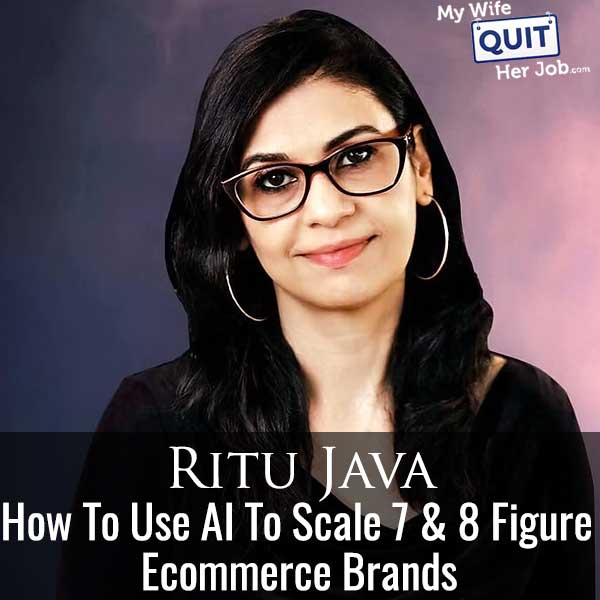
Seven and eight figure ecommerce brands are using AI in four specific places right now to scale: AI-optimized listings written for Amazon Rufus and other LLM shopping assistants, AI-generated video and image creative at 10x the old speed, low-code automations in Google Apps Script and Make.com that eliminate repetitive team work, and prompt-based content workflows that plug directly into Facebook, email, and product feeds. On this episode of the My Wife Quit Her Job podcast, I sat down with Ritu Java, CEO and co-founder of PPC Ninja, to break down the exact tools and automations her agency and top ecommerce clients are running.
Ritu has helped thousands of Amazon sellers scale, speaks at over 100 industry events, and just delivered a standing-room session on AI at my Sellers Summit conference. She is one of the few operators who genuinely lives in AI-land every day, so I wanted to pull out her real workflow, not the LinkedIn version.
Below is what her seven and eight figure clients are doing, the specific tools she uses, and the AI automation rule she applies to her own agency.
Get My Free Mini Course On How To Start A Successful Ecommerce Store
If you are interested in starting an ecommerce business, I put together a comprehensive package of resources that will help you launch your own online store from complete scratch. Be sure to grab it before you leave!
Table of Contents
Key takeaways
- Amazon listings must now be optimized for Rufus (Amazon’s LLM shopping assistant), not just SEO. That means proactively addressing negative Rufus answers, adding us-vs-them comparison images, and building FAQ images the LLM can parse.
- Under 5% of PPC Ninja’s clients have changed prices in response to tariffs. Most are just being extremely cautious with ad spend.
- Ritu’s AI stack: ChatGPT for brainstorming and planning, Claude for code and low-code tasks, Perplexity for live web research, Gemini for Google Workspace integration and long-video transcription, Sora and OpenArt for video creative.
- Her automation rule: if a task happens more than three times, automate it. She combines Google Apps Script (free, inside Workspace) with AI-generated JavaScript to build custom internal tools in under an hour.
- Canva is the final assembly layer for AI-generated creative. There are roughly 200 to 300 AI tools inside the Canva app set on top of Magic Expand, Magic Grab, and Magic Erase.
- PPC Ninja’s minimum criteria for taking on a client: $1M in annual sales AND an 8%+ conversion rate. Below 8% conversion, no ad spend math works.
How are 7 and 8 figure ecommerce brands actually using AI right now?
Seven and eight figure ecommerce brands are using AI right now for four things that consistently move the needle: AI-optimized product listings for LLM shopping assistants like Amazon Rufus, rapid AI-generated video and image creative for ad testing, low-code Make.com and Google Apps Script automations that eliminate repetitive team work, and prompt-tuned content generation for social and product copy at scale. Ritu Java confirmed those are the four buckets her agency clients pay for and see returns on.
The pattern across every case is the same. AI is not replacing the strategist. It is compressing the time between idea and finished asset, which lets a small team ship 5 to 10 times more variations, tests, and optimizations per week than before.
How to optimize Amazon listings for Rufus (Amazon’s LLM)
To optimize Amazon listings for Rufus, extract every question and answer Rufus surfaces on your product page, proactively address the negative ones in your images and A+ content, add a comparison image against competing products, and add an FAQ image that Rufus can read. Rufus reads both the text on your images and the meaning of the images themselves, so images are the highest-leverage surface.
Rufus is Amazon’s built-in LLM shopping assistant, accessible from a small button on the left side of the product page. When a shopper clicks it, Rufus offers pre-curated prompts (roughly 15 at a time) about the product, then answers based on the listing, reviews, Q&A, and A+ content.
The workflow PPC Ninja uses on client listings has three parts. First, extract the Rufus Q&A. Ritu’s team built a simple JavaScript browser tool that simulates clicks on every Rufus prompt and captures the questions plus answers as copyable text.
Ritu, who does not consider herself a programmer, built this tool with Claude in about 30 minutes.
Second, feed the extracted Q&A into a custom GPT that generates the content updates your listing needs. Third, build the new listing assets: FAQ images that mirror the questions Rufus is answering, comparison images against competing brands, and care-instruction pages that pre-empt negative reviews.
Why Rufus changes the SEO timeline
Rufus takes longer to update than traditional SEO because it needs to see customer opinion actually shift over time before the answer changes, so treat listing optimization as a multi-week to multi-month feedback loop, not an overnight win.
How to use AI to reframe a product’s negative narrative on Amazon
You reframe a product’s negative Amazon narrative by identifying the most common negative Rufus answer, then adding on-listing content that puts the responsibility on the shopper instead of the product. Ritu’s example: a delicate pendant that customers report “falls off.” The fix is a care instruction on the listing that says do not wear it in the shower, keep it away from shampoo, treat it as a treasure with care. Rufus then includes that context in its answer.
One negative Amazon review can influence what Rufus says about your product, even out of thousands of positive ones. That is why the reframing work is disproportionately valuable at scale. A single well-designed image can neutralize an entire complaint cluster.
What are the best AI tools for ecommerce operators in 2026?
The best AI tools for ecommerce operators in 2026 are ChatGPT for brainstorming and planning, Claude for coding and low-code automation, Perplexity for live web research, Gemini for Google Workspace and long-video transcription, and Canva plus Sora or OpenArt for AI creative. Ritu splits work across all of them because each has a specific strength.
Her breakdown, tool by tool:
- ChatGPT. Brainstorming, planning, high-level structuring. Ritu says it never makes her feel stupid about typos and shorthand, which matters when you are working in AI all day with multiple tabs open.
- Claude. Coding and low-code tasks. Handles JavaScript, browser bookmarklets, and downloadable HTML interactive apps well. The catch is credits burn fast even on the paid plan, so she uses it for execution and does the planning in ChatGPT.
- Perplexity. Live web research where you need current sources cited.
- Gemini. Google Workspace integration (Gmail, BigQuery, Looker Studio). Massive token window (up to 1 million+), and it transcribes hour-long video files reliably. Ritu personally dislikes its habit of correcting her spelling.
- Canva. Final assembly for creative, plus 200 to 300 in-app AI tools and native features like Magic Expand, Magic Grab, and Magic Erase.
- Sora, OpenArt, Kling, VO3, MiniMax. AI video generation. Sora is unlimited on the ChatGPT paid plan, and OpenArt is a $14/month gateway to about 40 videos worth of credits across Kling (Colors 2), VO3, MiniMax, Flux, and others.
How to automate ecommerce operations with Google Apps Script and AI
The way to automate ecommerce operations with Google Apps Script and AI is to have Claude or ChatGPT generate the JavaScript for you, then paste it into Google Apps Script (free with any Workspace account) so it runs against Gmail, Drive, Sheets, Calendar, or Google Spaces. Ritu builds most of her internal tools this way in under an hour.
Her three-times rule: if a team member does the same task more than three times, it becomes a candidate for automation. She looks for these opportunities in her operations every single day and finds them constantly.
The example she walked through: Walmart Seller Central sends every OTP login code to her email because her team’s logins are aliases of her address. Instead of manually forwarding codes to a globally distributed team in Philippines and India, she built a Google Apps Script that watches Gmail for the Walmart OTP email, extracts the code, and posts it to a dedicated Walmart channel in Google Spaces via a webhook. Whoever needs to log in grabs the code themselves.
Google Spaces is the Slack-equivalent inside the Google ecosystem, and PPC Ninja runs 45 to 50 Spaces (one per client plus internal ones). The automation stack that made this possible was Apps Script for glue and Claude for the JavaScript, and the whole thing shipped in an afternoon.
How to automate Facebook posting with Make.com and ChatGPT
You automate Facebook posting with Make.com by connecting a Google Drive folder as the trigger (upload an image → automation fires), routing the image to ChatGPT via API to generate a caption with emojis and hashtags, and then posting to Facebook (or multiple platforms) either directly or with a human-in-the-loop review step. Ritu runs this on her own jewelry brand and says the captions rarely deviate from her prompt.
The prompt is the load-bearing piece of the workflow. If your prompt has enough clauses (brand voice, tone rules, hashtag count, emoji policy, opening line style), the output is reliable enough to auto-post. If it does not, add a review step in the Make scenario before the Facebook publish action.
How to fix ChatGPT’s em-dash and hype problem in your custom instructions
You fix ChatGPT’s em-dash and hype problem by putting your style rules in both custom instructions AND memory, and by creating a short “code word” the LLM recognizes as an instruction to clean up its output. Ritu uses a made-up nonsense word only she and her ChatGPT know, and typing it triggers a full pass to remove em-dashes and other giveaways.
Memory is a per-account ChatGPT feature (under Settings) that stores facts about you across sessions. Ritu also references named writer styles she wants ChatGPT to emulate: for example, “write in the stable and calm style of Seth Godin, not hype-y or clickbait-y.” Memories cannot be edited, only deleted and recreated.
Custom instructions and memory work together. Custom instructions are the always-on system prompt, and memory is the persistent context that survives conversations. Both together give you a much higher probability that ChatGPT will actually respect the rules you set.
Which AI video generation tools work for ecommerce brands?
The AI video generation tools worth using for ecommerce creative in 2026 are Sora (unlimited on ChatGPT paid plans), OpenArt (a $14/month gateway to Kling, VO3, MiniMax, Flux and more), and Kling’s Colors 2 model for high-quality short clips. Ritu warns that 9 out of 10 generated videos are unusable garbage, which is why cost per video matters.
Her workflow uses multiple models on the same shot. She iterates the prompt in cheaper tools until the concept is right, then runs the final prompt on the more expensive premium model (Kling or VO3) to generate the version she ships. A five-minute VO3 video she recently saw broken down publicly had a book-length prompt, generated multi-step by AI, with reference images injected for lighting, angle, and style.
OpenArt is Ritu’s answer to the “which subscription do I pay for” question. At $14/month for roughly 4,000 credits (about 40 videos), you get access to almost every leading model without buying five separate subscriptions.
What are PPC Ninja’s client criteria and why 8% conversion matters
PPC Ninja works with ecommerce brands that have at least $1M in annual sales AND an Amazon listing conversion rate of 8% or higher. Below 8% conversion, the ad math simply does not work no matter how good the PPC agency is.
The reason is arithmetic. At 20% conversion, five clicks make one sale, so at $1/click your acquisition cost is $5 (a 10% ACOS on a $50 product). At 2% conversion, 50 clicks make one sale, so acquisition cost is $50 (a 100% ACOS on the same $50 product).
Ritu’s guidance: if your conversion rate is below 8%, fix your listing first, then hire the agency.
The one exception is very high-price-point products, where a low conversion rate is offset by a high per-sale margin. Those can still work.
Frequently asked questions
How do 7 and 8 figure ecommerce brands use AI?
Seven and eight figure ecommerce brands use AI in four main areas: LLM-optimized product listings (especially Rufus optimization on Amazon), AI-generated video and image creative for rapid ad testing, low-code Make.com and Google Apps Script automations that eliminate repetitive team tasks, and prompt-tuned content generation for social, email, and product copy at scale.
What is Amazon Rufus optimization?
Amazon Rufus optimization is the practice of structuring your Amazon listing (images, A+ content, bullets, and text) so that Rufus, Amazon’s built-in LLM shopping assistant, recommends your product and answers shopper questions favorably. The core moves are extracting Rufus’s Q&A, adding FAQ and comparison images that address common questions, and pre-empting negative Rufus answers with reframed on-listing content.
What is the best AI tool for coding if you are not a developer?
The best AI tool for non-developers who need to generate working code is Claude, because it handles JavaScript, HTML, and low-code tasks cleanly and returns usable output on the first try more often than ChatGPT. The tradeoff is that Claude burns through credits quickly, so many operators plan in ChatGPT and only switch to Claude for the actual code generation.
How does Ritu Java decide what to automate?
Ritu Java’s rule is: if a task happens more than three times, consider automating it. She looks for those patterns every day in agency operations and typically builds the automation in Google Apps Script or Make.com using AI-generated code, shipping most tools in under an hour.
What is the best AI video tool for ecommerce ads?
The best AI video tool for ecommerce ads in 2026 depends on budget: Sora is unlimited on the ChatGPT paid plan and good enough for concept iteration, while OpenArt at $14/month is a gateway to Kling, VO3, MiniMax, and Flux with about 4,000 credits (roughly 40 videos). For premium finished ads, Kling’s Colors 2 and Google’s VO3 lead the pack.
What conversion rate do you need on Amazon to run profitable ads?
You generally need an Amazon listing conversion rate of at least 8% to run profitable PPC ads at scale, because below that the cost per click math does not close on typical price points. Higher-priced products can tolerate lower conversion rates because each sale absorbs more click cost.
Will AI replace ecommerce agencies?
AI is not replacing ecommerce agencies in the near term, though it is shifting the nature of the work. Brands still need humans for business direction, context, oversight, and quality control on AI-generated outputs. The agencies that will survive are the ones that use AI internally to do more per client and expand into services that were previously not economical.