
Podcast: Download (Duration: 46:06 — 53.0MB)
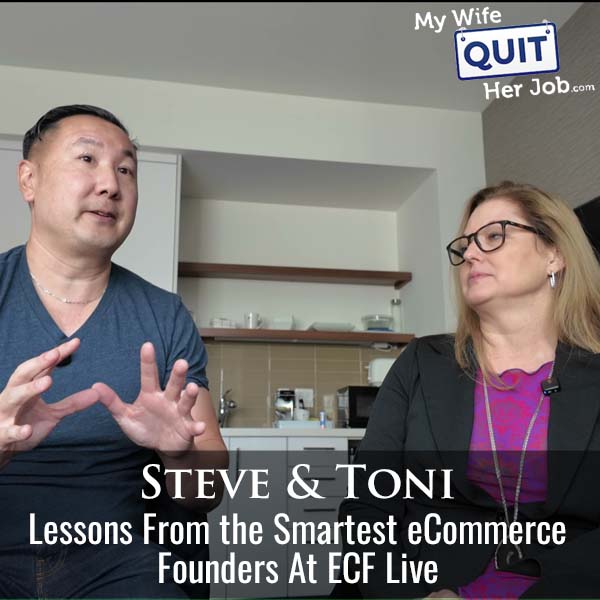
The best eCommerce Fuel Live 2025 lessons for DTC operators cluster around six themes: AI workflow automation is finally practical, Facebook ads have shifted from creative-first to message-first, image generation with Nano Banana is replacing Photoshop for most brand work, hiring is quietly moving from the Philippines to Kenya, the “scale-fast-and-exit” path is producing a lot of miserable founders, and the founder-to-CEO transition is where most seven-figure operators are stuck. My co-host Toni Anderson and I recorded podcast episode 612 in Bozeman, Montana at the eCommerce Fuel Live conference (ECF), walking through everything we learned across two days.
ECF is a small annual conference run by Andrew Youderian for seven- and eight-figure ecommerce founders. The room is small enough that every hallway conversation matters. We compared notes on the sessions we split up to attend, from Facebook ad strategy with Andrew Faris to AI image generation with Reto, to the founder-to-CEO talk with Aiden.
Below is the full breakdown of what actually mattered from ECF Live 2025, with specifics on the tools, tactics, and hiring shifts that mid-size ecommerce operators are moving on right now.
Get My Free Mini Course On How To Start A Successful Ecommerce Store
If you are interested in starting an ecommerce business, I put together a comprehensive package of resources that will help you launch your own online store from complete scratch. Be sure to grab it before you leave!
Table of Contents
Key takeaways
- AI workflow automation with n8n or Make is the highest-leverage practical shift, replacing thousands-per-month SaaS tools with $20/month setups.
- Facebook ads have moved from “test many creatives” to “test many messages” (Andrew Faris’s framework). Copy-and-tweak creative variations no longer work because Meta detects and suppresses near-duplicates.
- Google’s Nano Banana image model, accessed through AI Studio, is replacing Photoshop for most ecommerce lifestyle-image work.
- Hiring in the Philippines is saturating (staff churn is rising because demand is high); Kenya is emerging as the next hungry English-speaking hiring market.
- Latin American developers at roughly $30K to $40K per year are producing quality output equivalent to US developers, especially with AI-assisted workflows.
- The “scale fast, exit” mentality produces most of the ECF depression stories; the “milk the business, take home $1M to $2M a year” path is quieter and healthier.
- The founder-to-CEO transition (Aiden’s talk) is where most operators stall. If you brought your laptop to a two-day conference, you are still operating as a founder.
AI workflow automation with n8n and Make: the practical starter
AI workflow automation with n8n and Make is the practical starter for any ecommerce operator, because it lets you replace expensive SaaS tools with $20-a-month AI-connected workflows that automate the specific processes your business actually runs. Kevin (an ECF regular) did a live demo showing how to trigger a Slack notification from a Google Sheet update, then extend that to real business events. n8n is free if self-hosted (roughly one-click installs on most modern servers), and Make is a paid but cheap alternative for teams under 10,000 operations per month.
The rule Kevin gave: use whatever automation tool your team is already comfortable with. Switching midstream costs more than the incremental price savings.
The first automation to build is usually a large-order notification. I set up a workflow that scans every ecommerce order, runs the customer through ChatGPT with historic order context, and returns a probability score (0 to 100) that the buyer is a wedding planner or event planner. That triggers a Slack notification so my team can personally reach out to those customers rather than dropping them into a generic Klaviyo sequence.
Inventory forecasting is the next automation to build
Inventory forecasting is the second automation most ecommerce operators should build with n8n or Make, because the paid SaaS tools in this category cost thousands of dollars a month for features you use 10 percent of. Piping your order history into ChatGPT or Claude with a prompt tuned to your reorder cadence produces usable weekly forecasts for a fraction of the cost.
Get 80 percent of the value at 5 percent of the cost.
Facebook ads in 2026: message-first, not creative-first
Facebook ads in 2026 are message-first, not creative-first, because Meta now suppresses near-duplicate creatives inside a single account. Andrew Faris’s ECF session was blunt: taking a video that works and swapping the hook or headline no longer scales the winning ad, because Meta detects the similarity and picks one to run while nerfing the rest. The rule of thumb Andrew shared is that variations need to be at least 70 percent different to count as distinct ads.
The new approach is to organize each Facebook ad by message, put 10-plus creatives inside a single ad that all carry the same message, and measure at the message level rather than the creative level. Meta wants more creatives per ad set, so consolidation wins.
Andrew is also softening on his old “pump out as many creatives as possible” advice. With AI image tools, generating dozens of visual variations is trivial, so the constraint has shifted back to message quality. Find the message that works, then use AI to generate as many visual variations as you want.
Nano Banana and AI Studio: the Photoshop replacement
Google’s Nano Banana model, accessed through AI Studio, is functionally replacing Photoshop for most ecommerce lifestyle imagery work. Reto’s ECF session walked through a specific workflow that lets a brand generate holiday-themed lifestyle photos from existing product photos in seconds. That is a real dollar saving because Christmas photo shoots cost thousands of dollars and can be difficult to justify for a small product line.
The example that landed for me: I sent an email promotion, opened one of my old email creatives with Nano Banana, asked it to change the year to the current one, and shipped the email. In Photoshop, without the source PSD file, that would have been a 20-minute clone-tool job.
The productivity delta compounds fast. Ten small image edits per week at 10 minutes each saved is roughly 90 hours per year returned to the team.
The image prompting cheat codes
The image prompting cheat codes Reto gave were the highest-value part of her session, because the biggest reason people say AI image tools “do not work” is that they do not know the terminology to describe what they want. She named specific composition, lighting, and post-processing terms that produce dramatically better outputs.
The related tool she recommended is Prompt Llama (promptlama.com), a site of pre-built image prompts you can adapt by swapping in your own product. Use one of the site’s Christmas-themed prompts, replace “llama” with “wedding handkerchief,” and you have a holiday lifestyle image.
Custom mini-apps in AI Studio
AI Studio also lets you write custom mini-apps that chain multiple image operations (remove background, remove watermark, expand and blur, replace subject) into a single reusable workflow. That is functionally your own private Photoshop, tuned to the exact operations your brand runs every week. If you use Google Workspace, the app is shareable across your Drive with no separate logins.
Hiring shifts: Kenya, Philippines, Latin America
The hiring shift most ecommerce operators missed in 2025 is that Filipino talent is saturating and Kenya is emerging as the next hungry English-speaking hiring market. A friend at ECF, Jeff Oxford, had a Philippines team of 100+ people and moved the entire team to Kenya after seeing staff churn spike. Filipino workers now have so much demand that losing a job carries no urgency; Kenyan workers are eager, English-fluent, and motivated in the way Filipino workers were five years ago.
I am not moving my Philippines team today, but I am running the Kenya evaluation for my next hire. If you are scaling now, at least benchmark Kenya against the Philippines rate card before defaulting to what you know.
Latin American developers replace US developers
Latin American developers at roughly $30K to $40K per year are replacing US developers on many ecommerce teams because AI-assisted coding has flattened the quality gap. In Zach Plansky’s more technical ECF session, several attendees confirmed they run Latin American dev teams where the developers instruct AI to write code rather than writing it directly. Our friend Carson (a senior developer) sat in the same session nodding along; developers still matter, but the work is shifting from “write code” to “direct AI to write code.”
That does not mean you fire your US developer. It means the marginal next hire is meaningfully cheaper without a quality penalty.
The Ecuador warning: check labor laws first
Check labor laws before hiring in any specific country. Lisa (of 50 Flowers) shared at ECF that running her business in Ecuador is painful because local labor laws effectively make certain classes of employees un-fireable after a tenure threshold. That kind of rule kills the flexibility you were hiring internationally to get.
The AI model stack for ecommerce founders in 2026
The AI model stack most ECF founders converged on for 2026 is Nano Banana for images, Kling or Sora for video, ChatGPT for general tasks (with waning enthusiasm), Claude for creative writing (regaining ground), and Gemini for speed-sensitive tasks and coding. The models leapfrog each other every quarter, so the pragmatic move is to check back monthly and rotate.
I canceled my Midjourney membership because Nano Banana caught it and passed it. ChatGPT slowed down noticeably after the GPT-5 upgrade (I can type faster than it outputs on many prompts), so I have moved creative writing back to Claude. Gemini was a surprise at ECF: many operators use it heavily now, particularly for coding tasks where its speed matters. Lars’s bet is that Gemini wins overall because Google has the most to lose.
The takeaway on prompt quality: if a specific model is “not working” for you, the problem is almost always the prompt, not the model. Describe what you want with the specificity you would use with a new employee, and results improve dramatically.
Scale fast vs milk the business: two founder paths
Scale-fast-and-exit versus milk-the-business is the philosophical split ECF surfaces every year, and 2025 leaned heavily toward the milking path because too many “scale fast” stories ended in burnout. Andrew Youderian’s ECF opener asked several founders to tell the story of their lowest point. Most of those low points came from scaling too fast. One friend spent $5 million of his own money on his business after signing a personal guarantee. Others leveraged their homes.
The alternative is a $3M-to-$5M business netting $1M-to-$2M per year for a founder who wants a family life, weekends, and a low-stress operating cadence. Dana (a mutual friend) has built and sold multiple businesses in this range and is a strong argument for the pattern. If you cannot easily spend $1M per year (and most people cannot without buying real estate or cars), the “milk it” path may already be delivering the outcome the exit path is chasing.
Ezra Firestone’s wealth-building rule
Ezra Firestone’s ECF talk kept coming back to a specific wealth-building rule: one of the best ways to build wealth is to build businesses and sell them, then invest the proceeds. He is targeting a $100M outcome. Most operators in the ECF room would be delighted with $10M. Both are legitimate targets; the question is whether the multi-year burnout to get to $100M is worth it given the life stage you are in.
Founder-to-CEO transition: the Aiden test
The founder-to-CEO transition test that came out of Aiden’s ECF talk is simple: if you brought your laptop to a two-day conference, you are not operating as a CEO yet. A real CEO can go 48 hours managing only from a phone because the team is running the business without them.
The founder-to-CEO shift is where most seven-figure operators stall, because the founder mentality is “just fix it myself” and the CEO mentality is “build the process and train someone.” Founders who cannot make that shift end up bottlenecked by their own ownership of every problem.
Bill D’Alessandro’s story from years ago fits: when his business grew, he had to let go a friend who had been in the company from the beginning because the friend had not grown with the company. That decision was emotionally hard and financially necessary. Most founders wait too long on those calls.
The EO swap-companies idea
Jordan (a member of EO) shared a specific idea at lunch: every operator in his EO group should run each other’s companies for a week and make the hard people decisions without the emotional overhead. You cannot easily fire a friend or an early hire; a stranger can. That is a real advantage of hiring a CEO if you can afford it.
Portland Leather: the 5M-to-10M lesson
Portland Leather’s founder Curtis closed ECF with a lesson that resonated with a lot of the operators in the room: the marketer who was great in 2017 is not a great marketer today if they are still running the 2017 playbook. Going from $5M to $10M requires doing something different from what got you to $5M.
Curtis’s Etsy-to-Shopify jump illustrates the point. He was a top Etsy seller, tested Shopify on the side, made one sale on Black Friday, and shut down Etsy immediately. Straddling two channels for years usually hurts because you never fully commit. Sometimes the right move is a sharp pivot.
The Portland Leather backstory also has the classic scale-fast pattern (last $100 in the bank, homelessness, detox, then rebuilding). Those stories almost always come from single men without dependents, which is worth flagging if you are a founder with a family and evaluating whether that risk profile fits your life.
The three levers that move a store from six to seven figures
The three levers that reliably move an ecommerce store from six figures to seven figures are Meta ads, email marketing, and organic search working together. I hit seven figures at Bumblebee Linens once I added meta ads and email marketing on top of the SEO base. Any one of those channels alone stalls; two or three compound.
Portland Leather’s Curtis made the same point at a higher scale: to double your business, you have to think 10x. Tweaking the website or running the same ad set will not get you to the next tier. The outsized moves (new channel, new market, new format) are where the growth lives.
Frequently asked questions
What is eCommerce Fuel Live?
eCommerce Fuel Live (ECF) is a small annual invite-only conference for seven- and eight-figure ecommerce founders, run by Andrew Youderian. It typically hosts about 200 attendees, prioritizes hallway conversations over sponsor booths, and rotates locations year to year (2025 was Bozeman, Montana).
What AI tools are ecommerce founders actually using in 2026?
Ecommerce founders in 2026 are using Nano Banana (via Google AI Studio) for image generation, Kling and Sora for video generation, ChatGPT for general workflow tasks, Claude for creative writing, and Gemini for coding and speed-sensitive tasks. n8n and Make are the workflow-automation layer that connects those models to Shopify, Klaviyo, and internal tools.
What is Nano Banana?
Nano Banana is Google’s high-quality image generation and editing model, accessed through Google AI Studio. Ecommerce operators use it to generate lifestyle photos from product photos, swap backgrounds, apply seasonal themes, and edit existing marketing images in seconds. It is significantly faster than ChatGPT’s image tools and is functionally replacing Photoshop for most brand work.
How do you automate ecommerce workflows without paying thousands of dollars per month?
You automate ecommerce workflows without paying thousands of dollars per month by using n8n (free if self-hosted) or Make (cheap up to about 10,000 operations per month) to connect Shopify, Klaviyo, Slack, and AI models like ChatGPT and Claude. Most expensive SaaS tools in this category use only 10 percent of their features for a given brand, so a $20-a-month AI-powered workflow often replaces a $2,000-a-month SaaS tool.
Are Facebook ads still worth running for ecommerce in 2026?
Facebook ads are still worth running for ecommerce in 2026, but the strategy has moved from creative-first to message-first because Meta now suppresses near-duplicate creatives. Consolidate ads by message, put 10 or more creative variations inside a single ad, and measure performance at the message level. Copy-and-tweak creative variations no longer scale.
Should ecommerce founders hire developers in Latin America?
Ecommerce founders should evaluate Latin American developers on their next hire because the total cost of $30K to $40K per year now delivers quality output on par with US developers, especially with AI-assisted coding workflows. Filipino talent is saturating (higher churn, less urgency); Kenya is the emerging low-cost English-fluent market. Benchmark all three before defaulting to one.
What is the founder to CEO transition?
The founder-to-CEO transition is the shift from personally solving every problem in your business to building processes and hiring people who solve those problems for you. Aiden’s ECF test: if you brought your laptop to a two-day conference and could not manage from your phone, you are still operating as a founder. Most operators stall at this transition somewhere between $2M and $10M in revenue.