
Podcast: Download (Duration: 46:33 — 53.6MB)
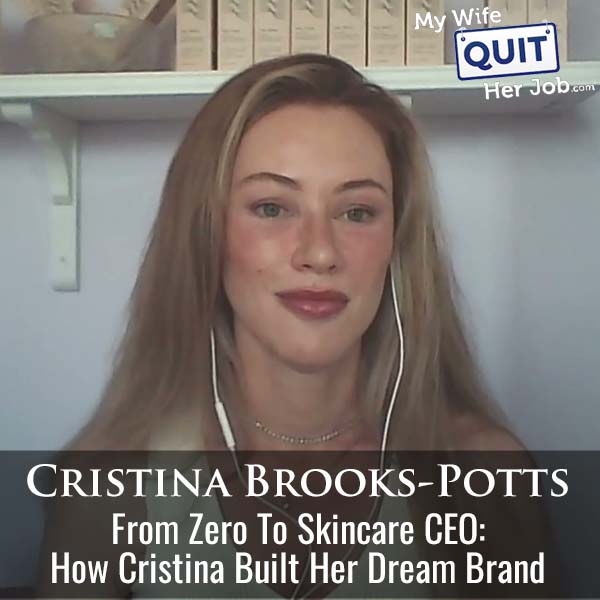
You can start a skincare brand from scratch on roughly $50,000 to $80,000, without ads, without a large social following, and without pre-orders, if the product is genuinely research-led and solves a specific unmet problem. That is exactly what my student Cristina Brooks Potts did with Authentic Ego, a skincare brand for hormonal, sensitive, and acne-prone skin that launched in 2023 after two years of R&D, attracted venture capital interest within 18 months, and grew almost entirely through Reddit mentions and organic backlinks.
Cristina joined my Create A Profitable Online Store course in 2021 and cashed out her retirement savings to fund the first product runs. She had no pre-order list, no wait-list, and barely any social presence when the store went live.
Her first 30 days had zero sales. Then Reddit users started finding her, reviewing her serums, and linking to her from every skincare community that mattered.
In podcast episode 613 we walked through exactly how she did it: the R&D-first formulation approach, how she found a real chemist, why she manufactured in the USA with Korean packaging, how much it actually cost, and the Reddit-first marketing playbook that a “founder in a sweatshirt” can run.
Get My Free Mini Course On How To Start A Successful Ecommerce Store
If you are interested in starting an ecommerce business, I put together a comprehensive package of resources that will help you launch your own online store from complete scratch. Be sure to grab it before you leave!
Table of Contents
Key takeaways
- Total launch cost for Authentic Ego: roughly $80,000 US, covering formulation, first product runs of two SKUs, packaging, testing, and site build.
- Bare minimum to start a research-led skincare brand today is about $50,000 for one or two custom SKUs (not white-label), roughly $25,000 per SKU.
- Cristina spent two years on market research using Reddit before launching. Reddit subreddits (r/acne, r/SkincareAddiction, r/FungalAcne) were the primary source for identifying real customer pain points.
- She had zero social presence, no pre-orders, and no email list at launch. First 30 days: zero sales. Then organic Reddit mentions and backlinks compounded.
- The brand attracted VC interest within about 18 months without paid marketing spend beyond a few dollars a day boosting one TikTok video.
- Manufacturing is in California (formulation and fill), packaging is sourced from Korea to protect against China tariffs and IP loss.
- You own your IP if you formulate the recipe yourself; you do not if a contract lab formulates for you and calls it “theirs.”
- FDA does not require certifications for cosmetic skincare, but claim language must stay defensible.
Marketing-led vs research-led skincare: why the distinction matters
Marketing-led skincare starts with a brand vibe, hires a contract manufacturer to hand you a slightly modified existing formula, and layers in whatever “actives” are trending on Google. Research-led skincare starts with an identified physiological problem, works backward from that problem to the ingredient combination that solves it, and only then engages a chemist to build the recipe. Most brands (including most celebrity brands) fall in the first bucket.
Cristina’s category insight: half of women get a second wave of hormonal acne in their late 20s and 30s, often layered with sensitivity issues (rosacea, eczema, perioral dermatitis, malassezia folliculitis) and aging concerns. The mass-market acne aisle answers with single-note actives (benzoyl peroxide, salicylic acid) that are often too harsh for that exact skin type.
That gap is where Authentic Ego lives. The brand formulates around four principles of early acne development (oxidative stress, lipid peroxidation, microbiome dysbiosis, and inflammation) rather than the standard exfoliate-and-kill-bacteria approach that everyone else runs.
How much it costs to start a skincare brand from scratch
It costs about $50,000 minimum to start a research-led skincare brand from scratch with one or two custom (non-white-label) SKUs, and about $25,000 per SKU on the low end. Cristina’s full launch to two SKUs was around $80,000 US and covered formulation, a first inventory run of roughly 1,000 units per SKU, primary and secondary packaging, safety and dermatologist testing, brokerage fees to import bottles from Korea, 3PL setup, and the Shopify store.
The largest single cost bucket is inventory. Skincare product runs are capital-intensive because minimum order quantities from manufacturers are typically 1,000 units at the low end and 50,000 at the high end. Bottle MOQs from Korean suppliers are typically 5,000 units, which is reasonable compared to domestic bottle suppliers who often quote 50,000-unit minimums.
You can shave the total by doing your own Shopify build, your own product photography, and your own founder content, but the formulation, testing, and inventory line items are largely fixed.
How to find a skincare chemist who will actually work with you
You find a skincare chemist who will actually work with you by ignoring the mass-market contract manufacturers with polished websites and doing forensic Googling until you find independent chemists whose websites are three pages deep and barely maintained. Cristina spoke to 30 to 40 chemists at the start of her search. Most refused the project because it challenged the standard acne-formulation approach, and one biochemist with 40+ years of experience took it on because she found the approach genuinely interesting.
The independent chemist matters because she formulates the recipe you designed rather than handing you a pre-existing formula with a few tweaks. She also does small-batch fills (1,000 units) that big contract manufacturers refuse to touch.
The signal for a good chemist partner: they have their own small manufacturing team, they are personally responsive, they do not have a flashy website, and they are willing to challenge industry defaults.
How to protect your skincare brand’s IP
You protect your skincare brand’s IP by formulating the recipe yourself and hiring a chemist to operationalize it, so the underlying blueprint stays in your head and no lab can legally lock you in. Most white-label labs own the formulas they hand you, so if you ever want to switch manufacturers you cannot take the recipe with you. That is anti-competitive by design and it is the norm.
The safer pattern: you pay the chemist for their formulation work and specify in writing that the resulting recipe is yours. This is normal for founder-led research-first brands and unusual for marketing-led brands who are just picking from a catalog.
Patents are theoretically available but heinously expensive for a small skincare brand. The practical protection is proprietary knowledge (which ingredients you deliberately avoid, and why) combined with a real R&D moat that competitors cannot copy without doing the same underlying research.
Reddit as a skincare market research and marketing channel
Reddit is the single best market research and organic marketing channel for skincare, because niche subreddits (r/acne, r/SkincareAddiction, r/FungalAcne) contain years of unfiltered customer complaints, ingredient debates, and product recommendations that no survey tool can match. Cristina spent two years reading Reddit as a “civilian” account before launching, asking real questions and learning exactly how her target customer described their problems.
That two years of Reddit reading is what let her position Authentic Ego with copy that resonates immediately. The brand launched with no email list and no pre-orders, but the first customers found the site via SEO, reviewed the serum on Reddit, added it to third-party review sites like Thing Testing and Skin Sort, and generated roughly 300 organic backlinks within 18 months.
How to post on Reddit as a skincare brand without getting banned
You post on Reddit as a skincare brand without getting banned by writing genuine resource guides (Cristina’s blog posts covered adjacent topics like taking B5 for acne, water filters, DIY cleansing oil) rather than promotional posts, and by never assuming a mod’s tolerance for brand accounts. Cristina got banned for life from r/acne after answering one product question under her brand account.
Google now indexes Reddit heavily and users deliberately append “reddit” to search queries, so Reddit content ranks visibly in Google results for skincare terms. That doubles the value of any Reddit resource guide you publish; it works as both a Reddit and a Google surface.
The Authentic Ego marketing playbook: founder-led TikTok on $2 a day
The Authentic Ego marketing playbook is founder-led TikTok content boosted with a few dollars a day in paid spend, layered on Reddit organic growth and word-of-mouth reviews. Cristina resisted social media for the first year because she wanted the brand to be about customers, not the founder. Once she started posting as herself, “in a sweatshirt on TikTok,” growth accelerated.
One specific video (about why one bottle of the Authentic Ego serum replaces five separate acne products) went semi-viral. She spent a couple of dollars a day for a full year running it as a paid ad, which is a fraction of what a typical DTC skincare brand spends.
The lesson she gives to any first-time founder: get on camera immediately, treat yourself as the conduit to the customer, and post consistently. Waiting to feel ready is the mistake.
Why Authentic Ego manufactures in USA with Korean packaging
Authentic Ego manufactures in USA (California) with Korean packaging to protect against both tariff exposure on finished skincare imports and IP loss to Korean contract manufacturers. Cristina sourced bottles from Korea in 2021 specifically because she anticipated a US-China trade war and wanted the components to come from a non-China origin.
The tradeoff Cristina names honestly: quality out of China is now equivalent to Korea for most skincare packaging, and roughly 80 percent of raw skincare ingredients globally are sourced from China regardless of finished-product origin. The Korea decision was insurance against political and tariff risk, not a pure quality decision.
Finished-skincare imports from Korea now face a 15 percent tariff (down from a much higher earlier rate), which is manageable. The bigger risk many Korean-manufactured skincare brands face is IP: some Korean contract manufacturers do not release the formula rights, so the brand cannot manufacture the product anywhere else.
FDA rules and claims for a new skincare brand
FDA rules for a new cosmetic skincare brand require no certification or approval before selling, but they limit the claims you can make on the product page. Claims like “treats acne at the root” or “clears acne in 12 hours” cross into drug-claim territory and can trigger an FDA warning letter. Descriptive claims (supports acne-prone skin, hydrating, formulated for sensitivity) are safe.
Historically the FDA has focused warning letters on egregious drug-style claims (melts fat in 12 hours) and has not sent many since the Obama administration. The practical rule for a founder: state what the product supports rather than what it treats, and back specific numeric claims with real evidence.
The “80 percent of consumers agreed” claim you see on many product pages is a consumer perception study. It is a low-rigor survey of free-product recipients, and Cristina refuses to use them because the numbers are essentially designed to sell rather than measure.
Clinical vs consumer perception studies in skincare
Clinical studies in skincare use a supervised panel over 30 to 90 days with objective photographic measurement of specific outcomes, while consumer perception studies survey free-product recipients about how the product made them feel. Real clinical studies cost meaningfully more than consumer perception studies and produce evidence a serious buyer or investor will actually trust.
Dermatologist testing has its own hidden shortcut. Most dermatologist-tested claims come from patch tests applied to volunteers’ backs (not faces) over two weeks, with volunteers who skew 60 to 85 years old because the pay is low. That does not reflect real-world use on a target customer’s face at all.
Authentic Ego is moving away from back-patch dermatologist tests and toward at-home use tests on target-demographic customers. That is more expensive but produces defensible real-world evidence.
Frequently asked questions
How much does it cost to start a skincare brand from scratch?
It costs a bare minimum of about $50,000 to start a research-led skincare brand from scratch with one or two custom (non-white-label) SKUs, and roughly $25,000 per SKU on the low end. Cristina Brooks Potts spent about $80,000 US to launch Authentic Ego with two SKUs, covering formulation, first inventory run of 1,000 units per SKU, primary and secondary packaging, safety testing, brokerage fees for Korean packaging, 3PL setup, and the Shopify store.
Do you need FDA approval to sell skincare?
You do not need FDA approval to sell cosmetic skincare in the United States. The FDA regulates skincare as cosmetics rather than drugs and does not require pre-market approval, but you must keep marketing claims defensible. Drug-style claims like “treats acne at the root” or “melts fat in 12 hours” can trigger a warning letter.
Should I white-label my skincare or formulate my own?
White-label skincare is faster and cheaper to launch but the lab typically owns the formula, so you cannot switch manufacturers and you have no real R&D moat. Formulating your own recipe with an independent chemist costs more up-front but keeps the IP in your name, lets you switch manufacturers, and gives you an actual competitive advantage.
How did Authentic Ego market without paid ads?
Authentic Ego marketed without paid ads by doing two years of Reddit market research before launching, posting genuine resource guides on Reddit rather than promotional content, encouraging organic reviews on third-party sites like Thing Testing and Skin Sort, and building a founder-led TikTok presence boosted with only a few dollars a day. Roughly 300 organic backlinks accumulated within about 18 months of launch.
Where should I manufacture a skincare product?
You should manufacture your skincare product in the US or Korea for quality, and choose between them based on tariff and IP considerations. Korean contract manufacturers offer better economies of scale but often refuse to release formula IP; US formulation and fill costs more but keeps the IP with you and avoids finished-product import tariffs. Packaging can be sourced from Korea with reasonable MOQs (around 5,000 units) versus 50,000-unit minimums common with US bottle suppliers.
Can I own the IP to my skincare formula?
You can own the IP to your skincare formula if you formulate the recipe yourself and specify in writing that the resulting recipe belongs to your brand. Most white-label labs retain formula rights by default, so you cannot take the recipe elsewhere. If you pay an independent chemist to build a recipe you designed, negotiate ownership up front.
How long does it take to develop a skincare product?
Developing a research-led custom skincare product from initial concept to first inventory run typically takes 12 to 24 months. Cristina Brooks Potts spent about two years from joining the course in 2021 to launching Authentic Ego in 2023, working full-time in enterprise sales and funneling commission income into the brand.