
Podcast: Download (Duration: 46:00 — 52.9MB)
Our 2026 ecommerce business plan is deliberately narrower than what we ran in 2025. Toni Herrbach and I are cutting the event travel that ate our year, launching a paid community, running every landing page through ChatGPT for feedback, hard-launching a long-form YouTube channel, and swapping paper-based warehouse workflows for a centralized digital system at Bumblebee Linens. The trade-off is that we say no to a lot more (AI animation projects, generic conferences, one-on-one calls with unprepared strangers) so we can put real weight behind the four or five bets that actually move revenue.
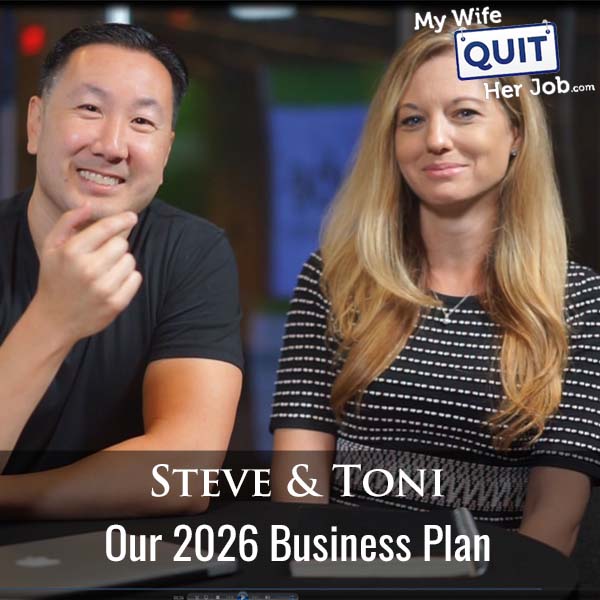
I sat down with Toni Herrbach, my long-time co-host on the My Wife Quit Her Job podcast, in episode 620 for our annual planning episode. Toni runs education and content for online business owners and works closely with Liz Wilcox on the Type A Circle YouTube channel and Fluencer Fruit community.
Below is our full 2026 playbook, side by side, including the specific tools we are betting on (Circle vs Discord, HeyGen avatars, Opus Clips, ChatGPT for landing page audits), the operational changes we already shipped in Q4 2025, and the projects we cut from the list because they would not clear the bar.
Get My Free Mini Course On How To Start A Successful Ecommerce Store
If you are interested in starting an ecommerce business, I put together a comprehensive package of resources that will help you launch your own online store from complete scratch. Be sure to grab it before you leave!
Table of Contents
Key takeaways
- The 2026 theme for both of us is focus over sprawl. Fewer bets, better execution, more no’s to shiny objects like AI animation and generic networking events.
- Steve’s 2026 bets: launch a paid community for people who already have a business, hard-launch the Type A Circle YouTube channel in January, and build internal AI tools for Bumblebee Linens (the Bumblebee bot already runs SQL queries against inventory).
- Toni’s 2026 bets: get better at using AI daily for landing page audits and repetitive tasks, only attend events where she is speaking or leading a roundtable, and explore live-building as a marketing channel.
- Both of us are cutting event attendance in 2026 after burning out on conference travel in 2025. Toni is applying to speak at Global Pet Expo and PetSummit. Steve is only committing to Seller Summit and ECF.
- Steve digitized Bumblebee Linens’ paper-based warehouse workflow while his wife Jen was on a girls’ trip to Korea, and it hit 75% adoption within days despite initial chaos.
- Both of us are running landing pages through ChatGPT for feedback and finding real value proposition improvements we could not see ourselves after years of familiarity blindness.
- Personality and live interaction are the durable moats against AI-generated content. Everything else (music, voice-over, avatars, animation, static video) is on a shorter and shorter clock.
Why we cut event travel from the 2026 business plan
We cut event travel because 2025 proved the ROI on being a general attendee is not there for people who have been in the industry more than a decade. Toni went to more conferences in 2025 than any prior year, got status on Delta, met interesting people, and still came out saying the total time investment did not justify the return.
The exceptions we are keeping are events where we get on stage. Toni is applying to speak at PetSummit (where she has spoken before) and at Global Pet Expo talking about email and retention marketing to the big pet industry brands. Speaking gives you a measurable return you can trace back to specific inbound leads, whereas attending as a general delegate does not.
If you are earlier in your career, our advice flips. Going as an attendee is genuinely valuable when you are building your first real network, because that is where the door-opening conversations happen. The rule is that events stop paying off once you have already been through that door.
Steve’s biggest 2026 bet: launching a paid community for existing operators
The community will target people who already have a business running, so the conversations skew toward operators solving real problems instead of newcomers looking for someone to hand them a product idea. Steve has been sitting on the launch because once you turn the switch on you cannot easily turn it off, and one bad recent 1:1 call (attendee showed up with zero prep asking for a product recommendation in 30 minutes) reinforced the need to gate the audience carefully.
The platform decision is still open. Steve is currently on Discord for the existing course community; Toni and Liz Wilcox use Circle for Fluencer Fruit and will be walking through the tool tradeoffs in an upcoming office hours session inside Toni’s community.
The main friction we are underestimating is the manual work of keeping a community lively. Liz Wilcox built Fluencer Fruit primarily through community engagement, and she has automated pieces of it, but the human curation of who is in the room is not something you can hand off cleanly.
Toni’s biggest 2026 bet: use AI daily to compound learning
Toni’s core AI resolution for 2026 is to touch it every day so she does not fall behind, because two days off from AI feels like the tools have changed under you. The specific workflow she has already started is running every landing page through ChatGPT with the product briefs and PDFs pre-loaded, then asking for what is missing, what is not explained well, and where the value proposition could be tightened.
Familiarity blindness is the reason this works. When you have run a brand for years, you already know how every feature and price tier fits together, so the gaps a first-time visitor sees are invisible to you. ChatGPT sees the page the way a new visitor does.
The filter Toni is applying is “which AI use cases move top-line or bottom-line revenue?” AI animation and AI video are fun and cool, but they do not clear that bar for her business, so she is deliberately staying out of that rabbit hole even though friends like Dana Michelle are producing impressive work in the space.
How Steve digitized Bumblebee Linens’ paper-based warehouse workflow
Steve replaced Bumblebee Linens’ paper-based order tracking system in the two weeks his wife Jen was in Korea, hit roughly 75% adoption within days of her return, and got surprisingly little pushback because the change came from employee feedback. He walked the warehouse floor asking staff what was inefficient, saw invoices literally dropping under tables and getting lost, and built a centralized system to replace the paper-plus-Slack combination that had accumulated over the years.
The lesson is that operational inefficiencies compound when the owner is not physically in the building. Steve normally goes into the office once a week; that cadence is not enough to see the workflow gaps that only reveal themselves under sustained daily observation.
Where Steve is heading next with AI at Bumblebee
The Bumblebee bot already answers natural-language queries against the store’s databases. Ask it “which SKUs have less than 10 days of inventory left based on recent sell-through?” and it writes the SQL, runs the query, and returns the answer along with a reorder recommendation.
The remaining friction is prompt phrasing across users. It works reliably for Steve; when Jen asked the same underlying question in her own phrasing, the queries broke. Standardizing the interface (or fine-tuning the intent parser) is on the 2026 roadmap.
Why we are both going harder on YouTube long-form in 2026
Steve is hard-launching the Type A Circle YouTube channel in January 2026 after soft-launching in late 2025 with a weekly upload cadence. Ten to twelve videos are already banked, the content foundation is solid, and the 2026 focus is on the details: better lighting (Adam is coming out this weekend to fix the studio setup), better thumbnails, and stronger titles.
The soft-launch was deliberate. Steve and Liz did not want to hard-launch until they had proven they could sustain the weekly cadence together without burning out, since collaborative channels only work if both people have the bandwidth week over week.
The channel is already generating early signal on shorts. They are combining natively recorded shorts with Opus Clips-generated clips from the long-form videos, and getting 700 to 800 views per short with basically no subscribers, which suggests the topic and hook selection is landing.
Why AI cannot kill personality-driven video (yet)
Personality is the last durable moat against AI-generated content because everything else, including music, voice-over, avatars, and animation, is getting good enough fast enough that consumers will accept it as long as the underlying output is good. There is already an “AI band” pulling huge download numbers from human curators mixing AI-generated voices, which was our proof point that music has effectively fallen. Video is next.
That said, category matters. Toni will accept an AI avatar of a person modeling a purse in her own body proportions, because most human models do not look like most of the population anyway. She will not accept an AI showing eye-cream results, because for a personal-transformation category she needs to see a real human close to her age.
The Bumblebee implication is that Steve can use an AI avatar (HeyGen just shipped a new version with much better mannerisms) to create product videos so he does not have to be on camera himself. From the brand’s perspective, the avatar-vs-human question is settled the moment the leads and sales come through the door.
The AI testimonial pattern that works
A pattern we already tested and that resonated with viewers: take a real customer review (the text is real, the customer’s permission is real) and have an AI voice deliver it on camera. The review content is authentic; only the delivery is synthetic. Some viewers pushed back on that, though the format converted, because people process video and audio more emotionally than reading a review off a static page.
The disclosure rule to know: if you run the AI-voiced testimonial as a paid ad, the FTC now requires you to disclose that the delivery is AI-generated. Organic content still lives in a gray area, though transparency is the safer bet.
Live building as a marketing channel we are both watching
Live-building is when a creator streams themselves doing their actual work (designing, coding, animating, cooking, embroidering) in real time with an audience. Dana Michelle has been live-building AI animations daily and using the stream to grow her client base and community, and Toni is fascinated by the format even though she has not figured out how it maps to her own business yet.
The reason it works is authenticity as its own testimonial. If a prospective client watches you actually do the work live, including the mistakes and mid-stream course corrections, that is stronger proof of expertise than any polished case study.
The categories where this obviously fits are service businesses (a lawn-care company streaming yard transformations, a bathroom-remodel crew streaming a build) and skilled trades. It fits less obviously for information businesses; Steve floated live-coding a Shopify store from scratch, and the group of people who would watch is genuinely bigger than you would guess.
Frequently asked questions
What is Steve Chou’s 2026 business plan?
Steve’s 2026 focus is three bets: launch a paid community for people who already run a business, hard-launch the Type A Circle YouTube channel in January, and build internal AI tools for Bumblebee Linens (including the existing Bumblebee bot that runs SQL queries against inventory data in natural language).
What is Toni Herrbach’s 2026 business plan?
Toni’s 2026 focus is on using AI daily for landing page audits and repetitive-task automation, only attending events where she is speaking or leading a roundtable (with speaking applications in for PetSummit and Global Pet Expo), and testing live-building as a marketing channel.
Should you attend more or fewer conferences in 2026?
If you have been in your industry more than about a decade, cut general attendance and only go to events where you are speaking or hosting, because the marginal ROI on being a delegate drops sharply once your network is built. If you are earlier in your career, keep attending as a delegate because that is when the highest-value new relationships get formed.
Circle vs Discord for building an online community in 2026?
Both work, and the choice is more about your audience’s habits than the feature set. Discord has a lower barrier for younger and more technical audiences; Circle has a cleaner interface and more built-in monetization for education and coaching businesses, which is why Liz Wilcox uses it for Fluencer Fruit.
Is it worth running ecommerce landing pages through ChatGPT for feedback?
Yes, and the reason is familiarity blindness. If you have run a brand for years, you cannot see the gaps a first-time visitor sees, but ChatGPT can, especially when you pre-load it with your product briefs and PDFs so it has full context on what the page is trying to sell.
Are AI avatars ready to replace on-camera creators in ecommerce?
For product demonstrations where the goal is showing how something looks or works (a purse on a body type similar to the viewer’s, a home-goods setup) AI avatars are ready and the audience will accept them if the content is good. For personal-transformation categories (skincare, hair, weight) audiences still want a real human close to their own age; that market is not there yet.
Does live-building work as an ecommerce marketing channel?
Live-building works best for service and skilled-trade businesses (lawn care, remodeling, pottery, candle making) where the process itself is watchable. For information and software businesses it can still build audience and community (Dana Michelle uses it to grow her client base), though the path from stream to revenue is longer.