
Podcast: Download (Duration: 51:10 — 58.8MB)
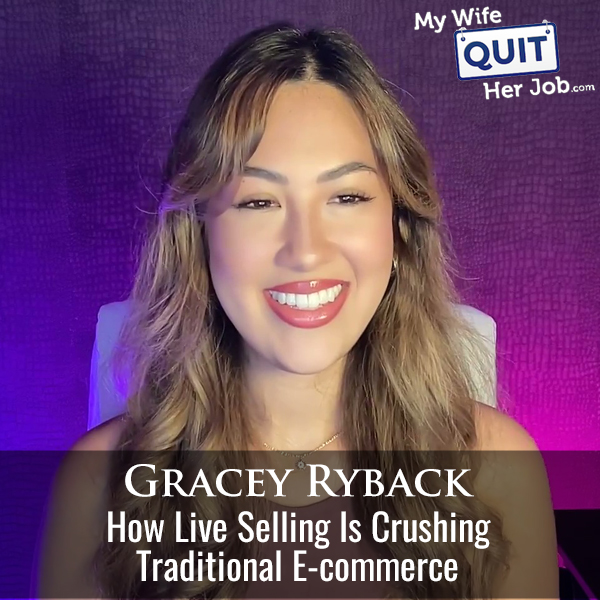
The winning live selling and influencer marketing strategy in 2026 is to get on TikTok Shop as a top-of-funnel discovery engine, treat organic content as SEO investment rather than a growth channel, and build a two-tier creator roster (a small handpicked shortlist for premium partnerships plus a wide mass-outreach pool for scale). On this episode of the My Wife Quit Her Job podcast, I sat down with Gracey Ryback, an Amazon influencer and content creator who has become one of the go-to voices in the TikTok Shop and Amazon creator space, to break down exactly how the top sellers are doing this right now.
Gracey started making Amazon deal videos “just for fun” during the 2020 lockdown and stumbled into affiliate marketing when sellers began asking her to promote their products. Six years later she teaches sellers how to build authentic creator partnerships and short-form content that actually moves inventory. Her read on what works in 2026 is different from what worked even a year ago, because organic reach is dying on every platform and TikTok Shop is quietly becoming the fastest path to profitable discovery.
Below is what Gracey shared: which platform to prioritize, how to structure a content calendar without burning out, how to source influencers who will actually convert, what the current commission math looks like on TikTok Shop, and why the Amazon halo effect is where most of the real ROI lives.
Get My Free Mini Course On How To Start A Successful Ecommerce Store
If you are interested in starting an ecommerce business, I put together a comprehensive package of resources that will help you launch your own online store from complete scratch. Be sure to grab it before you leave!
Table of Contents
Key takeaways
- US live selling is not yet at China’s scale. TikTok Live and Amazon Live wins in the US are heavily paid-traffic-driven, not organically viral, so plan for ad spend behind every live stream.
- TikTok remains the best top-of-funnel platform for short-form. Post 3x/week quality videos over daily low-effort ones and repurpose everything into Instagram, YouTube Shorts, and Pinterest.
- Content mix should be ~70% nurture (founder story, behind-the-scenes, product context) and ~30% reach (trend hijacks, viral sounds, controversial hot takes).
- Hashtags are dying. TikTok and Instagram now index the spoken words, captions, on-screen text, and even the video contents themselves, which then feed Google SEO, making every short-form post a durable SEO asset.
- TikTok Shop commissions run 10-30% and there is required GMV Max ad spend, so plan for a period of unprofitable-looking margins before the Amazon halo kicks in.
- Never pick influencers by follower count. Look at average views per video, engagement quality in comments, and previous work in your niche. GMV numbers in TikTok’s own creator directory are misleading because they are often driven by one lucky viral video.
Is live selling actually working in the US in 2026?
Live selling in the US is working for a specific type of seller, but it is nowhere near China’s scale and it is rarely organic. The seven-figure US live selling wins Gracey has audited were almost always driven by significant paid traffic pushed into the live stream, heavy pre-promotion of the stream itself, and brand-side production resources. Non-brand-supported organic live streams have not been generating comparable results.
Gracey’s hypothesis for the US-versus-China gap is buyer fatigue. American consumers are pitched from every direction (email, Meta ads, Amazon PPC, retail media, influencer sponsorships), so a two-hour “buy this now” stream lands differently than it does in a market with less end-to-end advertising saturation.
Amazon Live is still active and skews more curated (preselected products, planned themes, one-to-two-hour runtime) versus TikTok Live’s phone-propped-up-chit-chat format. Brand partnerships have historically favored Amazon Live for that reason, though TikTok Shop lives are catching up in the last few months.
Which platform should you prioritize for short-form ecommerce content?
Prioritize TikTok as the top-of-funnel platform for short-form content and repurpose the same clips into Instagram, YouTube Shorts, and Pinterest. Content built for TikTok’s raw and messy style tends to translate well downstream; content built for Instagram’s more polished aesthetic rarely translates back up to TikTok successfully.
The style difference is real. TikTok rewards phone-shot, no-makeup, in-bed-with-a-bonnet rants that go viral because someone liked the thought.
Instagram still leans curated (well-lit recipes, styled outfits, aesthetic home decor), although raw content is starting to perform there too. YouTube Shorts has a slower algorithmic push than either.
If you have to pick one platform and one style, TikTok wins on speed of feedback and reach, and repurposing outward is easier than repurposing inward.
How often should an ecommerce brand post short-form video?
Post 3x/week high-quality video rather than daily low-quality video. Quantity without quality burns the creator out inside a month and produces content that hurts your brand more than not posting at all. The bare-minimum quality bar is clear audio and clean lighting; miss either and the video will not perform.
Batch-posting is the practical fix. Keep a running note of ideas (Gracey mentions capturing them at 3am when they hit) and film them in batches a week or two later. Waking up under pressure to invent an idea for today’s post is how creators kill their own creativity.
Video length also matters. Keep it under 30 seconds when the message allows, because TikTok’s scrubber bar only appears above 30 seconds. Under 30 seconds forces the whole video to be re-watched if a viewer wants to check a detail, which drives up watch-time and algorithmic reach.
What is the right mix of nurture, reach, and product-mention content?
The right mix is roughly 70% nurture content and 30% reach content, with product mentions woven casually into both. Nurture content keeps your existing audience engaged (founder story, behind-the-scenes, honest bad-day posts about ranking losses or out-of-stock events, product context). Reach content brings new people in (trend hijacks, viral sounds, controversial hot takes, hopping on cultural moments like a Taylor Swift album drop).
Reach content is where founders get stuck because it demands they be a consumer of the platform. If you do not know what is trending on TikTok this week, you cannot hop on the trend, and no third-party trend site substitutes for actually scrolling.
Nurture content is where most brand-founders skip out because they are camera-shy. Gracey’s counter: you are already doing nurture content when you share your product story with a friend. Prop up your phone and record the same conversation, and you have your first nurture post.
For product mentions, skip “click the link in bio.” Just name the brand naturally (“this is [Brand] Handkerchief”) and let the viewer search-find-buy on Amazon or Google. It preserves the video’s watch-time and drives the exact halo behavior you want.
How do you know if a short-form video will go viral before it publishes?
Viral videos share four ingredients: a strong hook in the first two seconds, technically clean audio and lighting, at least one of value/education/entertainment/controversy, and something save-worthy or shareable at the end. Gracey can now look at a video without seeing view counts and predict whether it will hit, purely based on those signals.
The hook is the single highest-leverage element. A close-up of something unexpected, a controversial statement, a “why is nobody talking about how…” opener, or a fast flash of the product all work. A “hey, I’m Steve, today I wanted to talk about…” opener does not work.
Save-worthy content wins the algorithm because saves and shares get weighted more than likes. A recipe someone saves for later, a hot take someone shares to argue about, a genuinely funny clip someone sends to a friend: all three are stronger signals than a thumbs-up.
Comments-driven virality is real. A typo, a mispronunciation, or a mild “hot take” that people argue about in the comments can carry a video the algorithm would otherwise ignore. Gracey said “Auntie Ann’s” in a weird accent by accident, the comments exploded, and the video went viral.
Are hashtags dead? What replaces them for reach?
Hashtags are effectively dead and SEO has replaced them across TikTok and Instagram. Both platforms now index the spoken words in your video, the on-screen text, the caption, and (via AI vision) the actual products visible in the frame. You can tap on a TikTok and it will surface similar products for purchase without the creator lifting a finger.
Google is indexing that same short-form SEO data and surfacing TikTok and Instagram results in general web search. That means every short-form video you post is now a durable SEO asset for your brand and product name, not a 24-hour blip.
Say your brand name out loud in the video, put your product category in the on-screen text, write a caption that reads like a search query, and you are already ahead of most brands that still lean on hashtags.
How do you build an influencer army on TikTok Shop?
You build a TikTok Shop influencer army with a two-tier roster: a handpicked shortlist of 20-30 proven creators you invest in personally with samples, higher commissions, and small flat fees, plus a mass-outreach pool that you contact at scale (via tools like Yuka or Helium 10) as a numbers game. Both tiers are needed. The shortlist drives quality; the outreach pool drives volume.
TikTok Shop enables the whole model. The platform lets you send samples through its native flow, invite creators into a Discord community, run flat-fee campaigns for new launches, and offer higher commission rates to your VIP tier. TikTok is explicitly permissive of off-platform side deals with creators you meet through Shop, so once someone joins your Discord you can strike private arrangements as well.
Volume math: expect roughly 10% of mass outreach messages to respond with interest, and 5-10 of every 100 responders to actually produce a video. So a 1,000-message outreach yields 5-10 real collaborations. That is why the shortlist matters, because those 20-30 relationships are where the compounding happens.
How do you pick TikTok Shop influencers that will actually convert?
Pick influencers by average views per video, engagement quality in comments, and previous content in your niche, and never by follower count or TikTok’s own GMV number. A creator with one $50K viral video and 200 views on everything else is going to give you a 200-view video, not a $50K one.
The GMV number in TikTok’s creator directory is especially misleading. That lifetime GMV number is often 99% from a single viral video, so it does not predict what a normal video for your brand will do.
Gracey’s discovery method: search your product keyword on TikTok, filter by “most viewed” in the last 30 days, and study the creators behind those clips. That surfaces creators who have already proven they can convert your exact category, which is worth more than any directory ranking.
How much should you budget for TikTok Shop commissions and ads?
Budget for TikTok Shop commission rates of 10-30% (with 10-15% being the effective minimum on most categories), plus flat fees for shortlist creators, plus mandatory GMV Max ad spend to get any real reach. Most first-time TikTok Shop sellers underestimate all three and hit an “I’m losing money” wall in the first 60-90 days.
The margin math looks bad in isolation. Sample cost + commission + GMV Max spend + platform fees can easily eat through your gross profit on-platform, and many sellers panic and quit before the halo effect on Amazon starts to show up.
The Amazon halo is where the real ROI hides. Sellers regularly report that their TikTok Shop revenue is modest and their Amazon revenue jumped 20-50% during the same window because buyers discovered them on TikTok and search-find-bought on Amazon (better shipping, no $8 shipping threshold, Prime).
What kinds of products actually work on TikTok Shop?
Products that work on TikTok Shop are demonstrable in under 30 seconds, priced under about $75 for impulse-purchase behavior, and easy to describe in plain language. Beauty, cookware, home decor, office organization, and other “boring but ubiquitous” categories all perform. Extremely niche, hard-to-explain, or premium-priced products struggle unless the video is exceptional and TikTok-exclusive pricing is used to bridge the price gap.
Price ceiling: above ~$75-100 you leave impulse-purchase territory and viewers say “I want it, but not right now.” A $470 hair dryer is currently going viral, but only because TikTok Shop is running a $50 exclusive coupon that undercuts Amazon and retail.
“Boring” is not a disqualifier. Gracey’s line: “People say invest in boring businesses because people always need boring things.” A cookware set is boring and doing numbers. An office shelf paired with “organize with me” content is a natural placement.
Real disqualifiers: single-purpose survivalist gear at $500+, anything that requires a paragraph of context to understand, and anything where the visual payoff is not obvious inside a 30-second window.
How do you write an outreach email an influencer will actually respond to?
Write outreach that is direct, specific, and comprehensive in the first message: name the product, name the deliverable format (TikTok Shop link, live stream, UGC video), name the timing (this week, next month, Black Friday), name the goal (sales, brand awareness, liquidation), and name the budget or commission structure. Every missing detail forces a back-and-forth that stretches the deal cycle by a week.
The worst outreach reads “Hey, I’m looking for an influencer. Can you do it? Thanks.” That triggers 5-7 clarifying questions before the creator can even say yes or no, and busy creators just skip it.
If your budget is firm (“$50 flat plus 15% commission”), state it in the first email. If your budget is flexible, ask for their rate directly. Either way, remove the guessing game from the first exchange.
Frequently asked questions
Do I have to be on TikTok Shop to run influencer marketing?
No, but it is the fastest way to reach and build relationships with creators right now. TikTok Shop has native tools for sending samples, running commission-based campaigns, and offering higher commissions to VIP creators that non-Shop brands cannot access. TikTok also encourages off-platform side deals with creators you meet through Shop, so it doubles as a creator-sourcing engine even if you never take a Shop sale.
Should I create my own TikTok content or pay influencers to create it for me?
Both, with the priority on influencers if you can only pick one. Founder-created content is never wasted (it becomes long-term SEO), but a founder account starts from zero followers and takes months to move. Influencer collaborations reach an existing audience the same day the video posts, so most brand-new brands get faster ROI from creator work than from their own channel.
How many influencer campaigns should I run before deciding TikTok Shop is not working?
Run at least 50-100 videos before concluding your product does not fit. That number also unlocks GMV Max ad qualification, so hitting it is worth doing regardless. If none of those videos generate any sales, awareness, or organic views, the honest answer is either your product does not fit or your strategy needs to change, and it is time to reconsider.
What is the biggest mistake first-time TikTok Shop sellers make on margins?
Underestimating total spend. Sellers plan for commission (10-30%) and forget sample cost, GMV Max ad spend, and platform fees. The first 60-90 days look unprofitable on the surface, and many quit before the Amazon halo effect (20-50% Amazon revenue lifts driven by TikTok discovery) starts to show up in analytics.
Is the follower count of an influencer a good signal to work with them?
No, follower count is one of the worst signals. Judge influencers by average views per video, comment engagement quality, and whether their previous content converts in your niche. A 20K-follower creator with 50K average views is a far better bet than a 500K-follower creator with 2K average views.
What is the ideal short-form video length in 2026?
Under 30 seconds when the message allows. Videos under 30 seconds do not get TikTok’s scrubber bar, which forces full re-watches when viewers check a detail, which lifts watch-time and algorithmic reach. Above 30 seconds, only go longer if the content genuinely holds attention for the full duration.