
Podcast: Download (Duration: 46:50 — 53.9MB)
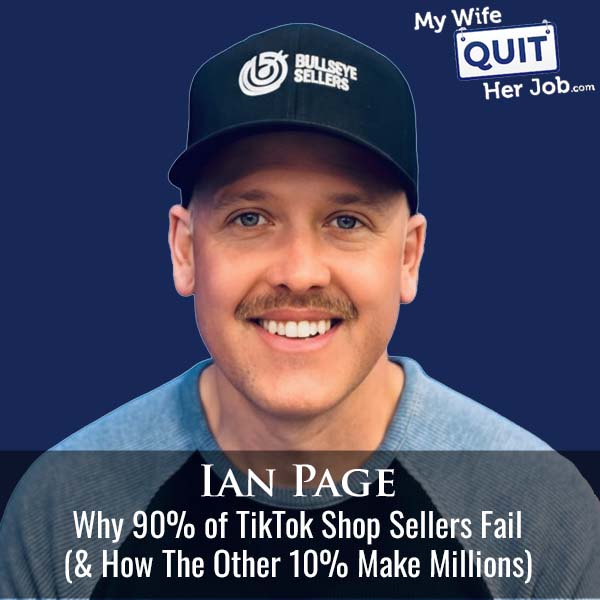
The two reasons most TikTok Shop sellers fail in 2026 are the probation and shop-score system (which quietly caps you at 500 sales a month and punishes you for carrier scan errors you cannot control) and the affiliate tier problem (real affiliates will not touch a small shop with no track record). On this episode of the My Wife Quit Her Job podcast, I brought Ian Page of Bullseye Sellers back on to explain exactly how the platform is rigged, why it is rigged that way, and the fixes the top 10% of sellers are using to sail past both walls.
Ian is honest to a fault. He is not a rah-rah TikTok Shop cheerleader. His agency manages nearly 100 brands, so his read on what has changed since our first interview six months ago is the most current view I could get, and it is different from what most public TikTok Shop content will tell you.
Below is what has actually changed on TikTok Shop, why Fulfilled by TikTok (FBT) is now effectively mandatory, how the four probation tiers really work, what affiliate outreach looks like today, and the three-pillar formula behind every viral shop we discussed.
Get My Free Mini Course On How To Start A Successful Ecommerce Store
If you are interested in starting an ecommerce business, I put together a comprehensive package of resources that will help you launch your own online store from complete scratch. Be sure to grab it before you leave!
Table of Contents
Key takeaways
- The probation and shop-score system quietly caps new sellers at 500 orders a month, and even perfectly-fulfilled orders can drop your shop score from 4.4 to 3.7 if a carrier fails to scan on time.
- Fulfilled by TikTok (FBT) is now effectively mandatory. It removes ~50% of the metrics that hurt your shop score, unlocks the “3-day shipping” badge, and costs about half of what Amazon FBA does for the same weight tier.
- The FBT waitlist is the real bottleneck for solo sellers. Agencies with a direct rep contact can skip it and get a shop approved by the click of a button.
- TikTok’s Project Horizon whitelists sellers who have done $10M+ on Shopify in the last 12 months and gets them to full “Pro” tier in 30 days instead of 90-120. Everything below that level goes through barbed wire.
- Only 1-3% of TikTok’s ~1M enrolled affiliates are Level 3 or higher (~$10K+ in monthly GMV). A brand-new shop cannot recruit them and has to build a Level 1 affiliate army from scratch.
- The three pillars behind every viral shop are a demonstrable video format, a clear unique selling proposition, and a genuinely good offer. Ian added the third pillar to his framework in the last six months after seeing “boring” categories like dog poop bags go viral.
What has changed on TikTok Shop in the last six months?
The biggest change is TikTok has tightened probation and shop-score enforcement dramatically to clean up the flood of counterfeit sellers and proxy corporations that came in during the platform’s initial land rush. Six months ago, most sellers could work their way out of probation manually; today, the system quietly caps you at 500 orders a month and penalizes you for carrier issues you did not cause.
The second change is Project Horizon, a heavily-incentivized program TikTok is pushing to agencies to recruit sellers doing $10 million-plus on Shopify in the trailing 12 months. Those sellers get whitelisted, skip the probation queue entirely, and hit full Pro tier in 30 days. Everyone below that revenue bar goes through the standard 90-to-120-day gauntlet.
The third change is that the seller subsidies that TikTok was handing out to almost anyone in the early days are gone. Incentives still exist, but only for much larger sellers, which further tilts the playing field toward established brands and away from small startups.
What is Fulfilled by TikTok (FBT) and why is it now mandatory?
Fulfilled by TikTok (FBT) is TikTok’s version of FBA: you ship inventory to a TikTok warehouse, they verify it and take over fulfillment, and roughly half the metrics that would otherwise damage your shop score (on-time tracking, customer messaging speed, refund handling) either go away or get handled for you automatically. Ian’s flat statement on the current landscape: “I wouldn’t do it” on TikTok Shop without FBT.
The reason is what happens without it. Ian described a client who refused FBT, self-fulfilled every order in under 24 hours, and still saw their shop score fall from 4.4 to 3.7 because FedEx failed to scan seven packages on time. The platform blames the seller, not the carrier.
FBT also unlocks a “3-day shipping, fulfilled by TikTok” badge on your product page that reads to buyers exactly like Amazon Prime versus non-Prime. Without the badge, you are competing at a permanent conversion disadvantage.
How much does Fulfilled by TikTok cost versus Amazon FBA?
Fulfilled by TikTok is roughly half the cost of Amazon FBA at comparable weights, with a flat all-in fee that includes inbound and outbound shipping. For a one-and-a-half-pound item, FBT charges around $5.71 all-in, which is substantially cheaper than the equivalent FBA fee once inbound and picking costs are layered in.
Here is the FBT pricing tier Ian walked through on the episode:
| Item weight | Single-unit fee | 4+ units per order |
|---|---|---|
| Up to 4 oz | ~$4.28 | ~half of single-unit |
| 1.5 lb | ~$5.71 | ~half of single-unit |
| 4+ lb | ~$7.66 | ~half of single-unit |
Storage fees exist, but Ian’s clients have not seen material storage costs because FBT’s check-in process is fast. Refunds are automated the same way Amazon handles them (the seller does not get to negotiate case by case), and the platform-wide refund rate his clients are seeing is 1-2%, below what the same brands see on Amazon.
How do the four TikTok Shop probation tiers work?
TikTok Shop has four sequential tiers (Beginner, Standard, Premium, Pro), and you graduate between them by hitting a checklist of shop score, active listings, and fulfillment metrics. Most of the criteria are opaque, and TikTok tells you the checklist without telling you the exact hack for each item.
Here is what the graduation checklist looks like for a real client Ian showed on the episode, currently sitting in Standard tier:
| Requirement | Threshold | Client status |
|---|---|---|
| Shop performance score | 4.0+ out of 5 | 4.4 (pass) |
| Counterfeit listings | Zero | Zero (pass) |
| Probation quiz | Passed | Passed (pass) |
| Active product listings | 10+ | 9 (fail, one listing short) |
The 10-listing requirement is the one that quietly breaks single-hero-product brands. If you built your whole business around one or two SKUs, you literally cannot graduate out of Standard without adding filler listings to hit the count.
Each tier upgrade unlocks more visibility, higher order caps, and better GMV Max ad performance. Under 500 orders per month is the effective Standard-tier ceiling right now, so brands hoping to go viral before Pro tier will hit a wall long before they think they should.
How long does it take to graduate to TikTok Shop Pro tier?
For a standard (non-whitelisted) seller doing everything right, expect 60-120 days to reach Pro tier. Ian’s agency gets clients through the tiers in about 60 days by combining FBT enrollment on day one, Selloco-driven giveaways to satisfy the delivered-order requirements, and a few insider tricks that push shop-score inputs faster. A solo seller without agency shortcuts should plan for the full 120 days.
The one exception is Project Horizon whitelisting for $10M+ Shopify sellers. Those brands hit Pro tier in about 30 days, get unlimited affiliate outreach, immediate FBT access, and are basically pre-approved to go viral. If you are not at that revenue tier, you are playing a slower game by design.
How does the TikTok Shop affiliate ecosystem actually work?
The TikTok Shop affiliate ecosystem has around 1 million enrolled affiliates on paper, but the distribution is brutally top-heavy: 85-90% have generated little or no GMV, 8-12% are Level 2 (~$5K in monthly sales), and only 1-3% are Level 3 or higher (~$10K+ monthly). The Level 3+ affiliates will not respond to a new shop with $2K in lifetime GMV, so a new brand has to build its own affiliate army from Level 1 pickups.
The math is simple. If a Level 3 affiliate is doing $50K a month in sales and your entire shop is doing $2K, they have no incentive to work with you. Ian’s line: “The brand basically earns the affiliates that it deserves.”
A brand-new shop gets around 1,000 outreach messages allocated by TikTok as a sample pack, and the typical response rate is 2-4%, so you can expect 20 to 40 affiliate responses to your first push. You will say yes to almost all of them regardless of their track record, because you need volume to seed the affiliate flywheel.
How do you get past the affiliate chicken-and-egg problem?
You get past the affiliate chicken-and-egg problem with a giveaway-buyback service like Selloco, which lets you fulfill enough real orders to satisfy the $2K sales threshold that unlocks affiliate messaging. Selloco recruits affiliates directly into its own pool, so you can pay ~$50 for a single affiliate video that seeds your shop and connects to the automated Selloco campaign in one flow.
The trick is that TikTok’s early sales requirements are specifically for “affiliate GMV,” not any GMV, so you cannot bootstrap with your own DTC traffic. The affiliate video has to exist and it has to generate at least one attributed sale.
Ian’s agency handles this by binding new shops to their agency portal, which gives them a shortcut to FBT approval and a warm-start affiliate outreach through their internal VIP WhatsApp group of proven affiliates (some doing $10K, $25K, or more per month). Solo sellers should assume they will do the Selloco version and expect a slower ramp.
What are the three pillars of a viral TikTok Shop product?
The three pillars are a demonstrable video format, a unique selling proposition, and a genuinely great offer. Ian’s original two-pillar framework was video-plus-USP; he added the offer pillar in the last six months after watching a dog poop bag brand go viral with $150K in sales from a single 30-second “hands only” point-of-view video, purely because the offer (a one-year supply of poop bags bundled with a brand-name holder at a deep discount) was too good to pass up.
Ian’s viral roll call from the last three months (all Level 1 or Level 2 affiliates when they started):
- A pop-up greeting card brand: 4.1M+ views on a single video, fully sold out of Amazon and TikTok inventory, manufacturer scrambling to catch up.
- A body-acne serum: 9M views from one affiliate who reframed the product for bikini-line use and blurred out the before-and-after, paid over $30K in commissions in 60 days.
- A hand-eye coordination toy: 2M views during Christmas 2025, spawned copycat videos from other creators, sold through the holiday.
- The dog poop bag brand: 7.8M views on a 30-second POV video, $150K+ in attributed sales, offer-driven rather than product-driven.
The pattern is that the product does not have to be exotic. It has to show its problem-solving quickly on video, have a clear reason someone would pick it over a substitute, and pair with a discount or bundle that feels genuinely worth the click.
What is the fastest way for a solo seller to get started on TikTok Shop?
The fastest solo path is: set up your shop, list at least 10 products, launch a Selloco giveaway campaign immediately (takes about three minutes), get on the FBT waitlist the day you can, and use Amazon Multi-Channel Fulfillment (MCF) as your bridge fulfillment until FBT approves you. The moment FBT is approved, cut MCF over to FBT to unlock the 3-day shipping badge and drop your fulfillment cost by roughly half.
Selloco covers the giveaway flow that satisfies TikTok’s real-orders requirement, MCF handles fulfillment better than most cold-start 3PLs because Amazon and TikTok’s logistics are currently jiving well together, and FBT is the endgame you migrate to as soon as the platform lets you in.
If you are a $10M+ Shopify seller, the fastest path is different: get on a call with a Project Horizon agency, get whitelisted, and skip the entire probation gauntlet.
Frequently asked questions
Is Fulfilled by TikTok (FBT) really mandatory, or can I self-fulfill?
You can self-fulfill on paper, but in practice FBT is effectively mandatory in 2026. Without it you are exposed to shop-score damage from carrier scan failures you cannot control, you cannot earn the 3-day shipping badge that materially improves conversion, and you are ineligible for a growing set of merchandising placements. Every serious TikTok Shop operator we interviewed is on FBT or trying to get on it.
How do I get off the FBT waitlist without an agency?
There is no clean self-serve path. TikTok has quietly made agency introductions the fastest route to FBT approval, which is why agency retainers pay for themselves for many mid-sized sellers. If you refuse to use an agency, submit your FBT application the day your shop is live and use Amazon MCF as your fulfillment bridge until you are approved.
Why did my TikTok Shop score drop even though I shipped every order on time?
Most likely because a carrier (FedEx, USPS, or UPS) failed to scan your package at a required tracking checkpoint on time. TikTok’s shop-score algorithm attributes those scan failures to the seller, not the carrier, and even a handful of misses can move your score from a passing 4.4 to a failing 3.7. FBT eliminates most of this exposure by taking fulfillment out of your hands.
Do I really need 10 active listings to graduate TikTok Shop probation?
Yes. The current Standard-tier graduation requirement is 10 active product listings, and single-hero-product brands get stuck here until they add filler SKUs. If you only sell one or two products, plan to add complementary or variant listings specifically to satisfy the count.
How many affiliate responses should a new TikTok Shop expect from its first outreach?
Around 20-40 responses per 1,000 messages sent, which is the 2-4% baseline response rate for new shops. You will say yes to almost all of them regardless of their track record, because your goal at that stage is affiliate-attributed GMV, not curated selection. The higher-tier affiliates come later once your shop has a proven track record.
How much cheaper is TikTok FBT than Amazon FBA?
Roughly half the cost for comparable weights, with the fee being an all-in number that already includes inbound and outbound shipping. FBT for a 1.5-pound item runs around $5.71, well under the equivalent FBA figure once inbound and pick fees are layered in.
Can I use TikTok Shop if I only sell “boring” products like dog poop bags?
Yes. Ian’s roll of recent viral shops includes a brand-name dog poop bag that sold $150K+ from a single 30-second video, because the offer (huge bundle at a deep discount) carried the video. The pattern is video-demonstrable, offer-driven, and category-agnostic, so if your product can be shown solving a real problem in under 30 seconds and you can pair it with a genuinely great deal, it can work.