Podcast: Download (Duration: 46:28 — 53.5MB)
To grow on social media with AI in 2026, batch one filming day per week, use AI to pull content ideas from work you are already doing (meetings, support tickets, articles you save), keep a human in the loop for every script, and let a repurposing tool distribute one piece to every platform. That is the exact system Sabrina Ramanov used to reach over 500 million views in about a year across TikTok, Instagram, LinkedIn, and YouTube after starting from zero.
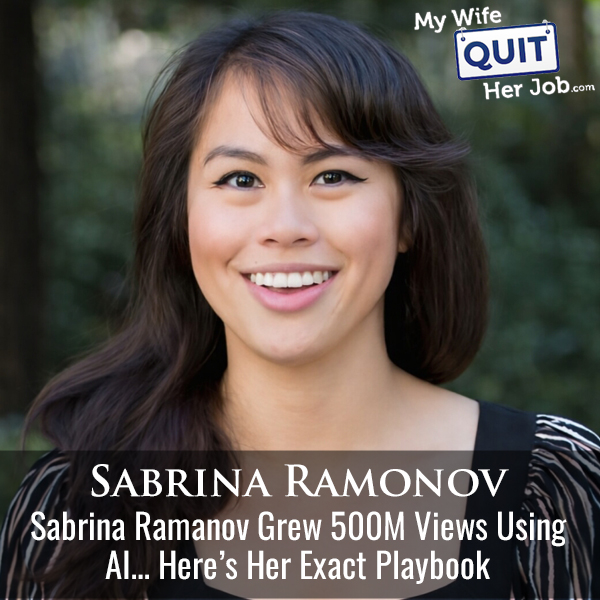
I sat down with Sabrina on episode 631 of the My Wife Quit Her Job podcast. She is a CS major from Berkeley, sold her first AI company (Curious), and now runs Blotato, the AI social media tool I personally use to schedule and repurpose my own posts.
This post lays out her full playbook: her posting cadence, how she sources ideas without burning out, the vibe coding stack she recommends to non-developers, and what actually converts viewers into paying customers.
Get My Free Mini Course On How To Start A Successful Ecommerce Store
If you are interested in starting an ecommerce business, I put together a comprehensive package of resources that will help you launch your own online store from complete scratch. Be sure to grab it before you leave!
Table of Contents
Key takeaways
- Sabrina posts about 21 original pieces of content per week, all filmed in a single batch day, then repurposed with Blotato to every other platform.
- She did not hit 1,000 views on TikTok until 3 months in. The single change that broke her out of “200-view jail” was adding hashtags like #AI and #ChatGPT.
- Her AI idea-sourcing pipeline pulls from three buckets: her own work (meetings, support tickets, GitHub issues), AI news via RSS.app, and viral hooks from unrelated niches like dating.
- She strongly advises against full automation for beginners. AI should deepen the creative process by finding blind spots, not remove you from it.
- For vibe coding, she recommends Lovable.dev for beginners (with Supabase built in via Lovable Cloud), Emergent.sh for mobile apps, and Cursor or Claude Code for maintaining a real product.
- Short form drives awareness. Long-form YouTube tutorials with automation templates are what actually convert viewers into Blotato users.
Who is Sabrina Ramanov and how did she grow to 500M views?
Sabrina Ramanov is a Berkeley CS grad, serial AI founder, and the creator behind Blotato, an AI tool for scaling organic social media. She grew her personal brand from zero to over 500 million total views in roughly a year across TikTok, Instagram, LinkedIn, and YouTube, and her Blotato website has already pulled 1.4 million visitors this year through that funnel.
She had been in AI since 2013 and sold her first company, Curious, before moving out of the Silicon Valley bubble. Once she left, she realized most people outside tech either did not know AI existed or were being sold $1,000 prompt packs by fear-based creators.
She started posting on TikTok about a year and a half ago with a mission to teach 1 million people about AI for free. She has long since blown past that number.
Should you start with a personal brand or a faceless account?
Start with a personal brand if you are selling B2B, and go faceless if you are selling B2C. Sabrina is clear: for B2B products like Blotato (which sells to agency owners and brand-builders), putting your face on the content is incredibly powerful because of the inbound opportunities it creates, whether or not it directly generates leads.
For B2C consumer apps, she sees the opposite. Most successful B2C mobile apps on TikTok have no personal brand at the helm, because the goal there is a repeatable viral video format that a UGC army of 100 hired creators can replicate.
If the content is tied to your face, it caps how scalable your distribution can be. If it is a format anyone can film, you can pay to blanket the platform.
How often should you post to grow on social media?
Sabrina puts out about 21 original pieces of content per week, which is roughly 3 pieces of content per day. That includes one long-form YouTube video, a newsletter, and about 20 short-form videos, all filmed in a single batch day.
For beginners, she is realistic. Consistency matters more than volume, so if all you can manage is one post a day, do that and stick with it.
Her honest benchmark: it took her 90 to 100 days of posting before it felt “wrong” to skip a day and posting became part of her identity. Most beginners never make it to 100 published posts, which is where most people fall off.
How to source content ideas with AI (the 3-bucket system)
Sabrina’s content-idea pipeline uses AI to scrape 3 sources: work you are already doing, AI news, and viral hooks from unrelated niches. All the ideas land in Airtable, where an AI agent scores them against her past viral content before she applies human judgment.
Bucket 1: Ideas from work you are already doing
Her AI bot scans her weekly Blotato office hours transcript (via an AI meeting notetaker), support tickets, emails, and GitHub feature tickets, then flags interesting trends. If 50 users are requesting the same feature, that is a content idea.
Her advice for most people: do not change what you are already doing. Just plug AI in to listen to your meetings and emails, and have it surface 10 interesting ideas from what you actually discussed that day.
The benefit is authenticity. Those ideas came up naturally in real work, which is what makes them worth talking about.
Bucket 2: AI news via RSS.app
She uses RSS.app to monitor Twitter accounts, TikTok accounts, and Instagram accounts in the AI space, then compiles the most interesting news for her audience. Her audience specifically responds to free tools and free resources, like when DeepLearning.AI drops a new free course.
She also pulls from the ChatGPT subreddit for funnier or more offbeat angles. The point is filtering for what your specific audience cares about, not just what is trending broadly.
Bucket 3: Viral hooks from unrelated niches
The third bucket is the most creative one. She scrapes consumer content from niches completely unrelated to AI (dating, relationships, lifestyle), looking only at the hook structures that make those videos go viral.
Then she repurposes the hook format for an AI use case. A viral opener from a dating video can become a viral opener for an AI tool tutorial with almost no modification.
How to score and pick content ideas without overthinking it
Once ideas land in Airtable, Sabrina’s AI agent scores each one against examples of her past viral content and predicts which will perform well. On a batch of 200 ideas, it will rank them for her before she filters further.
She then applies human judgment on top. Her example: she posted about Brave browser’s early AI-browser research long before it went mainstream, because she thought it mattered.
That post did not pop until OpenAI released Atlas and everyone realized AI browsers had safety issues. The AI scorer never would have surfaced it, but her instinct did.
How to film 20 short-form videos in one day
Sabrina batches everything in a single content day. She films one long-form YouTube video in the morning, breaks for lunch, then films about 20 TikTok videos in the afternoon.
Her filming setup is minimal: a selfie stick holding her phone, and her laptop displaying the Blotato-generated script notes right next to it. She glances at the notes and wings it. She only uses a teleprompter if she is literally reading a list.
For hooks specifically, she uses a feature in Blotato called the Viral AI Coach. You record the first 20 seconds of your video, upload it, and the tool transcribes the audio, analyzes the visual, and scores each hook so you can iterate before publishing.
Why full automation is the wrong goal for AI content
Full automation is the wrong goal because AI should deepen the creative process, not remove you from it. Sabrina used to publish fully automated tutorials because they were the simplest to demo, but users downloaded the templates and expected the output to be good enough to publish untouched. It rarely was.
Now every tutorial she ships includes a human-in-the-loop QA step. She is convinced 90% of creators should work that way.
Her framing is sharp: creators failing with AI are using it to distance themselves from writing and editing, which is exactly the part that matters. Creators winning with AI use it to find their blind spots and generate 5 challenging perspectives on the same idea.
Vibe coding for non-developers: where to start
Vibe coding is when a non-developer builds a real app by prompting an AI coding tool in plain English, and the tool writes, deploys, and often hosts the code for you. Sabrina recommends starting with a simple lead magnet on Lovable.dev because it does not require authentication, payment, or a complex backend.
Her example from a recent newsletter: she vibe coded an interactive ROI calculator in Lovable Cloud in a few hours. Users answer a few questions, get a personalized report, and hand over their email in exchange. Lovable Cloud automatically spins up a Supabase database, creates the schema, and captures every submission.
Another example she shared: an AI Agents and Automations Directory that she vibe coded in a few hours and that has pulled 37,000 visitors in 3 months. It is a single-page directory backed by a Supabase table.
Best vibe coding tools for beginners in 2026
Here is how Sabrina ranks the main vibe coding platforms based on what she has personally used or evaluated.
| Tool | Best for | Notes |
|---|---|---|
| Lovable.dev | Absolute beginners, web apps, lead magnets | Lovable Cloud auto-provisions Supabase (database + auth). Best default for someone brand new. |
| Emergent.sh | Mobile apps, high-polish UIs | Uses MongoDB for storage. Very impressive output, but downloaded codebases still have build issues (out-of-date libraries). |
| Bolt.new | Web and mobile | Still popular. Comparable to Lovable for most use cases. |
| Cursor AI | Existing codebases, developers | What Sabrina used to build the first Blotato MVP. |
| Claude Code | Complex existing codebases, refactoring | What Sabrina uses today to maintain Blotato. Her strongest recommendation for real production code. |
Should vibe coding replace hiring an engineer?
No. Sabrina is explicit: the goal of vibe coding is to hire a full-time engineer, not to avoid one. Vibe coding is for validating an MVP, getting paying users, and reaching the point where users are frustrated that things keep breaking (which means they actually want to use it).
At that point, you have the conviction and the revenue to hire a real engineer who will refactor about 95% of your vibe-coded codebase. That is exactly what happens with most vibe-coded MVPs that reach real product-market fit.
Blotato itself started as a Cursor-vibe-coded MVP that did not even have publishing built in. The core feature was just remixing an article into a post in your own voice, and that alone got the first 100 paying customers.
What actually converts short-form viewers into paying customers?
Long-form YouTube tutorials with automation templates convert far better than short-form. Sabrina’s honest breakdown: TikTok, Instagram, and LinkedIn short-form generate massive awareness (hundreds of millions of views), but the actual paying customers come from YouTube long-form and her email newsletter.
Her funnel logic: short-form is for reach, long-form is for authority, and email is for control. Her stated goal for every short-form video is to move that viewer onto her YouTube channel or email list, because she does not want to depend on the algorithm for her business.
One counter-example she shared: she ran a faceless TikTok channel that hit hundreds of millions of views with a Blotato watermark. Conversions were terrible, because a watermark on a video whose subject matter is unrelated to your tool tells the audience nothing about why they should click.
Frequently asked questions
How long does it take to grow on social media from zero?
Plan for at least a year of consistent posting, though the first meaningful traction often shows up around 90 to 100 days in. Sabrina spent 3 months in “200-view jail” on TikTok before her first video crossed 1,000 views. She treats social growth as a 5-year commitment, not a weekly one.
What is the fastest way to get out of TikTok’s low-view “jail”?
The single change that moved Sabrina from 200 views to consistent 1,000+ views was adding relevant hashtags like #AI and #ChatGPT to every post. From there, her first true breakout came from using TikTok’s Creator Search Insights to find low-competition search terms with real demand, then filming videos for those gaps.
What AI tools does Sabrina Ramanov actually use?
Her working stack: Blotato for repurposing and scheduling, N8N for scraper automation, RSS.app for news monitoring, Airtable for storing and scoring ideas, ElevenLabs for voice cloning, an AI meeting notetaker for office-hours transcripts, Claude Code for maintaining the Blotato codebase, and Lovable.dev for quick prototypes. She uses voice dictation (VoiceSync, similar to WhisperFlow) to talk her reactions into the system rather than typing.
Is vibe coding safe for a real business or just for prototypes?
Vibe coding is safe for MVPs and validation, but not for a scaled product. Sabrina’s own recommendation is to use vibe coding to get to paying customers, then bring in a real engineer to refactor roughly 95% of the codebase before you try to scale. Blotato followed exactly this path.
How often should a beginner post on TikTok or Instagram to grow?
Post at whatever cadence you can sustain, and prioritize consistency over volume. Sabrina posts about 3 pieces of content per day (all filmed in one batch day per week), but if you can only manage one post a day, do that and stick with it for at least 100 days. Most beginners fall off before they get there.
Should you use an AI avatar to scale your content?
Use an AI avatar as a safety net, not as your main output. Sabrina only turns on her avatar (recognizable by a purple cap she wears for transparency) when she is on vacation or sick, and it once saved her during a 2-week stretch when she lost her voice. Even then, she spent 4 hours tuning ElevenLabs parameters to get the enunciation right about 80% of the time.