

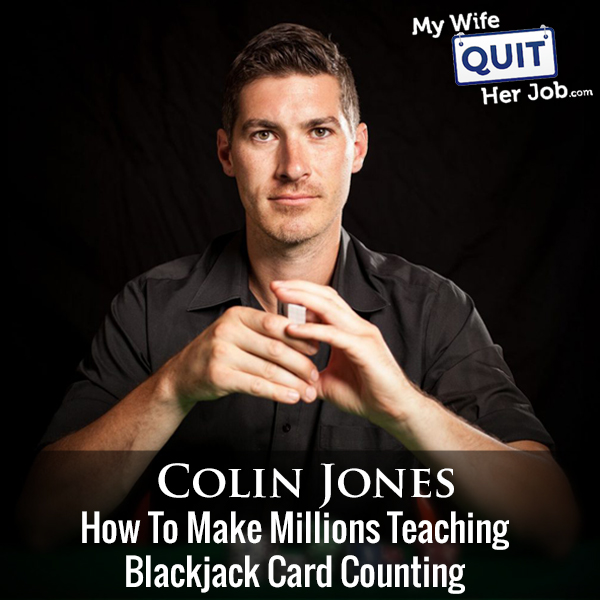
Podcast: Download (Duration: 45:32 — 52.4MB)
Colin Jones won roughly $4 million counting cards at blackjack, then realized he had built himself a job rather than a business. So he turned the skill into an education company at Blackjackapprenticeship.com, which now ranks in the top three for the word “blackjack” and gets over half its paying members from YouTube.
Colin and I have crossed paths at conferences for years, and he wrote a guest post for this blog close to a decade ago. His path from a math degree and a Red Robin shift to a seven-figure teaching business is one of the clearest examples of monetizing an unusual skill.
Below is how he ranked for one of the most competitive gambling keywords, why he switched a video mini course in for his eBook lead magnet, and the pricing change that grew revenue while shrinking his membership.
Get My Free Mini Course On How To Start A Successful Ecommerce Store
If you are interested in starting an ecommerce business, I put together a comprehensive package of resources that will help you launch your own online store from complete scratch. Be sure to grab it before you leave!
Table of Contents
Key takeaways
- Colin started with $2,000 from savings out of a $6,000 total, after roughly 100 hours of practice before ever entering a casino.
- Card counting carries a 1% to 2% mathematical edge, meaning you win about 55% of sessions and lose 45%.
- He stopped playing because it scales only so far. Casinos cannot absorb tens of thousands per hand, and the business could never be sold.
- Blackjack Apprenticeship ranks in the top three for “blackjack” after years of building the single best page for each target phrase.
- YouTube went from 10% to over 50% of paying members after he committed to weekly video for six months.
- Replacing his eBook lead magnet with a five-video mini course roughly quadrupled his conversion rate.
- Killing monthly membership in favor of annual increased revenue with fewer members and better-fit customers.
- An August algorithm hit was recovered, and exceeded, by fixing page speed for a few hundred dollars.
How Colin Jones became a professional card counter
Colin graduated with a math degree and no plan, working at Red Robin and substitute teaching. A friend who was teaching himself card counting loaned him the books and wanted a partner.
He practiced for more than 100 hours before setting foot in a casino, then convinced his wife to stake him $2,000 out of their $6,000 savings. They were living on about $1,500 a month, so the downside was going back to a job.
His wife did not think it would work and figured he would get it out of his system. The arrangement was that on days he was not called in to substitute teach, he would go play blackjack.
How card counting actually works
Card counting is legal because you are only using your brain. Colin describes it as a mix of chess and extreme couponing.
Blackjack is the only casino game where future events depend on past events. Once a queen is dealt, you will not see it again until the shuffle, whereas every other game is independent trials.
The system tracks what kinds of cards have been played, which drives your betting, combined with a playing strategy. It takes a couple hundred hours to learn and is not rocket science.
The edge is 1% to 2% depending on the quality of the game and the quality of your play. That means winning roughly 55% of sessions and losing 45%, so hours played matter enormously.
It also scales with bankroll. At $2,000 Colin made about $7 an hour, at $20,000 about $50 an hour, and with a couple hundred thousand dollars in play, $300 to $500 an hour.
What casinos actually do to card counters
Casinos have the right to refuse service and that is the extent of it. The physical intimidation in movies is fiction, and anyone forced into a back room against their will has a six-figure settlement claim.
The typical treatment is polite: your game is too good for us, you are welcome to play anything but blackjack. You move on to the next casino or return to the same one months later after they have forgotten you.
Colin lost about $40,000 in three hours on his first Vegas trip and was barred from all MGM properties that same day. Casinos evaluate players the way a counter evaluates a game, on long-run expectation rather than that night’s result.
He won that money back and considerably more over time. His best single session was about $45,000 in a couple of hours.
The one time he went to a back room, his team had $140,000 in chips at a casino they had been beating for four days and made the mistake of sending one person to cash out. The casino did not know what card counting was and kept asking how they had cheated.
Cash is also a constant logistics problem. Banks refuse to hand over $80,000 on demand, and three banks have closed Colin’s accounts entirely over the volume of cash moving through them.
Why Colin stopped playing and started teaching
Colin quit because card counting is a job, not a business. He never intended to count cards forever, and once the team hit its ceiling, the limits became obvious.
You cannot bet tens of thousands of dollars per hand because casinos cannot handle that money and will remove you immediately. The strategy scales only to a point.
The deeper problem was ownership. There was nothing to sell, and if he were hit by a bus, his family would have no business to sell.
The travel and the grind also stopped fitting his life as he had more children. He wanted something he could run from his basement.
What Blackjack Apprenticeship sells
Colin’s product ladder runs from $5 to $6,000, with the annual membership driving the majority of revenue.
| Product | Price | What it includes |
|---|---|---|
| iOS app | $5 | Training tool |
| Membership (annual) | ~$250 | Video course, forum, training software, casino database, premium podcast |
| Live training in Vegas | Higher tier | Two days of in-person training with Colin and a group |
| Private training | $6,000 | Several days one-on-one, including casino observation |
The casino database covers the blackjack game offered by every casino in the country. The training software and betting tools are the pieces that keep members subscribed past the first year.
Colin’s framing is that people join for the information and stay for the software. That is what makes renewals possible for a skill you could theoretically learn in a year.
He started the business completely from scratch, with no existing audience, timed around the release of the movie 21.
How Blackjack Apprenticeship ranks for the word “blackjack”
Colin’s SEO approach was to build the single best page on the internet for each target phrase, then let it sit while he chased easier wins elsewhere. That combination took years to reach the top three for “blackjack.”
He targeted longer-tail terms he could realistically compete for early on, while simultaneously publishing pages on high-value phrases like “blackjack strategy” and “how to count cards.” Those bigger pages were built as long-term bets.
The standard he applied to each one was: how do I create the best page on the internet for this phrase? Best content, most authoritative, best images.
For tools he used Google Keyword Planner and an occasional Moz subscription to check competitiveness. He has since handed SEO to someone on his team.
How Colin built links to a gambling site
Guest posts and broken link outreach did most of the work, with roughly a 1-in-20 hit rate on guest post pitches. He built lists, wrote the best pitch he could, and accepted that most would say no.
His one infographic, on how to play blackjack, performed well and earned a meaningful number of links. Newsjacking worked too: when Ben Affleck was barred from casinos, Colin published an article explaining why casinos remove card counters and picked up links from it.
Training drills and YouTube videos also attracted links. It was a combination of efforts rather than one channel.
His view on both card counting and SEO is the same: take it seriously and develop thick skin, because most things will not work and you keep grinding.
How page speed recovered an algorithm hit
Colin’s site was hit by the August algorithm update, and fixing page speed brought traffic back and then pushed it to all-time highs. He had already redesigned the site to be faster and still had very heavy assets on key pages.
He hired the work out for a few hundred dollars. The contractor combined JavaScript and image assets and set up a CDN.
The pattern he has seen repeatedly is that recovering from an update does not just restore your prior position, it exceeds it. His team spent three months working through every phase of SEO after that hit.
Why YouTube now drives over half of Colin’s paying members
YouTube grew from 10% to over 50% of Colin’s paying members after he committed to a weekly video for six months. He tracks this with a single post-purchase survey question: how did you first hear about us?
He had dismissed YouTube for years, assuming the audience was college students who would never spend $250 on a membership. What changed his mind was a scammer posting bad card counting information that viewers kept forwarding to him.
He started at a video every other week because weekly sounded like too much work. When the numbers moved, he committed to weekly for six months, and calls it one of the best business decisions he has made.
His explanation is that video builds trust dramatically faster than written content. Viewers get to know your personality, come to like you, and trust you in a way a blog post cannot produce.
He has gone from actively avoiding video, because he dislikes being on camera, to evangelizing it.
How to approach YouTube differently from SEO
YouTube is not a keyword-ranking game the way Google is. Tim Schmoyer of Video Creators told Colin to stop approaching it that way.
YouTube behaves more like cable television and wants viewers to stay on the platform. What matters is being the content served in the sidebar, in autoplay, and in suggested videos.
That means watch time and audience retention rather than keyword targeting. Colin now asks what content would genuinely serve his audience and how to make each video engaging enough to hold viewers to the end.
Deliberately searchable content is roughly 10% of his output, covering terms like “how to count cards” and “how to play blackjack.” His last video on how to count cards was 10 years old, and refreshing it performed very well.
The right answer is a mix of both approaches rather than either alone.
Colin’s video format and length
Colin’s videos run six to nine minutes, up from an original three to five. He was encouraged to lengthen them and it worked.
The structural rules are hooking viewers at the start and delivering value all the way to the end. He dropped the wrap-up he used to put in the last 30 seconds, because viewers leave the moment you stop giving.
B-roll makes a visible difference in the retention graph. Long uninterrupted stretches of him talking to camera is where people drop off.
He has also worked on storytelling, using anecdotes rather than pure content to hold attention.
How much to give away for free on YouTube
Colin gives away real material, including occasional videos pulled directly from his paid course. Tim Schmoyer’s advice was to put some of his best content on YouTube, not all of it.
Most of what he publishes covers lower-level concepts executed at high quality, some of it more basic than anything in his paid course. Roughly once a month he posts an actual membership video and notes in the description where it came from.
The unexpected benefit is that publishing better free content raised his standard for the paid course. He circled back and improved the paid material, which serves existing members better.
Why a video mini course beat an eBook lead magnet
Replacing his eBook with a five-video mini course roughly quadrupled Colin’s conversion rate. The logic was simple: most people buy the membership for its video course, so the lead magnet should be video too.
His eBook had actually performed worse than an earlier version of the same eBook. When he asked why, the answer was that it overwhelmed people with information.
The mini course goes bigger picture with less detail. Its first job is a paradigm shift, reframing card counting as investing rather than gambling.
That reframe self-selects the audience. People who like gambling recognize it is not for them, and people who think like investors recognize that it is.
By the third video he teaches something real, so viewers trust that he can teach. He deliberately stops short of going deep, because that is what the paid course is for.
The mini course also pushed him to add video across more of the site, which eventually led to the YouTube commitment.
His entire funnel runs on email. Even YouTube traffic is routed into the mini course email campaign.
How Colin converts YouTube viewers
Every video ends with an end card set to the maximum length, roughly the last 30 seconds. He keeps teaching during it so viewers do not leave.
The end card offers next steps: other videos from his channel, the mini course, or a subscribe button. Every video promotes the mini course.
Some viewers skip the funnel entirely and buy the membership directly, because YouTube built enough trust on its own.
Why killing monthly membership increased revenue
Colin scrapped monthly membership in favor of annual only, and revenue went up with fewer members. Two problems drove the change.
Some subscribers paid the minimum, binge-watched the video course, and canceled. More importantly, monthly attracted people who were not committed, since nobody learns card counting in a month.
It was an 80/20 situation. He lost a large share of members and they were the most difficult customers, the college student with $19 rather than someone with what it takes to actually do this.
This matches my own experience raising course prices. Fewer students, more income, and a dramatic improvement in the quality and commitment of the people who join.
Why Colin wrote a book about card counting
Colin wrote a book as a $20 rung between his $5 app and his $250 membership. His product ladder had a gap for people not ready to spend $250 who wanted more than an app.
The book is not a memoir and not a comprehensive manual. It is his best advice and best stories for someone either interested in card counting or already doing it.
His reasoning on scope is that the internet changed what a book needs to be. Twenty years ago a book had to cover everything; now people fill gaps with videos and articles, so the book carries the material that works best in book form.
He pitched exactly one publisher, his first choice, who had previously told him not to write it because there were too many blackjack books and no money in them. After reading the manuscript, they wanted to publish it.
Books also reach an audience that will not read blog posts or watch videos. The website then provides the training, community, and software a book cannot.
Colin’s focus going forward
Colin’s priority is lifetime customer value rather than new member acquisition. He wants more members reaching year two, three, four, and five instead of cycling through.
The forum matters here because card counting is lonely. Members want somewhere to talk about a wild night, win or lose, and to ask about the many subjective judgment calls.
You can find Colin at Blackjackapprenticeship.com and on YouTube at BJ Videos.
Frequently asked questions
Is card counting illegal?
No. Card counting only involves using your own brain, which is legal. Casinos have the right to refuse service, so they can bar you from playing blackjack on their property, and physical detention would expose them to a substantial settlement.
How much of an edge does card counting give you?
Between 1% and 2%, depending on the quality of the game and the quality of your play. That translates to winning roughly 55% of sessions and losing 45%, so profitability depends on playing enough hours for the math to work.
How much money do you need to start counting cards?
Colin Jones started with $2,000 and earned about $7 an hour at that bankroll. Earnings scale with capital: roughly $50 an hour at $20,000, and $300 to $500 an hour with a couple hundred thousand in play.
Why turn a skill into a teaching business instead of just doing it?
Because performing a skill yourself is a job with a hard ceiling and no sale value. Colin’s card counting could not scale past what casinos would tolerate at the table, and there was nothing his family could sell if something happened to him.
Should your lead magnet be an eBook or a video course?
Colin’s switch from an eBook to a five-video mini course roughly quadrupled his conversion rate. Video builds trust much faster, and matching the lead magnet format to your paid product’s format makes the transition natural.
Should you sell monthly or annual memberships?
For skills that take months to learn, annual filters for committed customers. Colin’s revenue increased with fewer members after dropping monthly, because monthly attracted binge-and-cancel subscribers and people who were never going to follow through.
How much of your paid content should you give away on YouTube?
Give away real material without giving away everything. Colin publishes high-quality lower-level content plus roughly one actual course video a month, and found that raising his free content standard forced him to improve the paid course too.
Does page speed affect your Google rankings?
It did for Colin. After being hit by an August algorithm update, fixing heavy page assets and setting up a CDN for a few hundred dollars restored his traffic and then pushed it past its previous peak.