
Podcast: Download (Duration: 49:30 — 56.9MB)
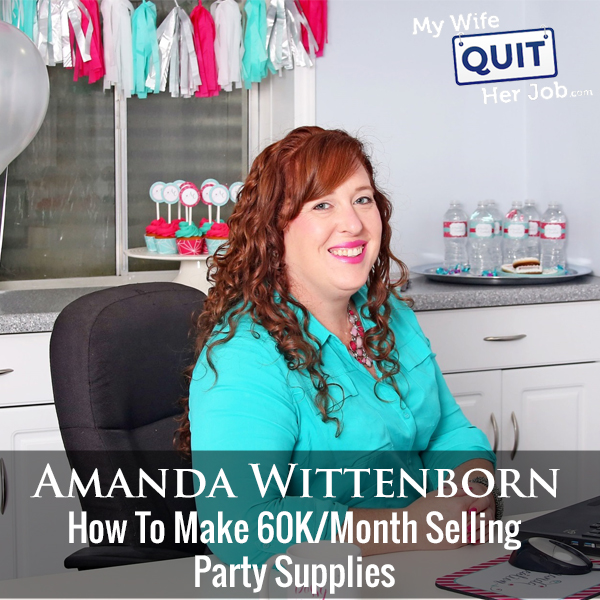
To sell party supplies on Amazon, design a product that Amazon can actually fulfill, list it merchant fulfilled to validate demand, then move the winners into FBA so they qualify for Prime shipping. Amanda Wittenborn of amandacreation.com does over $60,000 a month with this exact sequence, selling children’s birthday party invitations and matching decorations she designs herself.
Amanda joined me on the podcast after finishing as a finalist in the Five Minute Pitch, my Shark Tank style show. She is also a student in my Create A Profitable Online Store course, and she got there the hard way after Etsy shut down her store overnight and wiped out two and a half years of work.
Below is how she rebuilt on Amazon, why Prime shipping multiplied her sales by 10x, and what it costs her to test a new design.
Get My Free Mini Course On How To Start A Successful Ecommerce Store
If you are interested in starting an ecommerce business, I put together a comprehensive package of resources that will help you launch your own online store from complete scratch. Be sure to grab it before you leave!
Table of Contents
Key takeaways
- Amanda sells over $60,000 per month in birthday party invitations, decorations, and party supplies at amandacreation.com and on Amazon.
- Etsy banned her store over a Minecraft themed design she had written permission to make, erasing two and a half years of sales overnight.
- She could not sell personalized invitations on Amazon, so she invented fill-in style invitations that fit what the platform allowed.
- Switching from merchant fulfilled to FBA made her products Prime eligible and increased sales roughly 10x on the same designs.
- Her cost to test a brand new invitation design on Amazon is about $25, because her digital printer has no minimum order quantity.
- Her growth model is volume of designs: more themes means more sales, so she designs 20 to 50 new invitations in a burst every other month.
How Amanda Wittenborn started selling party supplies
Amanda started selling party supplies because she was already making them for free. She had been throwing elaborate themed birthday parties for her three sons for 13 years, back before Pinterest existed, and friends kept asking where she got the decorations.
Her first son’s first birthday was a monkey themed party where she hand stamped every invitation with scrapbook paper. Her husband built eight foot tall balloon palm tree sculptures for it.
Once she had a second child, hand making 30 invitations per party stopped being realistic. She started designing them digitally so she could print multiples, then extended the designs into water bottle wrappers, candy bar wrappers, banners, and posters.
Friends who came to the parties started recruiting her to make their party supplies too. One of them told her she should sell the designs.
Why Amanda’s Etsy store got banned and what it cost her
Amanda’s Etsy store was shut down permanently after she was flagged twice for Minecraft themed party supplies, even though she had written permission from the Minecraft company to make them.
Their only condition was that she avoid copyrighted images and terms, so she never used the word Minecraft, never named Creeper, and designed her own artwork from scratch. She got flagged anyway.
The first flag arrived two weeks after her third son was born. Exhausted with a newborn and knowing she had permission, she decided to handle it later.
A few days later she was flagged again, and that second strike closed the store. She contacted both Minecraft and Etsy and cleared the whole thing up, and Etsy still refused to reopen it.
Two and a half years of building products and sales disappeared overnight, right as the business had finally become profitable. This is the argument against depending on a single platform for all of your revenue, and Amanda lived it.
She cried for a couple of weeks, went back to digital scrapbooking, and then took a job designing party supplies for another company. That job reminded her she still loved the work.
How to sell personalized invitations on Amazon when the platform will not allow it
Amanda could not sell personalized invitations on Amazon, so she asked a different question: what product could she make that would work on Amazon? The answer was fill-in style invitations, where the buyer handwrites the party details onto a printed card.
She assumed nobody would buy them. Who wants to hand write all their party details in 2017?
She listed about 10 designs anyway with listings she describes as horribly written, and made her first sale two or three weeks later. That reframe is the whole lesson. Instead of forcing her existing product onto the channel, she designed a new product to fit the channel’s constraints.
Merchant fulfilled vs FBA for party supplies: what changed at 10x
Moving her invitations from merchant fulfilled to FBA increased sales roughly 10x, and Amanda now sells about ten Prime units for every one merchant fulfilled unit. The single variable that changed was Prime shipping eligibility.
Her merchant fulfilled fulfillment was genuinely clunky at the start. She printed the first order at Office Max, hand cut the invitations, bought envelopes at Michaels, and shipped a half assembled package to her first customer.
As orders grew she switched to Vistaprint white label shipping, placing each order manually so it arrived with no Vistaprint branding. Six months in, that process had become tedious.
| Fulfillment method | Handling time | Total delivery | Shipping cost | Relative sales |
|---|---|---|---|---|
| Merchant fulfilled | 3 to 4 days | 7 to 14 days | Buyer pays | 1x |
| FBA (Prime eligible) | Same day from Amazon | 1 to 2 days | Included with Prime | ~10x |
The math that pushed her to FBA was simple. If buyers were willing to wait 7 to 14 days and pay shipping on top of the price, what would happen when the product was in stock with Prime shipping?
She sent her first FBA shipment in January 2017 and the invitations started selling faster than she could have imagined. Her first FBA order was about $750.
Her customer is a mom who needs invitations fast, often because she forgot to order them or is throwing a party on short notice. Prime shipping is the entire value proposition for that buyer.
What it costs to test a new invitation design on Amazon
Testing a new invitation design on Amazon costs Amanda about $25, which is why she tests every single design she creates. Her pack cost is $2.80 for a pack of invitations, and she starts with five packs per design.
Her products are digitally printed, so her printer has no minimum order quantity per design. If she buys five packs each of 20 new designs, that is 100 units total, and the printer does not require 100 of the same design.
New designs always start merchant fulfilled while she waits for the first batch to print. Some sell before they ever reach the warehouse, which she treats as an early signal that the design is strong.
She uses two local printers, both about a half hour away, and everything is printed in the United States. She has not chased overseas printing because the domestic turnaround is fast and $2.80 a pack is already low.
How Amanda’s invitations stand out in a crowded Amazon category
Amanda’s invitations stand out on design, not on price or listing copy. She sells at a higher price point than most competitors in a category with heavy competition, and the listings still convert.
Her style is bright, colorful, bold fonts, bold colors, with every inch of the invitation packed with some kind of fun design element. She paid to have a listing professionally written and is not convinced it moved the needle much.
Her read is that when a shopper compares her unicorn invitation to someone else’s unicorn invitation, the higher price signals higher quality and the listing notes that the product is made in the United States. Bargain hunters go to the competitor, and she is fine with that.
Her launch process for new party supply designs
Amanda’s launch process is deliberately unfancy and fully delegated. She designs in bursts, sometimes 20 to 50 new invitations in a single week, roughly every other month when the creative bug hits.
Once the designs exist, she sends the files to a contractor who builds all the Amazon preview images from templates Amanda provided. A second contractor writes the listings from a template that shows her where to place keywords and descriptive text, then uploads them to Amazon.
She does not run ads right away. Campaigns start once a design is Prime eligible, and she does not jump start the review process at all.
How to handle Amazon listing hijackers and design knockoffs
Amanda handles hijackers with Amazon Brand Registry and handles knockoffs by ignoring them. Less than six months into selling on Amazon, someone jumped on one of her listings and printed her low resolution preview image as the actual product.
She found out from a one star review that said the item looked like a blurry pixelated copy. She got the seller removed, and Amazon refused to remove the review even though the purchase was not from her.
Rather than fight it, she closed that listing and opened a fresh one, which worked fine. That product sat in her basement for months while she solved the problem, so it is her favorite one to see sell now.
She is brand registered now, so nobody can hop onto her listings. What competitors can still do is copy the theme and colors and produce their own version, since changing 20% of the original artwork legally makes it a new design.
She ran the numbers on the copycats: similar sales, similar prices, similar revenue, and she is doing five times less work than they are. That is why she lets it go.
Growing a party supply business by adding more designs
Amanda grew from her first Amazon sale to over $60,000 a month almost entirely by adding more designs. Her early logic was arithmetic: if 200 designs produce a thousand dollars a month, then 400 designs should produce double, and 800 should double again.
She has an endless list of birthday party theme ideas and cannot keep up with them. The wide variety of themes is what drives discovery, because a parent searching for a specific theme finds her version of it.
Once an invitation proves itself, she adds matching products to it. Thank you cards, stickers, banners, and other coordinating items attach to the top selling designs rather than being launched blind.
How Amanda’s husband fixed the inventory problem
More SKUs made inventory harder, and Amanda solved it by bringing her husband in to run it in January 2018. She was reordering weekly and constantly running out of stock.
He described the pattern as ramp up, sell out, have nothing, ramp up, sell out, have nothing. Once he started keeping products consistently in stock, sales increased significantly.
He is the analytical one who likes spreadsheets and data, so he owns what to order and how much. He quit his job at the end of July 2018 to work in the business full time.
Why Amanda’s husband quit his job
Her husband quit because the business had passed his salary and family time was already their stated priority. Amanda would wake up some mornings having already sold more than he earned in a week.
He kept producing lists of milestones to hit first: pay this off, do this, get a new car, then I will quit. Amanda kept completing the lists and he kept writing new ones.
Around list number four she snapped a little and said something like “you’re never going to quit,” maybe daring him slightly. He walked into work the next morning and quit out of the blue.
They factored the cost of health insurance into the revenue target they needed before he left, so the coverage was covered. She puts it on autopay and tries not to think about the price.
Building an off-Amazon party supplies website
Amanda’s own site at amandacreation.com targets a different customer than Amazon does: the prepared parent shopping months in advance who wants everything personalized and printed, rather than fill-in. That is the exact product Amazon would not let her sell.
She runs WordPress with a WooCommerce shopping cart, chosen on her web designer’s recommendation when she migrated off Zen Cart. Hosting plus a few plugins costs her under $300 a year.
The site now has a customization feature where the customer types their party details directly onto the invitation. That produces a print ready file that goes to the printer and ships to the buyer.
Her first traffic strategy is rebuilding the email list she started years ago, cleaning it so only people who want the emails receive them. Facebook posting comes next, and she describes the whole effort as starting from scratch.
Custom orders from the website are fulfilled in house by a trained team member who uploads print ready files to the printer. Ready-to-go items sell through an FBA plugin that connects her Amazon inventory to the site.
Yes, she is aware the Etsy shutdown could happen again on Amazon. Nothing serious has gone wrong yet, beyond one sticker getting miscategorized as a jewelry product and briefly restricted, and the risk stays in the back of her mind.
What party in a box is and what it costs to launch
Party in a box is a complete coordinated birthday party kit: about 11 products including invitations, decorations, stickers, a banner, plates, cups, napkins, water bottle wrappers, and thank you cards. The box itself matches the party theme so it doubles as a centerpiece or gift box, and the tissue paper inside matches too.
Amanda had the idea five years before she executed it. She ordered paper plates and cups and they sat in her basement for a year because she had no idea how to make it happen.
She talked about the idea in a book club discussion about dreams beyond your means, and asked the universe for the means to make it happen. Two nights in a row.
On the third morning she woke up to an email announcing the Five Minute Pitch and its $50,000 prize. Her first reaction was that it was far outside her comfort zone, and she closed the email.
Then she entered anyway, and the contest became the deadline that forced party in a box into existence. She launched the first five boxes four days before the Five Minute Pitch finale.
The manufacturing costs of party in a box
Amanda originally estimated $9,000 to $10,000 to launch a single party in a box design, and she has since reduced that to roughly $2,500 to $3,000. That difference is what turned the idea from a pie in the sky dream into something she can repeat.
She found a plate and cup manufacturer at a good price with low minimum order quantities. Her existing printer handles most of the other items.
Napkins remain difficult because the minimum order quantity is still high. Banners were the other pain point, so for the first run of 20 boxes she printed, hand cut, and hole punched every banner herself.
How much money you need to start selling party supplies on Amazon
Amanda risked essentially nothing to start. Her first FBA inventory order was about $750, she spent zero on marketing for the first five or six months, and she got her Amazon monthly seller fee waived because she was accepted into Handmade at Amazon first.
Once she finally sat down to do it, getting listings live took her a single weekend and a couple of hours of actual setup work. She had thought about it for two years before trying, and it turned out far less complex than she had built it up to be.
Her PPC approach was equally unsophisticated. She threw everything into a single automatic campaign and let it run, landing an ACoS around 12%.
Amanda’s advice for people on the fence about starting
Start now and pick something with meaning to you. Amanda’s first point is that you can think an idea to death, and the way she runs the business today looks nothing like how she started, which she only learned by starting.
Her second point is that the meaning behind the product is what carries you through the rough stretches. There will be late nights and stressful weeks, and loving what you sell is what makes those worth it.
You can find Amanda’s invitations at amandacreation.com, on Amazon by searching Amanda Creation invitations, and on Facebook, Instagram, and Pinterest as Amanda Creation.
Frequently asked questions
How much does Amanda Wittenborn make selling party supplies?
Amanda Wittenborn makes over $60,000 per month selling birthday party invitations, decorations, and party supplies at amandacreation.com and on Amazon. At the time of the interview she expected to reach seven figures in annual revenue by the end of the year.
Is selling party supplies on Amazon profitable?
It can be. Amanda’s cost is about $2.80 for a pack of digitally printed invitations, she sells at a higher price point than most competitors, and her advertising ACoS runs around 12%. The margins work because the product is lightweight, cheap to print domestically, and has no minimum order quantity.
What are fill-in invitations and why do they sell on Amazon?
Fill-in invitations are printed party invitations where the buyer handwrites the date, time, and location by hand. They sell on Amazon because they are a stock product that can be inventoried and shipped through FBA, unlike personalized invitations that require a custom print run per order.
Does Prime shipping increase Amazon sales?
For Amanda’s invitations, Prime eligibility increased sales roughly 10x. She sells about ten Prime units for every one merchant fulfilled unit, because her buyers are parents who need party invitations quickly.
How do you protect party supply designs from being copied on Amazon?
Amazon Brand Registry stops other sellers from listing on your existing listings, which is the fix for hijackers. It does not stop competitors from producing their own version of a theme, since changing roughly 20% of artwork makes it a legally new design.
Why did Etsy ban Amanda Creation?
Etsy shut down Amanda’s store after two copyright flags on her Minecraft themed party supplies, even though she had written permission from the Minecraft company and had avoided all copyrighted images and terms. Etsy refused to reinstate the store after the flags were resolved.
How much money do you need to start selling on Amazon?
Amanda started with about $750 for her first FBA inventory order and spent nothing on marketing for the first five or six months. Her ongoing cost to test a brand new design is roughly $25.
What is party in a box?
Party in a box is Amanda’s complete birthday party kit containing about 11 coordinated products, including invitations, plates, cups, napkins, stickers, a banner, water bottle wrappers, and thank you cards, packaged in a themed box that doubles as a centerpiece. Launching a new design costs her about $2,500 to $3,000.