
Podcast: Download (Duration: 48:37 — 55.9MB)
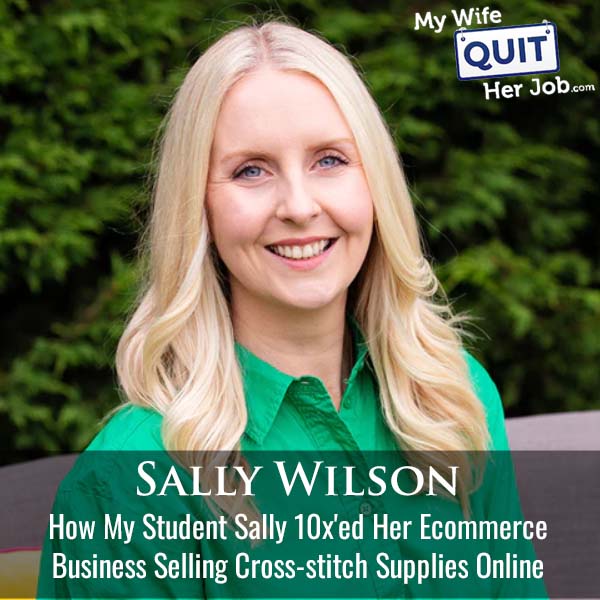
To scale an ecommerce business from six to seven figures, own a community your customers cannot get anywhere else, layer in a weekly YouTube channel, add a subscription box for recurring revenue, and run a serious email flow with a well-tested welcome series. That is exactly what my student Sally Wilson did to grow Caterpillar Cross Stitch (caterpillarcrossstitch.com) to seven figures in annual revenue, a 10X leap from where she was four years ago.
On this episode of the My Wife Quit Her Job podcast, Sally walked me through what changed in her business between six figures and seven, what she would double down on if she were starting over today, and the mindset shifts that were harder than the tactics.
Below is the full playbook: how she built a 20,000-member Facebook community, why her YouTube channel took two to three years to bear fruit, the subscription-box economics, and the exact email flow that keeps her open rate at 40%.
Get My Free Mini Course On How To Start A Successful Ecommerce Store
If you are interested in starting an ecommerce business, I put together a comprehensive package of resources that will help you launch your own online store from complete scratch. Be sure to grab it before you leave!
Table of Contents
Key takeaways
- Sally’s business grew 10X (six to seven figures) in four years, driven mostly by a niche Facebook group (now ~20,000 members) and a weekly YouTube channel.
- The Facebook group returned a 76% customer retention rate after the pandemic bump, keeping most 2020 first-time buyers active in 2021 and beyond.
- YouTube took 2 to 3 years to produce measurable revenue but is now her #2 traffic driver and email-sub source.
- Her subscription box (started 2021) runs every 2 months at ~25 GBP, is designed to feel like ~35 GBP of value, and includes 3 items from partner small businesses in every box.
- Amazon is only ~5% of revenue; 95% is direct via Shopify. She uses another student’s US warehouse to prep Amazon FBA inventory.
- Her 8-email welcome series drives a 40% open rate, roughly double the ecommerce average.
- Going from 4-5 employees to 14 was harder than the revenue milestone itself. Mindset, systems, and forward planning are the real seven-figure bottleneck.
How Sally Wilson grew Caterpillar Cross Stitch from six to seven figures
Sally grew Caterpillar Cross Stitch from six to seven figures over four years by treating community as her primary product and physical kits as the follow-on. She started the business in 2015 after taking my Create A Profitable Online Store course during maternity leave, hit six figures in 2019, quadrupled revenue during the 2020 lockdown, and kept 76% of those pandemic buyers active in 2021 by pouring effort into her Facebook group, YouTube channel, and email list.
The specific mix that produced the 10X leap:
- Facebook group (~20,000 members, 6 moderators, high daily engagement)
- Weekly YouTube channel (Mondays at 7pm UK, hosted by 3 people including Sally)
- Bi-monthly subscription box (Box 18 shipped Feb 2024, ~25 GBP each)
- Shopify DTC store (~95% of revenue)
- Amazon US and UK (~5% combined)
- Email marketing with an 8-email welcome flow (~40% open rate)
- In-person and virtual “Stitching Social” events, plus a first-ever retreat in Birmingham with 300 tickets
The one factor she named as the single most important accelerator was the Facebook group, both for community engagement and for real-time customer research on what products to launch next.
How to build a Facebook group that drives ecommerce revenue
To build a Facebook group that drives ecommerce revenue, pick a niche that has few real-world outlets (so people need an online home for it), collaborate with existing larger groups to seed your first 1,000 members, and post consistently through the boring early months when only two people are engaging.
Sally’s group grew because cross-stitch is a solitary hobby with a devoted audience and few in-person meetups. Most cross-stitchers do not know three other cross-stitchers in real life, so a well-moderated online group becomes the community they otherwise cannot find. The same dynamic works for any narrow hobby, professional specialty, or unusual interest.
Her seeding moves in the first year:
- Joined 10+ existing cross-stitch Facebook groups and studied engagement patterns.
- Collaborated with “Happiness Is Homemade” on a Stitch-Along project that cross-promoted her group to their members.
- Posted free cross-stitch patterns, giveaways, and downloadable ebooks in exchange for email opt-ins.
- Went live regularly, even to small audiences.
- Encouraged and posted funny in-jokes (“thread chicken”, “27 projects at once”) that made the group feel like home.
Moderation matters as much as content. Her group has 6 moderators and strict rules against negativity, which she credits for keeping the space useful for members dealing with mental health issues or illness who stitch as an escape.
How long does a YouTube channel take to grow an ecommerce business?
A YouTube channel typically takes 2 to 3 years of consistent weekly posting to become a measurable revenue driver for an ecommerce brand. Sally’s channel produced almost no visible impact for the first 18 months, then quietly compounded into her #2 traffic source and #2 email-sub source behind her Facebook group.
Her production system is deliberate and lean:
- One video per week (Mondays at 7pm UK time, evergreen and live).
- Three rotating hosts (Sally + 2 freelancers), which prevents burnout and gives the channel variety.
- A dedicated editor in the Philippines who receives 4 videos at a time and knows the format cold.
- Every video has a scripted CTA to subscribe, join the Facebook group, and grab the email freebie (10% off + free 8-pattern ebook).
The email-capture design is what turns YouTube views into recurring revenue. Sally does not treat YouTube ad revenue as the goal. She treats each video as a top-of-funnel machine that feeds the email list, which then converts to Shopify orders on launches.
How Caterpillar Cross Stitch’s subscription box works
The Caterpillar Cross Stitch subscription box ships every 2 months at 25 GBP, contains one themed cross-stitch kit plus 3 curated items from partner small businesses, and is designed to feel like ~35 GBP of value. It launched in 2021 as recurring revenue with a fun creative twist and is now on Box 18.
The mechanics that make it work:
- Community-voted themes. Members pick the box themes (Easter Eggs, Woodland Animals, Halloween, Mythical, Christmas, Pets, Sewing, Lighthouses, Seaside). Voting doubles as customer research and pre-launch excitement.
- Guest designers. Sally licenses the box’s cross-stitch design from another artist for 1 to 2 years, exposing subscribers to designers they may buy from later.
- Partner small businesses. Each box includes 3 curated items (hot chocolate, washi tape, ribbons) from small brands Sally sources, which builds goodwill and cross-promotion.
- Subscription-only availability. Boxes are not resold later, which drives conversion at each cutoff date and makes the subscription feel exclusive.
- Live launch pressure. Sally goes live on Facebook the day of each subscription cutoff to push undecided buyers over the line.
The box is profitable and growing, but it is not her biggest revenue line. It is a fun operational and community anchor that helps retain subscribers and gives her platform to test new designers.
What email flow drives a 40% open rate for a seven-figure ecommerce store
The email flow driving Caterpillar Cross Stitch’s ~40% open rate is an 8-email welcome series triggered by the newsletter opt-in, followed by post-purchase and abandoned-cart flows, all segmented by customer behavior. The 40% rate is roughly double the ecommerce industry average of ~20-22%.
Sally’s specific structure:
- Welcome series: 8 emails, spaced and sequenced based on open and click data. Every subject line and button color is A/B tested.
- Opt-in bribe: 10% off + free 8-pattern PDF ebook, matched to the audience’s actual intent (they came for cross-stitch, they get cross-stitch).
- Post-purchase flow: Educational how-to content plus community invites (Facebook group, YouTube subscribe).
- Abandoned cart: Standard flow with segmentation by cart value.
- Broadcast cadence: Regular but not spammy. New product launches, box themes, live-event invites.
She also runs Facebook ads specifically to the email list opt-in, treating the list as a paid-acquisition asset because the LTV of an email subscriber in her niche is large enough to justify the CPL.
Why the hardest part of scaling to seven figures is mindset, not tactics
The hardest part of scaling to seven figures is not the tactics, it is the mindset and system shift required to go from “solo founder or 4-person team” to “14+ employees, planned quarters, and forward inventory commitments.” Sally described it as the single biggest challenge in the jump from six to seven.
Specifically:
- Loss of nimbleness. At 5 employees, she could act on any idea within a week. At 14, the whole of 2024 is planned in advance, and spontaneous ideas have to be triaged against existing commitments.
- Imposter syndrome. Seven figures brings a “is this actually happening?” period that most founders underestimate.
- Staff management. Absences, sickness, holidays, recruitment, and training become a recurring management workload she did not have at smaller scale.
- Inventory planning. Shipping thousands of units means you cannot “just pull an all-nighter.” Stock decisions have to be right months in advance.
- Bigger rewards, bigger problems. The financial upside scales up, and so does the downside of any single mistake.
Sally still runs her own fulfillment. Most of her 14-person team is in production (assembling needle-minders, cutting fabric, running 3 thread-winding machines that dispense custom color and length), with smaller pods for fulfillment, customer service, marketing, and social.
Should you use Amazon FBA or your own Shopify store for ecommerce?
You should treat Amazon as a channel, not your primary storefront, unless your business model is explicitly Amazon-first. For Caterpillar Cross Stitch, Amazon is roughly 5% of revenue and Shopify is 95%, and the split has held steady even as Amazon has grown, because the community and email flywheel keep pulling customers back to the DTC store.
Sally’s Amazon setup is worth copying:
- Ship Amazon-bound inventory (needle-minders, small accessories at the ~10-15 GBP price point) to another course student’s US warehouse.
- Her partner’s team preps the shipment and forwards it to the nearest Amazon FBA fulfillment center.
- Sally never touches US Amazon fulfillment operationally.
- She focuses Amazon on gift-friendly, low-return items where the FBA price point is right, not her hero SKUs.
The takeaway: Amazon is best used surgically for specific SKUs where the unit economics work, while the community-driven DTC store carries the brand and captures the LTV.
How to run your first ecommerce in-person retreat or event
To run your first ecommerce in-person retreat, pick a central location, cap ticket count at what you can actually deliver (Sally sold 300 tickets for the inaugural Caterpillar Stitch Retreat in Birmingham), offer clear standard-vs-VIP tiers, add workshops and merch as revenue extenders, and let the community drive word-of-mouth.
Sally’s retreat evolved from smaller “Stitching Social” events she ran in-person in 2019, moved online during the pandemic (18 events per year, 15 people each, hosts in multiple time zones), and is now expanding back into a bigger in-person format. Every step was validated by the community first.
Events are rarely the biggest revenue line for an ecommerce business, but they compound goodwill in ways ads cannot. Attendees become superfans, tell friends, and post about the experience for months afterward.
Frequently asked questions
How long does it take to grow an ecommerce store from six to seven figures?
It typically takes 3 to 5 years to grow a niche ecommerce store from six to seven figures, though a lockdown-scale demand event can compress the timeline. Sally hit six figures in her fourth year (2019) and seven figures in her eighth year (2023).
What is the biggest driver of ecommerce revenue growth?
For most niche ecommerce brands, the biggest driver is a community + email list + weekly content channel combination, not paid ads alone. Sally’s Facebook group of ~20,000 members and her weekly YouTube channel together outperform every paid channel in her mix.
Is a subscription box worth adding to an ecommerce store?
A subscription box is worth adding when you have a strong community that will vote on themes, when you can source or design new content every cycle without burning out, and when the box gives customers a reason to stay engaged between larger purchases. It is meaningful recurring revenue but rarely the biggest revenue line.
How long does a YouTube channel take to grow an ecommerce brand?
Most ecommerce YouTube channels take 2 to 3 years of consistent weekly posting to become a measurable traffic and revenue driver. Sally’s channel produced almost no visible impact in year one, then compounded into her #2 traffic source.
Should ecommerce stores focus on Amazon or their own website?
Most ecommerce stores should treat Amazon as one channel and their own website as the primary brand. Sally’s ~5% Amazon vs. ~95% Shopify split is common for community-driven niche brands, because owning the customer relationship compounds LTV over time.
What is a good email open rate for an ecommerce business?
The ecommerce industry average email open rate is roughly 20-22%. Sally’s Caterpillar Cross Stitch newsletter runs closer to 40%, driven by a tightly opt-ed niche list, a well-tested 8-email welcome series, and consistent value in every send.
Do you need a Facebook group to grow an ecommerce brand?
You do not strictly need a Facebook group, but for niche hobby or interest categories, a well-moderated group is one of the highest-leverage community formats available. It gives customers a reason to return between purchases and gives the brand real-time product research.
How many employees does a seven-figure ecommerce business need?
Sally’s seven-figure store runs with 14 employees, most in production (custom kit assembly, thread cutting, packaging). A drop-shipped or manufacturer-fulfilled business at the same revenue level would need far fewer people, typically 3 to 6.