
Podcast: Download (Duration: 50:49 — 58.4MB)
The best way to find a profitable niche is to find a tribe you can serve rather than a gadget you can sell. Jason Hsieh built Lakikid to $600,000 a year selling sensory toys for children with autism and ADHD without ever using Jungle Scout or Helium 10. His product research method is calling customers on the phone for 30 minutes a week and listening.
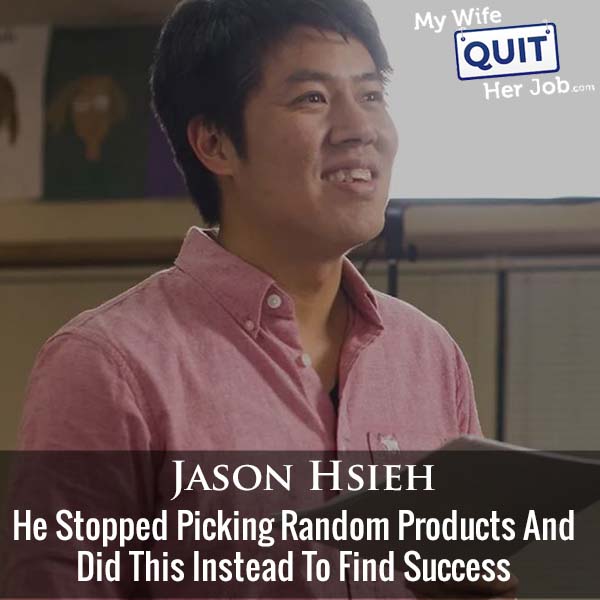
In this episode I sat down with Jason Hsieh, a student in my Create A Profitable Online Store course, who started his business after his son was diagnosed with autism and ADHD and he could not find affordable, quality sensory products made by anyone who actually used them.
Below is the full breakdown: how he researches products by talking to customers, the free-plus-shipping funnel converting at a $25 average order value, the 14-email Amazon launch sequence, how he recovered from nearly going bankrupt in 2020, and why passion is a genuine competitive moat.
Get My Free Mini Course On How To Start A Successful Ecommerce Store
If you are interested in starting an ecommerce business, I put together a comprehensive package of resources that will help you launch your own online store from complete scratch. Be sure to grab it before you leave!
Table of Contents
Key takeaways
- Call customers weekly for 30 minutes. This produces better product ideas than any research tool.
- If you follow the herd, you get slaughtered. Everyone using Jungle Scout sees identical data.
- Passion is the one thing competitors cannot copy. They can copy every product and every strategy.
- Free-plus-shipping funnel at $6.97 converts to a $25 average order value. Digital upsells take 20% at 100% margin.
- Launch on Amazon with 14 emails and no keyword tricks. External traffic is treated differently by the algorithm.
- 2020 nearly ended the business. Schools closed, $200K in debt, and laying off the entire team.
- Traction (EOS) rebuilt the company. Six months studying and implementing it.
- ClickFunnels for direct response, Shopify for brand. Two platforms with distinct jobs.
How to find a profitable niche without research tools
Find a tribe to serve rather than a product to sell. Jason’s framing: everyone teaching product research tells you to find the next gadget that makes money, and the better question is which group of people you can genuinely help.
His own niche came from personal necessity. His son was diagnosed with autism and ADHD while the family lived in Tokyo, where stigma around disability meant they could find only two therapy centers in a city of 14 million people. After moving to the US, he connected with parents, therapists, and teachers, and found the gap: affordable, high-quality sensory products created by someone who actually uses them.
Check the competition in your category. Search any of his competitors and the CEO is frequently a single man with no children, which tells you they are in it purely for the money.
Why talking to customers beats Jungle Scout
Call your customers on the phone for 30 minutes and ask what they struggle with, what products they have tried, what they liked, and what they did not. Jason does this weekly and gets more product ideas than any tool produces.
His argument against research tools: every seller using Jungle Scout or Helium 10 is looking at identical data, which means you all arrive at the same products. As he puts it, if you follow the herd, you get slaughtered.
My own view is that you can go broad and win on marketing execution, or go extremely narrow and dominate a small market. The middle is where it gets difficult.
Why passion is a real competitive moat
Passion is the one asset competitors cannot replicate. Jason openly shares his entire strategy because anyone can copy his products and his tactics, and nobody can copy why he does it.
The community reinforces this. He runs a parent support group where families share their experiences, which is not something a competitor can spin up by launching a similar product.
His stated goal is changing a million lives over ten years for families affected by learning disabilities, using the business as the vehicle. That framing shows up in the About page, which is a genuine reason to buy from him rather than an anonymous seller.
Worth noting the honest counterpoint: I am not passionate about handkerchiefs, and I am passionate about the business itself. Either can work. Having both compounds.
The free-plus-shipping funnel that generates free leads
The free-plus-shipping funnel offers a product for $6.97 shipping only, then uses upsells to reach a $25 average order value, which makes lead generation self-funding.
The economics: the product costs under $2, shipping is a few dollars more, so the front end roughly breaks even. Profit comes from what follows.
The highest-performing upsell is digital. An ebook bundle at $10 takes 20% of buyers at 100% margin, which means $10 of pure profit on a fifth of all funnel entries. The bundle covers behavior management strategies, which is exactly what his audience wants.
Physical upsells work too, with a three-pack bundle priced as the best value being the most common purchase.
Jason runs roughly 20 funnels, all collected on a single “funnel hub” domain so they can actually be found, a concept he credits to Russell Brunson.
Why use ClickFunnels alongside Shopify
Use ClickFunnels for direct response and Shopify for brand, because they do different jobs.
A website gives visitors a hundred possible actions: top menu, bottom menu, links everywhere. A funnel gives one: buy or do not buy.
Jason’s split is that all paid direct-response traffic goes to ClickFunnels, and Shopify serves as the branding site. ClickFunnels also handles his digital products and membership natively, with unlimited upsells and downsells built in.
You can replicate much of this in Shopify by stripping headers and footers. The argument for ClickFunnels is ease of use rather than capability.
The 14-email Amazon launch sequence
Launch Amazon products with an early-bird signup page, then send 14 emails during launch week driving to the listing with a pre-applied coupon.
The mechanics: build a dedicated early-bird email list before launch, generate anticipation, then send heavily during the launch week. Each email links to the Amazon listing with a coupon embedded so buyers click one button rather than entering a code.
This is purely a sales velocity play with no keyword manipulation. Amazon treats external traffic differently from internal activity, so a burst of outside buyers produces organic ranking without any of the search-find-buy tactics that now violate terms of service.
Jason has 35,000 email subscribers, which is what makes this viable, and email drives 20-25% of his Shopify revenue.
How the business nearly died in 2020
2020 nearly ended Lakikid. Most customers were schools, every school closed simultaneously, and Jason was carrying $200,000 in debt including a loan against his house that he had not fully disclosed to his wife.
The recovery was brutal simplification: lay off every team member, cancel nearly every software subscription, and run as lean as possible.
Two things brought it back. An SBA EIDL loan of $400,000 restored the cash flow needed to buy inventory, which had been the binding constraint. And six months studying and implementing Traction by Gino Wickman rebuilt how the company operates.
The inventory problem is worth understanding on its own. Limited cash meant buying too little, selling out in a month, waiting two to three months for the next container from China, and losing all Amazon ranking in the gap. That cycle repeated multiple times.
His retrospective view is that he is grateful for it, because it forced a reset that produced $600,000 in 2021 and a $1.2 million projection for the following year.
Why the casino analogy matters for Amazon sellers
Jason’s framing: Amazon is a casino, and your listing is a slot machine printing money. Amazon can remove you from the casino at any time.
He has had listings shut down, including his best-selling product. Combined with the ranking loss from stockouts, that is enough to make platform dependence genuinely dangerous.
His diversification target is moving from 80% Amazon to a 50/50 split between Amazon and his own channels, driven by email marketing and the funnel infrastructure.
How to build an email list in a niche community
Two front-end mechanisms feed the list: a free ebook download and the free-plus-shipping funnel, both driven by Facebook ads.
The back end is standard sequence work (welcome, abandoned cart, weekly newsletter) plus something less common: personal emails about what is happening in his own life, which builds the relationship that a purely promotional list cannot.
Content strategy centers on a weekly Facebook live interview show, typically with occupational therapists, teachers, and other experts serving the same community. That pillar content gets repurposed across Instagram, YouTube, and TikTok, which is the Gary Vaynerchuk model at smaller scale.
Frequently asked questions
How do you find a profitable niche without research tools?
Find a tribe you can serve rather than a product you can sell. Call customers for 30 minutes and ask what they struggle with, what they have tried, and what did not work. Everyone using Jungle Scout sees identical data, which means they arrive at identical products.
Does passion actually matter in ecommerce?
It functions as a competitive moat, since competitors can copy every product and every tactic and cannot copy why you do it. It also enables genuine community building. That said, being passionate about the business itself rather than the product also works.
How does a free plus shipping funnel work?
Offer a product for shipping cost only (around $6.97 on a sub-$2 product), which roughly breaks even, then profit through upsells. Digital upsells perform best: an ebook bundle at $10 taking 20% of buyers at 100% margin. Average order value reaches around $25.
Should you use ClickFunnels or Shopify?
Both, for different jobs. ClickFunnels handles paid direct-response traffic where you want a single call to action, plus digital products and memberships. Shopify serves as the branding site. Much of this is replicable in Shopify, and ClickFunnels is easier.
How do you launch a product on Amazon with an email list?
Build an early-bird signup list before launch, then send roughly 14 emails during launch week linking to the Amazon listing with a pre-applied coupon. This is a pure sales velocity play. Amazon treats external traffic differently, so organic ranking follows without keyword manipulation.
What happens when you run out of stock on Amazon?
You lose your ranking and have to rebuild from scratch. With limited cash you buy too little inventory, sell out in a month, then wait two to three months for the next container. That cycle repeating is one of the most damaging patterns for an undercapitalized Amazon seller.
How much does it cost to start a private label business?
Jason invested about $30,000 in Lakikid, covering inventory, shipping, marketing, and website development. He funded it through a year of retail arbitrage, buying used textbooks from thrift stores and reselling them on Amazon and eBay.