
Podcast: Download (Duration: 49:52 — 57.4MB)
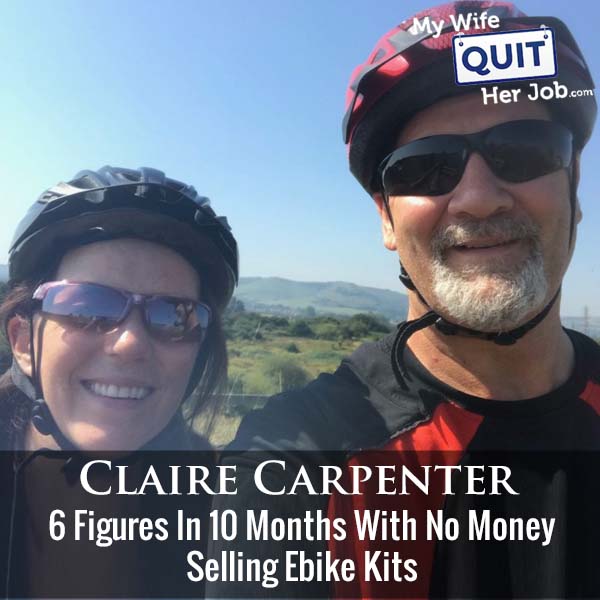
Starting an ecommerce business with no money works by preselling: build a simple site, run ads, take orders with an honest lead time, then use that revenue to place your first inventory order. Claire Carpenter did exactly this with e-bike conversion kits and reached six figures in 10 months, approaching half a million by the time we spoke.
In this episode I sat down with Claire Carpenter, a student in my Create A Profitable Online Store course, who launched while facing the loss of most of her household income during the pandemic.
Below is the whole story: how she found the product, how she sold kits she had never touched, the disastrous first shipment, and what she would do differently.
Get My Free Mini Course On How To Start A Successful Ecommerce Store
If you are interested in starting an ecommerce business, I put together a comprehensive package of resources that will help you launch your own online store from complete scratch. Be sure to grab it before you leave!
Table of Contents
Key takeaways
- She took orders before owning any inventory, with an honest eight-week lead time.
- Google Ads converted immediately. Three or four calls arrived within 20 minutes of switching them on.
- Her product violated nearly every beginner guideline and worked anyway.
- Phone support was the entire differentiator. Competitors had good sites and terrible service.
- She gave early buyers a large discount in exchange for taking a leap of faith.
- She sold a product she had never seen, which she does not recommend.
- Roughly 5% of units have a fault, handled through the manufacturer’s one-year warranty.
- Set artificial deadlines. Ten emails in half a day beats endlessly refining them.
Why she started with no runway
Claire launched because her household was facing a near-total loss of income within two to three months.
She works as a speechwriter, roughly two-thirds employed and one-third freelance. When the UK locked down in March 2020, the freelance income vanished immediately, and her employed work depended on the live events industry that no longer existed.
Her partner Clive is a mortgage advisor paid entirely on commission, in arrears by about three months. The housing market froze, which meant his income would disappear on a delay they could see coming.
They had no savings. What they had was a few months of income and a visible cliff edge.
The situation was worse than an ordinary job loss, since the entire economy was shutting down and finding replacement work was not realistic.
Buying the course was itself a risk. Spending part of a shrinking runway on training when it might not work is a genuinely hard decision.
What she sells and why it broke the rules
Claire sells kits that convert an ordinary bicycle into an electric bike: a motorized wheel, a battery, and a handlebar controller.
The product violates most of what I teach beginners. It is well over $200, far larger than a shoebox, and electronic, which means parts fail, technology dates, and support is demanding.
Those are guidelines rather than laws. They exist to reduce what can go wrong for a first-time seller, and a genuinely good product opportunity outranks them.
How she found the product
She gave herself one month, paid for a single month of Jungle Scout, and worked the process until something surfaced.
The constraint was deliberate. A hard deadline forces a decision, and without one the search continues indefinitely.
She explored categories she was personally interested in, including fitness, nutrition, and cooking, on the theory that interest makes selling easier.
The search was constant rather than scheduled. She and Clive discussed products at every meal, to the point of driving their children mad.
She had not known the e-bike kit category existed when she started. She recognized it the second she saw it.
How to evaluate competitors before committing
Claire studied UK competitors and found her opening in their reviews rather than their products.
Most competing kits were genuinely complicated, with roughly twenty parts and wires everywhere. One competitor had a streamlined kit similar to hers.
That competitor looked strong on the surface. Slick site, repeated national media coverage, all the signals of a serious business.
Their reviews told a different story. Customers described appalling customer service, unanswered phones, and unanswered emails.
That gap became the entire positioning. Clive’s view was that being unreachable is the standard failure of online businesses, so they put their phone number across the site and actually answer it.
The result shows up in the outcome. Of roughly 140 reviews, many specifically praise the customer service and name Claire and Clive personally.
How to presell a product you do not own
Build a simple site, switch on ads, and take orders with a clearly stated lead time.
Claire had a basic WooCommerce site built by a freelancer she had used before, wrote a couple of Google Ads, and turned them on with no real expectation.
Three or four phone calls arrived within 20 minutes. She switched the ads back off immediately because they were not ready to answer questions.
What they did next is the actual work. Clive spoke with the manufacturer constantly, day after day, until he understood the product well enough to answer any question a customer might ask.
Honesty about timing was non-negotiable. Every early customer was told upfront that the kit would take eight weeks.
Compensation for the risk came as a discount. New customers had no reviews to rely on and a two-month wait, so Klaviyo delivered £100 off as the first email after signup.
Nobody ever directly asked Claire whether she had used the product herself, which she says she would have found very difficult since she would not have lied.
How they got their first inventory order funded
The first order was 20 kits, funded by combining preorder revenue with a UK government pandemic loan.
Preorders alone were not enough. Three orders on a good day is roughly $2,000, which does not meet a manufacturer’s minimum.
The gap was covered by the UK Bounce Back Loan, which was government-backed and therefore skipped the usual requirements of two to three years trading history and published accounts. Claire qualified because her freelance speechwriting was already a limited company.
The order was placed without ever seeing the product, without third-party quality control, and without product insurance.
The first shipment disaster
Nearly everything went wrong with the first 20 kits, and the product turned out to be fine.
The shipment was delayed repeatedly until it landed in the middle of the family’s first holiday in years. They arranged redelivery to a third-party fulfillment centre, and UPS applied the new labels incorrectly, half-covering the originals.
Half the kits bounced between UPS and their empty home address. Those never arrived at all, and the manufacturer eventually absorbed the cost.
The half that reached the warehouse produced the worst moment. They had one shipped to their holiday location, installed it on a hired bike, and it did not work properly. It rubbed, made a high-pitched noise, and the power did not engage correctly.
Claire describes lying awake that night having already taken two months of orders, with customer money committed to buying more of a product they now believed was broken.
They installed the same kit on their own bike after the holiday and it worked perfectly. The rickety hired bike appears to have been the problem.
All 20 units were fine. Customers began calling to say the kits were fantastic, and reviews started arriving.
The customers whose kits vanished waited roughly three more weeks. Claire phoned every one of them personally to explain, and most were understanding even though nobody enjoyed it.
How they handle installation support
They recorded Clive installing a kit while narrating, and now send that step-by-step video to every customer.
The kit was chosen partly because it is among the easiest on the market to install, and some people still need help.
If a kit genuinely does not fit someone’s bike, they collect it and issue a full refund.
Returns are cheaper than expected. Their third-party fulfillment centre gets courier rates good enough that collecting a kit costs around £10, which nearly justifies using them on shipping savings alone.
How they handle faults and warranties
Roughly 5% of units have a fault, covered by the manufacturer’s one-year warranty.
The manufacturer honours it reliably, either adding extra units to the next order or reducing the price accordingly.
Clive’s engineering background changed what is possible. He now repairs motors directly, collecting a wheel from a customer and replacing the rotor rather than waiting for the next shipment.
Claire is direct that without that background between them, they could not run this business.
How they found a third-party fulfillment centre
Clive googled third-party fulfillment and phoned about a dozen of them.
Claire had intended to research it properly using the course material. She left to do something else and came back to find he had already picked one.
The one he found is half an hour away, cheap, and run by a bike enthusiast, which turned out to matter because they need slight modifications made to the kits.
How they fund inventory now
They use Clearbank revenue-based financing, which connects to the store’s backend and lends against actual sales.
The advantage is that it ignores trading history, personal credit, and published accounts entirely.
Repayment scales with revenue. On a day with no sales, nothing is repaid.
It is expensive money, and it moved lead times from two months down to roughly three or four weeks.
The remaining constraint is capital for inventory. That is the single thing limiting growth, which is why Claire says the one change she would make is having the funds to buy stock upfront.
What she would do differently
Beyond capital, Claire would not skip insurance and quality control again.
Her honest framing is that it worked out and she is not sure the stress was worth it. She and Clive have different risk tolerances, and hers is considerably more cautious.
Both omissions were purely financial. With money, they would have done both.
What was actually hardest
Getting customers was not the problem, since Google Ads handled it. The technical setup was.
Connecting Klaviyo or installing a review platform are half-hour tasks for most people and took Claire three or four days each.
Outsourcing helped and did not eliminate it, since some things only you can do.
Writing was straightforward, since she writes for a living. The email sequences went fine.
Her method for preventing perfectionism was artificial deadlines. She gave herself half a day to write ten emails, because without a limit she would spend forever refining copy or hunting for a better image to gain maybe 5%.
That mattered given the real deadline behind it.
Where the growth is going
Three priorities: YouTube for organic traffic, accessories, and international expansion to smooth seasonality.
Sales drop in winter and recover in spring, which makes southern hemisphere markets like South Africa or Australia attractive since their summer is the UK’s winter.
The United States and Canada are excluded. Their product insurer will cover everywhere else in the world, and not those two markets.
Accessories are the natural extension. Once customers trust you, cycling has plenty of add-ons people enjoy buying.
Repeat business exists in an indirect form. Most people fit one kit to one bike, and referrals come from partners who cannot keep up with them and from cycling clubs where two or three orders follow one visible kit.
Claire’s advice for people still deciding
Take action and hold your deadlines, because the process itself is what teaches you.
Her point about a failed product is the important one. If the e-bike kit had not worked, building the site, writing the emails, and connecting Klaviyo would still have been an enormous learning experience that watching videos does not provide.
She is confident she would eventually have found a product that worked, because the second attempt starts from a completely different level of capability.
Frequently asked questions
How do you start an ecommerce business with no money?
Presell. Build a simple site, run ads, and take orders with an honest lead time, then use that revenue to fund your first inventory order. Claire Carpenter combined preorders with a government-backed loan to place a first order of 20 units.
Can you sell a product before you have inventory?
Yes, provided you are upfront about the wait. Claire told every early customer the kit would take eight weeks and offered a significant discount to compensate for the risk of buying from a company with no reviews.
Should beginners avoid expensive or electronic products?
Those guidelines reduce what can go wrong, and they are not rules. Claire’s product is expensive, bulky, and electronic, and it worked because the opportunity was real and her partner had an engineering background to handle faults.
How do you compete against established competitors?
Read their reviews rather than studying their websites. Claire’s main competitor had a slick site and national media coverage alongside reviews complaining about unanswered phones and emails, which made customer service her entire positioning.
Do you need a phone number on an ecommerce site?
For a high-priced product, yes. It signals transparency and gives buyers confidence even when they never call. Many of Claire’s 140-plus reviews specifically praise the customer service and name her and her partner.
How do you fund inventory without savings?
Revenue-based financing like Clearbank connects to your store and lends against actual sales, ignoring trading history and credit checks. Repayment scales with revenue, so a day with no sales means nothing is repaid. It is expensive money that removes a growth ceiling.
How do you avoid perfectionism when launching?
Set artificial deadlines. Claire gave herself half a day to write ten emails, because unlimited time gets spent refining copy for marginal gains. She also gave herself one month to choose a product and paid for exactly one month of research tools.