
Podcast: Download (Duration: 50:06 — 57.6MB)
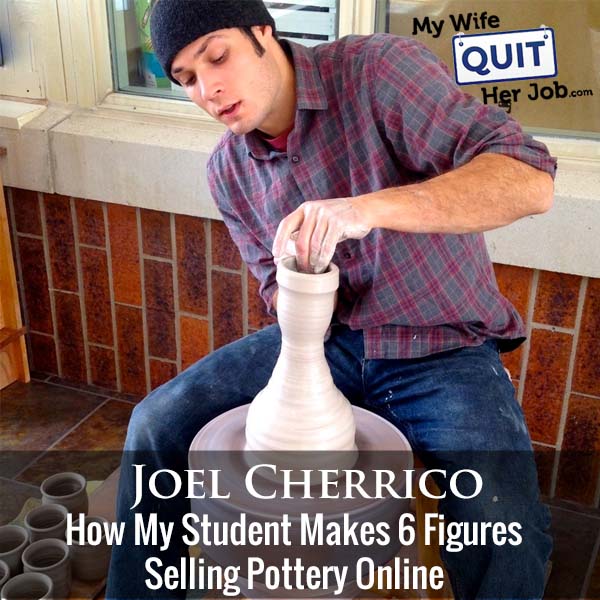
Selling art online works by making the art remarkable first, then building an audience around the act of making it. Joel Cherrico did it by live streaming himself throwing pottery, giving pieces away free to build a list, and raising his prices from $25 to over $500 per mug as demand grew.
Joel was one of the first two students in my Create A Profitable Online Store course back in 2011, when he signed up for the $99 no-support tier because he had no money at all. Today CherricoPottery.com is a six figure business with employees, and I have several of his pieces in my own living room.
This episode covers how he found his audience, why live video changed everything, the Guinness World Record he set, how he handled the backlash from raising prices, and his advice for artists who want to sell online.
Get My Free Mini Course On How To Start A Successful Ecommerce Store
If you are interested in starting an ecommerce business, I put together a comprehensive package of resources that will help you launch your own online store from complete scratch. Be sure to grab it before you leave!
Table of Contents
Key takeaways
- Perfect the art before chasing an audience. Joel spent four years in college treating it as a pottery apprenticeship.
- Live video was the inflection point. A single Facebook Live session reached over two million viewers.
- Giving pottery away outperformed ads. Free pieces built relationships with Tim Ferriss, Ryan Holiday, and Neil deGrasse Tyson.
- His Kickstarter raised $34,000 against a $25,000 goal and shipped to 16 countries.
- He raised prices from $25 to $45 to $85 to $125 per mug, adding glaze layers each time.
- Anything under $100 sells out and cannot be kept in stock. The $500 pieces sit in inventory.
- Over 400 Patreon supporters pay $5, $9, or $24 a month, with the top tier receiving a $500 mug after a year.
- The real fear is making something nobody wants, which most artists mistake for a fear of self-promotion.
How Joel Cherrico went from pre-med to professional potter
Joel started college pre-med with plans to become a doctor, and was pulling D’s and F’s in biology and chemistry while hating the work.
He had taken pottery in high school, made about a hundred pieces, and won an award from his graduating class for it. He knew he was good at it, without any idea how it could support him.
He switched to art anyway and spent four years treating college as a pottery apprenticeship, skipping out of classes to spend more time on the wheel.
His senior year he took business classes and noticed how far the internet could reach. Figuring out how to pack and ship something fragile took a few more years.
The full timeline is roughly 15 years of doing pottery full time, about 10 of them as an actual LLC.
How to price handmade art when you have no reference point
Joel’s model was a potter named Ayumi Horie selling mugs at $82 each.
His reaction was that $82 for a coffee mug seemed remarkable, and that he could hand-craft a great many coffee mugs.
What convinced him was watching her pots sell out immediately whenever she sent a simple email to her mailing list.
Tim Ferriss frames it in a way Joel found useful: great marketing works the first time. That is what he saw in Ayumi’s work, and he set out to understand how she did it.
Why live video changed the pottery business
Joel sold mostly locally for his first few years, throwing pots in front of people at farmers markets and art shows.
Demonstrating the craft in person turned out to be the skill that mattered, because when Periscope, Facebook Live, and YouTube live streaming arrived, he could already do the thing worth watching.
Getting started required no production setup. He bought a smartphone, downloaded Periscope, put it on a tripod, and clicked live.
The reach was extraordinary. When Guinness World Records visited his studio for an interview, they ran a Facebook Live session together while he threw pottery, and over 300,000 people watched.
Some of his own videos passed a million viewers. Streaming on other pages went further still, and one session on a page called Expanded Consciousness drew two million people in an evening.
He now runs a dedicated film studio, which he describes as a pottery wheel with a curtain behind it, and schedules about ten videos a month averaging five to ten thousand viewers each.
Why giving away free pottery beats running ads
Joel’s position is that giving away your art is the best marketing available to you.
His comparison is direct. You can spend $100 on a Facebook ad, or you can give away a couple of mugs.
The relationships prove the point. Tim Ferriss, Ryan Holiday, and Neil deGrasse Tyson all own his pieces because he mailed them for free, and one large piece sits in Neil deGrasse Tyson’s office today.
The same approach opened access to large Facebook pages. He would message a page and ask whether a free piece of pottery or a throwing demonstration would serve their fans, and stream for a couple of hours when they agreed.
Ryan Holiday’s advice shaped the early strategy: start small, start quick, and start with a mailing list of 300 people you know. Joel’s list was three or four hundred people when he took my course, and now runs into the tens of thousands.
How the cosmic mug Kickstarter raised $34,000
Joel turned his cosmic mug into a Kickstarter campaign, which was the best tool available at the time for putting a product into the world.
The campaign raised $34,000 against a $25,000 goal in one month and shipped to 16 different countries.
It took roughly a year of preparation. He researched Kickstarter projects and took a course from Klay Abear, whose emphasis was on building the list first.
Building that list meant giving away free cosmic mugs and letting people sign up when they wanted to buy one. The Kickstarter then offered those subscribers a discount on an otherwise expensive mug.
The money was less profit than it appeared. Creating, packing, and shipping a thousand pieces of pottery cost over $20,000, so he was still scraping by afterward.
The Guinness World Record for most pots thrown in one hour
About three months after the Kickstarter, Joel set the Guinness World Record for most pots thrown in one hour by an individual.
The previous record was 150 pots on an electric wheel. Joel made 159 on a kick wheel, which he powers with his legs.
Preparation took about a year of practice, with a final month of training five or six hours a day.
The physical demand was severe. One pot every 24 seconds for an hour straight, dripping sweat, with no certainty he could finish.
He got it on the first try, and the footage is on YouTube. Guinness World Records came to his town to interview him afterward, which produced publicity that he says is still generating sales years later.
Why raising prices repeatedly was the right move
When the record and the video reach arrived together, Joel’s inventory sold out faster than he could make it.
His response was to raise prices, then raise them again, then raise them again. The $25 mug went to $45, then $85, then $125.
Each raise came with more work in the piece. He added layers of glaze and brighter colors, and communicated that added intricacy to buyers.
The logic scales at the top end too. A $500 piece takes ten times as long to make as a $50 mug, and that is what justifies the price.
His position on low prices is unsentimental. It is irresponsible for an artist to keep prices low and struggle to make a living, and he spent five years doing exactly that after college.
How to handle customer backlash when you raise prices
Two things happened every time he raised prices. People got genuinely upset, and the mugs sold out.
Joel takes the frustration seriously rather than dismissing it. Viewers tell him his videos feel like Mr. Rogers or Bob Ross, that they are therapeutic, and that they have helped through dark times.
Many of those people are on fixed incomes and cannot afford a $100 mug, and they represent the bulk of his audience. His read is that the frustration comes from wanting to be a true fan and being unable to afford it.
His answer was to add lower-cost ways in rather than lowering the price of the art.
How the pottery Patreon subscription works
Just over 400 people support Joel on Patreon at $5, $9, and $24 a month.
The $5 tier gets an educational brochure pack, mailed with a piece of his wife’s handmade paper art, which ships far more easily than pottery.
The $9 tier gets a discounted deal on a cosmic mug, and the $24 tier receives a moon mug worth $500 plus a cosmic mug, a cup, and bonus content.
The economics work because of the time commitment. The $24 subscriber waits a year to receive that $500 mug, which requires staying subscribed throughout.
What happens when an artist manufactures in China
Joel has been designing a porcelain line manufactured in China, and the initial reaction from his fans was overwhelmingly negative.
His reasoning starts with the material. Porcelain ceramics are called fine china for a reason, the Chinese have been producing it for two thousand years, and the black space-inspired glaze on his cosmic mugs derives from a Song Dynasty glaze roughly a thousand years old.
He estimates over 700 porcelain factories in China, and believes the quality achievable there exceeds Italy or Germany for this specific product.
The uniqueness problem got solved through the glaze. The molded shapes are identical, and the glaze is complex enough that every mug still comes out individual.
Multiple batches have sold out at about $36 each, with 400 more mugs arriving the week we spoke.
Why the pottery business stays deliberately unscalable
Joel is clear that his product does not scale in quantity the way most ecommerce products do.
His hands can only make so many pots. Hiring a room full of potters would defeat the reason people support the work, which is connecting with an artist and following his story.
His solution was to scale value instead of volume. More intricate one-off pieces at high prices, alongside batches of a hundred simpler pieces.
The inventory pattern reflects that. Anything under $100 sells too fast to keep in stock, while $500 pieces and three-foot jars sit in storage representing hundreds of thousands of dollars of retail value.
Output is roughly three to four thousand pots a year, which he thinks could reach five or six thousand with help. He and his wife are the only two full-time employees, and she makes handmade paper that also sells to their fans.
Joel Cherrico’s advice for artists selling online
The art always comes first, and the economics are what get it off the ground.
Joel’s framing is that money is rocket fuel. The point is the exploration, and the rocket does not leave the launch pad without fuel.
The mindset he recommends is humility. Start from the assumption that nobody cares, because when he was struggling to sell $25 mugs, they simply sat there.
From there it is your responsibility to educate people on why what you make matters. If nobody is attracted to it, that is information about the work.
Why building an audience first is a trap for artists
Joel considers audience-first a trap that social media pushes people toward.
His experience is that durable success builds slowly over long periods, and that chasing clicks before you have made something worthy of them produces work that looks like everyone else’s.
He is candid that self-promotion came naturally to him and that his instinct is toward too much of it. The decision that mattered was suppressing that and letting the art speak.
His diagnosis of the common fear is sharp. Too many people say they are afraid to put themselves out there, when the real problem is being afraid to make something people want.
The order he actually followed was art first. About a hundred pots in high school, four years of college refining the craft, and roughly $5,000 in sales at a bus stop while learning what people wanted.
Why cosmicmugs.com exists as a separate site
Ryan Holiday suggested building cosmicmugs.com during a consulting call, post-Kickstarter, when Joel was struggling with online sales.
The question Holiday posed was simple. Figure out what it costs to sell a cosmic mug with a Facebook ad, $5 or $10, and build a real business rather than chasing fame and New York City.
The result was hundreds of hours of work across three websites, two on BigCommerce and one WordPress blog, all with Sumo email signups.
Joel’s takeaway is about focus. Concentrating the entire story into one coffee mug raised sales, and that focus works whether applied to marketing, products, or traffic.
Frequently asked questions
Can artists make a living selling online?
Yes. Joel Cherrico runs a six figure pottery business selling handmade pieces up to $500 each, with employees and a mailing list in the tens of thousands.
How do you price handmade art?
Price against the time each piece takes and raise prices as demand outpaces supply. Joel moved from $25 to $45 to $85 to $125 per mug, adding glaze layers and complexity at each step.
Should artists give their work away for free?
Yes, as a marketing investment. Joel compares $100 on a Facebook ad to giving away a couple of mugs, and free pieces built his relationships with Tim Ferriss, Ryan Holiday, and Neil deGrasse Tyson.
What is the best platform for selling art online?
Joel uses BigCommerce for two storefronts plus a WordPress blog, with Sumo for email capture. The platform matters less than the email list, since that list is what sells out each release.
Does live streaming help sell art?
Substantially. Joel’s Facebook Live pottery sessions have reached over two million viewers, and he now schedules about ten videos a month averaging five to ten thousand views each.
Should you build an audience before perfecting your craft?
Joel recommends the craft first. Chasing clicks before making something remarkable produces work indistinguishable from everyone else’s, and his own art became remarkable enough to set a world record.
How do customers react when an artist raises prices?
Some get genuinely upset, and the work sells out anyway. Joel meets lower-budget fans with a $5 to $24 monthly Patreon rather than lowering the price of the art itself.
Can an artist manufacture overseas without losing their audience?
It requires justification your fans accept. Joel’s porcelain line drew negative feedback initially, and sold out at $36 per mug once he explained the thousand-year Chinese glaze tradition behind it.