
Podcast: Download (Duration: 42:13 — 48.6MB)
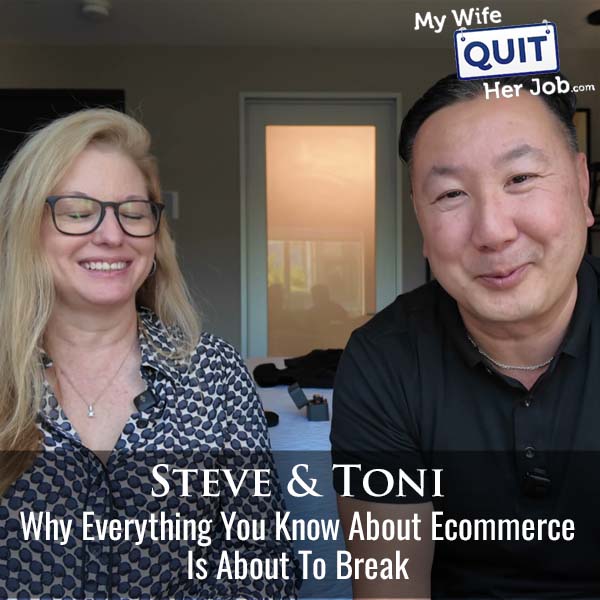
Agentic shopping is the emerging model where AI agents (ChatGPT, Claude, Perplexity, and platform-native agents like Google’s Universal Commerce Protocol and Shopify’s ChatGPT integration) do the product research, comparison, and cart-filling on behalf of consumers, with a human only clicking the final “buy” button. On this episode of the My Wife Quit Her Job podcast, my co-host Toni and I broke down what this actually means for ecommerce store owners, why the ad channels we all depend on (Meta, Google, TikTok) are about to change fundamentally, and what to invest in now to survive it.
I am in a full-blown midlife ecommerce crisis about this. My business currently runs on paid ads (Meta and Google), word of mouth, email, and SMS, and if a meaningful percentage of purchases in the next 2-3 years happen through AI agents that never see an ad, my paid channels stop working the way they do today.
Meanwhile, Amazon is scraping ecommerce sites and listing products without permission, Google Search is being replaced by AI Overviews, and social media is being flooded with AI-generated content that erodes the trust that made it a marketing channel in the first place.
Below is the full breakdown: what agentic shopping actually is, why Meta and Google ads will not disappear but will fundamentally change, why AI-mention ranking is now the single most important SEO investment, and the four practical things to do this quarter regardless of how the timing plays out.
Get My Free Mini Course On How To Start A Successful Ecommerce Store
If you are interested in starting an ecommerce business, I put together a comprehensive package of resources that will help you launch your own online store from complete scratch. Be sure to grab it before you leave!
Table of Contents
Key takeaways
- Agentic shopping means AI agents research products, compare options, and fill carts on behalf of consumers. Humans typically just approve the final purchase. If this becomes mainstream, ad-driven customer acquisition breaks because agents do not click ads.
- Google is more at risk than Meta. Meta ads work by interruption in a feed; Google ads work at the moment of search intent. AI agents replace search behavior first.
- Amazon lost roughly 10 percentage points of “product discovery starts” over the last few years. People increasingly start on TikTok (for younger buyers) or in AI chat (for research-heavy purchases).
- Amazon’s Buy For Me program scrapes ecommerce sites and lists their products on Amazon without permission. Product data goes stale, orders arrive wrong, and the brand takes the customer-service hit.
- The four things to invest in now: AI-search ranking (product descriptions with quantified claims, statistics, and real specifics), brand loyalty (branded searches AI agents will honor), Reddit and PR mentions (where AI models cite), and content that gets indexed.
- Product descriptions do not need to be beautifully written for humans. They need to be data-rich for AI. Real statistics, specific specs, and named differentiators are what AI cites.
- Brand loyalty is the moat. When a shopper tells an AI agent “only show me Kate Spade dresses” or “only show me Marriott hotels,” the agent respects that. Building brand loyalty is the anti-agentic-shopping strategy.
What is agentic shopping and why does it matter for ecommerce?
Agentic shopping is when an AI agent (ChatGPT, Claude, Perplexity, or a purpose-built shopping agent) performs the entire product research and comparison process for a consumer, presents a curated set of options, and increasingly executes the transaction directly. The consumer only approves the final purchase, and sometimes not even that. This matters for ecommerce because AI agents do not see ads, do not fall for retargeting, and do not respond to social proof the way human shoppers do.
The mechanics are already live in early forms. Google announced UCP (Universal Commerce Protocol), which lets AI agents buy from participating stores without loading a browser page.
Shopify has an agentic storefront that integrates directly with ChatGPT, and Perplexity has been executing shopping tasks for months. The platforms are racing to build the plumbing.
The consumer behavior is not universal yet. Most people still shop with a human in the loop for high-stakes purchases (travel, luxury, engagement rings). But for low-stakes repeat purchases (household supplies, generic clothing, gifts) the trust barrier is much lower and AI agents are already getting used.
Will AI shopping agents kill Meta and Google ads?
AI shopping agents will not kill Meta and Google ads outright but will fundamentally change how they work, and Google is at higher risk than Meta. Google’s ad business depends on search-intent traffic that AI agents are already replacing. Meta’s ad business depends on interrupting scrolling behavior that humans will still do even if AI does their transactional shopping.
The distinction matters:
- Meta ads (interruption): Even in an agentic-shopping world, humans still scroll Instagram and TikTok to be entertained. Meta ads that create awareness during scrolling still land on human eyeballs. The click-to-purchase step may bypass Meta, but the awareness half of the funnel survives.
- Google ads (intent): Google’s core value proposition is capturing the exact moment someone searches “best noise-cancelling headphones under $200.” If the moment now happens inside ChatGPT instead of Google, that ad revenue moves too. Google is aggressively building AI Overviews and shopping-in-AI features to defend this.
The realistic timeline: Google search traffic starts dropping meaningfully in 2026-2027 as AI shopping matures. Meta’s core business is more durable because it captures attention, not intent. But both platforms will look different in three years, and the specific bidding, targeting, and creative strategies that work today will need to evolve.
What is Amazon’s Buy For Me program and why is it a problem for ecommerce sellers?
Amazon’s Buy For Me is a program where Amazon scrapes external ecommerce sites, lists their products on Amazon, and executes purchases on behalf of customers without the seller’s permission. When a customer buys the listing, Amazon places the order on the seller’s actual website (or against their scraped data), and any mismatch between Amazon’s listing and the seller’s real product becomes the seller’s customer-service problem.
The specific failure modes:
- Amazon’s scraped product data is stale, so buyers see outdated prices, colors, or specs.
- Orders get placed against variants that no longer exist, and customers receive the wrong item.
- The seller takes the blame and gets negative reviews on Trustpilot, Google Reviews, and their own site.
- Customer service workload spikes because the seller now handles complaints for problems Amazon created.
For solo operators or small teams, this is a real capacity problem. You cannot handle the increased customer service load caused by Amazon’s misinformation, and there is currently no official opt-out for Buy For Me.
The industry response has ranged from robots.txt blocking to legal review, but the situation is very much in flux.
How is customer product discovery changing in 2026?
Customer product discovery in 2026 has fragmented dramatically. Amazon used to be the default starting point for over 60% of product searches; that share has dropped by roughly 10 percentage points over the last few years.
AI chat interfaces have picked up a growing share for research-heavy purchases, and TikTok has become the discovery layer for younger consumers with the actual purchase often happening on Amazon or the brand’s DTC site.
Where different segments start their discovery today:
- Younger consumers (Gen Z, young Millennials): TikTok first, both for scrolling discovery and as an active search engine. Purchase often lands on Amazon.
- Research-heavy purchases (electronics, travel, high-consideration items): increasingly starting in ChatGPT or Claude to gather options and comparisons before any browser visit.
- Traditional brand-loyal purchases: still starting on Amazon or the brand’s site directly, though this share is shrinking.
- Impulse and gift purchases: Meta and Instagram feeds still drive significant impulse discovery even as the purchase channel diversifies.
The tactical implication for ecommerce sellers: you need to be visible in every one of these starting points, because you cannot predict which one a specific customer will use. Amazon-only strategies were already fragile in 2024. In 2026 they are actively risky.
What should ecommerce sellers invest in to prepare for agentic shopping?
The four highest-ROI things ecommerce sellers should invest in to prepare for agentic shopping are: AI-optimized product listings (data-rich descriptions with real statistics), brand loyalty (so shoppers tell AI agents “only show me my brand”), off-site AI-citation building (Reddit, PR mentions, review sites), and content marketing that gets indexed by AI crawlers. These four work regardless of exactly when agentic shopping becomes mainstream.
Ranked by leverage:
- AI-optimized product listings. Rewrite every product description to include real statistics, specific specs, and named differentiators. AI models cite specifics, not vibes. This is a one-time investment that pays off across every AI touchpoint.
- Brand loyalty. A shopper who tells their agent “only show me Kate Spade” or “only book Marriott hotels” bypasses generic AI ranking. Building brand affinity is the single strongest anti-agentic-shopping strategy.
- Off-site AI-citation building. AI models are trained on and cite from Reddit, industry publications, Wikipedia, and specialty review sites. PR blitz, Reddit engagement, and getting mentioned in publications all matter more in 2026 than they did in 2023.
- Content that gets indexed. A well-written blog post attached to your store gets cited when AI answers questions in your niche. This is the “get mentioned in AI answers” strategy we discussed in episode 643.
How do you write product descriptions that AI shopping agents will cite?
You write product descriptions that AI shopping agents will cite by leading with quantified claims, real statistics, and specific differentiators rather than beautiful prose. AI models pick up “91% of customers prefer this over the alternative” or “ships within 24 hours 98.3% of the time” but ignore “our handcrafted attention to detail speaks for itself.” The writing does not need to be lyrical; it needs to be data-rich.
The practical process I ran on Bumblebee Linens for over 1,000 products:
- Have AI generate first-draft descriptions from your existing product data (specs, materials, dimensions, uses).
- READ each generated description carefully. AI hallucinates specs constantly.
- Add real statistics you actually track (shipping-on-time rate, return rate, customer preference from your own surveys).
- Include specific differentiators as concrete claims, not vague brand language.
- Publish and let AI crawlers index the new descriptions.
This took me weeks of reading. It felt like re-reading a book before publication because you cannot afford a single wrong stat in a description. But it is a one-time investment that keeps paying off as more AI systems cite content.
Why is brand loyalty the anti-agentic-shopping strategy?
Brand loyalty is the anti-agentic-shopping strategy because when a shopper tells an AI agent “only show me Yeti coolers” or “only book Marriott hotels” or “only Delta flights,” the agent honors that constraint and stops generic comparison-shopping. The brand becomes the filter the agent respects, which bypasses the whole “AI ranks generic products” problem.
The pattern is already visible in travel booking, where I have watched Toni use AI shopping heavily. She tells ChatGPT “I only want Marriott” and “show me Delta flights first” up front, and the AI does not question the loyalty; it just filters.
Every shopper who has strong brand preferences essentially opts their favorite brands out of generic AI ranking.
The implication for sellers: the brand-building investments that felt optional in 2015-2020 are strategic imperatives in 2026. Behind-the-scenes content, founder-journey video, factory tours, brand ambassadors, and community building all serve one purpose in an agentic-shopping world: making shoppers name YOU when they talk to their agent.
Will social media survive if AI generates most of the content?
Social media will survive but change significantly as AI-generated content floods the feeds and bot activity rises. Human users will spend less time on platforms where they cannot tell what is real, which erodes the attention Meta and TikTok sell to advertisers. The platforms are already responding by requiring AI-generation disclosures and giving verified-human accounts more distribution.
The specific concerns:
- Bot ratios: if bots on a platform outnumber humans by 10:1, the human attention Meta sells becomes proportionally more scarce and expensive.
- Trust erosion: when users cannot tell if an image is real, a review is real, or a person is real, they engage less deeply and click less often.
- Younger-generation defection: the older cohort’s social-media use is already declining. Whether Gen Z stays or moves to yet another platform is a live question.
The counter-argument: my kids’ entire social lives happen on social media, and they cannot imagine a world without it. For them, the platforms are utility infrastructure, not entertainment products they might opt out of.
So the demographic mix shifts, but the platforms themselves probably do not collapse.
What is happening to physical retail as ecommerce fragments?
Physical retail is unexpectedly rebounding in 2026, especially malls and category-defining stores. Younger consumers are treating malls as social spaces AND as try-before-you-buy showrooms, doing product research on their phones and then going to the mall specifically to try clothes on. The pandemic-era prediction that malls would die was wrong.
The behavior pattern I see in my own household: my daughter researches every clothing purchase on her phone (Instagram, TikTok, brand sites), goes to the mall to try items on in person, and then often buys online later for better prices or sizing options. The mall is not a purchase channel; it is a validation channel.
For DTC brands this means the pop-up-store and showroom-store strategy that has worked for Warby Parker, Allbirds, and others is going to matter more. Pure-digital brands that ignore physical presence entirely may be leaving conversion on the table for exactly the tactile validation the mall provides.
Frequently asked questions
What is agentic shopping?
Agentic shopping is when an AI agent (ChatGPT, Claude, Perplexity, or a platform-specific agent like Google’s Universal Commerce Protocol) does the product research, comparison shopping, and often the purchase itself on behalf of a consumer. The human typically only approves the final transaction, and increasingly the transaction happens without any human click at all. It matters for ecommerce because AI agents do not click ads, do not fall for retargeting, and do not respond to social proof the way humans do.
Will AI agents replace Meta and Google ads?
AI agents will not replace Meta and Google ads outright, but they will fundamentally change how both work, and Google is at higher risk than Meta. Google’s business depends on capturing search-intent traffic that AI agents are already replacing, while Meta’s business depends on interrupting scrolling behavior humans will still do even in an agentic-shopping world. The specific bidding, targeting, and creative strategies that work today will need to evolve in the next 2-3 years.
How do I get my products recommended by AI shopping agents?
To get products recommended by AI shopping agents, invest in four things: data-rich product descriptions with real statistics and specific differentiators, brand loyalty so shoppers name you when they talk to their agent, off-site AI-citation building through Reddit and PR mentions, and content marketing that gets indexed by AI crawlers. AI models cite specifics, not vibes, so rewrite product descriptions to include quantified claims like “91% of customers prefer this” or “ships within 24 hours 98% of the time.”
Is Amazon still the starting point for most product searches?
No. Amazon lost roughly 10 percentage points of “product discovery starts” over the last few years, dropping from its former dominant share as discovery fragmented across TikTok (younger consumers), AI chat (research-heavy purchases), and the brand’s own site (loyal customers). Amazon-only strategies were already fragile in 2024; in 2026 they are actively risky.
What is Amazon Buy For Me and can I opt out?
Amazon Buy For Me is a program where Amazon scrapes external ecommerce sites, lists those products on Amazon without the seller’s permission, and executes purchases on behalf of buyers, with no official opt-out mechanism currently available. Sellers have reported stale product data, mismatched orders, and negative reviews on their own sites caused by Amazon’s misinformation. Some sellers have started blocking Amazon’s crawler at robots.txt level, but that is a partial solution.
Should I be worried that social media will die because of AI content?
You should adjust rather than panic. Social media will keep functioning even as AI-generated content floods the feeds, but the platforms are changing as human attention becomes more scarce, verified-human content gets prioritized, and AI-disclosure requirements roll out. Continue investing in genuine human-created content (founder journeys, behind-the-scenes video, real customer stories); AI-generated content will get demoted as platforms fight the flood.