
Podcast: Download (Duration: 55:32 — 63.8MB)
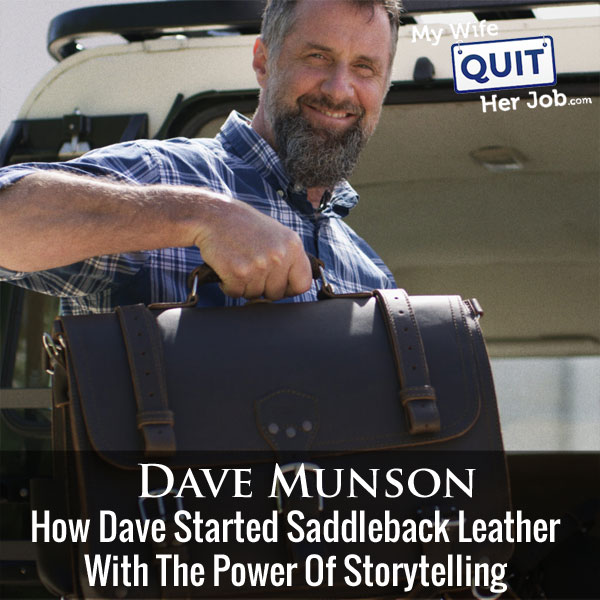
You escape commodity pricing by teaching buyers how to judge quality in your category. Dave Munson built Saddleback Leather selling into one of the most crowded product categories there is, and he did it without spending a dollar on marketing for the first nine years.
His tagline is the whole positioning in one line: they will fight over it when you are dead. The bags are built with no zippers and no breakable parts, designed to outlive the owner.
The company started with a sketch. Dave was teaching English in southern Mexico in 1999, could not find the bag he had in his head, found someone who could make it, and drew it out for him.
This episode covers how educating customers builds trust that competitors cannot match, why chasing viral videos is the wrong goal, how word of mouth carried the business for nine years, and what to do about knockoffs.
A note on timing: this is a 2017 conversation. Some Amazon program details have changed since, and the positioning principles have not.
Get My Free Mini Course On How To Start A Successful Ecommerce Store
If you are interested in starting an ecommerce business, I put together a comprehensive package of resources that will help you launch your own online store from complete scratch. Be sure to grab it before you leave!
Table of Contents
Key takeaways
- Educating buyers on how to judge quality makes them distrust competitors without you criticizing anyone.
- Saddleback spent nothing on marketing from 2003 to 2012 and grew entirely on word of mouth.
- Become a genuine expert in your material, since specific technical knowledge is what makes education credible.
- Chase many small content wins rather than one viral hit, described as 250 campfires warming a field.
- A single video led to an NPR Marketplace interview reaching about eight million weekly listeners.
- One local news segment, sourced from a low-viewership show, produced roughly $200,000 in sales.
- Amazon is about 8% of the business, deliberately limited to bestsellers to avoid choice paralysis.
- Suing a knockoff seller was quoted at $410,000, and a direct personal conversation solved it for free.
How do you compete against cheap competitors?
Compete on quality, because a price war against overseas manufacturing is unwinnable. Dave’s framing is that you cannot beat China on price and they cannot beat you on quality.
He is careful not to disparage anyone. Good manufacturers exist everywhere, and cost pressure is what produces corner-cutting.
His own experience shows the failure mode. Hardware ordered as nickel-plated brass tested at 34% copper rather than the 70% brass requires, and the fittings wore through in about a month.
Verification is how you avoid repeating it. Saddleback runs its own inspections and sends random samples to a government laboratory near its Mexican factory.
Supplier standards are vetted the same way. Their tannery voluntarily submits to third-party inspection covering water treatment, chemical testing, employee facilities, and leather quality.
Why educating customers sells more than advertising
Teaching people how to evaluate your product category makes them question everyone who has not taught them. Dave never criticizes competitors and simply explains what goes into a good bag.
His examples are concrete. Check that the hardware is a certain grade, confirm the thread is polyester rather than nylon.
The effect is indirect and powerful. Buyers start wondering whether other sellers are cutting corners, and that doubt is exhausting enough that they simply buy from the person who explained things.
The pattern transfers to any business. A fence installer explaining post depth and soil quality creates the same dynamic.
The prerequisite is real expertise. Dave knew nothing about leather beyond liking the smell, and built knowledge by touring factories and asking relentless questions.
His kangaroo leather example shows the depth he means. He learned that its fibers grow at 45 degree angles in three dimensions, which is why it stays both flexible and strong, and that a split hide keeps strength on both halves.
How do you build a brand story that sells?
Anchor it on something people genuinely want rather than something you want to say. Dave was traveling through Eastern Europe planning to buy a gold watch to hand down to his grandchildren.
Talking about that plan revealed the demand. Everyone he mentioned it to wanted something of their own to pass on.
That became the product requirement. No zippers, no breakable parts, built to be used after he is dead.
The slogan took months of work. Verbally processing the idea with other people and writing it out repeatedly produced the line about fighting over it when he is dead.
None of this existed at the start. His early eBay listings had no company name, just an offer to sell a bag he thought was good.
Should you put yourself in front of your own brand?
Yes, and you do not have to be on camera to do it. Dave is emphatically not shy and recognizes that many people are.
The alternatives are real. Be the voice rather than the face, film short educational pieces, write about quality, or partner with someone comfortable on camera.
What matters is revealing what you value. Saddleback made a film about Dave’s niece who has type 1 diabetes rather than announcing that they support diabetes research.
Viewers draw their own conclusions. People watch, recognize shared values, and decide they want to buy from someone like that.
Small buyers prefer buying from people. Given a choice between a corporation and a family running a business, most people root for the family.
Why you should not chase viral videos
Aim for many small fires rather than one large one. Dave’s analogy is a freezing field: one campfire warms a small circle, and 250 spread across it makes the whole field comfortable.
Most of his videos never exceeded 10,000 to 20,000 views for years. He kept making them anyway.
Judging by immediate ROI would have ended the company. He describes doing things that felt like good ideas and trusting they would pay off.
The compounding came later. After studying why one video worked, subsequent ones reached 60,000, 160,000, and 280,000 views.
Skill is the actual output of volume. You get good at video by making videos, at photography by taking many photographs, at public speaking by speaking.
What returns can content produce years later?
Openings you could never have predicted or purchased. A video about how to knock off a bag reached roughly 540,000 views and drew an unsolicited email from Seth Godin.
A year later it produced a Marketplace interview on NPR. That program reaches around eight million listeners weekly.
Low-viewership content produced the largest single result. A Fort Worth news anchor shopping for a briefcase found their weekly show on Facebook, watched an episode, and pitched a segment.
That segment was worth roughly $200,000 in sales. The show it came from typically draws one to four thousand viewers.
Two separate reality show approaches followed. Dave declined both, and the point stands that consistent output creates optionality.
How do you get your first sales without an audience?
Sell where buyers already are and route them to your own site. Dave sold on eBay for years while mentioning his website in listings.
The mechanic was simple. Buyers noticed there were other bags, searched the company name, and arrived at Saddleback directly.
Cash flow was reinvested immediately. He would sell a few bags, deposit the money for seven, then twelve, then fourteen, buy dog food and pay rent, and start again.
Early videos accelerated it. A tug of war with a crocodile and a bag stuffed with fish guts sunk 60 feet among sharks both demonstrated the durability claim.
The strategy worked at real scale. He hit about $75,000 in annual sales before starting his own factory in 2008 with roughly $60,000 in machinery and setup.
How should you handle knockoffs of your product?
Mostly ignore them and keep working. Dave met a man in an airport carrying a copy of his own design who had never heard of Saddleback.
His reaction was to note that at least the man liked his design. Those buyers return when the cheap version falls apart.
Legal action was quoted absurdly. Chicago lawyers offered to stop one seller for $410,000.
A personal conversation solved that case entirely. The seller was a former manufacturing partner, and Dave told him he would tell his father, which ended it.
Quality plus being first is the real defense. When you are established and educating the market, cheap copies cannot compete.
How do you use Amazon without weakening your brand?
List only bestsellers and work to move buyers to your own site. Amazon is about 8% of Saddleback’s business and sends substantial traffic to their website.
Restricting selection is deliberate. Too many choices causes buyers to choose nothing, a lesson learned the hard way.
Product economics also filter the catalog. Suitcases and large duffels cost too much in storage and fees to warrant fulfillment by Amazon.
Direct links are prohibited, so the redirect has to be indirect. Listings allude to a wider range available elsewhere.
A registration incentive pulls buyers to the site. Registering a bag earns a keychain, which brings the customer into their own channel.
What are Amazon shoppers actually looking for?
Something to carry their things, rather than the best briefcase in the world. Dave’s observation is that buyers are not searching for a bag people will compliment them on.
They are also not asking friends for recommendations. They go to Google Images, Google Shopping, or Amazon and browse.
That reframes the job. You are not competing to win a considered search, you are trying to make someone fall in love with a product they encountered casually.
What advice applies to any competitive niche?
Personalize the business and be generous with people. Dave’s answer for baby clothes or party favors is the same as for leather bags.
Show the family behind it. A small operation with visible people beats an anonymous corporation for most buyers.
Know your category deeply enough to teach it. Understanding what makes a product good in your niche is what earns trust.
Look for ways to improve the standard offer. Custom options and sensible bundling both differentiate a commodity.
Frequently asked questions
How do you sell a commodity product profitably?
Educate buyers on how to judge quality in your category. That builds trust in you and doubt about sellers who have not explained anything, without criticizing competitors directly.
Can you build an ecommerce business without paid advertising?
Saddleback Leather spent nothing on marketing from 2003 to 2012, growing on word of mouth driven by videos and customer recommendations.
Should you try to make a viral video?
No. Aim for many small pieces of content rather than one hit, since consistency compounds and a viral video is not a strategy you can repeat.
Do low-view videos have any value?
Yes. A Fort Worth news anchor found Saddleback through a show with a few thousand viewers, and the resulting segment produced roughly $200,000 in sales.
How do you compete with cheap overseas manufacturing?
On quality rather than price. Verify materials independently through laboratory testing and third-party factory inspections rather than trusting specifications.
What should you do about knockoffs?
Usually nothing. Legal action was quoted at $410,000 in one case, a direct personal conversation resolved it for free, and buyers of cheap copies tend to return later.
How much of your catalog should you list on Amazon?
Only bestsellers. Too much selection causes buyers to choose nothing, and bulky items cost too much in storage and fulfillment fees.
How do you get Amazon buyers to your own website?
Direct links are prohibited, so allude to a wider selection elsewhere and give buyers a reason to return, such as a product registration that earns a small gift.