
Podcast: Download (Duration: 26:02 — 36.0MB)
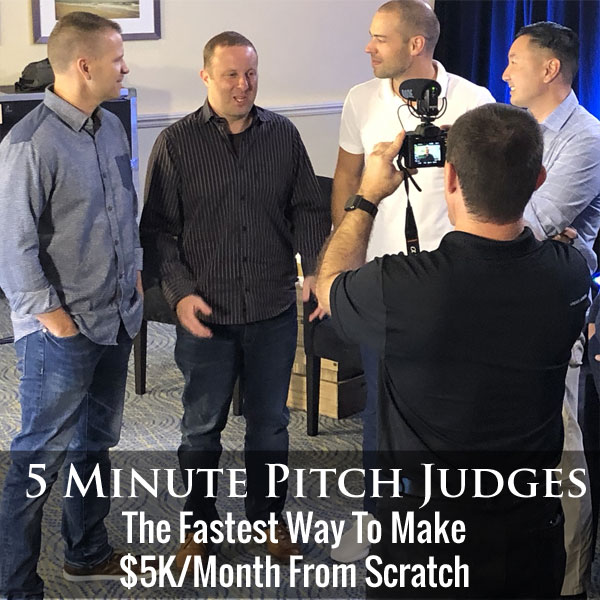
Four experienced entrepreneurs got asked the same question on a patio overlooking the ocean: with $5,000 and everything you know now, what would you do to reach $5,000 a month in profit fastest? They gave four genuinely different answers.
The panel is Mike Jackness of EcomCrew, Greg Mercer of Jungle Scout, Scott Voelker of The Amazing Seller, and me. Scott ran it as a speed round with no advance warning.
Below is each strategy, the disagreement about how long each takes, and the honest timelines for when each of us actually earned our first dollar.
Get My Free Mini Course On How To Start A Successful Ecommerce Store
If you are interested in starting an ecommerce business, I put together a comprehensive package of resources that will help you launch your own online store from complete scratch. Be sure to grab it before you leave!
Table of Contents
Key takeaways
- Mike would build an audience around a genuine passion, monetize first through affiliate links, then build the product the data points to.
- Greg would invent or significantly improve a physical product in a category he knows well.
- Scott would build an audience via giveaways and content, running affiliate offers while the audience grows.
- My answer needs no capital at all: become the authority inside an existing forum or community.
- Scott made no money for 56 podcast episodes. I made nothing for roughly 18 months, and that was AdSense.
- Greg never set out to build an audience. It formed around answering customer questions.
- Affiliate links are the fastest way to validate demand before you build anything.
- Mike commits to nothing he is not willing to do for three to five years.
Mike Jackness: build an audience around something you genuinely care about
Mike’s starting point is that the things he has succeeded at most are the things he was genuinely passionate about. Starting something purely for the money has worked for him and never as well, both for happiness and for long-term profitability.
His example is online poker, which never felt like work, compared to what he does now, which he enjoys and which feels more like a job.
So he would pick something that mirrors his actual life: travel, tennis, scuba diving. The advantage is that the subject matter expert is already you.
Then start a blog and build an audience, because traffic, audience, and trust reliably produce money. Affiliate marketing, SEO, content marketing, YouTube, and ecommerce all monetize that same asset.
His condition is sticking with it long enough, because most people quit too early.
Why affiliate marketing should be your first monetization
Mike’s specific sequence is to monetize first with affiliate links to products that already exist, using someone else’s product to establish that demand is real.
It does not have to be a perfect fit. Put affiliate links on a page and watch which ones people move toward.
Then look across your whole site and the resulting data, and the thing that performed best with someone else’s product is the thing worth building yourself, whether that is a course or a physical product.
His argument is that this converts a leap into the unknown into a decision with evidence behind it.
Mike is also explicit about the frame he is answering from. He is thinking about a long-term defensible business and is not concerned about how long it takes. Being handed $5,000 with no home and no belongings would produce a completely different answer.
Greg Mercer: invent or improve a physical product
Greg’s answer comes from watching the 5 Minute Pitch contestants, which left him enthusiastic about inventing.
He would create or significantly improve a physical product in an area where he has genuine expertise, describing himself as a tinkerer and creator by nature.
His worked example is beach volleyball. Nets sag constantly, and people work around it using ratchet straps of the kind you would use in a truck bed. Those could be built into the net itself, which is patentable, and $5,000 is enough to start.
His disagreement with the audience-first approach is about speed. Building a physical product and selling it immediately reaches $5,000 in profit before an audience gets large enough to sell to.
Mike’s response is that the two combine: an existing volleyball audience turns a product launch into fuel on a fire. Greg agrees that an audience makes launching anything easier and maintains that building one is hard and slow.
The honest caveat about inventing
Mike puts himself forward as the counterexample. He does not consider himself creative enough to be an inventor and could think about it for a year without producing an invention.
Not everyone can take this path.
Scott Voelker: build an audience through giveaways and content
Scott’s approach is a hybrid, and he is upfront that it fails if you do not want an audience or do not want to be on camera. Some people want to build on the back end only.
He would run a giveaway in the market to get people to raise their hands, then deliver content to them consistently around that market.
His bass fishing example: if he were fishing every weekend with his son, he would record it, report on it, and cover the lures he was making. Meanwhile he would run affiliate offers, which is the easiest way to make a sale without owning a product.
Why he trusts this
Scott’s evidence spans 15 years and three separate businesses.
His and his wife’s brick-and-mortar photography studio built a local email list of people who visited, managed in Outlook using blind copy as their broadcast system. They sold out their entire fourth quarter of photography sessions with no spots left, because the audience trusted them and wanted them specifically.
He then repeated it in digital photography online, building an audience and selling easily.
His summary: build an audience, earn know, like, and trust, and you can sell anything that audience wants.
My answer: you do not need the $5,000
My position is that this needs no capital, because plenty of listeners do not have $5,000 to start with.
A friend of mine went onto a popular forum and wrote genuinely long, substantive posts. People read them, commented, and asked questions, and he became a recognized authority inside that forum.
People started asking him for advice. He created a class, and members of that forum signed up, without him ever having his own website or audience.
I also mentioned a student who read my post about running a webinar, ran Facebook ads, got roughly 80 people to attend, and made about $4,200 selling deeper content off the back of it.
Why this is not get rich quick
Mike’s pushback is that get rich quick is the one strategy that does not work, and that a business with longevity requires real work.
Scott’s defense of the forum approach is that it only works because the person is genuinely knowledgeable and helpful. His analogy: someone offering you a free 25-minute tennis lesson, delivering real value, and you asking for more lessons afterward.
My own clarification is that it takes substantial time to develop something worth teaching, and then to develop the presentation and communication skills to teach it. That is not fast.
My rule is that I take on no project unless I am willing to do it for three to five years minimum, specifically so I do not quit early by accident.
How long each of us actually waited for the first dollar
| Business | Time to first revenue |
|---|---|
| My Wife Quit Her Job | ~18 months, and it was AdSense |
| The Amazing Seller | 56 episodes |
| EcomCrew | Multiple years on the content side |
| Jungle Scout | Early success, audience came later |
Scott’s first dollar from The Amazing Seller came at episode 56, from mentioning Greg’s Jungle Scout extension. He had started two previous podcasts that went nowhere, one in fitness and one in general marketing that was never niched down.
He kept going without monetization because listeners told him it was helpful, so he knew he was onto something even without knowing how he would eventually make money.
I saw no meaningful money until the three year mark. My mother was asking why someone with a Stanford degree was writing a blog for no money while thinking about quitting an engineering job, and told me she was not going to read it.
Greg never planned to build an audience
Greg’s path was different in a way worth noting. He never sat down and decided to build an audience.
The goal was creating a product that helped people. Those people had questions, so they published content answering them, later added an email opt-in, and an audience formed around that.
I pointed out that Greg started with no audience at all and instead befriended the three of us and leveraged our audiences to promote the tool.
Scott’s addition is that Greg built something people wanted badly enough that users shared it themselves, so the audience was built by demand for the tool rather than by content.
The strategy nobody has to be the face of
Scott raises one more option for people who do not want to appear publicly at all: spend 12 to 18 months doing solid keyword research, build a blog covering what people search for, generate traffic, and run ads on it.
That requires no personal brand.
His broader point is that people try one thing, conclude it does not work for them, and quit, when they may simply not have given it enough time or found their fit. His recommendation is to experiment and see what resonates with you.
Frequently asked questions
What is the fastest way to make $5,000 a month online?
The four panelists disagreed. Greg Mercer argued a physical product sells sooner than an audience can be built, while Mike Jackness and Scott Voelker favored building an audience and monetizing through affiliate offers first, and Steve Chou argued you can become an authority inside an existing community with no capital at all.
Should you start with affiliate marketing or your own product?
Mike Jackness recommends affiliate links first, because promoting products that already exist tells you which demand is real before you invest in building anything. The best-performing affiliate offer indicates what to build yourself.
How long does it take to build an audience?
Longer than most people expect. Scott Voelker made no money for 56 podcast episodes, Steve Chou waited roughly 18 months for his first AdSense revenue and three years for meaningful money, and Mike Jackness describes multiple years on the content side.
Do you need to be passionate about your niche?
Mike Jackness’s experience is that ventures built purely for money underperform ones built on genuine interest, both in enjoyment and long-term profitability. Passion also makes you the subject matter expert by default.
Can you build an online business without being the face of it?
Yes. Scott Voelker’s suggestion is spending 12 to 18 months on keyword research and content, building search traffic, and monetizing with ads, which requires no personal brand.
Is inventing a product realistic for most people?
Not for everyone. Greg Mercer favors it and describes himself as a natural tinkerer, while Mike Jackness openly says he is not creative enough and could spend a year without producing an invention.
How long should you commit to a new business idea?
Steve Chou takes on nothing he is not prepared to do for three to five years, specifically to avoid quitting early by accident. Most people abandon projects before the payoff arrives.
Does an audience make product launches easier?
Substantially. Greg Mercer agrees that a large audience makes launching an info product, physical product, or software product straightforward, while noting that building the audience is itself the hard and slow part.