
Podcast: Download (Duration: 42:48 — 49.3MB)
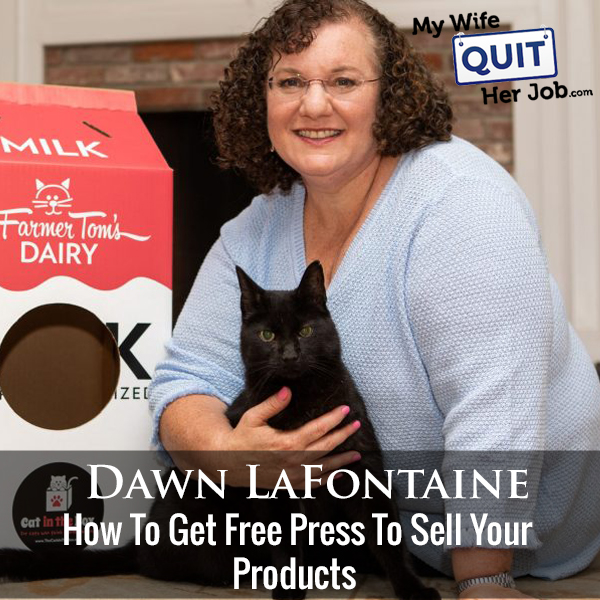
Getting free press works because journalists have space to fill and limited time to fill it. Dawn LaFontaine writes pitch emails that answer who, what, when, where, why, and how completely, includes publication-quality photographs, and supplies her own quotes, so an editor can publish with almost no additional work.
Dawn runs Cat in the Box, selling designed cardboard box toys for cats, and was a finalist on The 5 Minute Pitch. Her products have appeared in Parade, Product Hunt, and the Boston Globe.
This episode covers how she pitched press with no PR background, how she got onto Product Hunt, what manufacturing a printed box actually involves, and the shipping constraint that shaped her whole business.
Get My Free Mini Course On How To Start A Successful Ecommerce Store
If you are interested in starting an ecommerce business, I put together a comprehensive package of resources that will help you launch your own online store from complete scratch. Be sure to grab it before you leave!
Table of Contents
Key takeaways
- Write the story for the journalist. Answer every question, supply photos, and include your own quotes.
- Local papers outsold the Boston Globe, because syndication across small papers gave the story far longer legs.
- Every pitch needs a hook. A new business, a new product, or an event qualifies.
- Product Hunt runs on hunters. Find one who has posted products like yours and pitch them personally.
- Startup cost was about $14,000, with printing plates and cutting dies roughly half of it.
- Manufacturers must be the right size. Large ones will not take you and small ones cannot do the work.
- Box printing shifts up to a quarter inch, so designs must tolerate that movement.
- Design for shipping dimensions first. Her product is too large to ship affordably or use FBA.
Where the product idea came from
Dawn was dropping her mother’s cats at a cat sitter whose home was beautifully decorated and whose living room was full of old shipping cartons.
The sitter said, somewhat sheepishly, that they were for the cats.
Dawn already knew cats like boxes, and the question that stuck was why owners tolerate dirty Amazon boxes in their homes.
The product answers that. Clean, attractive, cat-safe boxes printed with human-grade soy-based inks on recycled cardboard, rather than something that might carry toxic inks and has been who knows where.
Her framing of why she pursued this idea over others is worth noting. She has product ideas constantly, and now understands it is never about the idea and always about the implementation.
Why corrugated cardboard specifically
One manufacturer told her the design was impossible in cardboard and suggested paperboard, the material used for cereal boxes and game boards.
Dawn rejected that because paperboard does not meet the underlying biological need.
Cats prefer an ambient temperature of roughly 86 to 97 degrees, which nobody keeps their house at, so cats are effectively cold most of the time.
The corrugations in cardboard create air pockets that insulate, making the inside of the box genuinely warm. That is a substantial part of why cats keep returning to them.
Why finding a manufacturer was a Goldilocks problem
Dawn cold-called and cold-emailed US cardboard and box manufacturers.
The difficulty was not locating manufacturers. It was finding one willing to work with her at her size.
Large manufacturers had the capability for complex designs and no interest in a business her size.
Small companies would have been delighted to have her and simply lacked the capability.
She settled with a medium-sized manufacturer that does excellent work, with the tradeoff that as a small customer her prototype iterations drop to the bottom of the queue, so a design cycle can run months.
What designing a printed box actually involves
Box companies employ packaging engineers, which Dawn did not know was a profession.
There is specialized software, and the prototyping is physical. There is a creative room where people hand-cut each version.
The iteration is granular. On her milk carton design, the small top panel where a date stamp would go had to be resized repeatedly, because too small or too large and it stops reading as a milk carton.
The sequence runs shape first. The manufacturer produces the box outline, and only then does a graphic designer create artwork to fit that specific shape.
Why printing on boxes is harder than printing on paper
Box printing carries substantial error tolerance.
A design must accommodate movement of at least a quarter of an inch in any direction.
Dawn’s cheese box illustrates the constraint. The manufacturer wanted a plain yellow box, and she went through multiple entirely different treatments trying to create three-dimensional Swiss cheese holes that their press could actually produce.
The final version satisfied both her and their equipment, after several complete redesigns rather than adjustments.
What it cost to start
Roughly $14,000 total.
Printing plates and cutting dies accounted for at least half of that, paid upfront.
The remainder covered manufacturing the boxes themselves, photography, and the designer’s work.
Dawn’s view is that those plates and dies function as a barrier to entry in their own right, arguably a higher one than a patent, because copying requires both the dedication and the upfront capital.
The prototyping itself was not expensive. The manufacturer wanted assurance she intended to buy and would likely have billed for their time otherwise.
Why she launched with two designs rather than five
Her original plan was five products launching together.
Getting two designs finalized took roughly eight months of iteration.
Five was never going to happen, and bundling them was not either.
How she got onto Product Hunt
Product Hunt is a platform where people follow what is new, mostly in technology, and it does carry a scattering of cat products.
Dawn wrote to Product Hunt the day she launched her site. They said no, then immediately emailed again saying yes.
The mechanism that matters is the hunter. You can submit yourself, and an established hunter with a track record and their own followers gives you meaningfully better odds.
She found her hunter by identifying someone in the top hundred who had previously hunted pet products, so the audience was already receptive, then tracked her down through LinkedIn and a contact form on her consulting site in the UK.
What she wrote to convince the hunter
Dawn credits her writing background for getting the right tone and length.
The line she opened with was that however many YouTube videos about cats and boxes cannot be wrong.
Beyond the cleverness, the letter was warm and short.
That produced the first few sales, which was not an explosion, and it was a start from nothing.
How to pitch a journalist
Contact information is deliberately easy to find, because publications want to be contacted. Look for a byline on an article similar to the one you want written about you.
The pitch must contain everything needed to publish. Who, what, when, where, why, and how, answered completely.
Include links to your photographs and your website.
Supply quotes. The publications Dawn pitched used her quotes exactly as written, so decide in advance what you want conveyed about your business and write it clearly and concisely.
The underlying logic is that a busy journalist has a paper to fill and little time for research. Removing the work is what makes publishing attractive.
Why every pitch needs a hook
The story needs a reason to exist now.
Dawn’s first hook was simply having opened a new business, pitched to the Boston Globe’s MetroWest section.
Her second was being a finalist on The 5 Minute Pitch, which a local paper covered because an event is inherently newsworthy.
Without a hook there is nothing to send. Her position between hooks is to wait until a new product release or something genuinely different happens.
Why local papers outperformed the Boston Globe
The Globe produced a one-day splash and a lot of friends calling to say they had seen it.
The MetroWest Daily News produced considerably more sales.
The reason is syndication. That paper feeds content into a network of smaller publications under different names, so the same story reached many separate communities.
The result was longevity. Sales trickled in over time from the local paper rather than arriving and stopping in a single day.
There is also a strategic sequencing point. Getting into a regional section is how you get into a major paper, because those sections actively want local business news.
Why she started with her own website rather than Amazon
Dawn understood the risks of building on Amazon and chose Shopify to avoid them.
Her honest assessment is that it created an entirely different set of problems instead.
The core difficulty is category creation. This is not an SEO play, because nobody is searching for a product they do not know exists. She has to find customers rather than being found by them.
She built and designed the site herself, describing herself as not technical by background and unafraid of technology, and preferring to learn before hiring.
Why shipping dimensions constrain everything
The boxes are light and too large to ship efficiently.
At $29.99 with free US shipping included, shipping costs $7 to $16 per box depending on zone, against roughly $4.50 to $5.25 to manufacture, $1.50 to $2 for the outer shipping box, and about 90 cents for velcro.
Distant US zones can only be reached through parcel select, which she considers a poor customer experience.
International is prohibitive at around $60 to the UK, despite genuine demand arriving through Instagram direct messages from people who cannot buy.
The size also rules out retail shelf space and Fulfillment by Amazon.
Her current redesign is built around that constraint. The new product must collapse into dimensions and weight that allow Priority Mail across all nine US zones plus Europe and Japan.
What Dawn LaFontaine would do differently
Her first answer is validating properly before building. She knew she owned cats and thought they would like it, and had no comparable product to benchmark demand against.
Her second is designing for shipping from day one rather than discovering the constraint afterward.
Her third point is the counterweight to both. The product matters less than the implementation, and everything you learn transfers to whatever you do next.
The related discipline is cost control. One of her criteria from the start was choosing cardboard specifically because it is cheap, on the principle that the first order of business is not bankrupting your family.
Frequently asked questions
How do you get free press for a product?
Email a journalist who covers stories like yours with everything needed to publish: the full who, what, when, where, why, and how, links to high-quality photos, and your own quotes.
Should you pitch big publications or local ones?
Local first. Dawn LaFontaine’s regional paper produced considerably more sales than the Boston Globe, because it syndicates content across many smaller papers giving the story far longer life.
What counts as a hook for a press pitch?
Opening a business, launching a product, or participating in an event. Without something newsworthy happening now, there is no story to pitch.
How do you get featured on Product Hunt?
Approach a hunter who has previously posted products similar to yours, since they bring an established audience. Find them through the hunter rankings, then contact them personally with a short, warm pitch.
How do you find a manufacturer as a small business?
Cold call and cold email, and expect a size problem. Large manufacturers with the capability will not take you, and small ones who want you often cannot do the work.
How much does it cost to develop a custom printed box?
Around $14,000 in Dawn LaFontaine’s case, with printing plates and cutting dies accounting for at least half, paid upfront before any boxes are produced.
Why is designing for print on cardboard difficult?
Box printing can shift up to a quarter inch in any direction, so artwork must tolerate that movement, which can force complete redesigns rather than adjustments.
Why do shipping dimensions matter so much?
They determine your postal rates, whether you can use Fulfillment by Amazon, and whether you can reach international customers. Dawn LaFontaine’s boxes cost around $60 to ship to the UK.