
Podcast: Download (Duration: 47:37 — 54.8MB)
Starting a dropshipping business that actually works comes down to picking a niche with strong keyword demand and weak competitor websites, then winning on SEO rather than paid ads. Amanda Austin spent months on keyword research before choosing dollhouse miniatures, and now ranks ahead of Hobby Lobby and eBay for many of her terms.
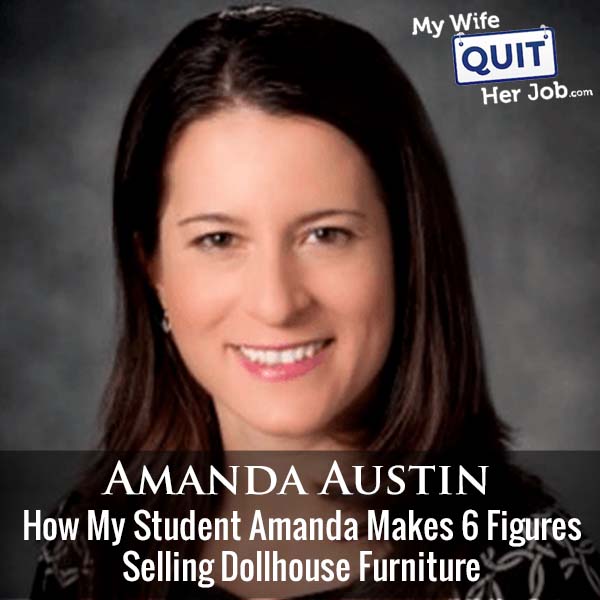
In this episode I spoke with Amanda Austin, a student in my Create A Profitable Online Store course who runs Little Shop of Miniatures. She built it to six figures in three years working 10 to 20 hours a week, and her store has grown roughly 250% a year.
Below is the whole build: how she validated the niche, how she found dropship suppliers at a trade show, why her first 18 months were slow, and the inventory sync problem that nearly ended the business.
Get My Free Mini Course On How To Start A Successful Ecommerce Store
If you are interested in starting an ecommerce business, I put together a comprehensive package of resources that will help you launch your own online store from complete scratch. Be sure to grab it before you leave!
Table of Contents
Key takeaways
- Pick a niche with strong keywords and bad competitor sites. Amanda’s competitors looked like 1990s clip art.
- She started for under $5,000 including the course and a trade show trip.
- Trade shows are where you find dropship suppliers. A dollhouse miniatures convention produced hers.
- Repeat purchase is what makes dropshipping work. Collectors buy again, headphone buyers do not.
- The first 18 months were slow, and the store took off in year three.
- SEO drives nearly all traffic. She ranks number one for terms ahead of Hobby Lobby and eBay.
- Margins run around 30%, high for dropshipping, on roughly $100 a month in software costs.
- Hire out what you cannot do. A developer she found on Fiverr solved an inventory problem that nearly ended the store.
How to choose a dropshipping niche
Find a niche where the search demand is real and the existing competitors have neglected their websites.
Amanda spent months on keyword research, keeping a large spreadsheet of candidate niches. Dollhouse miniatures kept surfacing as competitive on volume with a deep pool of related keywords.
The competitor audit sealed it. The established sites in the space looked like clip art from the 1990s with poor navigation, which told her she could build something better.
Passion was not the primary filter. Her words were that she would sell adult diapers if it made money, provided it was not something harmful.
A degree of affinity still helped. Her grandmother built her a dollhouse as a child and she spent years of allowance money filling it, which makes the customer easier to understand.
How to find dropshipping suppliers
Industry trade shows are where you meet the wholesalers who already dropship for other retailers.
Amanda joined a miniatures group, learned about a convention in Las Vegas, and went specifically to find a supplier.
Two large wholesalers import for the category. She chose the one based in Ohio, roughly two and a half hours from her house, based on proximity and rapport with the owner.
No convincing was required. They were already dropshipping for other retailers, so the arrangement was standard rather than a favor.
The relationship compounds. She started sending them an order a day and is now one of their top customers, visiting the warehouse and suggesting new products.
What it costs to start a dropshipping store
Amanda’s cash outlay was under $5,000, and monthly operating costs run under $100.
That figure covers the course and the trip to Las Vegas. The larger unpriced cost was six months of full-time work building the store before it earned anything.
Ongoing costs are minimal. Roughly $50 for Shopify, a handful of paid apps, and QuickBooks.
Margins are the part that makes it viable. She runs around 30% gross, which is high for dropshipping, and prices close to competitors while setting a much lower free shipping threshold.
Why product catalog size is an advantage in dropshipping
Over 3,000 listed products from a catalog of roughly 20,000 is what makes the SEO strategy work.
Carrying that much inventory yourself would be impossible, which is the specific reason Amanda chose dropshipping over holding stock.
Product selection follows demand signals. Shopify reports the hot sellers within each collection, so she restocks categories that convert and fills obvious gaps.
She works category by category. A session might be entirely miniature armchairs, or filling in a thinned-out category after her supplier discontinues imports.
Some products exist purely for search. She stocks dollhouse kits she does not want to sell, because they are heavy with bad returns, to capture the keywords people search.
Why repeat purchase determines whether dropshipping works
Dropshipping succeeds when customers come back, and fails when the product is a one-time purchase.
Amanda’s comparison is direct. She worked for an electronics store selling $150 headphones, where acquiring a customer cost real money and produced nothing further for years.
Miniature collectors behave the opposite way. Orders typically contain items from every category, and over 20% of her orders come from returning customers.
That behavior is what justifies her one paid channel. She uses a pay-per-sale advertising app costing a few hundred dollars monthly, which only works because buyers repeat.
How to drive traffic to a dropshipping store with SEO
Content targeting how-to questions in the niche produces traffic that paid ads cannot match on cost.
Amanda runs roughly 20 content pieces and describes them as cash cows. Dollhouse printables, how to wallpaper a dollhouse, and which glues to use each rank highly.
She had no expertise when she started. She has never built a dollhouse, wired one for electricity, or wallpapered one, and learned entirely from library books and forums.
Answering customers personally compounds the effect. Her founder story sits on the homepage, so buyers are visibly surprised when the owner replies to their question.
The results are unambiguous. She ranks number one for terms where she outranks Hobby Lobby and eBay, with essentially no advertising spend.
How to build email flows for a dropshipping store
A signup offer, a welcome series, and a weekly new-products email is the whole system.
The popup offers 10% off plus a free ebook. The discount arrives immediately and the ebook follows a day later.
The ebook is homemade and specific. A DIY dozen of miniature crafts made from household items, like a paper clip turned into a hanger, and subscribers get impatient waiting for it.
The welcome series runs about six weeks. Popular blog posts, coupon reminders, an escalated five or ten dollar offer if the first coupon goes unused, and trending products.
Automated flows cover the rest. Abandoned cart with a last-ditch coupon, plus browse abandonment which performs well.
The weekly email is deliberately odd. New products presented as random finds, which is what gets them opened. Promotions run roughly quarterly at around 10%, since her margin will not support deeper discounts.
The technical problem that nearly ended the business
Inventory sync between Shopify and an antiquated supplier system broke for roughly a year.
The third party app she bought stopped working right before a holiday season, just after her first child was born.
The consequence was continuous. Customers could order out-of-stock items from a 20,000 SKU catalog, and she was refunding portions of orders constantly.
Multiple people failed to solve it. She offered to pay anything, and American developers told her they did not know how.
A developer she found on Fiverr built a custom app that fixed it, working at roughly $10 to $20 an hour over about a month.
Her lesson is about hiring sooner. Learning things yourself is admirable and knowing your limits is what lets you focus on content, products, and store improvements.
She uses different hires for different work. The Fiverr developer for technical problems, and a Shopify expert in New York at around $50 an hour for the redesign.
What the first three years actually looked like
The store was a part-time income for roughly 18 months before anything changed.
Amanda took a job at another online store during that stretch, running email, promotions, and ads for a company doing millions in electronics, which she treated as an apprenticeship.
The inflection came during a holiday season. Something shifted in her rankings, the store outearned her day job, and she left.
The pandemic accelerated it further. She expected it to end the business and instead heard from customers stuck at home wanting to return to the hobby, and sales never slowed.
The growth rate settled at roughly 250% a year.
Why self-doubt is harder than the technical work
Amanda names the mental side as the hardest part of the journey, above any operational problem.
Her situation made it worse. A Fortune 500 job with a pension and strong job security, in a region without entrepreneurial culture, meant colleagues thought she was making a mistake.
Isolation compounded it. Doing everything alone, uploading thousands of products, has none of the incidental camaraderie of an office.
Her counterweight was community. Course office hours, forums, and other people doing the same thing gave her the evidence that it was possible.
Her framing on discouraging advice is worth keeping: most people warning you off are speaking from their own fears.
Why to start before your circumstances get harder
Amanda is direct that she could not have built this store with two young children.
The build required six months of full-time work getting the site and products up before it earned anything.
Preparation extends the runway. Before her second child, she queued weeks of emails knowing the first six weeks would leave time for nothing but customer complaints and sales tax.
Her forward plan reflects the constraint. A second dropship store is on the table, deliberately with about 10 products rather than 3,000, and importing directly is a five-year possibility once her children are in school.
Frequently asked questions
How do you choose a dropshipping niche?
Look for strong keyword demand paired with weak competitor websites. Amanda Austin spent months on keyword research and chose dollhouse miniatures partly because the established sites in the space looked like 1990s clip art.
How much does it cost to start a dropshipping business?
Amanda spent under $5,000 in cash, including a course and a trade show trip, plus about six months of full-time work before the store earned anything. Ongoing costs run under $100 a month.
Where do you find dropshipping suppliers?
Industry trade shows. Amanda attended a dollhouse miniatures convention specifically to meet wholesalers, and the supplier she chose was already dropshipping for other retailers, so no negotiation was needed.
What products work best for dropshipping?
Products people buy repeatedly. Collectors ordering across many categories produce ongoing revenue, while a $150 pair of headphones produces one sale and years of silence from that customer.
Can you make money dropshipping without paid ads?
Yes. Amanda’s traffic comes almost entirely from SEO, with roughly 20 content pieces answering how-to questions in her niche. She ranks number one for terms ahead of Hobby Lobby and eBay.
What margins can you get with dropshipping?
Amanda runs around 30% gross, which is high for dropshipping. She prices close to competitors and differentiates with a much lower free shipping threshold rather than lower prices.
How long does a dropshipping store take to make money?
Hers was a small part-time income for about 18 months and took off in year three. That matches the general pattern of ecommerce stores gaining traction somewhere between years two and three.
Should you hire developers for a dropshipping store?
Yes, once you hit your limits. Amanda’s inventory sync problem persisted for roughly a year until a developer she found on Fiverr built a custom app at $10 to $20 an hour, and she wishes she had hired sooner.