
Podcast: Download (Duration: 45:27 — 104.3MB)
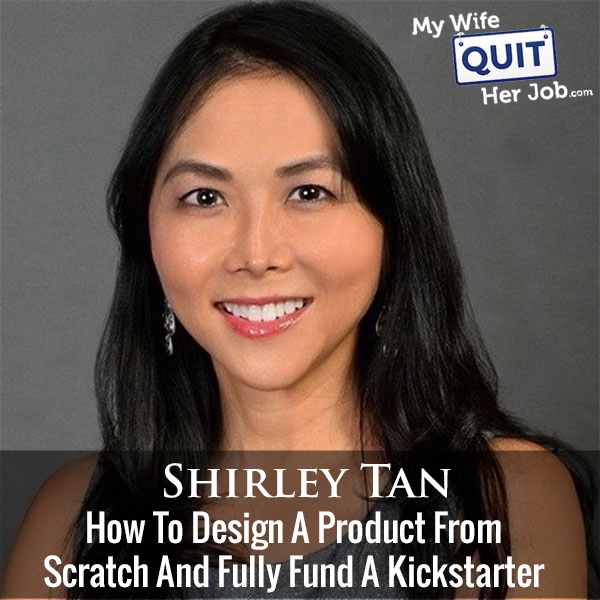
You can manufacture a product from scratch without any design or engineering background by building crude prototypes yourself, iterating until the design works, and handing that physical prototype to a factory that reverse-engineers it into a production spec. Shirley Tan did exactly that with the Posture Keeper, a chair-mounted support that stops you from slouching forward at your desk. She sewed her first version out of straps she bought herself and carved the memory foam lumbar pillow down with a kitchen knife.
Shirley is not an inventor by trade. She built and sold American Bridal, a wholesale and retail wedding products business doing about $6.5 million a year, to TheKnot.com in 2009. Her entire product history before this was private labeling existing goods sourced from the Canton Fair.
In this episode she walks through the full path from hand-sewn prototype to funded Kickstarter: three prototype versions, a provisional patent that cost under $2,200, a 30-unit factory sample run, and a campaign that hit its funding goal in 18 hours off a personal contact list rather than a real audience.
Get My Free Mini Course On How To Start A Successful Ecommerce Store
If you are interested in starting an ecommerce business, I put together a comprehensive package of resources that will help you launch your own online store from complete scratch. Be sure to grab it before you leave!
Table of Contents
Key takeaways
- You do not need engineering skills to invent a physical product. Shirley learned to sew straight lines on a sewing machine and hand-carved foam to build her first three prototypes.
- Handing a factory a physical prototype works. They reverse-engineer the bill of materials and source the components themselves.
- A provisional patent costs roughly $1,500 to $2,200 and locks in your filing date for one year while you finalize the design.
- A warm introduction to a factory removes most of the friction around sample costs, minimum order quantities, and trust.
- Shirley funded her Kickstarter in 18 hours mostly from a 3,000-person personal email list built from her own Gmail contacts, plus a 350-person Facebook ads list.
- Facebook lead ads for the pre-launch list cost $5 to $7 per email at first, optimized down to about $3.
- Kickstarter removes inventory risk because the campaign is a pre-order, so you only commit to a production run after the money is in.
- Kickstarter will not feature a product it considers borderline medical, even when the product makes no medical claims.
How do you build a product prototype with no design experience?
You build a product prototype with no design experience by buying raw materials and assembling them by hand until the thing does what you need it to do. Shirley’s first Posture Keeper prototype was a backpack she wrapped around her office chair to hold herself upright, built after years of chronic pain and physical therapy failed to fix her posture.
Her first real attempt was made almost entirely of straps, modeled on the posture correctors already selling in the market. She bought webbing material, buckles, and components, and sewed them together herself.
She did not know how to sew. She taught herself to operate a sewing machine and can still only manage straight lines.
That strap version died after four months. It had too many moving parts and looked like a mess when you put it on the chair, so she scrapped it and started over.
How Shirley solved the lumbar support thickness problem
The lumbar support problem was that every memory foam pillow on the market is over five inches thick, which pushes you off the front of a standard office chair. Shirley needed a thinner profile, and no supplier sells foam at that spec off the shelf.
Her solution was to shave the foam down by hand. She tried a utility knife first and eventually found a kitchen knife gave the cleanest cut.
That single detail is why the first factory run was only 30 units. The foam still had to be cut manually to her specification rather than run through standard production.
How do you get a factory to manufacture your invention?
You hand the factory your physical prototype and they work backward from it to a production spec. Shirley did not commission patterns, CAD drawings, or an engineering package. She brought the prototype she had built herself and asked whether they could make it.
Nailing down manufacturing came before the Kickstarter, deliberately. She would not launch a campaign until she knew the factory could actually deliver what she was showing on the page.
Her factory came through an introduction from Kevin Harrington, an original Shark Tank investor. She flew to China, met the owner, and toured the operation to confirm it was a real factory with real standards rather than a small cottage workshop.
Why a warm introduction to a Chinese factory changes the terms
A warm introduction gets you sample runs, flexible minimums, and free development work that a cold inquiry rarely does. Normally you pay for every sample, every design revision, and you commit to a minimum order quantity before anything gets made.
Shirley was effectively borrowing Kevin Harrington’s credibility, and the factory owner made the whole process easy on that basis. The owner also had his wife try the prototype, and she wanted one, which Shirley credits with sealing his buy-in.
The introduction also settled the IP question. Shirley would ordinarily worry about a factory copying her idea, and the referral gave her enough confidence to hand over the design.
Her own read is that this was luck rather than anything special about her. Plenty of importers get similar accommodation from factories under the right circumstances.
Should you visit your factory in China in person?
Visiting in person builds the relationship that determines how flexible your factory will be, even though the mechanics could probably be handled remotely. Shirley’s factory contact picked her up at her hotel and they shared meals together, and she attributes a lot of the goodwill to that time.
Her biggest ongoing manufacturing challenge is communication rather than capability. She describes herself as a stickler who double and triple checks every detail, and the factory owner regularly has to reassure her he has it handled.
How component sourcing affects your manufacturing timeline and price
Factories do not make every part of a multi-piece product, so your timeline and unit price both depend on components they have to buy from other suppliers. Shirley’s factory handles all the kitting and assembly for the Posture Keeper, which has many separate pieces.
Availability, timing, and the factory’s own resourcefulness all feed into the quote. Sourcing components takes real time even when everything is technically made in China.
Your first quote is also not permanent in either direction. Once volume rises, the factory can go back to its component suppliers with a bigger order and renegotiate, so a 20,000-unit run gets pricing a 500-unit run cannot.
One cost most first-timers underestimate is freight. Shirley’s initial 35-unit sample run was priced fairly by the factory, and air freight on those units cost far more proportionally than the goods themselves.
How does a provisional patent work and what does it cost?
A provisional patent locks in your filing date for one year while you finish the design, and it cost Shirley somewhere between $1,500 and $2,200. Kevin Harrington told her to file one immediately, before showing the product to anyone else.
She filed under her own name before the product even had a final name. The provisional does nothing except establish that you are pursuing the concept as of that date.
At the end of that year she filed the full utility patent, which requires much more: drawings, a description of how each component works, and what each part does. By then she had a near-final design to describe.
The one-year clock is the part to plan around. Letting a provisional lapse creates a gap in your claim that a competitor could potentially file into, so treat the deadline as firm.
Kickstarter or Amazon: which should you use to launch a new product?
Launch on Kickstarter when your product is genuinely new, and launch on Amazon when you are entering an established category with existing search volume. Shirley debated this for a couple of months and chose Kickstarter despite already knowing how to sell on Amazon.
Inventory risk was the deciding factor. A Kickstarter is a pre-order, so she carried no inventory unless the campaign funded, while Amazon would have required committing to roughly 3,000 units up front and pushing the factory into a full production run.
The second reason was social proof. Getting strangers to pay for a product they have never seen validates that the mass market will adopt it, which a private-label product on Amazon cannot tell you.
The category itself would have supported Amazon. Posture correctors and posture trainers are a real search category with a growing number of listings, so the choice was strategic rather than forced.
How Shirley funded her Kickstarter in 18 hours
Shirley hit her funding goal in 18 hours by emailing roughly 3,000 personal contacts accumulated over a decade in business, not by building an audience. Her rule for that list was simple: if you had ever exchanged email with her on Gmail, you were on it.
Those were colleagues, conference contacts, and people she had done business with across her bridal company and consulting years. A large share of the funding came from that group.
She had not planned to fully fund on day one. Around five in the afternoon she saw the number at 70% and started re-emailing everyone she had already contacted to push it over the line.
What did Facebook ads cost to build a Kickstarter pre-launch list?
Facebook lead ads cost Shirley $5 to $7 per email address early on, which she optimized down to roughly $3. That list reached just under 350 subscribers before launch.
She kept the ads-sourced subscribers in a separate segment from her personal contacts. Attributing pledges back to it proved difficult because backers often pledge under a different email than the one they signed up with.
By the standards of most funded campaigns, 350 is a very small pre-launch list. The personal network is what carried the campaign.
Does Kickstarter promote your campaign for you?
Kickstarter gives new campaigns an initial visibility push through category rankings, and holding that position depends on sustaining momentum against newly launched projects. Shirley ranked in product design and got the benefit of the doubt early on.
She was aiming for a Projects We Love staff pick and learned she was ineligible. Kickstarter treats anything it perceives as borderline medical as disqualified from that program, and the Posture Keeper landed in that bucket despite making no medical claims.
That is worth knowing before you launch. If your product touches health, pain, or the body in any way, plan your promotion assuming you will get no staff feature.
How do you keep a Kickstarter campaign selling after the initial push?
After the launch spike, most campaigns bring in a Kickstarter marketing agency with access to super-backer lists and cross-promotional swaps with other live campaigns. Shirley signed with one for exactly that reason.
She initially planned to run the whole campaign herself as a general contractor, drawing on her project management background from home renovation work. What changed her mind was recognizing that campaigns starting with a large existing community can leverage it, and campaigns without one need to buy that reach.
Agencies take a meaningful cut, so the campaign economics tighten. Shirley’s rationale was getting units into hands and collecting emails, on the theory that post-campaign demand comes from people who missed the Kickstarter and will pay full price later.
How do you build credibility for a health-adjacent product?
Shirley built credibility with chiropractor endorsements earned during development rather than solicited afterward. She developed the Posture Keeper with a chiropractor who had told her that sitting upright and not leaning forward would stop her nerves from pinching.
That chiropractor also defined the design constraints. He explained why a backpack alone would not work: it lacks lumbar support, it has to be comfortable, and you have to be able to get in and out of it easily.
Demonstration does the rest of the convincing. People are skeptical when they see it and change their mind within seconds of sitting in it, because it physically will not let them lean forward.
How do you design a product to fit all body types?
Designing for all body types was Shirley’s hardest engineering problem, because her original backpack prototype only worked because she is small. A backpack wrapped around a chair falls off, does not hook properly, and fails entirely on tall chairs or six-foot users.
Solving that meant rethinking the attachment and the geometry rather than scaling the same design up. The final version mounts to the chair in a way that works across chair heights and user sizes.
What is the post-Kickstarter plan for a physical product?
The standard post-Kickstarter sequence is to fulfill all backer pledges first, then open a direct-to-consumer store, then list on Amazon. Shirley planned to convert her Shopify site into a full shopping cart after delivery.
Her channel strategy avoids competing against herself. Amazon gets the single core variant, likely black, which is the highest-volume seller, while the Shopify store carries the additional colors and personalization options.
That split gives the direct store a reason to exist beyond price. Selling on Amazon is effectively mandatory in ecommerce today, and the differentiated variants are what make the owned channel worth running.
Frequently asked questions
Do you need a patent before contacting a factory?
Filing a provisional patent before you show your product to anyone is the safer sequence, and it costs roughly $1,500 to $2,200. It gives you one year to finalize the design and file the full utility patent.
Can a factory manufacture a product from a homemade prototype?
Yes. Shirley Tan handed her factory a hand-sewn prototype with hand-carved foam and they worked out the bill of materials and production spec from it, with no drawings or CAD files.
What is the minimum order quantity for a first production run?
Standard minimums usually run into the thousands, though a factory that believes in your product may accommodate a small sample run. Shirley’s factory made 35 units for her because the introduction came through a trusted contact.
How much does it cost to build a Kickstarter email list with Facebook ads?
Shirley paid $5 to $7 per lead when she started and got the cost down to about $3 per email. That is high compared to what many campaigns report.
How big does your email list need to be to fund a Kickstarter?
There is no fixed number, since the quality of the relationship matters more than the size. Shirley funded in 18 hours off roughly 3,000 personal contacts plus a 350-person ads list, because those contacts actually knew her.
Why did Kickstarter not feature the Posture Keeper as a staff pick?
Kickstarter excludes products it considers close to medical devices from its Projects We Love program. The Posture Keeper was judged borderline even though it is not marketed as a medical product.
Is Kickstarter better than Amazon for launching a brand new product?
Kickstarter suits genuinely novel products because it validates demand and eliminates inventory risk before you commit to a production run. Amazon suits products entering categories where shoppers are already searching for that item.
Should you sell the same product on Amazon and your own store?
Sell your core variant on Amazon and reserve colors, personalization, and add-ons for your own store. That way the two channels do not cannibalize each other and your direct store has a reason to exist.