
Podcast: Download (Duration: 53:11 — 61.1MB)
Instagram DM automation lets businesses automatically reply to direct messages, story mentions, and comments through an official Facebook API, which means you can qualify leads, collect emails and phone numbers, and close sales inside the DM thread. Facebook announced the API at F8 in June 2021 and rolled it out to all business accounts by that August.
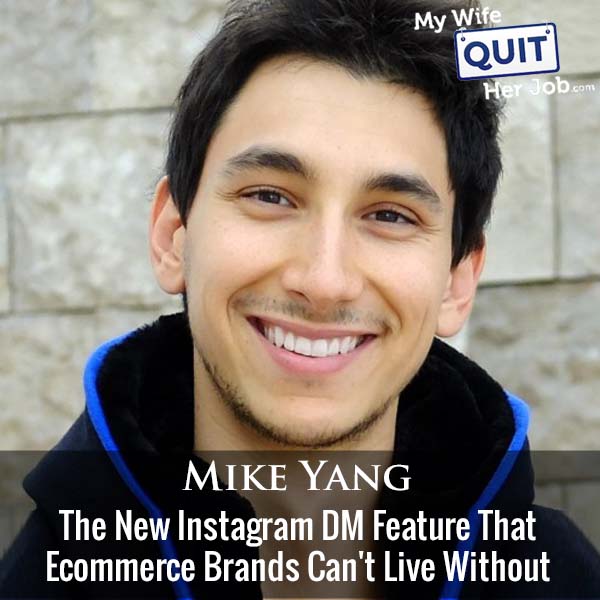
In this episode I brought Mike Yan, founder and CEO of ManyChat, back on the show. ManyChat is the chat marketing platform I use for both my store and my blog.
Below is the whole picture: why this matters more than Messenger automation did, what you can and cannot do, real campaign results from beta customers, and why Instagram’s organic reach makes the economics work.
Get My Free Mini Course On How To Start A Successful Ecommerce Store
If you are interested in starting an ecommerce business, I put together a comprehensive package of resources that will help you launch your own online store from complete scratch. Be sure to grab it before you leave!
Table of Contents
Key takeaways
- DM automation is officially sanctioned now. Automating Instagram DMs used to get accounts banned.
- Instagram organic reach runs 20% to 40% against roughly 1% to 3% for a Facebook page.
- No message tags on Instagram, which removes the main reason Messenger accounts got blocked.
- A one-line story mention auto-reply lifted engagement 30% to 40% for one influencer.
- A Costa Rica gym grew Instagram bookings 9x, reaching 40% of total bookings.
- One giveaway collected 2,500 emails and 4,000 story mentions by tiering entries.
- Instagram drove 70% of Facebook’s ad revenue growth in 2020, roughly $10B of $14B.
- Always capture email and phone. Every platform advantage eventually closes.
Why Instagram DM automation matters more than Messenger
Instagram’s organic reach is the difference. Stories and posts reach 20% to 40% of your followers, against roughly 1% to 3% for a Facebook page.
That reach solves the problem that made Messenger difficult. Messenger became pay-to-play, so reaching your existing subscribers required setting up an ad, which is enough friction that I frequently skipped it.
On Instagram, your stories, posts, reels, and lives are the re-engagement channel and they are free. You use organic reach to start the conversation and DM automation to close it at scale.
The shopping behavior compounds this. Instagram has become a genuine shopping platform, and a large share of ecommerce transactions there already happen in DMs. Automating that is a bigger unlock than automating a channel people mainly use to talk to friends.
Mike’s framing is that DMs were always the bottleneck. Small businesses cannot staff instant replies around the clock, and larger companies pay a fortune to.
What changed with the Instagram API
Facebook announced the Instagram messaging API at F8 on June 2, 2021, making DM automation officially permitted for the first time.
The rollout ran in stages through that summer: accounts with 10,000 to 100,000 followers first, then 1,000 to 100,000 in July, then all business accounts by the end of August.
The significance is the reversal. Before this, automating Instagram DMs violated platform policy and got businesses banned, which did not stop people from trying because it works so well.
Why Instagram DM automation is harder to get banned for
Instagram has no message tags, which removes the single most common reason Messenger accounts were blocked.
Message tags on Messenger allow businesses to message people beyond the 24-hour window for specific approved purposes like account updates or post-purchase notifications. Misunderstanding those rules was the top cause of bans.
Instagram simply does not permit messaging beyond 24 hours at all. That is less flexibility and a genuine safety net, since the API will not fire outside the window rather than letting you violate a rule you misread.
Manual messages from the app are treated separately, so this constrains automation rather than your own conversations.
Campaign 1: The story mention auto-reply
The simplest possible automation raised one influencer’s story engagement 30% to 40%.
Fraser Brooks has over 100,000 followers and gets tagged in stories constantly, which previously went unnoticed among his notifications.
His setup: when someone mentions him in a story, wait a few minutes, then send a thank you. He wrote several variations because his core fans mention him multiple times a week and he did not want repetition.
That is one flow taking roughly a minute to build. A story mention counts as an interaction, which opens the 24-hour window for further conversation.
Campaign 2: The keyword link
A keyword trigger sends a link to anyone who DMs a specific word, which produced 200 website visits in half an hour for Fraser’s online summit.
The story said to DM him “Summit” for the link. Everyone who did received it automatically.
This is particularly useful for accounts without link stickers, since a keyword reply delivers a link that the account could not otherwise share in a story.
The follow-up is where it compounds. Sending the link opens the 24-hour window, so you can ask whether they plan to attend, offer quick reply buttons, collect their email, and pass it to both your webinar software and your email platform without the person ever leaving Instagram.
Campaign 3: The appointment booking flow
A Costa Rica gym grew bookings from Instagram 9x, to the point where Instagram became 40% of their total bookings.
COVID capacity limits meant every member had to schedule visits in advance rather than dropping in.
Their story asked people to DM “appointment,” then the automation asked which of their three city locations, then sent the matching calendar link.
The economics are the point. Staffing instant replies around the clock across three locations is not viable for a gym, and ManyChat starts around $10 to $15 a month.
Campaign 4: The tiered giveaway
An ecommerce brand collected over 2,500 emails and generated over 4,000 story mentions from a single giveaway by tiering the entries.
The structure: a post offered a shopping spree, and commenting with tagged friends triggered an automated DM confirming one entry.
That DM then offered five more entries in exchange for an email address, which is where the 2,500 emails came from.
The next message offered five more entries for mentioning the brand in a story, using the story mention trigger to verify. That produced the 4,000 mentions.
Each step is voluntary and each one increases the prize odds, which is what makes people move through it.
What Instagram DM automation can do
Most of the Messenger feature set carried over, with a few gaps.
Available:
- Quick replies. Tappable buttons so customers choose rather than type, which is how you qualify people. A marketing agency can ask about budget and offer bands as buttons.
- Keyword triggers. Specific words in a DM launch specific flows.
- User input capture. Collect emails and phone numbers and route them to your CRM or email platform, including using the person’s Instagram first name in the email.
- Follow-ups within 24 hours, plus conditional logic, delays, and actions.
- Media. Pictures, videos, and audio.
- Generic template cards. An image, title, description, and buttons, which works well for displaying a product with a buy button.
- External integrations. Because the platform only needs Instagram’s ability to send text, anything you could build on Messenger works, including calling your own server to generate a unique coupon code.
- Live chat takeover. Step in manually at any point.
- Click-to-DM ads. The ad presents conversation-starter options rather than opening directly, and everything downstream works the same.
Missing: horizontal scrolling galleries, message tags, and one-time notifications.
Why Instagram’s organic reach stays high
The same attention divided among fewer posts produces higher reach per post.
Average daily time is comparable across both apps, roughly 28 minutes on Instagram and around 31 on Facebook.
The difference is supply. Posting to Facebook can be a single emoji or a reshare with nothing added, which floods the feed with low-value content. An Instagram post requires a photo and a caption, so there is meaningfully less of it and the average quality is higher.
Mike is candid that he expected Instagram’s organic reach to have declined already and it has not.
Why Instagram matters so much to Facebook
Instagram accounted for 36% of Facebook’s total ad revenue and drove roughly 70% of its growth.
Facebook’s ad revenue grew from about $70 billion in 2019 to $84 billion in 2020. Instagram contributed roughly $10 billion of that $14 billion increase.
The projection at the time was Instagram passing 50% of total Facebook ad revenue by 2023, which would make the platform Facebook bought for a billion dollars its primary business.
Roughly 50 million businesses use Instagram, and Instagram revenue was growing about 50% year over year off a base already in the tens of billions.
Why you should use a platform advantage while it lasts
Every free reach window eventually closes, which is an argument for moving early rather than an argument for skipping it.
My own history is a pattern of getting burned. Facebook pages drove enormous traffic before the reach was throttled, and groups worked next until that reach was cut too.
Messenger was extraordinary five years ago and then became pay-to-play.
Mike’s response is that you get three or four good years, and that is worth having. Plenty of businesses exist because they caught Messenger’s 80% open rates and 20% click-through rates early.
The safeguard is what to build while you have the advantage. Whatever channel starts the conversation, always capture the email and the phone number, because those are the assets you own rather than rent.
One reason this cycle may differ: Instagram now has real competition from TikTok, which is plausibly why reels reach is so generous. Competition tends to keep organic reach alive longer than monopoly does.
Where Messenger still works
Messenger remains valuable where your audience actually uses it, which varies enormously by country.
It performs well in the US, UK, Australia, Canada, and across Southeast Asia including the Philippines and Vietnam. Elsewhere another Facebook property such as WhatsApp may dominate.
The European restrictions Facebook imposed in December 2020 were rolled back during the first half of 2021, once servers were relocated off US soil to satisfy European law. The experience is now comparable in the US and EU.
SMS is worth understanding as a US-specific advantage. American SMS is cheap and a local number rents for about $1 a month, while in some European countries the same number costs $40 to $60 monthly before sending anything.
Frequently asked questions
What is Instagram DM automation?
Automated replies to Instagram direct messages, story mentions, and comments through an official Facebook API. It lets businesses qualify leads, collect emails and phone numbers, and complete bookings or sales inside the DM thread without manual replies.
Is automating Instagram DMs against the rules?
Not since Facebook released the official messaging API, announced at F8 in June 2021. Before that, automating DMs violated platform policy and got accounts banned. The API made it legitimate for all business accounts by that August.
Can you message someone on Instagram after 24 hours?
No. Instagram has no equivalent of Messenger’s message tags, so automated messaging is limited to 24 hours after the person’s last interaction. That is less flexibility and also removes the most common cause of account bans on Messenger.
What is Instagram’s organic reach?
Roughly 20% to 40% through stories and posts, against about 1% to 3% for a Facebook page. The likely reason is supply: posting to Instagram requires a photo and caption, so there is less content competing for the same amount of user attention.
What can you automate in Instagram DMs?
Keyword triggers, quick reply buttons, email and phone capture routed to your CRM, follow-ups within 24 hours, conditional logic and delays, images and video, product cards with buy buttons, external API calls for things like unique coupon codes, and live chat takeover.
What can’t you do with Instagram DM automation?
Horizontal scrolling galleries, message tags for messaging beyond 24 hours, and one-time notifications are all unavailable. Those exist on Messenger and did not carry over at launch.
How much of Facebook’s revenue comes from Instagram?
Instagram accounted for 36% of Facebook’s ad revenue and drove roughly 70% of its growth, contributing about $10 billion of the $14 billion increase from 2019 to 2020. It was projected to pass 50% of total ad revenue by 2023.