
Podcast: Download (Duration: 55:20 — 63.6MB)
Competing on Amazon without black hat tactics now works better than it did five years ago, because Amazon has become a pay-to-play platform where ads sit above the fold. That is genuinely good news for white hat sellers: you can buy visibility that used to require gaming the organic algorithm.
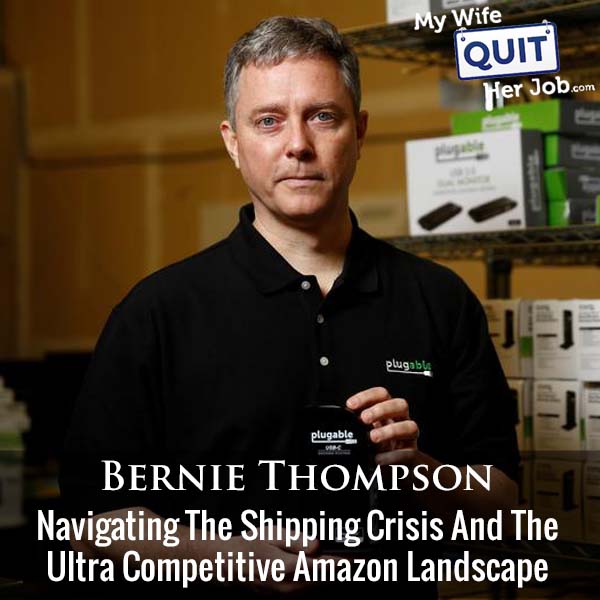
In this episode I brought Bernie Thompson back on the show. He runs Plugable, an eight-figure electronics brand selling USB and Bluetooth devices worldwide, in what may be the most competitive category on Amazon.
Below is the full picture: how black hat has evolved, the Vine program for launch reviews, content marketing for technical products, the sales tax problem that keeps Plugable off Shopify, and the supply chain situation.
Get My Free Mini Course On How To Start A Successful Ecommerce Store
If you are interested in starting an ecommerce business, I put together a comprehensive package of resources that will help you launch your own online store from complete scratch. Be sure to grab it before you leave!
Table of Contents
Key takeaways
- Pay-to-play is better for white hats. Ads are a level field where gaming organic rank was not.
- Black hat went in-house. Big brands moved rebate programs internal after third-party services were exposed.
- Amazon Vine solves the launch review problem with up to 30 units and no seller control over reviewers.
- Chinese factories now launch their own brands, which worries Bernie more than Amazon Basics.
- Sales tax nexus blocks Shopify. Using FBA obligates you in every warehouse state.
- Back-in-stock alerts are the best email capture Plugable has found.
- Add 8 to 10 weeks to shipping timelines, and Amazon counts transit time against inventory limits.
- Small bid changes cause impression cliffs. Five cents can cut impressions tenfold.
Why timing mattered for building an Amazon brand
Bernie’s assessment is that Plugable succeeded partly because it launched in 2009, and would likely have failed starting a few years on either side.
Starting earlier would have required building logistics infrastructure and breaking into traditional electronics distribution before he had the resources, which he thinks would have stalled the business.
Starting later would have dropped him into the middle of the Amazon gold rush around 2014. Plugable has never bought reviews or run black hat tactics, and he believes a new white hat brand would have been run over.
Even with a head start it was close. Plugable grew every year since 2009 and grew slowly through the gold rush years, because competitors were effectively pushing them off the platform. Existing brand momentum is what carried them through.
How black hat tactics have changed on Amazon
Black hat activity is quieter and more sophisticated than it was in 2014, and it has largely moved in-house rather than disappearing.
The old version was blatant, with brands openly refunding purchases in exchange for five-star reviews.
What changed the calculus was enforcement. Several very large brands including Mpow and Aukey were suspended for activity they had run for years, reportedly after a third-party rebate service suffered a data breach that exposed exactly who was doing what. Rumor is the FTC became involved, which forced Amazon to act.
Bernie’s read is that Amazon had historically been slow to act, valuing the price pressure these brands created more than policing their behavior.
The consequence is that surviving brands brought rebate operations in-house as loyalty programs, where they control the lists and the data.
The deterrent effect has limits. Chinese companies are largely unreachable and untraceable even for Amazon, and a banned brand can return in another form.
Why five-character Chinese brands flooded the platform
The pattern in electronics over recent years is a flood of brands with five essentially random characters as a name, a US trademark, and brand registry enrollment.
The US trademark office is genuinely overwhelmed with Chinese applications, and Bernie’s explanation is simple: Amazon dominates US physical goods retail, any Amazon strategy requires brand registry, and brand registry requires a trademark.
The risk calculus favors it. These brands have little to lose, since getting caught means getting kicked off and returning under a new name.
Why pay-to-play helps white hat sellers
Ads occupying most of the space above the fold create a level playing field, which is better for honest sellers than an organic algorithm everyone was gaming.
Four or five years ago, competitors manipulating organic rank pushed Plugable’s newer products far down the results with no way to surface them short of doing the same.
Now anyone can buy that position. It costs money, and it is not susceptible to black hat.
The caveat Bernie raises is click fraud. Amazon is completely non-transparent about how much occurs, and competitors have obvious motivation to run what he calls a denial of money attack using click farms against rivals’ ads. Nobody knows the scale.
How to get reviews when launching on Amazon
Amazon Vine is the sanctioned solution, allowing roughly 30 units to be distributed to reviewers Amazon selects rather than reviewers the brand controls.
Plugable spent years lobbying Amazon executives to bring Vine to third-party sellers, and it is now available. Brand registry is a prerequisite, which is one of the strongest arguments for registering.
The problem it solves is measurable. Advertising a product with zero reviews means paying far more per sale at a much lower conversion rate.
How to use content marketing for technical products
Product education becomes content marketing when you treat each customer question as a story with a specific audience.
The underlying anxiety in electronics is that buyers fear choosing wrong. Will this dock work with my laptop? Will it drive two monitors, or three, on Windows and on Mac?
Plugable’s approach is segmenting by platform. Video content aimed specifically at Mac owners, other content aimed at Chromebook owners, prioritized by which audiences and which stories are most interesting.
Competitor product launches create the best openings. When Apple launches a new MacBook, the question of what works with it is a natural opportunity to talk about your products.
Bernie’s motto captures the strategy: better products, better information, better support. Since no single dramatic advantage is available in electronics, the goal is being slightly better across dozens of small dimensions.
How to segment an email list for product launches
Segment by what you know about the customer, since Mac-specific content sent to a Mac user reads as service rather than spam.
Bernie’s original resistance was not wanting to bother people, which left a 50,000-subscriber list essentially unused for years. I scolded him about it on a previous episode and it took a year or two before it changed.
Plugable now runs ActiveCampaign with tight segmentation, treating themselves almost as journalists for each audience.
The practical advice for smaller operations is to loosen up. Tight segmentation is genuinely a lot of work, which is exactly why he avoided it. Even coarse segmentation into a few broad categories meaningfully improves open and conversion rates, and you can refine as you grow.
The best acquisition source is counterintuitive: back-in-stock notifications. Signing up to be told when a hot out-of-stock product returns is Plugable’s most effective email capture channel.
The sales tax problem that keeps sellers off Shopify
Using a fulfillment network with warehouses in a state creates a sales tax obligation in that state, which is why Plugable runs Shopify with the cart turned off.
The bind is structural. Amazon trained consumers to expect one or two day delivery, which requires warehouses near customers. FBA has warehouses in roughly 40 states, and other networks like Deliverr cover eight to ten.
Every one of those states expects you to register, collect, file, and remit. Software vendors claiming to solve this handle the calculation side and cannot remove the registration and filing burden, and your signature is on the returns.
Marketplaces are exempt from this problem for you. Marketplace facilitator laws now make Amazon, Walmart, and eBay responsible for collecting and remitting, which takes it off the seller’s plate entirely.
Shopify and WooCommerce are not marketplaces, so the obligation stays with you. Practically, if you use FBA and are not registered in 40 states, running Shopify puts you in state tax trouble.
Why unpaid sales tax becomes a problem later
Accumulated tax liability surfaces when you sell the business, because acquirers deduct it from the transaction value to clear the risk.
The current environment makes this acute. Bernie sees an asset bubble in ecommerce acquisitions with large funds actively buying, and that liability gets taken out of your proceeds at closing.
The trap is that you cannot easily exit it. Registering on a go-forward basis once you are big enough invites states to look backward and assess what you should have collected.
The mechanism is worse than it sounds. Sales tax is nominally a consumer tax that businesses collect, and when states decide you should have been collecting, they make you pay it out of your own pocket.
Bernie’s suggested fix is that Shopify should become a marketplace facilitator, which would solve this for millions of small companies. Plugable would turn their cart on immediately.
What is happening with shipping and inventory limits
Add eight to ten weeks to pre-pandemic shipping timelines. Plugable’s factory-door-to-Amazon window went from about five weeks to substantially longer.
The delay accumulates at every stage: two to four weeks scheduling a container at origin, added time on the water, ships anchored off the Port of LA, then constrained chassis and trucking once goods land.
For electronics there is a second crisis layered on top. Bernie has been in the industry about 30 years and has never seen anything comparable to the current chip shortage.
Amazon’s inventory limits collide with this badly. The clock starts when you generate a label, so labeling at the factory means two months of transit time counting against your FBA limits.
The workaround is labeling domestically at the last possible moment through a 3PL or your own warehouse. Plugable has had its own US warehouse for six years, and lacks one in Canada, the UK, Europe, Australia, Singapore, and Japan, where they hit the same wall other sellers hit domestically.
The limits create a perverse outcome. Ship in a thousand units, have your limit cut by two thousand, and your bestsellers go out of stock while slow sellers occupy your remaining slots. Bernie wonders aloud whether pressuring brands into discounting slow movers is systemic rather than accidental.
Why moving manufacturing out of China got harder
Plugable hit its goal of manufacturing more than 50% of products by revenue outside China, and shipping from those countries is worse than shipping from China.
The reason is container routing. Shipping companies concentrate containers on the China-US route because it is the largest and containers fill reliably, so schedules and equipment out of Thailand, Vietnam, and Taiwan are harder to secure. Plugable is running about two weeks longer from those origins.
Chinese brands hold a separate structural advantage: they can warehouse goods at the factory and release them worldwide as needed. Companies without a Chinese corporation cannot, because tax and export regulations push factories to export so they can recover VAT paid on materials.
Who actually competes with an Amazon brand
Bernie’s biggest competitive worry is his own factories launching their own brands rather than Amazon Basics.
Amazon did directly target Plugable’s top seller in a prior episode’s story, and has not been as explicit since. They continue launching products in the category without being the primary threat.
The factory dynamic is a byproduct of how electronics works. Chip vendors make the multimillion dollar investments and publish reference designs, and factories and brands tweak those designs rather than laying out boards from scratch.
So factories are not copying Plugable’s products. They build closely related products from the same reference designs for every brand they serve, including the brands they now own themselves, sometimes openly and sometimes quietly held by the factory owner.
Anker is the model other Chinese brands follow, having genuinely mastered Western marketing. Bernie has known founder Steven Yang since before Anker existed and considers them gray hat at most, always with the customer in mind.
How to manage Amazon PPC bids at scale
Small bid changes can cause impression cliffs, so you need visibility into what a bid change actually did rather than only what it cost.
The failure mode: drop a bid from 90 cents to 85 to improve ACOS, and impressions fall to a tenth of previous levels. A five percent bid cut drops you below a pack of competitors clustered in that range, and you lose the placement entirely.
Bernie’s tool, PPC Ninja, ingests all Amazon advertising reports, normalizes and connects the data across all time rather than one report for one period, and charts any metric including bid history so those cliffs are visible.
The bid automation changed in an important way. It previously used fixed lookback windows of two weeks, and now triggers on data sufficiency instead: enough impressions, clicks, and sales to justify a judgment.
The practical effect is speed where speed is warranted. A keyword generating a few hundred impressions, 50 clicks, and two sales in one day gets a recommendation that day, while a slow-moving long-tail keyword waits four weeks rather than getting a recommendation based on insufficient data.
Frequently asked questions
Can you compete on Amazon without black hat tactics?
Yes, and more easily than five years ago. Amazon became a pay-to-play platform where ads occupy most of the space above the fold, which is a level playing field. Previously, competitors gaming organic rank buried honest sellers with no way to surface products.
How do you get reviews when launching on Amazon?
Amazon Vine, which distributes up to roughly 30 units to reviewers Amazon selects rather than reviewers you control. Brand registry is required. Advertising a product with zero reviews costs far more per sale at a much lower conversion rate.
Why can’t you use Shopify if you sell on Amazon FBA?
Storing inventory in a state creates a sales tax obligation there, and FBA has warehouses in about 40 states. Marketplace facilitator laws make Amazon and Walmart responsible for collecting and remitting, while Shopify is not a marketplace, so the obligation stays with you.
What happens if you ignore sales tax nexus?
The liability surfaces when you sell your business, since acquirers deduct accumulated exposure from the transaction value. Registering later invites states to assess retroactively, and they make the business pay a nominally consumer tax out of its own pocket.
How long does shipping take from China now?
Add eight to ten weeks to pre-pandemic timelines. Delay accumulates at every stage: container scheduling at origin, ocean transit, ships anchored at port, then constrained trucking. Shipping from Vietnam, Thailand, or Taiwan runs about two weeks longer than from China.
How do Amazon inventory limits interact with shipping delays?
The clock starts when you generate a shipping label, so labeling at the factory means months of transit counting against your FBA limits. Label domestically through a 3PL or your own warehouse at the last possible moment instead.
Why do small Amazon PPC bid changes hurt so much?
Dropping a bid five cents can cut impressions tenfold, because it drops you below a cluster of competitors bidding in that narrow range and you lose the placement. This makes visibility into bid history against impression and sales data essential.