
Podcast: Download (Duration: 54:03 — 62.1MB)
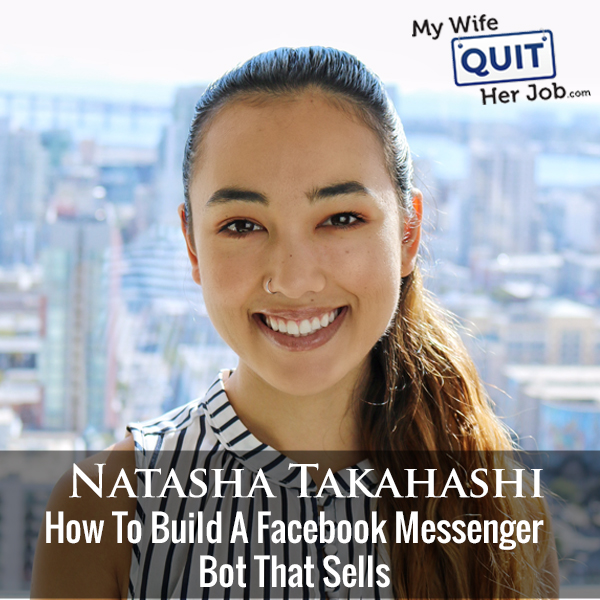
The thing that gets Messenger bots banned is block rate, and the fix is letting subscribers choose which types of messages they receive. Natasha Takahashi was brought into one company running a 50% block rate, and the solution was an onboarding flow that states plainly when messages arrive, how often, and what they cover.
Natasha is the chief marketing officer and founder of School of Bots. She dropped out of USC midway through her freshman year to start a chatbot agency, and has spoken at Social Media Marketing World and Traffic and Conversion.
This episode covers how to qualify subscribers from giveaways, the subscription system that keeps a bot healthy, sending frequency, and where Messenger opt-ins actually convert.
Get My Free Mini Course On How To Start A Successful Ecommerce Store
If you are interested in starting an ecommerce business, I put together a comprehensive package of resources that will help you launch your own online store from complete scratch. Be sure to grab it before you leave!
Table of Contents
Key takeaways
- Block rate and experience ratings are the only two metrics Facebook watches. Too many of either triggers a penalty.
- Let people subscribe to specific message types during onboarding, which is the primary defense against bans.
- Qualify giveaway subscribers immediately with a quiz-style flow rather than treating them all as leads.
- Tag every interaction, since ManyChat cannot filter unsubscribes without one.
- Message at least monthly, or weekly if you produce content regularly.
- Turn content into a bot experience rather than sending links, using five to seven interactions.
- Mobile Messenger opt-ins convert poorly, because browser login is required while people use the app.
- Test one thing at a time. Implementing twenty use cases at once tells you nothing.
Why testing one thing at a time matters
Natasha’s most common observed mistake is enthusiasm.
Someone arrives in the chatbot world, sees every possible use case, and implements twenty of them.
The result is having no idea what is working, because nothing was tested in isolation.
That was her own early error too, and it applies regardless of what the business sells.
How to turn existing content into a bot funnel
Her example is an ecommerce company selling inflatable lifestyle loungers.
They had commissioned ambassadors worldwide to produce a documentary-style blog, and nobody was reading it.
The bot version turned those blog experiences into a three-day drip sequence, taking subscribers through Bali, Iceland, and Mexico as a choose-your-own-adventure.
The reason it worked is comprehension. Seeing a product online leaves you unsure how you would actually use it, and walking through three destinations makes it obvious.
It became their highest converting funnel across any channel they had run.
How to acquire Messenger subscribers through giveaways
Giveaways are already part of most ecommerce calendars, which makes them the easiest place to add a bot.
This company ran joint giveaways with other lifestyle brands, bundling hotel stays, plane tickets, and products.
The opt-ins ran in two places. A checkbox on the registration page, and Messenger as one of the actions that increases your number of entries on the confirmation page, which also drove organic traffic.
The first giveaway produced about 7,000 subscribers, and one a few weeks later added roughly 10,000 more.
Why giveaway subscribers must be qualified immediately
The risk with giveaway traffic is obvious. Many entrants want the prize rather than your product, and a high block rate endangers the bot.
The solution is a qualification flow that runs the moment they enter.
It reads like a quiz. Questions about their interests, whether they had used a lounger before, and their broader experience with the category.
Three outcomes follow. Someone clearly uninterested gets thanked for entering, and is asked whether they want future messages about specific topics.
Someone genuinely interested gets product questions plus the message-type choice, then enters the three-day country sequence which also serves as bot onboarding.
Low-quality leads stay on the list and get tagged, since ManyChat makes segmenting by tags and fields straightforward.
How the subscription system prevents bans
Facebook watches two things. Whether people block your bot, and how they rate the messenger experience.
Enough of either produces a temporary ban, a penalty, or a warning.
Natasha was brought into an info products company running a 50% block rate, who had operated their own bot for roughly two years without understanding the policies.
The two fixes that recovered it, and that she now applies universally, are letting people subscribe to specific message types, and building onboarding that states clearly when messages will arrive, how often, and what they will cover.
Her framing is that users call the shots. Facebook only intervenes once enough of them block you, so keeping the relationship transparent from the start prevents the problem entirely.
The typical topic categories are events, discounts, and new content, mirroring what a company would send by email.
How to keep a Messenger list clean
Anyone who has not engaged within 60 to 90 days despite receiving messages gets removed.
The subtler rule concerns intent. If someone enters the unsubscribe flow at all, they get tagged immediately even if they never confirm.
Those people are tracked for the next 90 days and weeded out, because hinting at unsubscribing is signal enough regardless of whether they still open messages.
The mechanical constraint is that ManyChat lets you view unsubscribed or deleted conversations and cannot filter by that state.
The workaround is tagging every interaction: every button click, every quick reply, every response. That is what makes bulk actions and data pulls possible later.
Why Messenger converts better than email
Natasha’s answer is lead quality produced by the interaction itself.
Getting the content requires a back and forth. To receive a free guide, a mini course, or a three-day sequence, you have to actually converse.
That produces more touch points and a more intimate relationship with the company.
Email remains largely one-way. Some people click and few respond, because the format encourages reading and finishing rather than interacting.
The secondary effect for ecommerce is community. Many stores build an audience on Instagram without any place for that audience to talk, and a bot fills that gap.
How often to message your Messenger list
The floor is once a month, so people do not forget you.
Natasha’s evidence for that threshold came from Messenger’s business tab, which at the time only surfaced conversations from within the past month. Anything older got lost in the general inbox.
If you produce content regularly, weekly is the happy medium. It keeps you in the inbox without becoming annoying.
For daily content producers, offer a choice. Daily or every other day, which their experience suggests is too much, or a weekly digest.
The digest only works if it is genuinely interactive. A broadcast blast gets ignored, while a few back-and-forth interactions about the content perform.
How to send content without annoying people
The complaint I raised is that having to click through interactions just to reach content is irritating when you simply want to read it.
Natasha’s answer is that the interactions should be the content.
That means breaking the material down inside the bot. Audio from a podcast, a video split into shorter segments, or a blog article rebuilt as five to seven bot messages.
The distinction matters. Clicking a button and then being sent to a blog article is friction with no payoff, and receiving the substance inside the conversation is not.
Why Messenger did not work for Social Media Examiner
They stopped sending content through the bot because it was not producing return.
The volume was the problem. Publishing daily across ten different topics means no single piece suits most subscribers, and segmenting by topic becomes unmanageable.
They tested variations, including a button describing the article before clicking through, and found genuinely interesting data along the way. Mobile readers arriving from the bot stayed on the page roughly four times longer than email readers.
After three or four months, open and click rates declined steadily because people knew what was coming and it was too much.
Natasha’s retrospective fix would have been sending only the single best-performing piece each week, rebuilt as a bot experience.
Her conclusion is that bots suit companies with three to five core topics rather than broad publishers, where a website simply presents everything more clearly.
Why mobile Messenger opt-ins underperform
This surprised both of us and is worth knowing before you place opt-ins.
Messenger requires being logged into Facebook in the browser you are opting in from.
On mobile, people use the Facebook app rather than a browser, so the opt-in demands a login they do not have, and they abandon.
The measured effect at Social Media Examiner was roughly 50% or fewer opt-ins through Messenger than they normally saw with email, returning to normal as soon as the bot opt-in was removed.
Natasha sees a similar result for roughly 70% of clients, because so much web traffic is mobile.
Desktop is a different story, where people are logged into Facebook in the browser already and the opt-ins work well.
Where Messenger opt-ins actually work
The fastest route to scale is Facebook ads and page posts using comments-to-messenger, particularly when the bot is added to a funnel that already works.
Beyond that, giveaways and joint collaborations perform well, as does routing people in from other platforms.
The method is head-to-head testing against email everywhere a customer might interact: website, email newsletter footers, email signatures, links within emails, webinar confirmation pages, and countdown pages.
Where Messenger beats email, keep it. Where it does not, keep email there and bring people into Messenger at a different point in the lifecycle.
What unsubscribe rates to expect
My own Messenger unsubscribe rate runs at least 1% per send, which is dramatically higher than email.
Natasha considers 1% a reasonable average across message types.
The rate varies by what you send. A promotional follow-up behaves differently from a piece of content or a webinar invitation.
Her expectation is that it will consistently exceed email, which is why acquisition has to keep pace.
What Facebook announced for Messenger at F8
The headline was interoperability, meaning the planned integration of WhatsApp, Instagram, and Messenger.
The implication for bots was that a Messenger user could message Instagram and WhatsApp users without holding accounts on those platforms, which would put bots in front of a combined audience across the three largest messaging platforms.
No deadline was given at the time.
The second announcement was a Messenger desktop app due that autumn, positioned partly against iMessage.
Neither announcement addressed the mobile opt-in problem, and Natasha’s guess at a fix was routing people into the Facebook app to opt in, the way third-party apps handle Facebook login.
Why digital products cannot be sold in Messenger
The restriction is not Facebook’s.
Apple and Google app store policies prevent digital product purchases inside the app, so it is a device-level constraint.
Physical products can be sold through the buy button or by routing to a checkout page, which requires pre-approval.
Natasha’s practical view is that building that system yourself is slow for a store that already has a site, which is why integrations exist to handle it.
How Natasha Takahashi built her agency
She left USC midway through her freshman year, having already worked as an independent contractor doing marketing for startups since her junior year of high school.
She told her parents by writing a five to seven page letter explaining her reasoning and her actual plan, then sat them down and asked them to read it fully before responding, specifically so she would not be interrupted and lose her thread.
Their answer was to take a leave of absence and see how it went.
The agency came first, in 2017, with School of Bots following about eighteen months later once they had genuine case studies and understood the policies well enough to teach them.
Early clients came from cold email, cold outreach, events while travelling through Asia, and a personal brand she had been building on LinkedIn, Facebook, and Instagram before starting.
The first few bots were built free, and became the case studies that made paid work possible.
Her early mistake was targeting Revlon, L’Oreal, and similar companies before having any capability to deliver, and refocusing on small and midsize digital businesses is what actually worked.
Frequently asked questions
Why do Facebook Messenger bots get banned?
High block rates and poor experience ratings, which are the only two metrics Facebook watches. Enough of either produces a temporary ban or penalty.
How do you prevent a Messenger bot from being blocked?
Let subscribers choose which message types they receive, and build onboarding that states clearly when messages arrive, how often, and what they cover.
How do you qualify Messenger subscribers from a giveaway?
Run a quiz-style flow immediately on entry asking about their interests and experience with your product category, then tag them by segment rather than treating all entrants as leads.
How often should you message a Messenger list?
At least monthly so people do not forget you, and weekly if you produce content regularly. Daily sending typically becomes too much.
Why do Messenger bots convert better than email?
Because receiving the content requires a genuine back and forth, which qualifies the lead and creates more touch points than a one-way email.
How should you send content through a bot?
Rebuild it inside the conversation as five to seven bot messages rather than linking out. Clicking a button only to be sent to an article is friction without payoff.
Why do mobile Messenger opt-ins convert poorly?
Messenger requires a Facebook login in the browser, and mobile users are logged into the app instead, so the opt-in demands a login they do not have and they abandon.
What unsubscribe rate is normal for Messenger?
Around 1% per send on average, which is considerably higher than email, so subscriber acquisition has to keep pace with attrition.