Podcast: Download (Duration: 32:55 — 38.0MB)
Owned marketing means channels where you control the relationship rather than renting access from a platform. Amazon is a table at someone else’s marketplace, and Facebook and Google ads are traffic you are renting, while email, SMS, podcasting, and direct mail are yours.
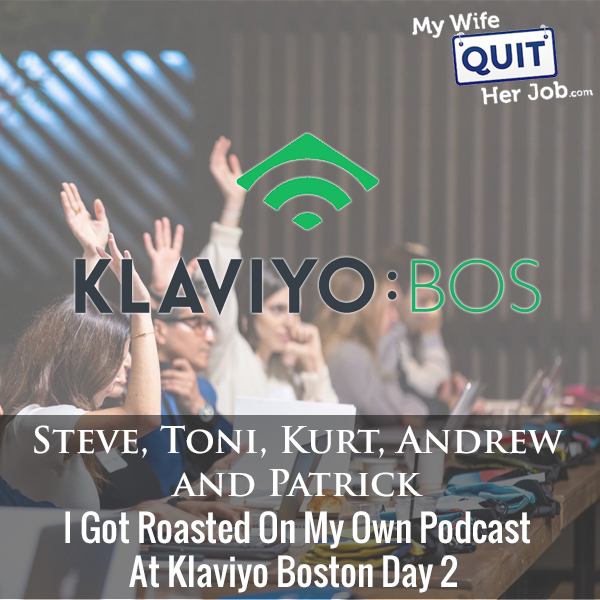
This episode was recorded on day two of Klaviyo’s Boston conference with Andrew Youderian of eCommerceFuel, his colleague Patrick Ryan, Kurt Elster of The Unofficial Shopify Podcast, and my partner Toni Anderson. They also used it to roast me, which I decided to publish anyway.
Below are the takeaways: which flows matter most, what smart send times do, why personalization is the theme everyone converged on, and the case for caution with SMS.
Get My Free Mini Course On How To Start A Successful Ecommerce Store
If you are interested in starting an ecommerce business, I put together a comprehensive package of resources that will help you launch your own online store from complete scratch. Be sure to grab it before you leave!
Table of Contents
Key takeaways
- Owned marketing means channels you control, unlike Amazon, Facebook, or Google where you are a tenant.
- Welcome series and browse abandonment were named repeatedly as the flows nobody would live without.
- Smart send times lift open rates about 10% from a single checkbox.
- Individual send-time optimization needs roughly 3,000 emails per person to be accurate, so the model works at list level instead.
- Split browse abandonment by category viewed so the email is about what they actually looked at.
- Chubbies runs about 30 subject lines per campaign and A/B tests four over three hours.
- Custom sender names work. Chubbies sends from addresses like hello darkness my old friend at their domain.
- SMS carries real backlash risk, because texting is a personal channel.
What owned marketing actually means
Andrew Youderian’s definition is any channel where you have total control.
Google, Facebook, and Amazon do not count, because you are hitchhiking on someone else’s platform.
Email, SMS, podcasting, and direct mail do.
Kurt Elster’s framing is more direct. Amazon is renting a table at their marketplace, and Facebook and Google ads are renting from the traffic store.
The caveat worth acknowledging is that email is not perfectly owned either. Gmail’s tabbed inbox means Google still decides whether you land in promotions.
Why content comes before selling
The recurring theme across merchant presentations was creating entertaining content first rather than sales content.
Kurt’s long-held principle is that people buy from people rather than brands, and the entire conference was effectively built around that idea.
The pattern in the sessions was consistent. Asked which flow they could not live without, brand after brand named the welcome series.
Asked what happens in that welcome series, the answer was introducing people to the brand, the team, and the why. Products and sales come later.
These were seven and eight figure brands, which is what makes it notable. The advice amounts to going back to basics that got overlooked in favor of newer tools.
Why you need a reason beyond selling things
Andrew’s second observation was about brand purpose.
Starting a business that sells people random stuff makes it hard to stand out.
It also makes it hard to hire motivated, smart people.
With the volume of noise now, having a genuine reason for existing is doing more work than it used to.
What smart send times do
The feature automatically tests across 24 hours to find when your audience opens.
The reported average lift is about 10% on open rates, from enabling a single option.
Kurt’s assessment is that it is an immediate win requiring no work, which makes everyone more money the moment it is switched on.
The alternative most of us were doing is picking a time we assumed worked and blasting it out.
Why send times are optimized at list level rather than per person
The original plan was per-individual optimization, since one person opens at 11am and another at 9am.
Klaviyo’s data scientists found that approach needs roughly 3,000 emails sent to that individual before the data is reliable.
Without that volume it simply is not accurate.
The implementation instead trains on one broadcast to find when your list as a whole has the highest open rate, then sends subsequent campaigns at that time in each person’s local time zone.
That works considerably better than the per-person version at realistic list sizes.
Why browse abandonment deserves personalization
Browse abandonment and welcome series were the two flows named most often.
Kurt’s critique is that browse abandonment works and tends to be generic.
The upgrade is splitting the flow by the category someone viewed, which is a straightforward flow filter.
Someone who looked at wallets receives an email about which wallet is right for them, rather than a generic reminder that they visited.
His framing is repurposing existing content into something customer-focused and service-oriented, which is how smaller brands differentiate from large consumer packaged goods companies.
What Chubbies does with subject lines
Chubbies sends five emails a week, with a year-to-date open rate around 9% and roughly 16% on average across sends.
They generate about 30 subject lines per campaign, then A/B test four of them over a three-hour window before sending the winner to the rest of the list.
The custom sender name is their signature move. Rather than sending from the brand, they invent addresses matching the theme, like hello darkness my old friend at their domain, or is it the weekend yet.
Subject lines themselves stay extremely short, often two words.
Toni’s open question, which was outside the session’s scope, is what their conversion rates look like given that many sends are content rather than sale emails.
The number worth watching is deliverability. Below roughly 15%, entire providers like Yahoo or Microsoft may start blocking you outright.
Why personalization was the through-line
The theme across every session was a higher degree of personalization in email.
The flow builder’s branching is what enables it, splitting on customer type within a single automated sequence.
High lifetime value customers get treated differently from people who have not purchased yet, where heavy discounting to get them through the door makes sense.
My own takeaway was that my flows predate the current builder entirely. I have multiple overlapping flows that exclude each other manually, which can now be consolidated into one flow with conditional branching.
How predictive gender changes discounting
Toni’s realization came from combining two sessions.
Her initial reaction to predicted gender was that it seemed irrelevant, since most of her customers are women.
Working through it during the conference, she recognized that her male purchasers are almost always buying gifts, they arrive organically, and they never use a coupon.
The conclusion is that she should be segmenting specifically to avoid sending coupons to people who will buy without one.
Why SMS carries real risk
The major announcement was SMS implemented identically to email, enabled with what amounts to a checkbox in preferences.
Andrew’s caution is the one worth taking seriously. Of every marketing medium, SMS has the most potential to backfire, because text is a personal channel.
His own reaction to being spammed by text has been emotional backlash against the brand.
A message from a brand he genuinely loves about a product he wants is acceptable. Volume is what destroys it.
My own intended use is narrow. SMS as a last resort for people who have stopped opening email, and for webinar reminders where the message is genuinely time-sensitive rather than promotional.
What the new analytics features change
The customer analytics were the most immediately useful announcement for me.
Because Klaviyo holds your full store data, you can pull revenue for any segment directly: anyone who spent over $100 and bought a specific product in the last week, graphed year over year.
That removes the step of asking someone else to run spreadsheet calculations to answer a basic question.
Patrick Ryan’s read is that most people were jumping through hoops for analytics data that is now a couple of clicks away.
What makes a brand conference worth attending
The structural difference is that most talks come from merchants and customers rather than staff, so it is practitioners pulling back the curtain rather than a product pitch.
The staffing ratio is roughly one Klaviyo employee for every two attendees, with tables and open laptops throughout the venue.
The most valuable slot is dedicated one-on-one time where an employee reviews your actual flows and campaigns.
Beyond that, the lunch conversation with a data scientist is what produced the send-time explanation above, and questions raised in a keynote can be pursued in depth immediately afterward.
What Toni Anderson looks for in event execution
Sessions starting and ending on time, which sounds minor and determines whether you can reach the next session you wanted.
A walkable venue.
Food and drink available continuously, which attendees notice more than organizers expect.
Kurt’s addition is that swag was gamified rather than handed out. Poker chips earned for different actions get dropped into a Plinko board spelling the company name, with each letter corresponding to different merchandise.
Andrew’s more practical observation is that the paper schedule beat the app, and that hand bells were an effective and gentle way to move people back into sessions without breaking up conversations abruptly.
What each of us took away
Kurt is auditing client flows against everything heard, checking that welcome series and browse abandonment are running and are genuinely engaging rather than corporate, plus enabling smart send times immediately.
Andrew is improving testing discipline, rebuilding their nurture sequence, and redesigning blog opt-ins.
Patrick’s focus is using existing data points to personalize sequences properly, plus experimenting with send times, subject lines, and custom sender addresses.
Mine is consolidating overlapping flows into single flows with conditional branching.
Toni’s is segmenting male gift buyers out of coupon-bearing emails entirely.
Frequently asked questions
What is owned marketing?
Any channel where you control the relationship rather than renting access. Email, SMS, podcasting, and direct mail qualify, while Amazon, Facebook ads, and Google ads do not.
Which email flows matter most?
Welcome series and browse abandonment were named repeatedly by seven and eight figure brands as the flows they could not operate without.
Do smart send times actually work?
Yes, with a reported average lift of about 10% on open rates. It requires enabling a single option rather than any ongoing work.
Why is send time optimized per list rather than per person?
Individual optimization requires roughly 3,000 emails sent to that person before the data is reliable. Training on the list and applying it per time zone works better at realistic list sizes.
How do you improve a browse abandonment flow?
Split it by the category someone viewed, so the email addresses the specific products they looked at rather than sending a generic reminder about their visit.
How many subject lines should you test?
Chubbies generates around 30 per campaign, tests four across a three-hour window, then sends the winner to the remainder of the list.
Is SMS marketing risky?
Yes. Andrew Youderian considers it the medium most likely to backfire, because text is a personal channel and excessive volume produces emotional backlash against the brand.
Why should content come before selling in a welcome series?
Because people buy from people rather than brands. The brands presenting used welcome series to introduce the team and the reason the company exists, with products following later.