
Podcast: Download (Duration: 50:15 — 57.8MB)
Average ecommerce gross margin across 450 surveyed stores was 39.2% with a net margin of 17.4%, and those figures held nearly flat year over year despite Amazon fee increases and a 15% rise in paid traffic costs. Dropshipping sits at the bottom of the range at 28% gross and 14% net, while manufacturing your own product reaches 49% gross.
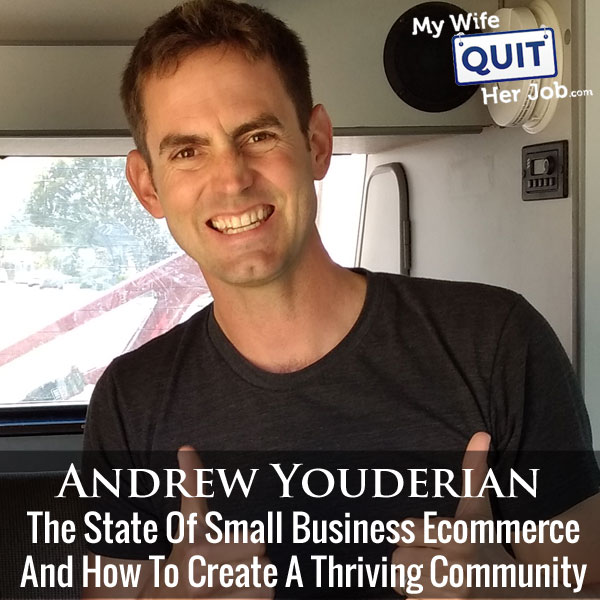
Andrew Youderian runs Ecommerce Fuel, a private community for six, seven, and eight figure store owners, and publishes an annual State of the Merchant Report from a survey of its members and the wider community. The 2018 edition covered 450 respondents representing roughly a billion dollars in combined revenue.
Andrew built and sold two dropshipping businesses, Right Channel Radios and Trolling Motors, and was the second guest ever on this podcast. This episode covers the margin and growth benchmarks from that survey, plus how he built a paid community from zero when nobody would pay to join an empty forum.
Get My Free Mini Course On How To Start A Successful Ecommerce Store
If you are interested in starting an ecommerce business, I put together a comprehensive package of resources that will help you launch your own online store from complete scratch. Be sure to grab it before you leave!
Table of Contents
Key takeaways
- Average gross margin was 39.2% and net margin 17.4%, essentially unchanged from the prior year.
- Dropshipping runs 28% gross and 14% net. Manufacturing runs 49% gross and 20% net. Private label nets highest at 21%.
- Stores where Amazon is 60%+ of revenue grew 51%, versus 30% for stores not on Amazon at all.
- Organic search was the number one traffic source for 51% of merchants, despite widespread complaints about declining organic reach.
- Direct traffic converted best at 3.94%, followed by email at 3.32%, paid at 2.66% and organic at 2.40%.
- Average conversion rate jumped from 2.10% to 2.62% year over year, a surprisingly large move across an entire survey population.
- Mentions of Amazon as the biggest business struggle tripled, with 80% of those about compliance, competition, and over-reliance rather than being outcompeted.
- Andrew spent a year quietly tagging prospective members in Gmail before inviting 5 people a day for 30 days to seed the community.
What are typical ecommerce profit margins by business model?
Manufacturing your own product produces the highest gross margin at 49%, dropshipping the lowest at 28%, with the overall survey average landing at 39.2% gross. Net margins compress that spread considerably.
On net margin, dropshipping returns 14%, manufacturing 20%, and private label edges ahead at 21%. The overall average was 17.4%.
Those figures barely moved year over year, which surprised Andrew given the cost pressure. Gross was 39.6% and net 17.7% the prior year.
Sales channel also shifts margins, and the gap is widening. Selling primarily on Amazon produces 36% gross and 16.6% net, while selling primarily through your own storefront produces 40.4% gross and 17.7% net.
How did margins hold steady while costs rose?
A jump in conversion rates appears to have absorbed the cost increases. Average conversion moved from 2.10% to 2.62%, which is a 20%-plus improvement across an entire population of store owners.
That is a strange result. Lifting your own conversion rate by 20% is difficult for one store, and seeing it across 450 at once suggests something environmental.
Andrew’s first hypothesis was a shift toward manufacturing, which carries better conversion rates. Conversion rose across every business model, which ruled that out.
His remaining explanation is a strong US economy with consumers willing to spend. The other plausible contributor is that operators collectively got better at retargeting, site design, and the tactics that circulate through communities like his.
Meanwhile Amazon fees kept climbing and paid traffic costs rose roughly 15%. Those pressures were real and the conversion gain offset them.
Which business models are most common in ecommerce?
Private label accounts for about 22% of the mix and pure dropshipping about 16%. The survey splits merchants into five models: pure dropshipping, a hybrid of dropshipping and reselling, proprietary manufacturing, private label, and pure reselling.
Private label in this framing means manufacturing on a contract basis using someone else’s design or a tweaked version of it. Proprietary manufacturing means the product is genuinely yours.
Is dropshipping growing or declining?
Dropshipping performed better than Andrew expected, with stores in that model growing an average of almost 33%. The share with flat or declining revenue fell from roughly 45% the prior year to 33%.
That means two thirds of dropshipping stores grew. Andrew sold his own dropshipping business 18 months before this conversation specifically because of concerns about the macro environment.
He suspects the AliExpress dropshipping wave inflated those numbers. Shopify was heavily promoting apps that let anyone ship directly from Chinese manufacturers to customers, which brought a lot of new entrants into the model.
Neither of us considers that a durable business. Barriers to entry are minimal, shipping times run to a month, and quality control worsens when there are fewer intermediaries between factory and customer.
Andrew’s broader position stands regardless. If you have nothing proprietary and are competing purely on distribution, Amazon will beat you.
How much of ecommerce revenue now comes from Amazon?
Across the survey’s roughly billion dollars in aggregate revenue, about $276 million came through Amazon, up from roughly $200 million the prior year. That is a little over a quarter of total revenue.
Amazon was the number one sales channel for 26% of stores, up from 20% the year before. Some 55% of merchants sell on Amazon in any capacity.
Andrew estimates roughly 25% of respondents are pure-play Amazon sellers, though that figure was not directly measured.
Do stores selling on Amazon grow faster?
Growth correlates directly with Amazon exposure. Stores not selling on Amazon at all grew 30%, stores selling there in any capacity grew 41%, and stores where Amazon is 60% or more of revenue grew 51%.
The survey-wide average was 37% year over year. For context, overall ecommerce growth that year ran in the low to mid 20s, so this population outgrew the market meaningfully.
That is not an argument that Amazon is the only path. It does mean that on average, more Amazon meant faster growth in that period.
Why is Amazon now merchants’ biggest reported problem?
Mentions of Amazon in response to “what is your number one struggle” tripled year over year. Only 20% of those were about Amazon outcompeting an off-Amazon business.
The other 80% breaks down into three overlapping concerns. Terms of service and policy compliance issues came up in about 70% of them, Amazon becoming more competitive including listing hijacking and trademark issues in about 31%, and over-reliance on Amazon in about 31%.
Malicious negative reviews are a growing part of this. Unscrupulous sellers pay people to leave negative reviews and damage a listing at launch, which is a hard problem for a company committed to removing humans from the process.
What is the best traffic source for an ecommerce store?
Organic search remains the number one traffic source for 51% of merchants, despite universal complaints about Google pushing organic results below ads. Three quarters of stores pay for traffic, and only 30% name paid traffic as their top source.
Conversion tells a different story than volume. Among merchants reporting each as their primary channel, direct converted at 3.94%, email at 3.32%, paid at 2.66%, and organic at 2.40%.
Direct and email are the standouts. Both represent people who already know you, which is the same conclusion nearly every guest on this show arrives at independently.
The paid figure of 2.66% is lower than I would expect, and the survey does not separate Google from Facebook. Search intent generally converts better than social interruption, so a blended number understates one and overstates the other.
How do you start a paid online community from zero?
Spend a year building relationships before you launch anything, then invite your seed group personally over a concentrated period. Charging for access to an empty forum is a reliable way to fail.
Andrew blogged for a year while getting to know people in ecommerce, on top of four or five years already spent running stores and building a network. Every time he met someone interesting with meaningful experience, he tagged them with a Gmail label.
That produced a list of roughly 150 to 175 people. Over the following 30 days he invited five people per day personally, explaining what he was building.
You get one shot at the momentum. Losing it means either re-approaching the same people, which is awkward, or building an entirely new seed list.
How do you get discussion going in a new community?
Start three or four discussions yourself every week and use the mention feature to pull specific people into each one. Andrew considers @-mention notifications the single most important feature in forum software.
His reasoning is about the ramp. Reaching self-sustaining organic discussion takes a long time, and until then the founder has to drive engagement manually.
Mentions matter two to three times more early on than they do later. Email notifications generally are what bring people back into the conversation.
Recognition is the other half. When someone writes a substantial post and nobody responds, there is no reason to do it again, so likes from respected peers and a personal thank-you from the founder both matter.
Andrew led by example in the early days with his own detailed posts. Setting that cultural expectation is what makes long, generous posts normal rather than unusual.
Why build a private forum instead of a Facebook group?
Facebook groups cannot be customized, cannot be branded, and are not owned by you. Andrew built custom functionality into his community that Facebook could not support.
Ownership is the argument that has aged best. Facebook cannibalized organic page reach after promising that fans could always be reached, and has since reduced group reach as well.
Context matters too. Andrew wanted a dedicated destination for ecommerce discussion rather than a tab competing with wedding photos from your brother’s friend.
How do you screen members for a revenue-gated community?
Verify revenue from public signals first and ask for proof only when the signals are ambiguous. Ecommerce Fuel requires $250,000 in annual sales, or $50,000 per month for Amazon-only sellers.
The public signals stack up quickly at the top end. A store with 400 reviews in the last 30 days, 5,000 lifetime reviews, a domain authority around 40, and 15,000 Facebook fans is almost certainly past the threshold.
The opposite case is equally clear. Poor design, domain authority of 10, no review or social engagement, and weak product descriptions means asking for a revenue snapshot, since paid traffic could still be driving real volume invisibly.
Amazon sellers get checked through their merchant page. A dozen products each carrying over a hundred reviews is a reasonable proxy for the required volume.
Every member uses their real name and real store. Some people dislike that requirement, and it is what makes the transparency work.
How do you enforce culture in an online community?
Run a strict no-jerks policy with a one-strike warning, and remove people who do it twice. Andrew has thrown members out and does not regret it.
The distinction he draws is between malice and carelessness. Many people simply do not register how their written tone lands, which is worth a warning rather than removal.
Genuinely atrocious behavior gets no warning. The judgment calls are the hard part of moderation and there is no way around making them.
Applications get read for personality signals too. A thin application from someone already borderline on revenue is usually a decline.
Why run an event that barely makes money?
Events are the most effective way to build real relationships, which is worth far more than the thin profit. Andrew estimates the effective hourly rate at two or three dollars once you count the work.
The purpose is cementing bonds that formed online. Meeting in person is a tired observation precisely because nothing substitutes for it.
My own version at the Sellers Summit works from the opposite direction. Without a standing forum, the event is how I gather my most engaged readers and listeners in one place so those relationships strengthen year over year.
Frequently asked questions
What is a good profit margin for an ecommerce store?
Around 39% gross and 17% net is the survey average across 450 stores. Manufacturing your own product reaches 49% gross, while dropshipping runs 28%.
Which ecommerce business model is most profitable?
Private label produced the highest net margin at 21%, with proprietary manufacturing at 20% and dropshipping lowest at 14%. Manufacturing leads on gross margin at 49%.
Are margins better on Amazon or your own website?
Your own storefront, by roughly four points of gross margin and one point of net. That gap widened year over year.
Do stores that sell on Amazon grow faster?
On average yes. Stores off Amazon grew 30%, stores on Amazon in any capacity grew 41%, and stores where Amazon is 60%+ of revenue grew 51%.
What is the average ecommerce conversion rate?
2.62% across the survey, up from 2.10% the previous year. By channel, direct converts at 3.94%, email at 3.32%, paid at 2.66%, and organic at 2.40%.
Is organic search still worth pursuing for ecommerce?
Yes. Organic search remained the number one traffic source for 51% of merchants even as its conversion rate trailed other channels.
Is AliExpress dropshipping a viable long-term business?
Not for building something durable. Barriers to entry are minimal, shipping can take a month, and quality control suffers with fewer intermediaries between factory and customer.
How do you launch a paid membership community?
Build relationships for a year before launching, assemble a seed list of 150 or so people you know personally, then invite them over a concentrated period and drive the first discussions yourself.