

Podcast: Download (Duration: 49:42 — 57.2MB)
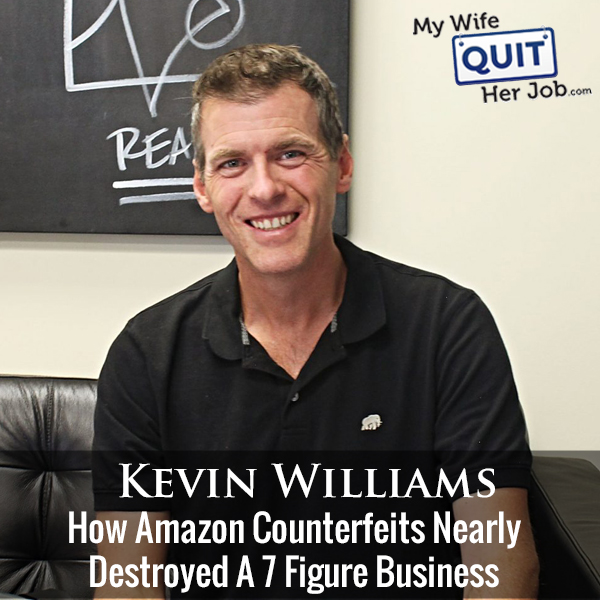
Amazon counterfeit sellers cost Kevin Williams his best-performing listing, a seven-figure page with 1,200 reviews and first-page rankings across multiple keywords. Counterfeiters hijacked it, sold junk copies of his product under his brand, and buried the listing under roughly 150 one-star reviews from real customers who thought they had bought the real thing.
Kevin runs BrushHero.com, which sells a power cleaning brush that attaches to a garden hose and spins with enough torque to clean wheels, bikes, and boats. He was last on the show in episode 209, when Brush Hero had just aired on Shark Tank and was projecting $5.5 million for the year.
Below is exactly how the counterfeiting unfolded, what it cost, and the specific intellectual property protections Kevin says he should have bought before he scaled.
Get My Free Mini Course On How To Start A Successful Ecommerce Store
If you are interested in starting an ecommerce business, I put together a comprehensive package of resources that will help you launch your own online store from complete scratch. Be sure to grab it before you leave!
Table of Contents
Key takeaways
- Kevin has filed over 7,200 individual intellectual property takedown actions since May 2018. Only about 23 of them were patent-based.
- Roughly 85% of his successful takedowns are copyright claims, because the DMCA forces marketplaces to act on reported copyright infringement.
- He shut down a seven-figure listing with 1,200 reviews rather than let a 3.6 star rating damage his brand with retail buyers.
- Commingled FBA inventory let counterfeit units get shipped to his own customers under his own orders. His advice is to never commingle.
- Counterfeiters registered his trademarks and patents in China before he did, and fixing that cost nearly $50,000.
- Registering your website copyright with the USPTO costs roughly $135 to $150 and unlocks statutory damages of about $30,000 per incident.
- Seven hijackers appeared on his listing at 4pm on Thanksgiving, timed so Amazon could not remove them before Cyber Monday. Estimated cost: $30,000.
- Brush Hero still grew 80% year over year through the worst of it.
How Shark Tank exposure attracted Amazon counterfeiters
Brush Hero’s Shark Tank episode aired at the end of January, and by late April counterfeits started appearing. The show delivered everything it promises: media attention, a sales surge, and high morale.
It also delivered an audience Kevin had not accounted for. Chinese manufacturers were watching too, and his product is injection molded, which is exactly the category China dominates.
Kevin actually produces in the UK and assembles in the US, so he was not sourcing from China at all. That did not matter.
Before the show, Brush Hero already had Walmart and Costco distribution incoming and had done roughly $3 million in 2017. The 2018 projection was $5.5 million.
How Kevin discovered the counterfeits
Kevin found out through his own customer service phone line. Calls came in about brushes popping off, turbines breaking, and most alarmingly, why the box said made in China.
Customers mailed in their packaging, and the counterfeits turned out to be complete fakes rather than knockoffs. The fake boxes used Brush Hero’s product images, images of Kevin himself, the real patent numbers, and Brush Hero’s actual customer service phone number.
So when the fake product failed, the buyer called Kevin’s team. He describes that as absolutely devastating.
How Amazon brand gating disappeared and hijackers arrived
Kevin had brand restriction, commonly called brand gating, on his Amazon listing, and it vanished during an Amazon system upgrade. Hijackers appeared within hours.
Brand restriction is granted case by case and rarely, often as a result of arbitration or litigation. Brush Hero received it because it was an early participant in Amazon’s Launchpad incubator program, and a rep appears to have simply enabled it on the back end.
Nobody told Kevin it existed. He found out when an authorized reseller hit the restriction screen requiring written permission to sell the brand.
Then Amazon upgraded to Brand Registry 2.0 around April or May of 2018, which added genuinely useful IP enforcement tools and appears to have refreshed his records. Amazon has no record that Brush Hero was ever restricted.
Kevin’s regret is not taking screenshots. Without proof, there was no argument to make.
Hijackers vs parallel listings: the difference that matters
A hijacker lists on your existing product page, undercuts your price, and takes the buy box. A parallel listing is a separate page selling a similar or counterfeit product alongside yours.
Hijacking is far more damaging because it steals the asset you spent years building. Kevin’s listing had 1,200 reviews, over four stars, keyword relevance across the category, and external traffic from Shark Tank and Facebook advertising.
Every marketing dollar he spent was routing customers to counterfeiters. The hijackers arrived both as FBM sellers shipping direct from China at rock-bottom prices and as FBA sellers placing counterfeit inventory into Amazon warehouses.
Why you should never commingle Amazon FBA inventory
Commingling let Amazon ship counterfeit units to Kevin’s own customers against his own orders. Amazon treats products sharing a UPC as fungible, so a fulfillment center grabs whichever unit is closest to the buyer.
That works fine when every unit with that UPC is genuine. It breaks completely once counterfeiters ship units bearing your UPC into Amazon’s network.
Kevin would win the buy box, make a legitimate sale, and Amazon would pull a fake off the shelf and ship it. The customer received a counterfeit from the real brand and left a one-star review.
When he asked Amazon for help, Amazon pointed out the buyer was connected to one of his orders and asked him to prove the shipped inventory was fake. He could not.
The inverse also happened. A counterfeit seller would occasionally ship a genuine Brush Hero to their own buyer.
Why Kevin commingled in the first place
Amazon encouraged commingling for fulfillment efficiency, and it saved warehouse complexity. Most of Kevin’s inventory lands in the Stockton fulfillment center, so an East Coast order would otherwise require airfreighting a unit across the country to meet the Prime promise.
Skipping FNSKU labeling also mattered because most of Brush Hero’s volume comes from retail and direct channels rather than Amazon. Stickering Amazon-bound inventory adds steps and cost.
Kevin’s verdict is unambiguous: it was a huge mistake, and no Amazon seller should commingle.
How 150 one-star reviews destroyed a seven-figure listing
Roughly 150 consecutive one-star reviews dropped Kevin’s listing from first place in multiple categories to off the first page, cutting sales on those listings by more than 50%. Those were legitimate reviews from real customers who received counterfeit product.
Amazon declined to remove them. Kevin could not leave a 3.6 star rating on his flagship listing, because the damage extended well past Amazon.
Retail buyers checked Amazon before every meeting and saw 150 one-star reviews. The counterfeits were hurting the brand everywhere, not just the direct sales channel.
So he shut down a listing doing seven figures a year with 1,200 reviews. He revived an old Vendor Express listing from his Launchpad days that carried about 150 reviews and adapted it.
He has not recovered the ranking, the velocity, or the keyword relevance since. Hijackers found the replacement listing within days.
Closing the old listing did cause the counterfeiters real friction. Their inventory became unsellable, so they had to recall and re-sticker it for the new listing.
Which intellectual property protections actually work on Amazon
Copyright drives about 85% of Kevin’s successful takedowns, because the Digital Millennium Copyright Act requires marketplaces like Amazon, eBay, and Google to remove reported infringing material. Patents drive almost none.
| Protection | Share of ~7,200 takedowns | Why |
|---|---|---|
| Copyright | ~85% | DMCA forces marketplaces to act on clear image theft |
| Trademark | Most of the remainder | Effective, especially with a Chinese registration |
| Patent | ~23 actions | Amazon demands a court order; Kevin suspects those 23 were accidents |
Image theft is the easy case. Kevin has a photo of himself cleaning his neighbor’s dog, and when a counterfeiter uses it, Amazon can remove the listing in 12 to 48 hours.
Where it gets brutal is a hijacker not superficially using your images. You have to buy the product, wait two or three weeks for it to ship from China, photograph the packaging, and only then file the report.
Meanwhile that listing sits live siphoning traffic. Kevin cites a competitor called 360 Brush Cleaner that stopped stealing his images and still uses his box, which still has his picture on it.
Why patents do not help against Amazon counterfeiters
Amazon will not arbitrate patent disputes and demands a court order instead. Pursuing a patent decision in court can cost $100,000 per action.
The result is also close to worthless in practice. Shut down one seller under a patent and they move the same inventory to a new seller name, and you start the court process again against a different entity.
Kevin’s business model is built on patents, so this frustrates him particularly. His summary is that patents have not been useful for tactical intellectual property enforcement.
Where patents do matter is against players who follow the rules. Brush Hero created the hose-powered water brush category, and without a patent a large retailer running private label could replicate the whole thing and crush them.
So a patent protects you from legitimate competitors. It does very little against a counterfeiter in another jurisdiction.
Why you should register your trademark in China before you scale
Counterfeiters registered Kevin’s trademarks and patents in China before he did, and unwinding that cost him nearly $50,000. Filing first would have cost a fraction of that.
Alibaba has been a reasonable partner on trademark takedowns because bad press motivates them, and other platforms less so. They generally want to see an actual Chinese violation.
Kevin’s read is that Chinese manufacturers respect Chinese law more than foreign law, which makes a Chinese trademark the enforcement tool with teeth. He has won some of the trademark battles and expects to lose the patent battles, and is now trying to invalidate the counterfeiters’ patents on prior art grounds.
The $50,000 figure reflects using a large US firm, DLA Piper, and fighting existing filers across multiple categories. Filing first through local counsel would have been considerably cheaper, and Kevin estimates $15,000 to $20,000 for original trademarks across multiple categories.
His honest framing is that $50,000 is painful for a company heading toward $3 million. He would rather have spent it on a hire or a new product, and instead spent a year playing whack-a-mole.
Why you should register your website copyright with the USPTO
The copyright notice at the bottom of your website claims rights without registering them, and unregistered copyright has no teeth in court. Registration is what unlocks statutory damages.
The process is simple enough to do yourself: download a PDF version of your website and submit the whole thing to the USPTO as a registered work. It costs roughly $135 to $150 and takes eight to 12 months to receive a registration number.
Once registered, statutory damages run around $30,000 per incident. Six stolen images could mean $180,000 in statutory damages plus lost income plus the infringer’s revenue plus a multiplier.
Kevin ranks this first in priority precisely because it is cheap, easy, and slow. Start the clock early.
Using pixel-level watermarks to survive automated review
Kevin now embeds tiny pixel-level watermarks in every product image, because platform reporting systems are heavily automated and easy to fool. A counterfeiter flips an image horizontally in Photoshop and the automated matching fails.
Buried watermarks survive skewing and distortion, so he can point to the mark and establish the image as a derivative of his original work. Most counterfeiters are too lazy to find them.
What the Amazon Transparency program does
Amazon’s Transparency program puts a unique, machine-readable QR code on every individual unit, encoding a manufacturing date and identity. Scan one on Kevin’s product and it reports built in Salt Lake City in November 2018.
Amazon is supposed to block units without a valid Transparency code from entering circulation, and it has not fully kicked in for Brush Hero. He enrolled in mid-2018 and fulfillment centers are still working out how to reliably find and scan the codes.
The cost is about 10 cents per unit: five cents for the code plus the sticker and the labor to apply it. There is no subscription or recurring platform fee.
Unlike an FNSKU, which prints identically on every box, each Transparency code is unique and encrypted. A counterfeiter can copy one code across many units, and Amazon is supposed to detect the duplication.
Kevin is optimistic about Transparency and expects Amazon to push every counterfeit-prone category, like toys and nutraceuticals, toward it. He also expects Project Zero to end up as universal Transparency adoption.
How Kevin fights hijackers day to day
Kevin takes down seven or eight listings a day and pays about $24,000 a year to an IP monitoring firm. He has used three different intellectual property monitoring firms and settled on Pointer Brand, based in the Netherlands.
These firms identify keywords, images, and multilingual references to your product across marketplaces worldwide, reporting through APIs or manual channels. Kevin also has a virtual assistant doing internal checks daily and feeding findings to the firm.
Once you understand the Brand Registry reporting process, you can build internal SOPs and run it yourself at smaller scale. What you will miss are the listings appearing in countries where you do not sell.
Kevin has found listings in Bangladesh and Bolivia, because counterfeiters are dumping devalued inventory anywhere they can. Ignore international monitoring and you may find your brand reputation ruined abroad five years later.
eBay is his worst channel, accounting for roughly 90% of his claims. Fake product listing ads also appear in Google, undercutting his own brand searches from Shopify stores and dropshippers.
The Thanksgiving hijacking
Seven hijackers appeared on Kevin’s listing at 4pm on Thanksgiving afternoon, deliberately timed around the US holiday. He reported them by 4:30 and Amazon did not remove them until the following Tuesday or Wednesday.
That covered Black Friday, the weekend, and Cyber Monday, and he estimates it cost roughly $30,000. Counterfeiters understand Amazon’s response times as well as sellers do.
How to prove a product is counterfeit to Amazon
Amazon requires you to purchase the suspected counterfeit and photograph it before it will act. Arguing that a listing is obviously fake goes nowhere.
Kevin was once told by an Amazon employee that he might have shipped bulk product to a retailer in China who was now shipping it back one unit at a time at a quarter of his price. That is the level of proof burden sellers face.
His process now is to buy the fake, expedite shipping, photograph it, and submit. FBM sellers shipping from China make this agonizingly slow.
His summary: you cannot fight the gorilla, so learn the rules of the Amazon jungle.
Why Kevin went to the press about Amazon counterfeits
Kevin went to the media after exhausting Amazon’s internal channels, reaching the director level of the Transparency program and finding that even that person could only forward information with no reply. He decided visibility was the remaining lever.
He wrote a press release covering the Shark Tank story, the entrepreneurial arc, and Amazon’s non-response, then pitched outlets he believed Amazon employees actually read. He solicited the Wall Street Journal, New York Times, LA Times, Money, and Fortune.
Inc. was third or fourth on his list and the first to bid, with a San Francisco bureau chief reaching out. The reporting ran for weeks, and Kevin acted as a resource connecting the reporter to other sellers who had experienced false positive reviews and other black hat tactics.
He knew it was real when Inc. flew a photographer from Los Angeles to Salt Lake City for a shoot at his 3PL. Inc. had an exclusive on the story once they picked it up.
Was fighting Amazon counterfeits worth it?
Kevin says yes, and Brush Hero still grew 80% year over year through the worst of it. The real cost was opportunity: the counterfeits consumed capital and attention he would have spent acquiring a brand, developing a new product, or hiring.
He remains bullish on Amazon because Amazon is starting to recognize what counterfeits do to its own brand. He points to recent enforcement actions in Vendor Central and to Project Zero as evidence.
His argument against walking away is simply the size of the channel. Abandoning Amazon leaves a lot of money on the table.
His description of the experience is waking up every day and getting kicked in the shins. He would probably do it again.
You can find Kevin at BrushHero.com and on LinkedIn.
Frequently asked questions
What is an Amazon listing hijacker?
A hijacker lists their own product on your existing Amazon listing, undercuts your price, and takes the buy box, so buyers who think they are purchasing your product receive theirs. This differs from a parallel listing, where a competitor creates a separate page for a similar or counterfeit item.
What is commingled inventory on Amazon?
Commingling means Amazon treats every unit sharing a UPC as interchangeable, so a fulfillment center may ship any seller’s stock to fill your order. If counterfeiters have shipped fakes bearing your UPC into Amazon, your own customers can receive counterfeit product against your legitimate orders.
How do you prove a product is counterfeit to Amazon?
Amazon requires you to purchase the suspected counterfeit yourself, photograph the product and packaging, and submit that evidence through Brand Registry. Asserting that a listing is obviously fake is not sufficient.
Does a patent protect you from Amazon counterfeiters?
Barely. Amazon will not arbitrate patent disputes without a court order, court action costs around $100,000, and a defeated seller can simply relist under a new seller name. Patents are far more useful against legitimate competitors than against counterfeiters.
Should you register your trademark in China?
Yes, before you scale. Counterfeiters registered Kevin Williams’ trademarks and patents in China first, and unwinding that cost nearly $50,000 versus an estimated $15,000 to $20,000 to file originally across multiple categories.
How do you register a website copyright?
Download a PDF of your entire website and submit it to the USPTO as a registered work. It costs roughly $135 to $150, takes eight to 12 months, and unlocks statutory damages of around $30,000 per infringement incident.
What is the Amazon Transparency program?
Transparency applies a unique encrypted QR code to every individual unit, letting Amazon and customers verify authenticity and manufacturing origin. Kevin’s cost runs about 10 cents per unit including the code and sticker, with no subscription fee.
How much does IP monitoring cost for an Amazon brand?
Kevin pays approximately $24,000 per year to Pointer Brand, an IP monitoring firm in the Netherlands. Once you understand Brand Registry’s reporting process, smaller sellers can build internal procedures and do much of this themselves.

