Podcast: Download (Duration: 42:17 — 48.7MB)
The biggest upgrade available to most ecommerce email programs is branching your automated flows instead of sending one generic sequence to everyone. A first-time visitor abandoning a $5 cart and a repeat customer abandoning a $500 cart should receive completely different emails, and modern flow builders let you split on exactly that.
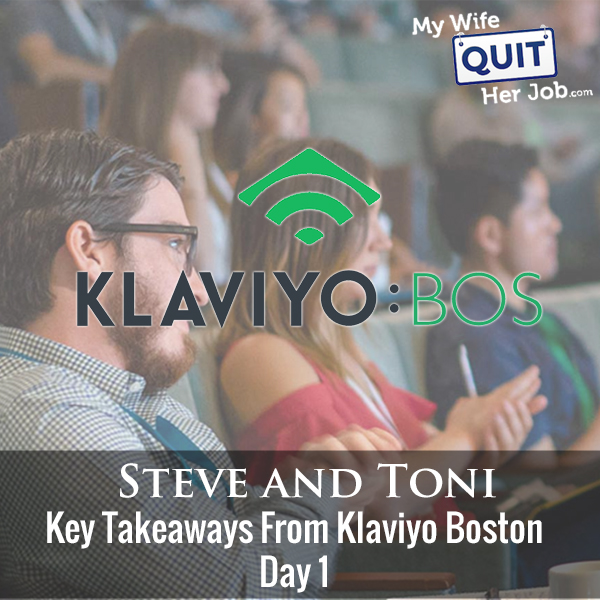
My partner Toni Anderson and I recorded this live from Klaviyo’s annual conference in Boston, which more than doubled in size from the previous year.
This episode covers the branching options worth implementing, predictive customer data, A/B testing inside flows, and the smaller tactics that lifted our open and click rates.
Get My Free Mini Course On How To Start A Successful Ecommerce Store
If you are interested in starting an ecommerce business, I put together a comprehensive package of resources that will help you launch your own online store from complete scratch. Be sure to grab it before you leave!
Table of Contents
Key takeaways
- Branch abandoned cart flows on customer history and cart value. New customers may need a coupon and repeat buyers usually do not.
- Predicted gender and predicted next order date let you change imagery and timing automatically.
- A/B test inside the flow itself, then delete the losing email rather than rebuilding.
- Tag and timestamp customers on first order to trigger anniversary emails a year later.
- One brand ran a 13-email flow where the final email held a 30% open rate and 13% conversion.
- Prioritize flows over campaigns with smart sending, since flows consistently outperform broadcasts.
- Pre-header text works. It functions like a meta description for the inbox.
- Video in a subject line raised Toni’s open rate 10% and click-through from 2% to 7%.
Why to branch your abandoned cart flow
The standard setup sends the same abandoned cart email to everyone, typically at four hours, one day, and two days.
Branching on customer history changes the offer. Someone who has never purchased is worth a coupon, because a customer who has bought once is roughly 60% more likely to buy again, and the goal is simply getting them across that first line.
An existing customer usually does not need one. Offering a discount to someone who would have bought anyway is money given away.
Cart value is the second split. Five dollars in a cart does not justify a discount, and a $500 cart leaves considerable room for 10% or 20%.
You can also branch on the specific product in the cart and change the subject line to match it.
What predictive customer data enables
Klaviyo added a set of data science fields including lifetime value, expected date of next order, and predicted gender.
Predicted gender lets you dynamically change imagery. A female customer sees women’s products in the same email where a male customer sees men’s.
Toni’s use goes further than imagery. She would change subject line phrasing and body copy entirely, testing more emojis and punctuation for one segment against direct, to-the-point language for another.
Expected next order date drives timing rather than content, letting a replenishment or win-back email fire when a purchase is actually due.
How to A/B test inside a flow
Most email platforms require writing two separate emails, sending twice, and manually comparing.
Klaviyo lets you drop an A/B test block directly into the drag-and-drop flow builder.
You write two emails inside the flow and it splits automatically.
Once a winner emerges you delete the loser, leaving the optimized sequence in place with no rebuilding.
How to use tagging inside a flow
The newer capability is tagging profiles mid-flow and updating them based on actions taken.
Tagging and timestamping a first order enables anniversary emails. For a wedding linens store, that means wishing customers a happy first anniversary, then targeting the second anniversary, which is traditionally cotton.
Category tagging is the other use. Tag someone who shops or opens emails about a particular category, then branch so only those people receive that category’s emails.
That matters most with genuinely different product lines. Apron buyers are not handkerchief buyers, and pocket square buyers are neither.
The distinction worth understanding is that segment-based broadcasts already existed. What is new is doing this dynamically inside an automated sequence.
How long should an email flow be
The counterintuitive data point came from a brand running 13 emails in an expected-next-purchase flow.
The room’s reaction was that 13 is too many.
The final email held a 30% open rate and a 13% conversion rate.
My own position is that no flow is too long, because every additional email produces some revenue, which is why we simply keep adding to ours.
Toni’s caution is that open rates typically decline further into a flow, and she moves stronger topics later to compensate. The takeaway is to test flow length rather than defaulting to four emails.
How to stop flows and campaigns from colliding
Running many automated flows creates the risk of someone receiving four emails in one day.
Smart sending caps how frequently any individual receives email.
The priority order matters. Set it so flows take precedence over broadcast campaigns, because flow emails consistently outperform campaigns.
How to test flow timing
Most people never change the four-hour default on their first abandoned cart email, which is simply what the system suggested.
Wait periods can be tested dynamically, comparing which delay converts best for the first, second, and third email.
Win-back flows benefit most from this. Testing the delay is effectively how you discover your real repurchase window.
What to do with subscribers who never open
Rather than deleting unengaged subscribers, upload them as a custom audience for Facebook and Instagram ads.
The logic is that someone ignoring email may still be active on social.
For past customers who have gone quiet, the offer that works is a giveaway, a free-plus-shipping offer, or a free item with any purchase.
The pattern afterward is useful. Once someone purchases again, they become far more likely to start opening emails again.
Whether emojis belong in subject lines
Toni has tested emojis for roughly six weeks with open rates increasing, and it is the only variable she changed.
The emojis that work for her are ones she personally relates to, and she matches them to the topic rather than adding them decoratively.
I find them a genuine turn-off and would not use them.
The resolution is the gender split. Branch on predicted gender and test emojis with the segment more likely to respond.
Context still governs. Emojis from a retailer are fine, and emojis from your bank are not.
Why pre-header text is worth writing
The pre-header is the text shown under the subject line, particularly on mobile.
By default it pulls the first sentence of your email.
Writing it deliberately makes it function like a meta description in search, and Toni has tested with and without it with a significant difference.
Her approach is either promotional language or a question, aiming for something genuinely engaging in that second line.
Whether professional images beat user-generated content
The Coco Paris team A/B tested professional photography against user-generated content and found it roughly 50/50.
The recommendation is to test rather than assume, because for many brands user-generated content wins outright.
The parallel is video, where lower-production footage frequently outperforms polished work.
GIFs also lift click-through rates, and they do not have to be cheesy. Animating between angles of the same product is enough.
Why video in a subject line lifted results
Toni tested including the word video in her subject line with a link to a video in the email.
Open rates rose roughly 10%, and click-through went from about 2% to about 7%.
The videos were genuinely relevant rather than forced, and short product videos assembled from images work well at around 20 seconds.
I would not open an email advertising a video, which is a reminder that your own preferences are not your audience’s. Younger segments are considerably more likely to watch than read.
Why location-based branching matters
The problem we hit ourselves was a free shipping countdown displaying to an international customer.
Free shipping applies to US orders over $75, and location is not known until checkout begins.
She reached the threshold, saw the countdown complete, and did not receive free shipping.
Branching email content on location prevents that, showing the free shipping offer only to the people eligible for it.
What benchmarks Klaviyo publishes
One feature neither of us knew existed is industry benchmarks for open rates, click-through rates, and conversion rates.
The categories included arts and crafts, beauty, and furniture among others.
The value is having a reference point beyond asking other sellers in unrelated industries what their open rates look like.
The published open rates ran above 32% across categories, which raises a reasonable question about whether the data skews toward the most engaged sending.
What Coco Paris learned from a failed launch
Their first employee sent a launch email to a list of roughly 300 people before the product or website was ready.
She kept her job, and the company has since grown substantially, reaching Sephora among other retailers.
The lesson Toni drew is about permission to experiment. Many people avoid trying a feature because it might not work.
With a list of 300 people, there is genuine forgiveness available. The company made significant early email mistakes and grew anyway.
The other detail worth noting is that they signed up for Klaviyo because it was free up to 250 contacts, which is a working demonstration that freemium converts.
What Kara Goldin built at Hint Water
Hint is unflavored-sweetener fruit water, using real fruit, positioned as an alternative to diet sodas.
Kara Goldin started it with nothing while nine months pregnant, walking into Whole Foods and asking them to take twelve cases.
The growth came through other people’s stores: Whole Foods, Starbucks, then corporate offices including Google and Amazon, where reorders kept climbing.
The turning point was Starbucks pulling the product despite it performing at three times what they expected, which is when she concluded she needed to own the customer directly.
Hint is now the largest independent drink company not associated with Coke or Pepsi.
Her latest product came from getting skin cancer on her nose, then reading the chemical list on her sunscreen and deciding to make one without them, using the same fruit extracts as the drinks.
Why the Klaviyo conference model works
The event runs roughly one Klaviyo employee for every two attendees, with the entire company attending.
Tables staffed by people with open laptops sit throughout the venue, so there is never a point where you cannot get help.
The most valuable slot is dedicated one-on-one time where a Klaviyo employee reviews your actual flows and campaigns and tells you what you are missing.
The company grew from 10,000 brands to 20,000 in a year, doubling headcount alongside, and attributed roughly $40 million of one Black Friday weekend’s ecommerce sales to their platform.
Frequently asked questions
How should you branch an abandoned cart flow?
On customer history and cart value. Offer first-time buyers an incentive to cross the initial purchase line, and send repeat customers a reminder without a discount they do not need.
What is predicted next order date used for?
Timing replenishment and win-back emails to fire when a purchase is actually due, rather than at an arbitrary interval you guessed at.
How many emails should be in a flow?
Test it rather than defaulting to four. One brand’s 13-email flow held a 30% open rate and 13% conversion rate on the final email.
Should flows or campaigns take priority?
Flows. They consistently outperform broadcast campaigns, so configure smart sending to prioritize automated emails when both would reach the same person.
Does pre-header text affect open rates?
Yes. It functions like a meta description in search, and writing it deliberately rather than letting it pull your first sentence produces a measurable difference.
Do emojis in subject lines work?
It depends on your audience. Toni Anderson saw open rates rise over six weeks of testing, and the safest approach is branching on predicted gender and testing per segment.
Should you use professional photos or customer photos in email?
Test both. Coco Paris found it roughly 50/50, and user-generated content outperforms polished photography for many brands.
What should you do with subscribers who never open?
Upload them as a Facebook and Instagram custom audience rather than deleting them, then use a giveaway or free-with-purchase offer to bring past customers back.