

Podcast: Download (Duration: 48:23 — 55.7MB)
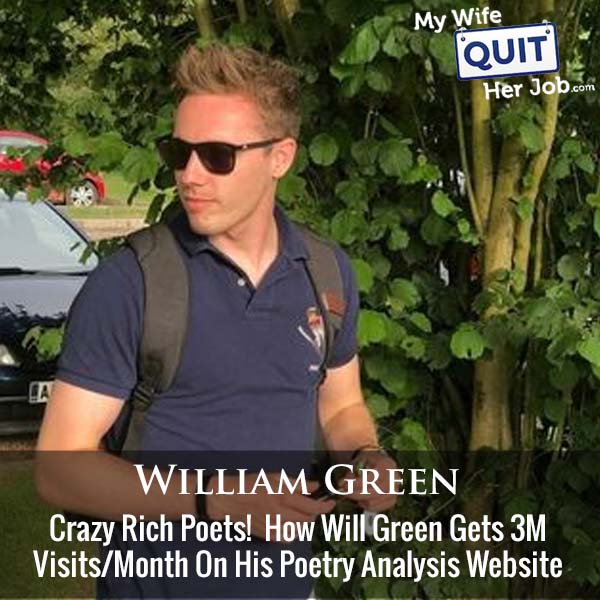
Will Green built poemanalysis.com to over 3 million visits per month and near seven figures in ad revenue by turning school poetry syllabuses into individual poem analyses and then bundling them into linkable “reference guide” listicles that .edu sites pass authority to. In this episode of the My Wife Quit Her Job podcast, Will (a former McLaren supercar engineer who runs poemanalysis.com, bookanalysis.com, and oceaninfo.com) shares his exact content-site playbook.
Will is in a mastermind group I am in, and his story is proof that you can monetize almost any interest online if you follow through. He started the site as a teenager uploading revision notes, kept it alive through his automotive-engineering master’s and his years testing McLaren supercars, and only went full-time after a Google employee at an Ezoic (now Raptive) event essentially yelled at him that he was sitting on a gold mine.
Here is the full playbook: how Will researches poems worth writing about, the listicle structure that beat National Geographic on a two-month-old site, the schema markup and image-caption trick that pulled a rich snippet from a DA-zero domain, and how ad RPMs on his network compare.
Get My Free Mini Course On How To Start A Successful Ecommerce Store
If you are interested in starting an ecommerce business, I put together a comprehensive package of resources that will help you launch your own online store from complete scratch. Be sure to grab it before you leave!
Table of Contents
Key takeaways
- Poemanalysis.com does over 3 million visits per month with a catalog of about 4,300 poems, monetized 100 percent by display ads at Raptive (formerly AdThrive) RPMs of roughly $12 to $15 per thousand visitors, versus Ezoic’s ~$7 during COVID.
- The scalable topic engine is exam boards. Will’s team maps published US, UK, and India examining-body syllabuses (like AQA’s Power and Conflict anthology), writes one deep article per poem, then combines them into “here are all the poems on this syllabus” listicles that attract .edu backlinks.
- The listicle structure that beat Domain Authority 80 sites on oceaninfo.com (age: 2 months): intro, then H2 per item, two bolded bullet-point facts, a featured image whose caption AND alt tag answer the article’s core question in a full sentence, then a 150-200 word paragraph.
- Ads hurt SEO. Will estimates traffic would jump if he switched ads off for a week, and competitors he watches routinely see rankings rise on pages where they strip ads.
- Ad revenue is the worst monetization method. Will is moving to products and memberships that add to the free experience (never gate it), because a paywall crashes SEO and every competitor who paywalled ended up bleeding traffic.
- He killed a Twitter tips site, a swipe-style financial tips site, an iPad tech site, and a steam-engine site before poem analysis worked. He calls failures more useful than wins, because they tell you what to fix.
- SEMrush vs Ahrefs: Will keeps both. Ahrefs for keyword research and low-volume accuracy checked against Google Search Console; SEMrush for site audits, user-intent classification, and its new “click potential” score.
Who is Will Green and how big is poemanalysis.com?
Will Green is the founder of poemanalysis.com, an educational content site that draws over 3 million visits per month analyzing 4,300+ poems, plus sister sites bookanalysis.com and oceaninfo.com. He monetizes primarily through display advertising and pulls close to seven figures per year across the portfolio.
Will’s background is not literary. He holds a master’s in automotive engineering with motorsport and spent his early career at McLaren testing supercars, before COVID and a Google employee’s pointed comment convinced him to go full-time on the website. He started the seed idea at age 15 or 16 by posting his school revision notes online and noticed that poetry pages consistently outperformed everything else.
At a London Ezoic panel he sat between two publishers with 15-20 employees pulling half a million and 800,000 monthly visits. He revealed he was doing 1.5 million with one or two helpers, took the day off McLaren, and jaws dropped. That was the moment he started taking it seriously.
How Will researches poems worth writing about (the exam-board method)
Will’s research process starts with the standard SEO stack of Ahrefs and SEMrush against the seed terms “poem,” “poetry,” and their variants, then studies which competitor pages rank and improves on them. The unique unlock is exam-board syllabuses, which do not show up in keyword tools because they are new each year but drive predictable student search traffic.
His team downloads the annual PDFs published by examining bodies in the US, UK (like AQA), and India, and lists every prescribed poem. Each poem gets its own long-form analysis article. Then those individual poems are bundled into a single article (“the poems you need to analyze for AQA Power and Conflict, 2026”).
Those bundled articles are the link magnets. Teachers, forums, and .edu sites pick them up because they map cleanly to a real syllabus students are studying that year, and the backlinks pass authority into every individual poem page linked from the bundle.
The listicle structure that beat DA 80 sites on a two-month-old domain
Will’s listicle template goes: introduction, then for each item an H2 heading, one to two bolded bullet-point facts, an image with a full-sentence caption AND alt tag that answers the article’s core question, then a 150-200 word paragraph that expands beyond what the caption already said. Every element digests the same information in a different way so both human readers and Google’s crawler can extract the answer.
He tested this on oceaninfo.com with a “most dangerous rivers” listicle when the domain was two months old and had a Domain Authority of zero. Google pulled his image captions verbatim into a list-format rich snippet at the top of the SERP, ahead of National Geographic and other DA-80 competitors on identical keywords.
The image caption is the load-bearing element. Instead of the usual short keyword alt text (“dangerous river”), Will writes a full sentence that directly answers the article’s question (“The Amazon is dangerous because…”), and puts the identical sentence into the alt tag. Because every caption in the article answers the same question in a repeatable pattern, Google extracts the whole list.
How does schema markup help a content site rank?
Schema markup helps a content site rank by structuring content in a format Google can parse into rich snippets, which lift impressions even when click-through rate drops. Will rolled out FAQ schema across poemanalysis.com about a year before the interview and saw FAQ questions surface under his search results, expanding SERP real estate.
For the top rich snippet itself, though, no specific schema is required. What matters most is content structure so regimented that Google cannot help but extract it: consistent H2 patterns, one-idea-per-section, and image captions or bullet points that answer the article’s question directly.
Different schema types help different niches. Recipe schema hurts a non-food site and helps a food site; FAQ, BreadcrumbList, and Article are generally useful. Pick the schemas that match the actual entities on your page and skip the rest.
What is Will’s ad revenue per thousand visitors, and which network pays best?
Will’s page RPM (revenue per thousand visitors) at AdThrive (now Raptive) runs roughly $12 to $15, compared to about $7 on Ezoic before he switched. During COVID he had one or two days on Ezoic that were net negative on his account after fees. Higher-paying networks unlock as sites hit their traffic thresholds (typically 100,000 sessions per month for Raptive at the time).
Ad network RPM comparison from Will’s own accounts
| Network | Approximate page RPM | Notes |
|---|---|---|
| Ezoic (during COVID) | ~$7 (occasionally negative) | Volatile during the ad-market crash |
| AdThrive / Raptive | $12 to $15 | Requires ~100K sessions/month to join |
Will follows Google’s guidelines of roughly 20 to 25 percent in-content ad density, avoids ads above the fold, and runs one or two sticky ads. He admits it is intrusive and estimates traffic would jump if he removed them for a week, so the higher ad density doubles as an incentive for future ad-free membership signups.
Why ad revenue is the worst way to monetize a content site (and what to do instead)
Ad revenue is the weakest monetization lever because it caps at RPM times traffic and it actively suppresses that traffic by degrading core web vitals, bounce rate, and user experience. Will now believes the objective for any mature content site should shift decisively away from “more traffic equals more ad revenue” once you hit a healthy baseline.
The alternative is products, services, or memberships that add to the free experience rather than gate it. Will is against paywalls on educational content on principle, and the data agrees with him: every direct competitor that paywalled analyzed poems saw SEO collapse, and one member-model competitor lost 80 percent of its traffic but made more money from paid memberships.
His planned membership will bundle an ad-free experience with premium extras, so paying users buy an upgrade rather than access to content that used to be free.
The 4 content-site failures Will learned from before poemanalysis.com worked
| Failed site | Topic | Why it failed | Lesson Will carried forward |
|---|---|---|---|
| Twitter tips site | How to optimize Twitter | Will was not an expert; content quality was thin | Do not write about what you cannot cover as an expert (or hire someone who can) |
| Swipe-style financial tips site | Personal finance one-liners | 200-word entries were too short to index and rank | Word count and depth matter to Google, not just UX |
| iPad tech site | iPad news and reviews | Content copied competitors without a clear angle | Original take beats aggregation |
| Steam engines site | Steam engine history and mechanics | Passionate readers used comments to point out problems long before Google penalized them | Reader feedback in comments is an early-warning system worth mining |
Will’s philosophy: he wants to fail more often than he succeeds because failures give unambiguous signals about what to fix. Successful sites reveal much less.
Frequently asked questions
How much traffic does poemanalysis.com actually get?
Poemanalysis.com averages over 3 million visits per month, with significant seasonality tied to when students are in school. The site has a catalog of roughly 4,300 individual poem analyses plus bundled syllabus listicles, and Will confirmed the ballpark figure on the podcast in mid-2023.
How much does a poetry content site make from display ads?
Will’s site makes close to seven figures per year, driven by page RPMs of roughly $12 to $15 on AdThrive/Raptive across 3M+ monthly visits. Earlier on Ezoic he ran closer to $7 RPM, with volatility during the COVID ad-market crash that put him briefly net-negative.
What is the best listicle structure for SEO in 2026?
The listicle structure that Will used to beat DA 80 competitors from a DA 0 site is: introduction, then per item an H2 with the item name, one to two bolded bullet-point facts, a featured image whose caption and alt tag are identical full-sentence answers to the article’s core question, then a 150-200 word paragraph adding context beyond what the caption said. The repeating caption pattern is what Google’s crawler extracts into a rich snippet.
Do image alt tags actually help SEO for content sites?
Yes, when the alt tag is a full-sentence answer to the article’s question rather than a bare keyword. Will pairs each image with a caption and alt tag that repeat the same complete sentence (e.g. “The Amazon is dangerous because…”), and Google used those captions to build a rich-snippet list from his article, beating National Geographic on the same query.
Ahrefs vs SEMrush for a content site: which one wins?
Will uses both because their algorithms disagree often enough to be worth cross-checking. Ahrefs wins for keyword research and low-volume accuracy (verified against Google Search Console), while SEMrush wins for site audits, its user-intent classifier (informational/commercial/branded), and its newer “click potential” metric that estimates click share versus zero-click SERPs.
Should a new content site put content behind a paywall?
No. Every direct competitor Will watched paywall educational content saw their SEO collapse, because Google needs to crawl the content to rank it and users bounce when they hit a paywall. The winning model is keep the analysis free, add optional products, memberships, or premium formats that add to the free experience rather than gate it.
How do you get .edu backlinks to a content site?
Will earns .edu backlinks by producing “reference guides” that map one-to-one to real exam-board syllabuses (like AQA’s Power and Conflict anthology in the UK). Each bundled article groups every prescribed poem for a specific exam, in a specific country, in a specific year, and teachers and school forums link to it because it saves them work.