
Podcast: Download (Duration: 39:40 — 45.7MB)
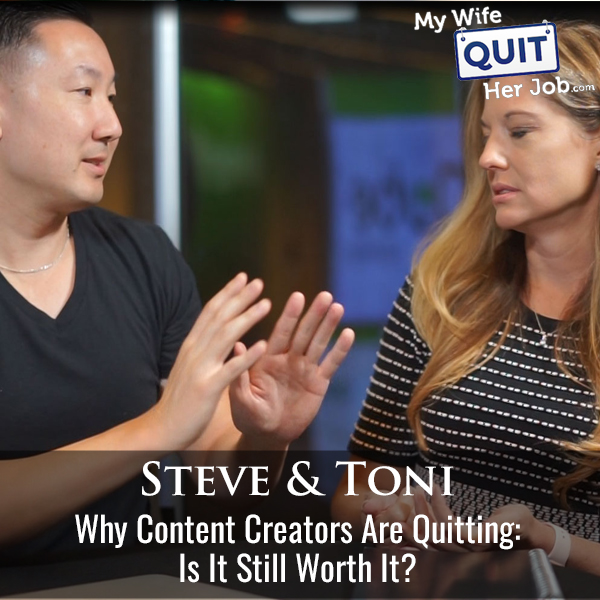
Content creation is still worth it in 2024, but only if you build across multiple platforms, own an email list, and sell your own product or course instead of relying entirely on brand deals, ad revenue, or Google search traffic. On this episode of the My Wife Quit Her Job podcast, my co-host Toni and I dug into a Wall Street Journal piece titled “Social Media Influencers Aren’t Getting Rich, They’re Actually Barely Getting By” and compared it to what we are seeing in our own creator network.
The single-platform, single-income-stream creator business is the one that is dying. Google search traffic to independent sites dropped to about 36 percent of results (the rest goes to Reddit, LinkedIn, Quora, and other aggregators). Ad-thrive bloggers are walking away from sites without even trying to sell them. Pet influencers we met at Pet Summit are living entirely off brand deals that vanish the moment a bigger creator shows up in the niche.
Below is what the creators who are quietly thriving all have in common, the RPM math on TikTok vs. YouTube, and why every kid, entrepreneur, and day-job professional should be creating content right now even if they never intend to make a dollar from it.
Get My Free Mini Course On How To Start A Successful Ecommerce Store
If you are interested in starting an ecommerce business, I put together a comprehensive package of resources that will help you launch your own online store from complete scratch. Be sure to grab it before you leave!
Table of Contents
Key takeaways
- Creators quitting today are almost all single-platform, single-revenue-stream operators. Google-only affiliate bloggers, TikTok-only influencers relying on brand deals, and Instagram-only pet accounts are the profiles getting wiped out.
- Creators still thriving all sell their own product. A course, membership, physical product, or high-ticket service sold to an email list, distributed through creator collabs.
- YouTube RPMs run $50 to $60 in peak season. TikTok Creativity Fund pays about $0.50 to $1 per RPM. That is roughly 100x more revenue per view on long-form YouTube than short-form TikTok.
- TikTok is now a search engine for Gen Z. About 40 percent of TikTok views come from TikTok Search. Recipes, how-tos, and product research all happen there now.
- The most valuable use of content creation is not the ad revenue. It is the resume, the credibility, and the doors it opens for speaking, TV bookings, hiring outcomes, and any job you apply for later.
- Google now indexes selectively by default, according to reports from portfolio site owners. Being cited by AI answers and appearing in aggregator platforms (Reddit, Quora, YouTube) matters more each quarter.
Why are content creators quitting in 2024?
Content creators are quitting in 2024 primarily because single-platform business models are collapsing at the same time. Google’s helpful-content and core updates decimated affiliate bloggers, Instagram’s algorithm changes crushed pet and lifestyle influencers who relied on brand deals, and TikTok’s creator payouts never scaled into a sustainable income for most people.
The Wall Street Journal piece Toni and I discussed reported that most social media influencers are “barely getting by,” and the pattern is consistent with what we see in real forums and masterminds. Google-dependent creators in the ad-thrive/mediavine tier are literally walking away from sites without listing them for sale. Pet influencers with millions of Instagram followers depend on brand deals that dry up in a quarter when the algorithm shifts.
The creators quitting are the ones who bet everything on one traffic source and one revenue stream. Most did not diversify while the going was good, and there is no fast way to build a second leg once the first one goes.
Which creator business models are still working in 2024?
The creator business models still working in 2024 all share three traits: multi-platform distribution, an owned email list, and a product the creator sells directly to that list. The people we know quietly stacking six and seven figures are almost never doing it on ad revenue and brand deals alone.
A concrete example from a real-life friend of Toni’s: a pelvic-floor physical therapist with a PhD started running webinars for other therapists five years ago. Today she works three days a month at her private practice, holds webinars two to three times a week, is a sought-after international speaker (Dubai and beyond), and earns most of her income from her digital courses and trainings. She leveraged her domain expertise and built the whole thing on webinars plus an email list, not on going viral.
The pattern is repeatable across niches. Kristen at Pet Living built a YouTube-first content business around pet-behavior education. Her friend who took Marie Forleo’s B-School launched a coaching business from zero and hit six figures in 18 months by networking hard, running email campaigns, and creating a real product.
YouTube vs. TikTok vs. blogging: what pays best for creators?
For pure revenue-per-view, YouTube pays roughly 100x more than TikTok on ads alone. A peak-season YouTube RPM in a business or finance niche runs $50 to $60. The TikTok Creativity Fund pays $0.50 to $1 per RPM, and only on videos over 60 seconds. Blogging is a distant middle ground: the top 20 posts generate almost all the traffic, and Google is sending less of it every quarter.
| Platform | Typical RPM | Content shelf life | Best monetization path |
|---|---|---|---|
| YouTube (long-form) | $5 to $60 | Years (evergreen how-to lives 4 to 5+ years) | Ads + email capture + affiliate + your own course |
| TikTok | $0.50 to $1 (Creativity Fund, 60+ sec) | 3 days to 6 months depending on the video | Brand deals, TikTok Shop, funneling to email |
| Instagram Reels | Bonus programs only, inconsistent | 2 to 3 days typically | Brand deals, ecommerce (best e-comm platform) |
| Blog (Google SEO) | $10 to $40 (varies by niche) | Multi-year for evergreen, but declining traffic | Ads + affiliate + funnel to product |
| Amazon Influencer (video reviews) | Prime Day and Q4 spikes; some creators paying for vacations from single events | Lives on Amazon listings indefinitely | Commission on sales, evergreen once posted |
The stat that sharpened my thinking: my total TikTok Creativity Fund earnings since I started are around $120. A single YouTube video from the past two weeks made over $1,000 in ad revenue alone in a week and change. The RPM gap is that big.
Why long-form content beats short-form for creator businesses
Long-form content beats short-form for creator businesses because it captures email, ranks in search for years, and monetizes at RPMs that are 10 to 100 times higher than short-form platforms. Short-form is a top-of-funnel awareness tool. It is not a business by itself for most niches.
The email capture problem is the biggest one. On a five-minute YouTube video, I can pause at the four-minute mark and say “if you’re enjoying this, my free six-day mini course goes deeper” and drop the link in the description and pinned comment. On a 30-second TikTok, the viewer swipes away before the CTA lands. My TikTok email captures are so small they do not register in my daily numbers.
TikTok can still work as a top-of-funnel channel and as a source of brand deals, TikTok Shop commissions, and Amazon Influencer video content. Treat it as a distribution channel that feeds a longer-form asset. Never as the whole business.
Why TikTok search matters more than most creators realize
TikTok search now drives about 40 percent of the views on my TikTok account, and Gen Z uses TikTok as their default search engine for recipes, how-tos, and product research. That fundamentally changes what “shelf life” looks like for a TikTok video: some of them keep pulling views for six months, because searchers keep finding them.
Toni’s teenagers default to TikTok for anything they want to learn quickly. Recipes, home repair (though my husband Brian refused to trust a plumbing tutorial from TikTok when we needed to replace a cast iron vent pipe, and searched YouTube for a licensed plumber instead), medical education from licensed professionals, product reviews. TikTok search behavior is legitimizing the platform as a knowledge source for a younger audience.
For creators, this means SEO-style keyword thinking is starting to apply to TikTok captions and on-screen text. Ranking in TikTok search is a real, growing traffic source that most creators are not optimizing for yet.
How Google’s AI changes are affecting bloggers in 2024
Google’s AI changes are affecting bloggers by cutting the share of search traffic going to independent websites and increasingly routing users to Reddit, Quora, LinkedIn, aggregator sites, and AI-generated answers instead. Recent reports from portfolio site owners indicate Google is also more selective about indexing new content, meaning many pages never enter the index at all.
The strategy shift on our blog has been complete. I used to originate every piece of content as a blog post and then repurpose it into a YouTube video. That order is reversed now. YouTube scripts come first, and the transcripts get turned into blog posts. The blog posts do not follow traditional SEO structure at all, and to my surprise, some of them are still ranking.
The takeaway for existing bloggers is not to abandon the blog. It is to stop treating blog traffic as the primary business. Let the blog collect long-tail search traffic, use it to feed your email list, and put your creative energy into the platform where new attention is actually growing.
Why every entrepreneur should create content even if they never monetize it
Every entrepreneur, professional, and job-seeker should create content in 2024 even with no intention of monetizing it because a public body of work is now the most valuable resume you can build. It opens doors for TV bookings, speaking gigs, hiring decisions, and referrals in ways a static LinkedIn profile never will.
Concrete examples we watched play out:
- Friends at Sellers Summit in Orlando (Connie Albers, Leslie Samuel, Josh Elledge) are regulars on local news because they have vaults of on-camera video. News stations audition by watching your existing clips.
- A hiring decision at a friend’s company came down to three candidates. The one with a professional portfolio website and a YouTube channel walking through his own product work got hired over two candidates who only had resumes.
- Contractors and service businesses that post real work on video (like our friend John in our course, who runs a landscaping business and films his projects) close prospects faster than the ones who show up with a text-only quote.
- My own daughter is filming a course right now, and even before it launches, the process of producing it has upgraded her presentation, editing, and on-camera skills in a way no side project could match.
The old advice was “write a book.” The 2024 version is “build a video portfolio.” Books still work, but a real body of on-camera work is a faster, more visible signal of competence in almost every field.
How to start a content business in 2024 the right way
To start a content business in 2024 the right way, pick one long-form primary platform (usually YouTube or a blog), one short-form distribution platform (TikTok or Instagram Reels), commit to an email capture strategy from day one, and plan to launch your own product within 12 to 18 months instead of relying on ad revenue.
Here is the sequence most successful creators we know followed:
- Choose your primary long-form platform. YouTube if you can be on camera, a blog if you cannot. This is the asset that will still be earning in five years.
- Add short-form as a distribution channel. Repurpose long-form content into TikTok, Reels, and YouTube Shorts. Do not build your business on any of them.
- Capture email from every touchpoint. A real lead magnet in the description, in the pinned comment, on the blog sidebar, in the podcast outro. Not just “subscribe to my newsletter.”
- Sell one thing to that list. A digital product, membership, physical product, or high-ticket service. This is where the actual money is.
- Diversify traffic through collabs. Guest appearances on other creators’ channels are the single fastest way to grow an email list once you have a product to sell.
Even if the podcast, YouTube channel, or blog never becomes a full-time income, the skills and the portfolio compound into everything else you do. That is the real reason creating content is still worth it in 2024.
Frequently asked questions
Can you still make a full-time living as a content creator in 2024?
Yes, but the path is narrower than it was five years ago. Full-time creators today almost always sell their own product (course, membership, physical goods, or high-ticket service) to an email list, on top of ad revenue and brand deals. The single-revenue-stream creator business has largely stopped working.
Which platform is the best for new content creators to start on?
YouTube is the best platform for most new content creators to start on today because it pays the highest RPM, the content has a multi-year shelf life, and it is the easiest platform to capture email addresses from. Blogging is still viable in narrow, low-competition niches, but is a slower path than it was pre-AI.
How much money do content creators actually make?
Creator income is bimodal. A small number of top creators earn seven and eight figures. The vast majority earn less than a full-time salary, and Wall Street Journal reporting in 2024 confirmed most social media influencers are “barely getting by.” The creators who cross the six-figure line consistently are almost always selling their own product, not living off ad revenue alone.
Is blogging dead in 2024?
Blogging still works as a supporting asset for a broader creator business, but the growth curve for independent sites has flattened and is likely to keep declining as AI answers absorb informational queries. Blogs are useful for email capture, SEO long-tail traffic, and feeding a course or product funnel. Blogs no longer work as a standalone business for most people.
Should I quit my day job to become a full-time content creator?
Do not quit your day job for content creation until your side income covers your basic living expenses for at least six months and you have proof your revenue is not tied to a single algorithm change. The reason so many creators are quitting in 2024 is that they went full-time on a single platform’s tailwind and got wiped out when the wind shifted.
What’s the fastest way for a new creator to make money?
The fastest way for a new creator to make money is brand deals in the niche they already have audience credibility in, followed by affiliate commissions, followed by TikTok Shop or Amazon Influencer video reviews on high-turnover products. The slower, more durable path (owning an email list and selling your own product) makes far more money in the long run but takes 12 to 24 months to compound.