

Podcast: Download (Duration: 47:42 — 54.9MB)
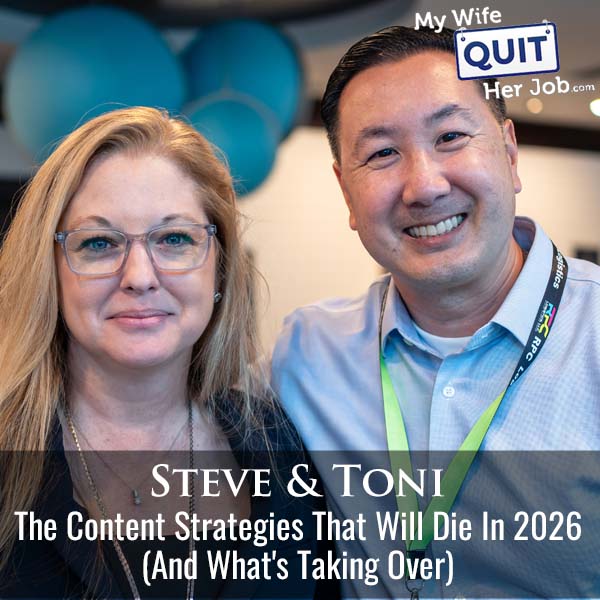
The content strategies that carried creators through 2024 and 2025 are dying in 2026, and the replacements are already visible in the feeds of anyone paying attention. Plain teaching content is getting killed by AI summarize buttons, faceless AI channels are diluting every algorithm with unwatchable volume, and the influencer economy is quietly collapsing as every third post turns into a paid sponsorship. On this episode of the My Wife Quit Her Job podcast, my co-host Toni Herrbach and I walked through what we actually see working right now.
The good news is that clever, opinionated, personality-driven content still wins hard. Toni’s son launched an AI-animated Bible-history Instagram account one month before this recording, and hit 100,000 followers in that first month with zero prior audience. Meanwhile, faceless AI channels running 20 videos per day per account are earning almost nothing per creator once you divide by the sheer volume of similar accounts.
Below are the eight predictions we made for 2026: what is dying, what is taking over, and the specific format and delivery changes creators need to make right now to survive summarize buttons, feed saturation, and the coming trust collapse of AI-generated everything.
Get My Free Mini Course On How To Start A Successful Ecommerce Store
If you are interested in starting an ecommerce business, I put together a comprehensive package of resources that will help you launch your own online store from complete scratch. Be sure to grab it before you leave!
Table of Contents
Key takeaways
- Clever, opinionated content still wins in 2026. Toni’s son grew a Bible-history Instagram account from zero to 100K followers in one month with AI-animated cartoons plus original, funny scripts.
- Faceless AI content channels pumping 20+ videos per day are diluting every platform’s algorithm. Volume plays are losing to genuine cleverness because platforms are getting better at ranking real engagement.
- Facebook’s creator payouts have surged. Jeff Rose has documented earning $40K to $50K per month from Facebook viral commentary content (tip debates, hot-take posts).
- Interview podcasts are past peak. If everyone you know wants to start one, the market is saturated. Growing an interview podcast from zero in 2026 is much harder than growing a YouTube channel.
- AI summarize buttons (Gemini on YouTube, ChatGPT with transcript plugins) are killing pure teaching content. Creators need to make videos that are entertaining, opinionated, or interactive enough that summaries feel incomplete.
- The YouTube-to-Netflix pipeline is now open. Mark Rober’s YouTube videos got packaged as a Netflix special with a 30-second intro added, and ranked in Netflix’s top 10.
- The influencer economy is fracturing. Trust in sponsored content is collapsing as AI avatars pitch products and celebrities push liver detoxes; creators with authentic vouching-based endorsements still move product.
- In-person events are making a resurgence as everything else gets more artificial. The best unpublished playbooks come out at the bar at conferences, not from any online source.
What content strategy still works in 2026 despite AI saturation?
Clever, opinionated, personality-driven content still wins in 2026, even in a feed drowning in AI-generated volume. The proof is that platforms are getting better at ranking real engagement (shares, comments, saves) over raw view counts, so a genuinely interesting piece of content outperforms 100 faceless AI videos automatically.
Toni’s son is the case study. He started an AI-animated cartoon Instagram account one month before this recording, focused on Bible history and archaeology (an unlikely viral topic).
His scripts are his own. He listens to historical archaeology podcasts at his restaurant job all day, turns the material into funny sharable animations, and hit 100,000 followers in his first month with zero starting audience.
The pattern is that his videos generate thousands of shares each, which almost no faceless AI content can do. Shares and comments beat impressions in 2026 algorithms, so cleverness and angle translate directly to reach.
Are faceless AI content channels going to dominate 2026?
Faceless AI content channels will not dominate 2026 because sheer volume dilutes every creator in the same category, and platform algorithms are increasingly weighting engagement quality over raw output. When a hundred accounts each pump 20 AI-scripted videos per day into the same niche, the per-account revenue collapses toward zero.
There is a real risk that when volume hits 1,000x today’s levels, algorithms cannot rank anything well because there is not enough human viewing data per video. That failure mode is likely still years away, but the direction is clear.
China’s regulation on this is instructive. Chinese creators must have credentials to publish content on finance, health, or law. A version of that rule (or a de-facto version enforced by platform trust signals) is a plausible response if the AI content flood becomes unmanageable.
How much can you earn from Facebook viral commentary content?
Facebook is now paying $40,000 to $50,000 per month to creators who post viral commentary content, according to Jeff Rose, who has been running that playbook and shared the numbers in a recent podcast recording. The bar to get approved is achievable and Meta is aggressively subsidizing the content type to compete with TikTok.
The format that works is short, opinion-triggering content on hot-button topics. Jeff Rose’s version leans provocative (“would you tip on this receipt?”), and Tiffany Ivanovsky runs a less controversial, humor-based version built around her family’s real adventures.
Both drive massive share and comment counts, which is what Facebook’s payout formula rewards.
The catch is that viral commentary content builds cash flow, not influence. It generates payouts and eyeballs, but it does not build the kind of trust that gets people to sign up for a course or buy a product. Match the format to the outcome you actually want.
Are interview podcasts still worth starting in 2026?
Interview podcasts are not worth starting from zero in 2026 unless you have a unique access angle or an already-established audience. The market is saturated (the Golden Globes added a Best Podcast category this year, which is peak-signal), and growing a new interview podcast is dramatically harder than growing a comparable YouTube channel with less production effort.
The Amy Poehler model works because she is Amy Poehler and can book Gwyneth Paltrow. The clip of them discussing 6pm dinners and 8pm bedtimes drove 100K+ likes as a standalone reel, which is the actual acquisition mechanism for modern podcasts.
If you insist on starting a podcast, pick a niche that is not another interview show. Toni’s son wants to start a Bible-history podcast; that has a shot because the topic is specific and underserved. “Founders interviewing founders” does not.
How are AI summarize buttons changing YouTube content strategy?
AI summarize buttons (Gemini’s YouTube summary, ChatGPT plugins that ingest transcripts) are quietly killing pure teaching content on YouTube. If a 20-minute how-to video can be reduced to a bullet list in three seconds, most viewers now take the summary and skip the video, which means the creator earns nothing.
The fix is to make videos that resist summarization. Entertainment, personality, back-and-forth banter, unusual delivery, and opinionated hot takes all lose meaning in a summary. A pure teaching video (“here are five ways to improve your Amazon listing”) is trivially summarizable and vulnerable.
Toni and I have observed this on our own course feedback: students consistently mention the interaction between the two of us as the reason they stay for full episodes. Two people arguing lightheartedly about a topic does not compress into a bullet list, because the value is in the exchange itself.
What kinds of YouTube videos are hardest for AI to summarize?
The hardest YouTube videos to summarize are commentary, sports takes, interview banter, opinionated reviews, and any content where tone or delivery carries meaning the transcript does not. Sports-take channels are pure talking-head videos with no b-roll, but the specific phrasing and delivery hold the viewer for the full runtime in a way an AI summary flattens.
Recipe blogs learned this the hard way. The 42 paragraphs about grandmother’s kitchen in Italy exist to satisfy SEO word counts, and readers hated them enough to install jump-to-recipe plugins. The 2026 version of that mistake is padding a video for watch time without giving the viewer a reason to watch every minute.
Can YouTube creators land distribution deals with Netflix?
YouTube creators can now land distribution deals with Netflix and other streaming platforms, which was essentially impossible five years ago. Mark Rober’s YouTube videos were repackaged as a Netflix special with a short custom intro, and ranked in Netflix’s top 10.
The economics make sense for the platforms. A creator with an existing audience of millions can self-promote in a way no scripted show can, so Netflix does not need to spend on marketing. It is the same pattern publishing houses used with popular bloggers a decade ago: the built-in audience is the entire value proposition.
For creators building toward this, the implication is that entertaining, format-consistent, high-production content on YouTube is now an on-ramp to premium video distribution. Pure teaching content will not translate; entertainment will.
Is the influencer economy dying in 2026?
The traditional influencer economy is fracturing in 2026 because every third social post is now a sponsorship, AI avatars are pitching products at scale, and shopper trust in celebrity endorsements has collapsed. When Bethenny Frankel and an Olympic gymnast are both hawking the same liver detox in your feed, no one believes either of them.
The replacement is a smaller, higher-trust tier of creators whose product mentions are effectively vouches. Shalene Johnson posts a photo, mentions the shoes are from Amazon, and the SKU sells out within hours. Creators who refuse most sponsorship deals and only mention products they actually use retain the buying power that broad-base influencer marketing has lost.
For brands, the takeaway is that follower count is a broken proxy in 2026. What matters is trust density: how much a specific creator’s word actually moves inventory. That number is now easy to measure and hard to fake.
Why are in-person events making a comeback in 2026?
In-person events are making a comeback in 2026 as a direct reaction to the artificiality flooding every digital surface. When AI avatars pitch fake products, when creators cannot be trusted, and when every video may be AI-generated, the value of sitting across a table from a real operator with real numbers climbs sharply.
The unpublished playbooks come out in person. No one publishes their full strategy online; the best information (real revenue numbers, real problems, real what-actually-worked stories) comes out at the bar at a conference, usually after a couple of drinks. That was true in 2015 and it is even more true in 2026 because the digital signal has degraded.
For anyone attending events this year, the highest-leverage move is not the mainstage talks. It is the informal conversations, the dinners, and the small-group hallway chats where trust builds fast enough that people share the details they would never post publicly.
Frequently asked questions
Is AI-generated content going to replace human creators?
AI-generated content is not going to replace human creators in 2026, but it is going to replace the middle tier of generic, teaching-style content. Human creators with a distinct voice, real expertise, and genuine personality are more valuable than ever precisely because AI content has commoditized the “just teach me this” tier below them.
How much money can you make from Facebook creator payouts?
Facebook creator payouts for viral commentary content can reach $40,000 to $50,000 per month for creators posting consistently on hot-button topics with high share and comment velocity. Meta has aggressively expanded its creator monetization program to compete with TikTok, and the approval bar is achievable for creators willing to post opinion-triggering content daily.
What is a “faceless AI channel”?
A faceless AI channel is a social media account (typically YouTube, TikTok, or Instagram) where every element (script, voiceover, visuals, editing) is generated by AI, with no on-camera human presence. Operators run automation stacks that publish 10 to 20 pieces of content per day per channel across multiple accounts. Per-video engagement is usually low and revenue depends on volume more than quality.
Should I start a YouTube channel or a podcast in 2026?
Start a YouTube channel over a podcast in 2026 unless you have a unique access angle (celebrity guests, insider access, an underserved niche). YouTube offers dramatically faster distribution for a new creator through the algorithm and short-form video, while podcast growth from zero is now brutally competitive because interview-format saturation is high.
Does in-person networking still matter for online businesses?
In-person networking matters more for online businesses in 2026 than it did in 2019, because the signal-to-noise ratio online has collapsed. The unpublished playbooks, the real revenue numbers, and the actual “what worked” stories only come out in person, usually in informal settings after formal event programming ends.

