
Podcast: Download (Duration: 48:51 — 67.4MB)
You can self publish a book on Amazon in about 90 days by spending one to two weeks on the idea and outline, 30 to 45 days writing at roughly 30 minutes a day, and a final month building anticipation before launch. The target length is 15,000 to 40,000 words, and the marketing work starts before you write a single sentence.
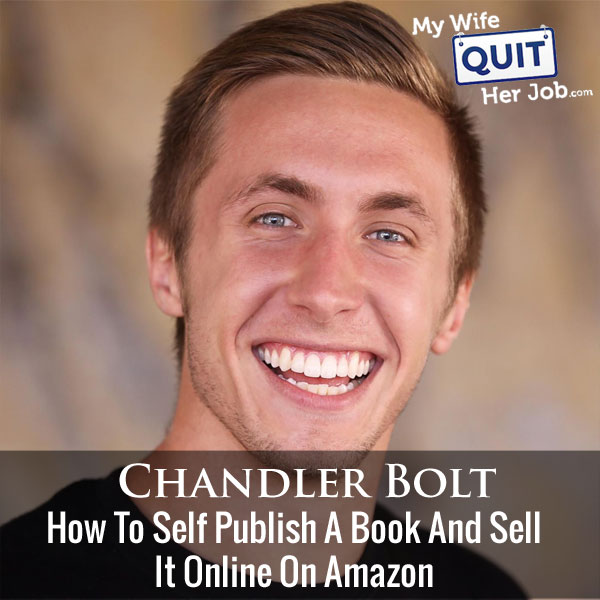
Chandler Bolt runs Self Publishing School and wrote his first book at 19 as a C-level English student in the process of dropping out of college. That book earned close to $7,000 in its first month and a few thousand a month in passive income afterward, and it became the foundation of a business that reached over $7 million in three years.
This episode covers why he considers traditional publishing the wrong choice for almost everyone, how to pick a topic specific enough to sell, the launch team mechanic that drives a first launch with no audience, the free-to-paid pricing ladder, and why book covers deserve real money.
A platform note: CreateSpace, which Chandler names for print books, has since been folded into Kindle Direct Publishing. Print, ebook, and audio all remain available with no upfront cost, now through KDP and ACX.
Get My Free Mini Course On How To Start A Successful Ecommerce Store
If you are interested in starting an ecommerce business, I put together a comprehensive package of resources that will help you launch your own online store from complete scratch. Be sure to grab it before you leave!
Table of Contents
Key takeaways
- The 90-day timeline splits into one to two weeks of idea work, 30 to 45 days of writing at 30 minutes daily, and a month of pre-launch buildup.
- Get specific enough that a reader knows within two seconds what the book is about and whether it will help them.
- Sell pain pills rather than vitamins. Reposition “how to prevent burnout” as “what to do once you burn out.”
- A launch team of 5 to 50 people who leave reviews at launch is the 80/20 of a successful first book.
- Run a two-day free period before the real launch to accumulate downloads and reviews, then step pricing up weekly from 99 cents.
- Amazon pays 70% royalties between $2.99 and $9.99, and 35% outside that range in both directions.
- Put the title in the upper third of the cover, not the bottom, because that is where the eye lands first.
- Give away the audiobook through the Look Inside feature to capture email addresses from people who never buy the book.
Should you self publish or use a traditional publisher?
Self publishing makes more sense for roughly 99% of authors, and the exception is someone commanding a large advance who genuinely needs international distribution. The economics have shifted decisively toward independent authors.
The numbers behind that claim are stark. Over 70% of all books sold move through Amazon, less than 16% of bestselling ebooks come from traditional publishers, and roughly 70% of author earnings go to independently published authors.
The most common reason people want a publisher is the belief that the publisher will market the book. They will not. They will ask you how you plan to market it.
What you give up is substantial: years of your life, creative freedom, and control of the process. Chandler’s comparison is to what ride-hailing did to the taxi industry, where the incumbent structure is stacked against the person doing the actual work.
Can a self published book hit the New York Times bestseller list?
Reaching the New York Times list as a self published author is very difficult, partly because it is an editorial list rather than a pure sales ranking. Editors can exclude a book that met the sales threshold.
The qualifying algorithm is genuinely complex. It requires sales spread across zip codes, across independent bookstores, chain stores, and Amazon, with only a limited portion coming from bulk corporate or event orders.
Chandler cites specific cases of authors who sold well past the roughly 10,000 to 12,000 copies needed in week one and were kept off anyway. Jeff Walker reloaded and pushed harder in week two, hitting number one, after being excluded despite qualifying in week one.
USA Today and the Wall Street Journal lists are closer to true sales rankings. Getting into physical bookstores is possible though difficult, and Amazon’s own physical stores stock based on what sells.
How specific should your book topic be?
A reader should understand within two seconds what your book is about and whether it will help them, judging from the title and subtitle alone. If they cannot, the topic is too broad.
Chandler’s example is a student whose original concept was roughly “live your passion, fulfill your dreams, and accomplish your purpose.” Nobody reading that knows whether they are the audience.
The conversation revealed what she was actually passionate about, which was helping people quit their day job. The book became Go Solo with a subtitle about quitting the job you hate and starting a small business you love.
That version tells a browser instantly whether they are the reader. She went on to get an endorsement from Barbara Corcoran of Shark Tank.
There is no such thing as too specific. Chandler’s own first book positioned itself as productivity tactics for entrepreneurs struggling with work-life balance who want control of their schedule.
Why you should sell pain pills instead of vitamins
People reach for their credit card when something hurts and stand idle when offered prevention. Nobody wakes up planning to buy vitamins, and plenty of people wake up with back pain and go looking for relief.
The application to book positioning is direct. One student was writing about preventing burnout in the workplace, which nobody searches for.
Chandler’s reframe kept the entire contents of the book and changed the hook to what to do once you have burned out. That is the moment someone actually opens a search box.
Established authors with large followings can get away with clever, vague titles because their audience creates the initial traction. A first-time author has no such cushion and needs the title doing the work.
What does it cost to self publish a book?
Budget $200 at the bootstrapped low end and $1,000 to $1,500 at the reasonable high end. Most people spend far more than they need to.
Editing and the cover are the two real expenses. Everything else, including print, ebook, and audio distribution, carries no upfront cost through Amazon.
Skipping the editor entirely is not the recommendation, though Chandler self-edited his first book. A cheap alternative is asking a former English teacher, which is often a meaningful moment for them too.
His own sequence is worth copying if you are short on cash. He self-edited, the book performed well, and he used first-month proceeds to hire an editor and publish a revised version a month or two later.
What makes a book cover sell rather than just look good?
A good-selling cover is different from a good-looking cover, and designers default to the latter. Three things separate them.
First, the cover has to communicate the subject instantly, the same two-second test the title has to pass. Second, the title must be easily readable at thumbnail size.
Third, put the title in the upper third of the cover. Designers habitually place it at the bottom, which fights natural eye movement since people look at the upper third first and read down and to the right.
The cover is your billboard on Amazon. Spending years writing and then five dollars and five minutes on the cover is the single most common mistake Chandler sees.
For testing, he puts cover options to a vote with his email list and on social media. That is less rigorous than paid testing and doubles as pre-launch buzz, since people who weighed in feel invested in the launch.
How do you launch a book with no audience?
Build a launch team, which is simply a group of 5 to 50 people who agree to support the book. Chandler calls it the 80/20 of a successful launch.
Anyone qualifies: friends, family, coworkers, colleagues, other parents at your kid’s practice. The commitment is small and specific.
Each member gets a free digital copy ahead of launch and leaves a review when the book goes live. In exchange their name appears in the acknowledgments.
Chandler had a few hundred Facebook friends and no list when he launched his first book at 19. The 4,000-person email list came from the book rather than preceding it.
What is the free-to-paid launch strategy on Amazon?
Run a two-day free period before your actual promotional push, so your launch team can download and review the book while it sits quietly on Amazon. Chandler calls this the stealth launch.
During that window, submit the book to sites that promote free and discounted Kindle titles. Buck Books and Awesome Gang are two of the paid-discount variety, and a number of equivalent free-book sites exist.
Those submissions generate a large volume of free downloads, which builds ranking in the free store. The transition to the paid store then starts from a position of visibility rather than obscurity.
How should you price a self published Kindle book?
Switch from free to 99 cents, then step the price up roughly one week at a time until you reach your target. The ladder creates urgency and gives you a legitimate reason to keep talking about the book.
The royalty structure sets your ceiling. Amazon pays 35% between 99 cents and $2.99, jumps to 70% from $2.99 to $9.99, and drops back to 35% above $9.99.
That makes $2.99 to $9.99 the sweet spot for most books, and Amazon designed it that way deliberately. They want to discourage both throwaway 99-cent titles and publishers pricing ebooks high to protect print sales.
Your goal changes the answer. Pricing a Kindle edition at $9.99 pushes more readers toward the physical copy, which makes sense if print sales are what you want.
Should you record an audiobook for your first book?
Record the audiobook, especially if the book supports a business. It earns well in many genres and it builds a connection nothing else matches.
The reason is time. An audiobook listener spends hours with your voice, which makes them far more likely to check out your podcast, your blog, or your products afterward.
Narrating it yourself is worth the effort. Chandler took a day and a half in a studio and is glad he did, citing Gary Chapman narrating The Five Love Languages as an example of an author who feels personally known because of it.
Hiring a narrator is cheaper than doing it yourself once you account for studio time, and DIY recording is a viable middle path.
How do you use a book to generate leads for your business?
Give away the audiobook and the first five pages for free, and place that offer where the Look Inside feature displays it. Browsers can opt in without ever buying the book.
That trade looks irrational until you compare values. A lead entering Chandler’s world is worth far more than a Kindle royalty, and many of those people buy a format of the book anyway.
The compounding is what makes it work. In one month his team generated about 1,500 leads, and a meaningful share came from a book published two or three years earlier.
Because the lead is the goal rather than the royalty, he happily spends on Amazon ads and treats break-even as a win. He is effectively being paid to acquire leads.
Should you run ads for a self published book?
Amazon’s own ad platform works well for books and functions much like sponsored product ads, with keyword bidding determining where you appear. That is where Chandler puts his book ad budget.
Facebook ads for books are a different matter. Tracking is difficult and the interaction between Amazon’s and Facebook’s terms of service sits in a gray area, so he avoids sending Facebook traffic directly to a book listing.
His Facebook budget goes elsewhere. Ads pointing at his own offers, with the book included as part of the funnel, perform far better than ads pointing at Amazon.
Is fiction or nonfiction more profitable to self publish?
Nonfiction produces base hits and fiction produces home runs, with correspondingly higher strikeout rates. Most of the money on Amazon sits in fiction, and the top 100 across all of Amazon is nearly all fiction.
The reason is reading behavior. Fiction readers consume one to two books a week as entertainment, which creates a volume of repeat purchasing that nonfiction rarely sees.
Fiction is also considerably harder to execute. A nonfiction reader forgives mediocre prose if the content delivers, and a fiction reader will not.
Fiction demands consistent voice, character development, plot, conflict, and a sustained story arc. Two or three slow chapters and the reader is gone.
Chandler’s advice for anyone planning two books is to write the nonfiction one first. It is a meaningfully easier first attempt.
Frequently asked questions
How long does it take to self publish a book?
About 90 days: one to two weeks on the idea and outline, 30 to 45 days writing at roughly 30 minutes daily, and a month of pre-launch promotion.
How long should a self published book be?
Between 15,000 and 40,000 words for a nonfiction book. That range is achievable at 30 minutes of writing a day inside the 90-day window.
How much does it cost to self publish on Amazon?
Roughly $200 at the bootstrapped end and $1,000 to $1,500 at the higher end, with editing and cover design accounting for nearly all of it. Amazon charges nothing upfront for print, ebook, or audio.
What royalty does Amazon pay on Kindle books?
70% for books priced between $2.99 and $9.99, and 35% both below $2.99 and above $9.99. That structure makes the middle band the default choice for most authors.
What is a book launch team?
A group of 5 to 50 supporters who receive a free advance copy and leave a review when the book launches, usually in exchange for a mention in the acknowledgments. It is the highest-leverage part of a first launch.
Can you get reviews from a free Kindle promotion?
Yes. Running a two-day free period before your promotional push lets your launch team download and review the book, which builds a review base before real traffic arrives.
Where should the title go on a book cover?
In the upper third. Designers often place it at the bottom, which works against how people scan a thumbnail.
Should you write fiction or nonfiction first?
Nonfiction. It is easier to execute well, since readers forgive weaker writing when the content delivers, while fiction demands storytelling craft you either have or do not.