
Podcast: Download (Duration: 47:05 — 54.2MB)
Self publishing makes more sense for roughly 99% of authors, because over 70% of all books now sell on Amazon and no publisher is required to get there. Traditional publishing still wins on prestige, international distribution, and access to the New York Times list, which is why established names use it for one flagship book and self-publish everything else.
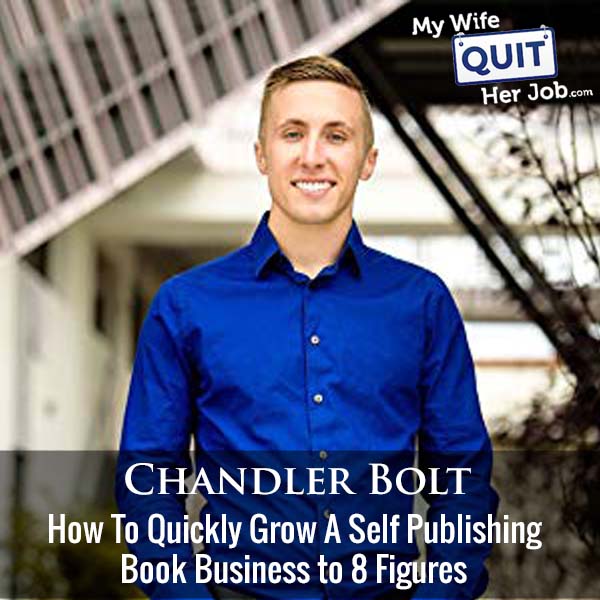
Chandler Bolt runs Self Publishing School, teaching people to write and publish a first book in three months at 30 minutes a day. He has made the Inc 5000 and grew his business by triple digits year over year.
This episode covers the economics of each path, how to structure a book launch, how Amazon ads work for books, and the content strategy behind his own growth.
Get My Free Mini Course On How To Start A Successful Ecommerce Store
If you are interested in starting an ecommerce business, I put together a comprehensive package of resources that will help you launch your own online store from complete scratch. Be sure to grab it before you leave!
Table of Contents
Key takeaways
- Over 70% of books sell on Amazon, which removed the publisher’s distribution monopoly.
- Kindle royalties are 70% between $2.99 and $9.99, dropping to 35% outside that band.
- The New York Times list is editorial, meaning editors choose. USA Today is a true sales-based list.
- Launch teams drive day-one reviews from five to fifty supporters who read the book in advance.
- Never incentivize reviews. Free copies and name credits are fine, and quid pro quo is not.
- Three reviews from one IP address get all three removed.
- Amazon ads return roughly 2x to 3x, and breaking even is fine when the book feeds a business.
- Ads come after launch, since launch velocity comes from promo sites and the launch team.
How Chandler Bolt grew the business by triple digits
Three things drove it: strong people, a genuine gap in the market, and staying laser focused on what they do well.
The newest addition was content marketing, which he admits he underinvested in for years.
The logic is that helping people extensively during the consideration phase means that by the time someone commits to writing a book, working together is the obvious choice.
The rest is restraint. He describes the business as a one-trick pony that helps people write and publish a book to grow their business, without an elaborate ascension model or a $30,000 mastermind.
He is explicit that this leaves money on the table, and that the focus produced better execution.
How to build a content strategy around search intent
The filter is whether a term has both search volume and buyer intent.
The terms that matter are how to write a book, how to self publish a book, and self publishing itself.
Everything is measured on daily organic unique users rather than traffic generally, because organic is the defensible long-term moat.
The process runs in two steps. First, can we write the best article on the internet for this topic. Second, can we earn backlinks so it can rank.
Chandler’s reasoning on competitive terms is that Google’s objective is ranking the best article, so genuinely being the best eventually produces links and the engagement signals that follow from people staying on your page.
They target long-difficulty keywords they may not rank for in three to six months anyway, to build momentum.
How to layer YouTube on top of a blog
Videos get made for the highest-traffic posts first, working down in order.
The mechanism is mutual reinforcement. An article getting 2,000 hits a day with an embedded video might produce a hundred video views a day.
Those views help the video rank on YouTube for the same term, which sends traffic back to the blog.
The end state is occupying more search real estate, with both the article and the video on page one for the same keyword.
His view is that video and audio are the future of search, which is why the investment started even though it began late.
Why self-publishing.com stays separate from Self Publishing School
Chandler bought self-publishing.com and deliberately did not redirect it.
The reason is credibility. The intent is a genuinely independent, unbiased resource for the whole industry rather than a propaganda arm for the school.
The scope differs too. Self Publishing School covers how to write and publish your first book, while self-publishing.com covers the industry: which service companies exist, how Ingram Spark works, how to get an ISBN.
He believes the broader property can eventually be larger than the school.
The strategy also differs by domain age. The new site targets lower-competition keywords to build momentum, while the school chases the hardest terms.
Why the publisher’s distribution monopoly collapsed
Publishers held power because you needed one to reach bookstores, and bookstores were where sales happened.
Chandler’s analogy comes from watching his brother’s Grammy-nominated band up close. Record labels held the same chokehold over radio distribution.
Both industries are shifting toward independent deals for the same reason.
Now that over 70% of books sell on Amazon and Amazon requires no publisher, the original justification is gone.
Hal Elrod is his example of the ceiling. The Miracle Morning has sold over two million copies, self-published.
What you actually earn from self publishing
Kindle royalties are 70% for books priced between $2.99 and $9.99, and 35% for books priced from 99 cents to $2.99.
Audiobooks published independently through ACX run 20% or 40%.
Print royalties vary by trim size, colour, and page count, generally landing at 20% to 40% depending on list price and print cost.
| Format | Typical price | Royalty |
|---|---|---|
| Kindle | $2.99 to $9.99 | 70% |
| Kindle | 99 cents to $2.99 | 35% |
| $12.99 to $17.99 | 20% to 40% | |
| Audiobook (ACX) | Set by length | 20% or 40% |
There is also an Audible bounty. If someone signs up for Audible and your book is their first download, you earn a bounty on top of the royalty, which Chandler puts at roughly $75 to $100.
Why traditional publishers limit your marketing
Two things surprise most first-time authors about traditional deals.
Traditional publishers will not market your book.
You also lose control in ways that undercut your own marketing. Chandler has friends who cannot run Amazon ads on their own books, because the publisher holds the account login.
When traditional publishing is the right choice
There are four genuine advantages.
Ego and legitimacy. Being published traditionally reads as more credible to the outside world, which is a real reason people choose it.
Remaining distribution advantages in bookstores and similar channels.
Access to the New York Times list, which is effectively closed to self-published books.
International rights and distribution, which matter if reach rather than royalties is the goal.
The profile it suits is narrow. Someone with existing clout whose objective is maximum international reach rather than income, accepting significantly less money and fewer rights in exchange.
The common pattern among established authors is one big traditionally published book as a credibility play, with everything else self-published at far better royalties.
Why the New York Times list is not a sales ranking
The New York Times list is editorial, meaning editors select the books.
It is directionally meant to reflect sales, and editors can keep a book off for essentially any reason.
Chandler’s example is Michael Hyatt, who by his account sold enough in week one to be number one and did not appear on the list at all, apparently caught by an effort to exclude internet marketers.
USA Today runs a true bestseller list based on actual books sold, and self-published books can reach it.
How to run a book launch team
A launch team is a small group of supporters, anywhere from five to fifty people.
They read the book ahead of time, leave a review on day one, and generally spread the word.
What they get is a free digital copy, their name printed in the book, which people genuinely love, and a look behind the scenes of the launch.
The structure is a Facebook group with one assignment per week for about three weeks before launch, covering social sharing and PR.
The point is day-one reviews. Launching with five, fifteen, or fifty reviews already in place drives early sales meaningfully.
You do not need an existing audience. Chandler ran this before he had one, personally messaging anyone who shared the book with a video asking them to leave an honest review that day.
Where the line sits on incentivizing reviews
The distinction Amazon cares about is incentivization.
Offering a gift card or anything of value in exchange for a review crosses the line.
A launch team asking for a review as something that would be helpful, without making it a condition of the free book or the name credit, stays on the right side.
Amazon is actively cracking down, and there are known patterns. Three reviews from a single IP address typically result in all three being removed, so multiple household members reviewing is a risk.
Reviewers also need to have spent enough on Amazon to qualify, which silently blocks some supporters.
People speculate about Facebook connections. Nobody has proven it, though Amazon owns Goodreads and most people log into Goodreads with Facebook.
How Amazon ads work for books
Amazon’s ad platform has been effective, returning roughly 2x to 3x on cost of sale.
Breaking even is acceptable when the book feeds something else. Chandler is happy to lose money on ads because readers become leads, customers, reviewers, and further book sales.
The untracked benefit is ranking. More sales lift your Amazon rank, which puts you in more searches, which sells more books organically.
The targeting is author and book focused. You bid on related authors and related books, which is why keyword tools that scrape bestseller lists are useful.
The placements sit where “customers also bought” used to be on a competitor’s product page, plus sponsored slots that look native alongside the cover, ad copy, and review count.
The tool he recommends is Publisher Rocket, which also helps select publishing keywords and categories.
Why ads come after launch rather than during
Ads cannot generate enough velocity during a launch window to move the needle.
Launch velocity comes from promotional sites, the launch team, and any pre-release list.
Ads are the sell-more-books strategy, sustaining sales month after month afterward.
Which book promotion sites work
Only a handful of promotional sites actually produce results.
Each has different requirements. Some need a 99-cent promo, some a free Kindle giveaway, some require $2.99 pricing plus 25 reviews.
The ones Chandler names are BookBub, Buck Books, and BKnights, with roughly half of the useful ones free and half paid.
BookBub is the standout. It is harder to get accepted and considerably more expensive than the others, and it drives real sales.
What actually drives Amazon book rankings
Sales velocity and review velocity are the two things that matter most.
The ecosystem resembles podcast rankings closely, which is why the advice is to scrap for every review possible, especially early.
Not all search traffic is author or title driven. Amazon is one of the largest search engines on the internet, and people search for things like best leadership books.
Rankings draw on title, subtitle, description, and the content of the book itself, plus related-book associations that reviews help you climb.
How Chandler Bolt books speaking gigs
Speaking went from zero in 2017 to roughly a million dollars in customer acquisition the following year, across 24 events.
The approach was deliberately high volume, following a core value of fail fast and fail often, on the theory that more attempts means faster learning.
The model is sponsorship plus speaking. He often waives the speaking fee, brings the team, and runs strategy sessions covering attendees’ goals, challenges, and next steps, converting where there is a fit.
That makes revenue per event measurable, and the current focus is fewer, higher-caliber stages with a higher average stage value.
Getting booked is targeted outreach and referrals with a real pipeline: initial outreach, contact made, intro call, follow-up call. Doing a genuinely good job for one organizer produces the next invitation.
Frequently asked questions
Should you self publish or use a traditional publisher?
Self publishing suits roughly 99% of authors, since over 70% of books sell on Amazon and royalties are far higher. Traditional publishing suits established names wanting international reach and bestseller list access.
How much do you earn per book self publishing?
Kindle pays 70% for books priced $2.99 to $9.99 and 35% outside that range. Print runs 20% to 40% depending on trim size and page count, and ACX audiobooks pay 20% or 40%.
Can a self published book hit the New York Times list?
Very rarely. The New York Times list is editorial rather than sales-based, so editors choose. USA Today runs a true sales-based list that self-published books can reach.
What is a book launch team?
A group of five to fifty supporters who read your book in advance and leave reviews on launch day, receiving a free copy and a name credit rather than payment.
Is asking for reviews against Amazon’s rules?
Asking is fine. Incentivizing is not. Offering gift cards or anything of value in exchange for a review crosses the line, while a free copy without a review requirement does not.
Why do Amazon reviews get removed?
Common causes include three reviews from the same IP address, which usually removes all three, and reviewers who have not spent enough on Amazon to qualify.
Do Amazon ads work for books?
Yes, typically returning 2x to 3x. Breaking even is still worthwhile when the book generates leads, since higher sales also lift your organic ranking.
When should you run ads during a book launch?
After launch rather than during. Launch velocity comes from your launch team and promotional sites, and ads sustain sales in the months that follow.