
Podcast: Download (Duration: 49:19 — 68.0MB)
Greg Mercer’s position is blunt: for 99.9% of people listening, the right answer is to double down on whatever is already making money. Mike Jackness and I both argued for diversifying. Nobody fully convinced anybody.
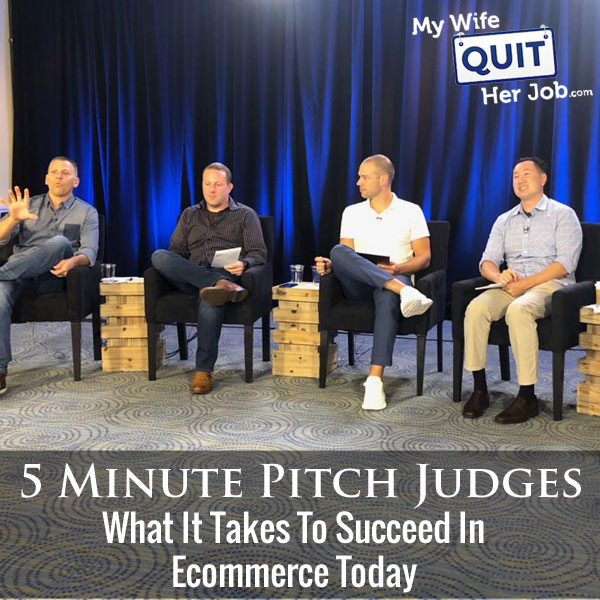
This was recorded on a patio in San Diego immediately after the four of us finished three days of judging 32 businesses for the 5 Minute Pitch. Greg runs Jungle Scout, Mike runs EcomCrew, Scott Voelker runs The Amazing Seller.
Below is what we saw that separated the strong businesses from the weak ones, the full double-down versus diversify argument, and why all four of us still say start on Amazon.
Get My Free Mini Course On How To Start A Successful Ecommerce Store
If you are interested in starting an ecommerce business, I put together a comprehensive package of resources that will help you launch your own online store from complete scratch. Be sure to grab it before you leave!
Table of Contents
Key takeaways
- Defensibility matters more than anything now. A pure me-too product with no intellectual property is very hard to sustain.
- Personality repeatedly overcame weak numbers in the pitches we scored.
- Greg’s advice for almost everyone is to double down rather than diversify, and he names diversification as his own biggest career mistake.
- Mike’s rule is not to diversify until your risk profile demands it, which he places well into seven figures.
- All four of us recommend starting on Amazon, because it removes fulfillment, logistics, payments, and traffic from your first year.
- Scott’s newer brand reached 70,000 monthly uniques and roughly $5,000/month in ad revenue with no Amazon link.
- Polarizing brand positioning works well in saturated categories.
- An idea is worthless without execution, and copycats of Bumble Bee Linens simply faded out over time.
What separated the strong businesses from the weak ones
Mike’s answer to whether bootstrapping still works is unambiguous. We had just watched roughly two dozen of 32 companies performing well, many of them young.
What he considers essential now is uniqueness and defensibility. It cannot be a me-too product in any form, and it needs intellectual property or something genuinely hard to knock off.
He acknowledges the tension in his own position, since almost everything is a me-too product at some level because almost everything has been invented. Very few people genuinely invent.
Personality overcame the numbers
The thing that surprised me most was how much a founder’s personality swayed me. I went into several pitches ready to write off a commodity product in a saturated category, and the founder’s passion changed my scoring.
Scott confirmed this was a consistent theme. Companies doing well had a face attached to the brand, someone relatable that customers want to buy from, and the advice we gave struggling companies frequently came back to that.
In several cases personality overcame numbers that did not really add up.
Polarizing positioning in saturated markets
Greg identified a pattern he liked: brands that market in a deliberately one-sided, almost binary way.
His example is soap positioned exclusively for tough men, framing it so that girly hands cannot handle it. You are effectively creating enemies in your branding while producing a passionate following among people who feel they belong inside the group you are addressing.
He rates this especially highly in saturated or highly competitive niches.
The hustle stories
What we saw repeatedly was founders who could reasonably have quit and did not.
One founder had a spotty wireless connection, so he bought 150 feet of Cat 5 cable and wired his house specifically so he could participate in the pitch. Hearing that, I was confident he would succeed.
Another loaded inventory into a rented U-Haul himself. One had a huge success on a television shopping show followed by a serious setback. One hit a bad cash flow situation, and the same person had cancer.
Mike’s framing, borrowed from a former podcast partner, is learning to fail forward: treating failure as the mechanism for becoming a better entrepreneur.
Greg’s summary of everyone who made it past the first round is that they were pure hustlers, regardless of background, education, or prior experience.
Why they were willing to share publicly
My read is that the successful founders were genuinely using the products they built. They were experts in their field, found deficiencies in the tools they used, and built something better, which gives them real domain knowledge.
Mike’s version is that he talks openly about everything his business does because he believes it adds real value to customers and community. Someone reselling a me-too product for short-term money has every reason to be guarded.
Should you build your brand in public?
Scott pushed back on Mike here, and the disagreement is worth preserving.
Scott’s position is that he started a brand with a partner 18 months earlier and believes he would have had less of a head start had he shared everything publicly. Building in public invites people to copy you, hit you with negative backlinks, or outright rip off the brand.
Mike agreed it puts you at a disadvantage and shared ColorIt publicly from day one anyway. His reasons: he is financially secure enough not to care as much, he never expects to sell 100% of any niche, and if someone catches him he treats that as his own failure to work hard enough.
He is explicit that this is not advisable and that Scott is right.
What actually happened with our copycats
My wife was genuinely worried when I started My Wife Quit Her Job that people would copy Bumble Bee Linens, since there is no meaningful IP in handkerchiefs.
We did get knockoffs, including ones called Hummingbird Linens and Queen Bee Linens. They were clearly reading the blog, and some used our own photos to build mock shops.
Those competitors trailed off over the years. My confidence came from my ability to market rather than from anything protectable.
Greg’s summary is that an idea is worthless without execution. Someone else having the idea to sell coloring books or linens does not matter, because businesses require getting up every day and doing monotonous unglamorous work.
Mike’s addition: it sounds effortless in a 30-minute podcast, and people discover how much execution it takes when they try it for a year.
The same holds in blogging. People copy or lightly reword content constantly, and those blogs never succeed, because the brand and the voice behind it is what matters.
Why all four of us say start on Amazon
Mike is emphatic despite having started off Amazon himself, calling it out of your mind not to start there.
The reason is everything Amazon removes from your first year: picking, packing, shipping, logistics, labeling, customer service, and traffic. Running your own site means learning payments, listing management, sales tax collection, email marketing, and Facebook ads simultaneously.
That leaves you free to focus on getting the product right, the photography, and the listing.
His view is that a crossroads eventually arrives where you need off-Amazon channels to avoid concentration risk, and that you need a business large enough to be worth diversifying first. He places that well into seven figures.
My caution about Amazon
My concern is what I see with students. They find success on Amazon and lose track of their brand entirely.
It behaves like a drug. The money arrives from that channel, so it feels obvious to pour everything back into it.
My advice is to press the Amazon channel until you have genuinely saturated it, and start building your own site on the side once you have traction rather than diverting all resources. Building a real brand can only happen outside Amazon.
Scott’s framing is that Amazon is the launch pad rather than the destination.
The double down versus diversify debate
Greg raised this as something he genuinely struggles with weekly, and it produced the sharpest disagreement of the conversation.
| Position | Argument |
|---|---|
| Greg Mercer | Double down. For 99.9% of listeners, the answer is doing a better job at whatever already makes money. |
| Mike Jackness | Do not diversify until your risk profile demands it. Chase two rabbits and both escape. |
| Steve Chou | Diversify to protect income once a business reaches a level worth protecting. |
| Scott Voelker | Diversify as a safety net, and note that doubling down on your brand counts as doubling down. |
Greg’s argument is that Amazon comes easily to him and launching more products is straightforward, and looking back at his career, most of his mistakes were attempts to diversify, acquire, or start new projects instead of doubling down on his core strengths.
His caution is about the cost of devoting brainpower and mental energy to projects that statistically will not outperform the thing you are already good at.
I pointed out that Greg himself went through an acquisition spree, which he acknowledged as exactly the mistake he was describing.
Why I diversify
My reasoning is partly risk tolerance and partly that my income goals are less ambitious than Greg’s, who wants to build a nine figure company.
I treat everything like a drug and I am satisfied with a seven figure business, so once income reaches a certain point I want to protect it. That makes diversification the priority.
I also diversify sometimes purely to build a different skill set, which is a separate goal from maximizing money.
Scott’s reframe
Scott’s addition is that doubling down does not have to mean more products on the same channel. It can mean doubling down on your brand: building external channels, content, and traffic to your own site.
His concrete example is his newer brand’s website, which went from zero to over 70,000 monthly uniques and growing. Adding display advertising is producing roughly $5,000 a month in recurring revenue with no link to any Amazon product.
His warning is about the alternative pattern. Someone in his mastermind was staying ahead purely by launching more products as competition arrived, which leaves you permanently behind and holding inventory you can no longer sell.
Mike on why paranoia increases with experience
Mike’s position connects the two threads. Doubling down on what works is sound until the day your account gets shut down or a listing gets suspended, which has happened to him.
When you are young you feel indestructible and assume it will not happen. After it happens several times you become more guarded.
He is honest that he does not know the right answer and struggles with it almost daily. His own weakness is shiny object syndrome, and his defense is staying laser focused within ecommerce for six or seven years even while running multiple brands.
Greg noted this defense sits awkwardly alongside a podcast and a course, which Mike defended as still being ecommerce.
Why we do podcasts and courses at all
Scott raised the question he gets constantly: if you enjoy building businesses, why not just build ten businesses instead of teaching?
Mike’s first answer is that building a business is not easy.
His real answer is about diminishing returns on money. He wants money like everyone, and it has become progressively less of a factor, because the money-to-happiness curve flattens quickly and eventually more things stop making you happy.
What produces genuine satisfaction is the messages from people whose lives changed, who quit their jobs, who got a business out of a hole. He acknowledges it sounds like something you say in a commercial and maintains it is true.
Scott’s version is that growing a client’s business grows the number of stay-at-home mothers that client employs.
My own version is that priorities shift. I take on projects now based on whether they make me happy, and none of us made money on the 5 Minute Pitch. We were in debt on it.
The same is true of running events. Between the upfront risk and the work involved, you could earn considerably more from a workshop or a webinar, and Sellers Summit exists for the community rather than the margin. Toni Anderson deserves the credit for making that work.
What we each took away
Mike’s takeaway was straightforwardly that he loves his life, is thankful to travel, meet interesting people, and not live on someone else’s terms.
Greg’s was that he loves working with entrepreneurs, and that it is easy to get stuck behind a computer week after week without those connections.
Mine was similar. Most of my friends at home are engineers, lawyers, and doctors, so I get very little entrepreneurship enthusiasm locally, and I value building community around it.
Scott’s observation is that reaching a level you thought was the destination produces the question of what is next. What he saw across the contestants is people who want a lifestyle business and also want to build something they are proud of.
My addition: you need a higher purpose. We built ours to spend more time with our kids, and doing it purely for money eventually feels empty.
Mike’s closing advice
You do not have to plan everything in advance. The 5 Minute Pitch had a general guideline and no detailed plan, and behind the scenes it was messier than it looked.
Had we tried to plan every detail, it would never have launched. We decided to do it, did it, and worked it out along the way.
I added the correction that Liz was the brains behind the project and none of it would have happened without her.
Frequently asked questions
Should you double down on what works or diversify?
Greg Mercer argues that for almost everyone the answer is doubling down, and names diversification attempts as his own biggest career mistakes. Mike Jackness advises against diversifying until your business is large enough that concentration risk genuinely threatens you, which he places well into seven figures.
Should you start selling on Amazon or on your own site?
All four panelists recommend Amazon first, because it removes fulfillment, logistics, labeling, customer service, payments, and traffic from your first year. The counterpoint is that Amazon success can become a trap, so build your own site alongside once you have traction.
What makes an ecommerce business defensible?
Uniqueness and intellectual property, according to Mike Jackness, since a pure me-too product with nothing protectable is very hard to sustain. Personality and a visible founder also function as defensibility, since those cannot be copied.
Should you build your brand publicly?
Scott Voelker argues it costs you a head start and invites copycats and negative attacks. Mike Jackness shared ColorIt publicly from day one, agrees it is a disadvantage, and accepts it because he never expects to own a whole niche.
Do copycats actually hurt your business?
In Steve Chou’s experience they faded out. Bumble Bee Linens attracted multiple knockoffs, including ones using their own photographs, and all of them trailed off over the years because execution and brand voice matter more than the idea.
Does polarizing branding work?
Greg Mercer rates it highly in saturated categories. Positioning that deliberately excludes some buyers creates a passionate following among the people who identify with the group you are addressing.
Why do successful entrepreneurs teach instead of just building?
Mike Jackness points to diminishing returns on money and says messages from people whose businesses or lives changed produce more satisfaction than a product selling better. Events and shows like the 5 Minute Pitch frequently make little or no money.
How long does it take to build audience traffic to your own site?
Scott Voelker’s newer brand reached over 70,000 monthly unique visitors and roughly $5,000 a month in display advertising revenue, and elsewhere in the conversation the panel estimates 12 to 18 months before meaningful search traffic appears.