
Podcast: Download (Duration: 47:30 — 54.6MB)
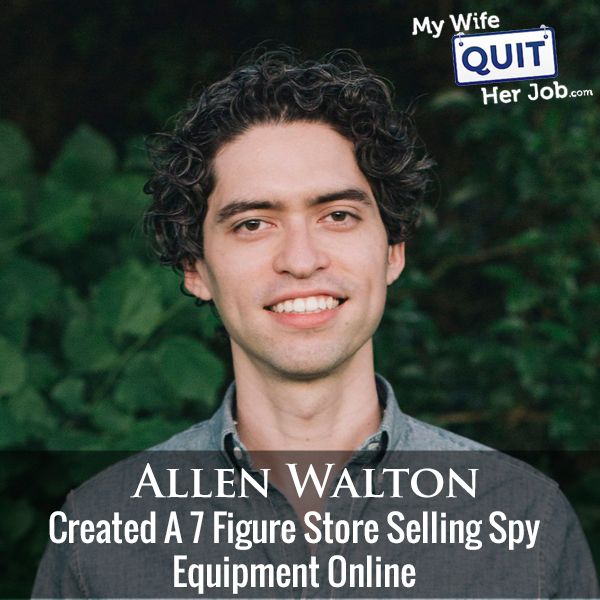
Allen Walton sells products with no brand names, in an industry he describes as sketchy people selling sketchy products to paranoid customers, where every competitor lists the same white-labeled goods from the same Chinese factories. He built SpyGuy.com into a seven figure business by doing the three things none of them do: curating what he carries, explaining the differences, and answering the phone.
Allen bootstrapped the company for under $1,000 including LLC formation, and it has been featured in Forbes, Entrepreneur, CNBC, and Fast Company.
Below is how he differentiates commodity products, the PPC apprenticeship that scaled the business, the HARO strategy that produced his press coverage, and what he got wrong in a redesign.
Get My Free Mini Course On How To Start A Successful Ecommerce Store
If you are interested in starting an ecommerce business, I put together a comprehensive package of resources that will help you launch your own online store from complete scratch. Be sure to grab it before you leave!
Table of Contents
Key takeaways
- Allen started the entire company, including legal setup, for under $1,000.
- Spy equipment has no brand names, so 20 sellers list the identical product under 20 invented names.
- He differentiates through original product photography, video, and descriptions specifying actual internal components.
- Roughly 15% to 20% of orders are placed over the phone, with four staff doing sales and lifetime tech support.
- He took a PPC apprenticeship a month after launching, earning $1,000 a month while learning to scale AdWords.
- Google Shopping suspensions arrive with no warning and take one to two weeks to resolve.
- A HARO response, engineered to name-drop Tim Ferriss, turned a Forbes mention into 300,000 views.
- Customer lifetime value equals the first order. There is almost no repeat business.
How Allen ended up selling spy equipment
Allen grew up in Dallas eating at a pancake house next to a spy shop that looked, in his words, sketchy as hell. He would peer through the windows without going in.
At 21, living at home with parents who wanted him working, he saw a help wanted sign and his mother made him apply. He got the job.
The shop sold CCTV systems to businesses and homeowners alongside genuine spy gear: hidden cameras, GPS trackers. They worked with police departments and private investigators, and occasionally celebrities wandered in to look around.
He worked there roughly two years, then was hired by the TV show Cheaters to build them an online spy shop, having convinced them ecommerce was the direction rather than another brick-and-mortar store. That ran about three years before he left to start SpyGuy.
A year in he needed help and recruited Vince, the man who had originally trained him at the Dallas shop. Vince now handles training for new employees.
Why sourcing in an unbranded category is difficult
Nothing in this category carries a brand name. You cannot buy these products at big box retailers, so everything moves through online sellers or small local spy shops.
Allen’s read on why: major brands do not want their name on a hidden camera, and a meaningful share of people in the industry are themselves sketchy.
Most inventory comes from Asia plus US distributors. Searching Alibaba surfaces products, and many Chinese factories produce identical items, apparently from public molds, or the listings belong to trading companies sourcing from a factory you cannot identify.
Allen made the trip to China and contacted everyone he could, and still cannot determine who actually manufactures much of what he sells.
He carries inventory on everything rather than dropshipping, falling back on supplier dropshipping only when something is out of stock.
White labeling is universal. On Amazon you will see the same product sold by 20 suppliers under 20 invented names, most of which look like someone spilled alphabet soup, still in the original Chinese gift box with the original instruction manual.
How to differentiate a commodity product
Allen competes on information rather than price, and he is frequently more expensive than Amazon.
He shoots his own product photos in his own studio and produces video for most products, where competitors have none.
His descriptions specify what competitors omit. Two hidden cameras can look identical while one has a plastic enclosure and the other aluminum, which feels substantially higher quality. More importantly, the internal components differ: his camera might be 1080p while a cheaper identical-looking listing is 480p or 720p.
Customers call regularly asking why his price is higher, and having a phone number to call is itself the differentiator.
Curating the catalog aggressively
After roughly a decade in the category, Allen stocks only products customers genuinely like and that generate low support burden and few returns.
His reasoning is that eliminating products you do not believe in eliminates the returns, the unhappy customers, and the negative things they say about you online.
Selling over the phone
Roughly 15% to 20% of orders come in over the phone, measured in a test earlier that year.
Four staff handle both sales and tech support, trained on everything in stock using internal training videos. Support is lifetime on every product sold, handled in-house.
The reason people call is that nobody buys this equipment casually. They have a specific need, real concerns, and usually want to be discreet.
Allen is direct about what those situations are: a parent in an Alzheimer’s home they suspect is being abused, an autistic child whose teacher may be verbally harassing them, a woman being harassed at work who needs proof, people going through divorces. Customers frequently want to unload emotionally, and his team are not therapists, so they listen and then match the person to the right product.
Why Allen put his face on the site despite hating it
Allen resisted appearing on his own website for the first two years. He dislikes being on camera and did not want to be publicly associated with spy equipment.
His framing: he would happily put his face on a music equipment store, and nobody shares spy gear on Facebook or Instagram.
What changed his mind was recognizing he was in a strange industry full of genuine people who needed help, with nobody filling that need.
So he positioned himself as the person you can trust: everything in stock, no dropshipping, a phone number that reaches someone who will help. That was radically different from what everyone else offered.
The result is customers recognizing his voice when he picks up the phone. He still takes sales calls occasionally to keep a finger on the business, introduces himself as Allen, and gets told he is the guy from the video.
How Allen learned PPC by apprenticing
Allen concluded SEO would take forever in a competitive niche, so he learned paid ads instead, working through three books, YouTube, and the PPC Hero blog.
A month after launching, he took an apprenticeship with someone he found on Craigslist in suburban Dallas who was solo-managing large AdWords accounts for companies like Simplehuman and See’s Candies.
He was there two or three months earning about $1,000 a month, which helped while the business was young. That knowledge is how he scaled initially, and paid search remains a large share of sales.
What he learned was less about the AdWords interface than about analysis: spreadsheets, pivot tables, lookups, conditional formatting, and reporting that made profitable ads easy to identify.
He handed PPC management to someone he met at the first Ecommerce Fuel event and has not been in the weeds since.
Google Shopping and text ads work. Display never stuck.
Google Shopping suspensions
Google has suspended Allen’s Shopping account for weeks at a time over what he sells.
The experience is that sales drop like a rock overnight, you cannot reach anyone useful, you cannot speak to the policy team directly, and phone support cannot tell you specifically what the problem is. Resolution takes one to two weeks.
Why organic traffic stayed under 10%
Allen knows SEO well and neglected it for years, which he attributes to complacency after money stopped being a motivator.
Once the store was producing a comfortable monthly profit he spent a year or two doing very little, and describes paying the price for that now that Google suspensions periodically remove his main channel.
Direct traffic is meaningful, with people typing SpyGuy into the address bar, driven substantially by word of mouth and on-site reviews.
How Allen got featured in Forbes and CNBC
Allen used HARO, Help A Reporter Out, which emails source requests from journalists three times a day. He also used Profnet, which he describes as higher quality and considerably more expensive.
He answered questions on subjects he genuinely knew: digital marketing, entrepreneurship, security topics.
The break came from a Forbes request looking for million-dollar solopreneurs. He recognized that very few people run a solo business at that revenue, so a strong answer had a real chance.
The Tim Ferriss amplification
Allen deliberately name-dropped Tim Ferriss repeatedly during the Forbes interview, planning to use the mention as a reason to contact him.
Forbes made Ferriss the banner image, and the article sat at about 1,000 views over three days.
Allen installed Twitter on his phone with alerts for Ferriss’s posts, waited for genuinely authentic tweets rather than scheduled ones, and replied with the link. It took two attempts.
Ferriss retweeted it, included it in Five Bullet Friday, and posted it to Facebook. Views went from roughly 1,000 to 300,000, and Inc. subsequently ran a version of the story.
Allen now cites the Forbes and CNBC pieces in every subsequent HARO response, which gives journalists confidence in featuring him.
He is candid that HARO has been poor for him over the last two years. He also recommends Ryan Holiday’s Trust Me, I’m Lying for PR tactics.
Why this business has almost no repeat customers
Customer lifetime value equals the first order. Allen calls the lack of repeat business brutal and something he would change if starting over.
Business customers are the exception. Police departments, private investigators, and business owners combating employee theft do reorder, and Allen flags them when an order shows a business name or title like private investigator.
He has no acquisition strategy for those buyers. They find him through search.
Why email marketing has not worked
Allen has no email capture on the site and sends only a few campaigns a year around Black Friday, Cyber Monday, and Valentine’s Day.
Two structural reasons: almost no new products enter this category, so there is nothing to announce, and customers do not repurchase.
The Valentine’s Day campaign has a logic specific to this niche. Someone having an affair celebrates twice, typically on February 13, so the campaign runs in the lead-up positioning it as the moment to catch a suspected affair.
He acknowledges a real gap in not emailing visitors who do not buy on the first or second visit.
Why Facebook ads have not worked either
There is no demographic for spy equipment. Analytics shows visitors distributed evenly across every age group, with slightly more male visitors and more female converters.
No common interest, trade, or demographic predicts a buyer.
Retargeting roughly breaks even, and multiple Facebook specialists have looked at the account and agreed it is genuinely difficult. There is also a discretion problem, since customers get upset seeing spy equipment ads on a shared computer, and some are infuriated by an order confirmation email.
What Allen learned redesigning his site
Allen ran a $150 Shopify theme with a logo designed by someone he had argued with on Reddit about whether logos matter, and kept it essentially unchanged for three and a half years.
The trigger for change was partly comparison. Meeting people at conferences who took real pride in their businesses made him want a site worth the 100% of his income it generated.
There was also a specific problem. His original logo was a detective in a fedora, and Google’s Chrome incognito icon evolved to look increasingly similar, to the point where customers accused him of copying Google.
His marketing person pushed back hard, since the existing site converted well and a redesign risked a sales drop. Allen’s position was that they could always revert.
His two mistakes
The first was running too many projects simultaneously. He was redesigning the site while exploring manufacturing his own products and filming new videos, and switching between them consumed too much mental bandwidth. He would make the website the sole priority for six months.
The second was hiring two separate specialists who did not communicate. A branding expert produced wireframes down to the pixel and did not work in Shopify, and a Shopify developer had to implement them, leaving Allen acting as middleman between them.
Buying the shorter domain
Allen bought SpyGuy.com about a year before this interview, having previously run Spy Guy Security.
His reasoning is that six letters beats fourteen. It sounds like a Silicon Valley startup, it is straightforward, it rhymes, it is memorable, and the logo reinforces it.
You can find Allen at SpyGuy.com.
Frequently asked questions
How do you compete when your product has no brand name?
Compete on information rather than price. Allen Walton shoots original product photography and video, and writes descriptions specifying internal components, so buyers understand why two identical-looking cameras differ in quality and price.
Is it worth carrying inventory instead of dropshipping?
For Allen it is a core differentiator, since having everything in stock lets him promise availability and provide informed support. He falls back on supplier dropshipping only when an item is temporarily out of stock.
Do phone sales still matter for ecommerce?
In considered-purchase niches, substantially. Roughly 15% to 20% of SpyGuy’s orders are placed over the phone, and the availability of knowledgeable support is itself a reason customers choose them over cheaper marketplace listings.
How do you learn PPC without a budget?
Allen took an apprenticeship with an experienced AdWords manager he found on Craigslist, earning about $1,000 a month for two to three months while learning to run campaigns at scale. He supplemented it with books and the PPC Hero blog.
What happens if Google suspends your Shopping account?
Sales stop overnight, you cannot reach the policy team directly, phone support cannot explain the specific problem, and resolution typically takes one to two weeks. It is a strong argument against depending on a single traffic channel.
Does HARO actually work for getting press?
It worked for Allen, producing a Forbes feature that led to CNBC and Inc. coverage, and he notes it has been much weaker over the last two years. Answering only questions you genuinely know, and citing prior coverage in later responses, improves your odds.
Should you put your face on your ecommerce site?
Allen resisted for two years and credits it as a major trust signal in an industry full of anonymous sellers. Customers recognize his voice on sales calls, which reinforces that a real accountable person runs the business.
What should you avoid when redesigning your store?
Running other major projects at the same time, and hiring separate branding and development specialists who do not communicate with each other. Allen ended up acting as middleman between a designer who worked in pixel-perfect wireframes and a Shopify developer implementing them.