

Podcast: Download (Duration: 17:12 — 23.9MB)
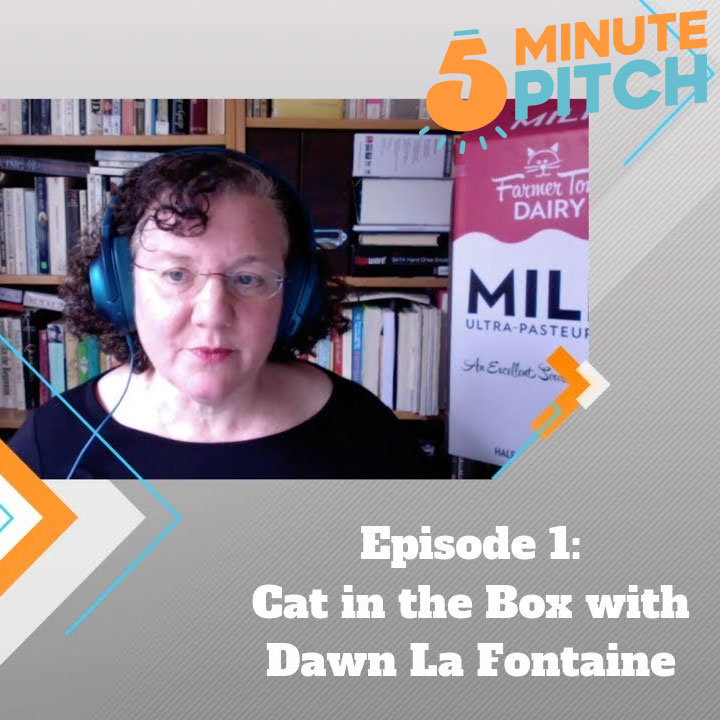
A product that costs $6 to manufacture and up to $18 to ship has a margin problem, not a product problem. That is the core issue the judges identified when Dawn LaFontaine pitched Cat in the Box, her line of decorative cardboard boxes for cats, on the first episode of the 5 Minute Pitch.
The 5 Minute Pitch is a Shark Tank style competition where a panel gives away $50,000 to one business. The judges are me, Mike Jackness of EcomCrew, Scott Voelker of The Amazing Seller, and Greg Mercer of Jungle Scout, with Andrew Youderian of eCommerceFuel joining as guest judge for this pitch.
Below is Dawn’s full pitch, the unit economics the judges pulled apart, and why they advanced her anyway despite fewer than 100 lifetime sales.
Get My Free Mini Course On How To Start A Successful Ecommerce Store
If you are interested in starting an ecommerce business, I put together a comprehensive package of resources that will help you launch your own online store from complete scratch. Be sure to grab it before you leave!
Table of Contents
Key takeaways
- Dawn sells cat boxes at $30 including shipping, against $5.50 to $6.25 in manufacturing and $9 to $18 in shipping and cartons.
- That leaves roughly $12 per sale before advertising, which the judges flagged as too thin to fund paid acquisition.
- She had sold fewer than 100 units at the time of the pitch, driven by press and Instagram rather than advertising.
- Cardboard boxes cannot be patented or trademarked, and the printing plates and cutting dies create a real barrier to entry.
- Her 7,000 Instagram followers in a short window were treated as proof of concept by the judges.
- Ordering 500 units cost nearly the same as 250, and she had not yet explored pricing at higher volume tiers.
- The judges’ unanimous fix was redesigning for a smaller shipping footprint and moving to wholesale.
- All five judges voted yes and advanced her to the deliberation round.
What Cat in the Box sells
Cat in the Box sells whimsical printed cardboard box toys for cats. Dawn got the idea on a trip with her mother to her mother’s cat sitter, wondering why cat owners tolerate ugly Amazon boxes sitting around their homes.
Her pitch rests on three scientific reasons cats are drawn to cardboard boxes.
The first is thermoregulation. A cat’s thermoneutral zone runs about 14 degrees higher than the temperature in our homes, meaning cats are effectively cold all the time, and corrugated cardboard is an excellent insulator while the tight space encourages curling up.
The second is stress relief. Hiding is a species-level behavioral strategy for coping with environmental change, so a box gives a cat a natural way to de-stress.
The third is predatory behavior. A box lets a cat stalk and ambush, which is the tiger underneath the lap pet, even when its food comes from a can.
Cat owners already know this instinctively. Nearly every cat owner has at least one cardboard box permanently occupying their home.
How the product is made
Dawn manufactures in the United States because cat safety matters to her. The inks are human-grade soy inks, the same ones used on pizza boxes.
The boxes are made from recycled cardboard for environmental reasons.
Her products have been featured in Parade online, the Boston Globe, Product Hunt, Boston Voyager, several popular cat blogs, and local media. Design Boom, a premier design publication, called her Mega Milk Carton a Warhol-esque stroke of genius.
The unit economics that concerned the judges
The judges pushed hardest on margin, and the numbers explain why.
| Line item | Cost |
|---|---|
| Selling price (shipping included) | $30 |
| Manufacturing | $5.50 to $6.25 |
| Shipping carton | ~$2 |
| Shipping itself | $7 to $16 depending on US destination |
| Approximate remainder | ~$12 |
Dawn ships only within the United States, and most of the cost of getting a box to a customer is the shipping rather than the product.
Roughly $12 per sale before any advertising spend is the constraint. My concern in the pitch was exactly this: those margins are borderline for funding paid acquisition, which is the channel she would need to scale.
She had not yet explored pricing at the highest volume tiers with her manufacturer. What she did know is that ordering 500 cost almost the same as ordering 250, which suggests real room at volume.
Why an oversized product is expensive to ship
Cardboard boxes are dimensionally large relative to their weight, which is what drives the shipping cost. Dawn also lives amid inventory, since cardboard consumes an enormous amount of space, and a third design would require warehouse space.
Her own stated priority for the $50,000 was designing a more compact box that would be cheaper to ship domestically and viable internationally, where she has had unsolicited interest.
She acknowledged the design mistake directly. She wants to start a new, more compact product as soon as possible rather than waiting for the current two to build momentum.
Can you protect a cardboard box product?
A cardboard box cannot be trademarked or protected by patent. Dawn’s designs are not copyrighted or trademarked.
The practical defense is cost of entry. Creating the printing plates and cutting dies is expensive enough that duplicating her product is not trivial, even though a competitor could produce a similar design.
Andrew’s read was that the business is defensible in practice because Dawn makes her own designs. Nobody has anything comparable on the market beyond one loosely similar item on Etsy.
How Dawn markets Cat in the Box
Instagram is her primary customer connection, alongside a Shopify store, a recently opened Etsy shop, a YouTube channel, and Pinterest.
Her best marketing asset is customers themselves. Buyers repost stories and photos of their pets using the products continuously, which makes them genuine product ambassadors.
Her sales to date came from personal connections, social media, and the bump from her PR efforts. She had not run advertising at all.
Andrew asked what single marketing strategy she would focus on to drive the most results. Her answer was Facebook advertising supported by her press coverage and the blog post I had written about her, which he pushed back on immediately as too uncertain to be the plan.
Her backup was simply to explore advertising, which she had not started.
What customers actually say about the product
Dawn had received no negative comments at the time of the pitch. Her framing is that cats will love any box, including a Captain Crunch carton on the floor, so the real question is whether owners like them.
The surprising finding was about storage. She designed the boxes assuming owners would flatten and hide them when company came over, and instead people leave them out permanently because they think they look good.
The boxes show up in the background of customers’ photos of their cats playing with other toys.
What the judges recommended
Every judge landed on the same fix: shrink the shipping footprint. Mike wanted the packaging smaller, Scott agreed after the panel handled the product and examined its footprint, and Andrew noted it becomes easy to ship once the folding and packing are resolved.
Andrew’s additional recommendation was wholesale. Selling into boutique pet stores means shipping in bulk to one destination on a pallet rather than paying per-customer shipping, which would raise margins substantially on the shipping side alone.
Dawn had already identified wholesale as a use for the prize money, alongside the compact redesign.
Greg raised durability, asking how long the boxes last and why a buyer would choose one over a carpeted cat product. Dawn’s answer was that a cat owner buys both, and lifespan depends entirely on the cat, since some are notorious cardboard chewers and a box could last indefinitely for cats that do not chew.
Why the judges advanced her
All five judges voted yes. The market reasoning was consistent: the pet industry is large, the cat market is intense, and nobody had seen a product like this.
The proof-of-concept argument was her Instagram audience. Roughly 7,000 followers in a short window demonstrated real demand independent of sales volume.
Greg was explicit that he would have liked to see more than 100 sales and voted her through regardless. Fewer than 100 units is genuinely thin evidence, and the panel weighted the audience, the differentiation, and the fixability of the margin problem more heavily.
Where Dawn wants to take the business
Her three-year vision is multiple designs plus expansion beyond boxes entirely. The community of cat lovers connecting with her brand opens the door to other unique cat products that do not currently exist on the market.
Her stated reason for entering the competition was mentorship rather than the money. She described the business as still in pre-infancy and wanted input from the judges more than anything else.
Frequently asked questions
Why do cats like cardboard boxes?
Three reasons, according to Dawn LaFontaine’s research. Corrugated cardboard insulates well and cats’ thermoneutral zone runs about 14 degrees above household temperature, hiding is a natural stress-relief behavior for the species, and a box lets a cat stalk and ambush the way a predator does.
What margin do you need to run paid advertising?
More than Dawn had. At roughly $12 per sale after manufacturing and shipping on a $30 product, the judges considered her margins borderline for funding customer acquisition through advertising.
Why are oversized products expensive to ship?
Shipping is priced on dimensional size as well as weight, so a large lightweight product like a cardboard box costs disproportionately. Dawn’s shipping and carton costs ran $9 to $18 against $5.50 to $6.25 in manufacturing.
How does wholesale improve margins on bulky products?
Wholesale ships many units on a pallet to a single destination instead of paying individual shipping on every order. Andrew Youderian recommended it specifically as the fix for Cat in the Box’s shipping-driven margin problem.
Can you protect a cardboard product design?
Not through patent or trademark, since a cardboard box itself is not protectable. The practical barrier is the cost of the printing plates and cutting dies required to produce a competing version.
Does volume ordering reduce manufacturing cost?
Significantly, in Dawn’s case. Her quote for 500 units was nearly the same as her quote for 250, meaning per-unit cost dropped sharply, though she had not yet priced the highest volume tiers.
How many sales do you need before pitching investors?
More than 100 would have been preferable here. Greg Mercer said directly that he wanted to see more sales and voted her forward anyway, because her Instagram audience and product differentiation offset the thin sales history.
What is the 5 Minute Pitch?
A Shark Tank style competition where entrepreneurs pitch a panel of ecommerce judges for a $50,000 grand prize. Over 30 entrepreneurs pitch via video call, with finalists presenting live in Miami.

