
Podcast: Download (Duration: 50:08 — 57.7MB)
Selling CBD online means solving banking and payment processing before you solve marketing, because mainstream processors will shut you down and mainstream ad platforms will not take your money. Nate Lipton has had bank accounts closed roughly half a dozen times and credit card processing pulled roughly half a dozen times, including one bank holding six figures for over six months.
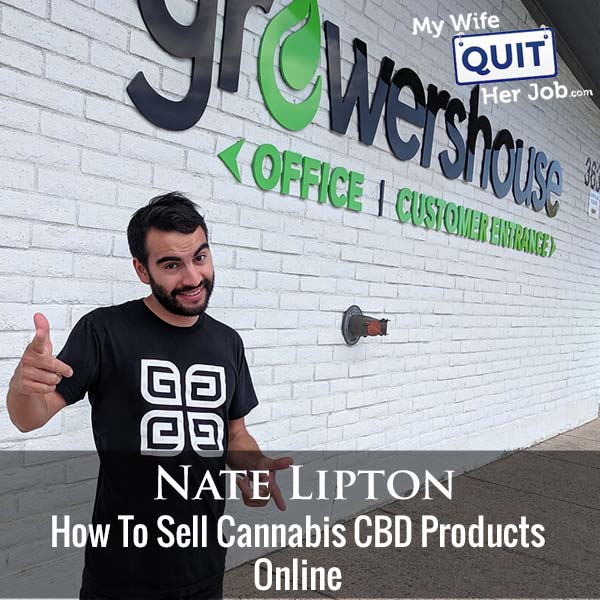
Nate runs Growers House, an eight figure ecommerce store selling growing supplies, plus Growers Network and the CBD retailer TruPotency.
This episode covers the white side versus dark side distinction that governs everything, how to get banked and processed, why 80% of the CBD products he tests fail, and what marketing works when advertising is closed off.
Get My Free Mini Course On How To Start A Successful Ecommerce Store
If you are interested in starting an ecommerce business, I put together a comprehensive package of resources that will help you launch your own online store from complete scratch. Be sure to grab it before you leave!
Table of Contents
Key takeaways
- White side companies never mention cannabis, which preserves banking, processing, and Google advertising.
- Dark side companies can target customers directly and lose most conventional financial infrastructure.
- Redundancy in banking and processing is mandatory, because shutdowns are a matter of when rather than if.
- CBD processing costs 4% to 7%, often requiring a foreign entity or an out-of-state credit union.
- Roughly 80% of CBD products fail lab testing, mostly on mislabeled cannabinoid content.
- Original product testing content built the business. Nobody else was measuring grow lights objectively.
- Publish video transcripts on your own site to convert video content into indexable text.
- About 1,200 CBD brands launched in 2019, so a narrow niche beats competing on head terms.
How Nate Lipton got into the cannabis industry
He studied economics and finance at the University of Oregon, graduating around 2010, and briefly joined Morgan Stanley before leaving after about three months.
Cannabis attracted him because he saw a long growth horizon, at a point when only a handful of states had medical programs and state and federal law were in open conflict.
Entering then meant accepting real risk. He managed a dispensary in San Francisco and worked for an ecommerce growing supply company in the Bay Area.
He considered opening a dispensary and decided against it. The licensing paperwork was enormous, and police in some counties raided licensed dispensaries and litigated the legality afterward, depending on the local district attorney.
Selling growing equipment kept a layer of separation. He could serve the industry without touching the plant.
What white side and dark side mean in cannabis
A white side company sells into the cannabis industry without acknowledging it overtly.
The reason is infrastructure. Staying white side preserves banking relationships, credit card processing, public perception, and Google advertising.
Growers House is white side. The site sells equipment for growing plants, and the word cannabis appears only where it is unavoidable in a product title.
That framing is defensible on the customer base alone. Buyers include the USDA, NASA, and universities including Arizona, Cornell, and Loyola Marymount.
A dark side company is explicitly about cannabis. Growers Network and the Cannacribs video series are dark side, which means much harder access to processing and banking.
The tradeoff is directness. Dark side lets you target customers using the terms they actually search.
How to solve banking as a cannabis or CBD company
Nate’s Arizona corporation had to register as a foreign entity in Washington state and bank through a Washington credit union.
The reason is jurisdictional. Washington is a recreational state and Arizona is medical only, and those credit unions will only bank entities registered in their state.
Shutdowns happen even to white side operations. Banks have told Growers House that while they understand the company never touches the plant, it sits close enough to the industry that they are making a business decision to end the relationship.
The worst case he experienced was a bank holding six figures for over six months.
His advice today is that the path is easier than four years ago. Find a credit union in a legal state, be entirely above board about what you do, and they exist if you look hard enough.
How to get credit card processing for CBD
PayPal is out. They will collect your money, discover what you sell, shut you down, and hold funds for six months.
Nate uses T1 Payments, an international processor widely used in CBD, which required establishing a UK address and entity.
Domestic options exist and he was applying to two, PayKings and Alepay, to broaden coverage.
Pricing runs 4% to 7%, which he treats as the cost of operating in an early industry.
Even large backend banks are unreliable. One prepared to bank a group of CBD companies pulled out at the last minute.
TruPotency lost processing about two weeks after launching, and again roughly three weeks before we recorded, which is why plan B has to already exist.
How Growers House got its first traction
The retail store came first, in the worst possible Tucson location near the airport, because distributor agreements grant exclusive radii and every better area was taken.
The online store was near silent for about three months, and local advertising for the retail store carried them through.
The breakthrough came around 2012 with LED grow lights, which were popular with hobbyists and surrounded by competing claims that every manufacturer’s light was best.
Nate’s response was buying a PAR meter, measuring photosynthetically active radiation across each fixture’s intended coverage area, and publishing the graphs alongside a short YouTube video.
Nobody else was doing that. The video took off because it gave buyers a way through the noise, and it linked back to the products tested.
How to run product comparisons without alienating vendors
Vendors do not always take testing well, particularly the less professional ones.
Nate’s approach after learning this is telling vendors in advance that the test is happening.
The invitation matters. Ask whether they want to be included, set expectations that the information will be objective, and promise to share the results.
Doing that essentially eliminated the pushback.
The unexpected benefit is that testing pushed manufacturers to iterate. Results galvanized them to improve their next product and focus on the features that mattered.
Losing products stay in the catalog, because there is often no single best. One wins on price performance, one on outright performance, and one on form factor for smaller operations.
How to make video content rank
Nate’s first rule is publishing information nobody else has published.
The second is aiming that originality at existing demand. Test the best compact LED grow lights if people are already searching for the best compact LED grow lights, rather than trying to create demand where none exists.
The third is a technique worth copying. Publish the video on your own site alongside a written transcript.
Almost nobody reads a transcript, and that is not the point. It puts the video’s content on your site as indexable text, which you can hyperlink to your product pages.
He goes further and pre-defines keywords he wants in that written content, then says them in the video.
Why Cannacribs worked as a content play
Growers Network exists because Nate wanted to speak to customers directly without endangering Growers House’s white side status.
The first product from it was Cannacribs, structured like MTV Cribs but touring the largest and most technologically advanced cannabis growing operations in the country.
It showed exactly how the product sold in recreational states gets grown, which nobody had documented.
High Times TV picked it up as their first cannabis-centric video series, and one episode has passed a million views.
The unexpected outcome is institutional. Cannabis companies now use the series to train new hires on products, terminology, and operations.
The Legalize Tomatoes shirt captures how they handle the line. Early on, when a customer called asking how to grow cannabis in a closet, the answer had to be that they could not advise on cannabis, but here is what they would do for tomatoes.
Why 80% of CBD products fail lab testing
TruPotency does not private label anything, deliberately, because selling your own product undermines any claim to objective testing.
The premise came from a University of Pennsylvania study finding roughly 70% of tested products were mislabeled.
Products arrive with certificates of analysis from the manufacturer. TruPotency sends the same products to an independent certified lab for HPLC testing, and results routinely differ from the supplied COA.
The pass criteria are specific. Cannabinoid content within plus or minus 10% of the label, no residual solvents, no molds, no pesticides, and no undisclosed constituents.
Of roughly 400 products through the lab, about 60 are live on the site. A product labeled 500 milligrams containing 50 is charged for at 500, which Nate considers close to theft.
They publish every lab report on the corresponding product page.
How to make lab data useful to shoppers
Raw lab reports are difficult for consumers to interpret, so TruPotency hired a neuroscientist as director of science.
He built an algorithm from published research on cannabinoids, the compounds within cannabis, of which THC and CBD are the two most familiar among more than a hundred.
The model combines the cannabinoid profile with the terpene profile. Terpenes occur throughout natural products and interact with cannabinoids in ways that can make an effect more sedative or produce more mental clarity.
The output tells a shopper which product is more likely suited to what they want.
Alongside that, a science advisory board of MDs and PhDs guides which products plausibly work at all.
How to compete in a saturated CBD market
Roughly 1,200 CBD brands launched in 2019, and perhaps ten formulators make most of those products.
That means most brands are selling substantially similar goods while competing for the same head terms.
Nate’s advice is finding a genuine point of differentiation and choosing a narrower niche.
The research method is keyword-led. Use a tool like Ahrefs to find what people actually want CBD for, then become the best at that specific application, whether that is sleep, anxiety, or small breed pets.
You can always expand outward from a niche, and you are unlikely to win a head term against 1,200 competitors.
TruPotency’s own differentiation is the testing, aimed squarely at the fact that the FDA has issued no standards and anyone can enter.
What CBD costs to start compared to other cannabis businesses
Growers House was bootstrapped on about $150,000.
TruPotency is a considerably higher budget operation, likely near $500,000 before it is genuinely running, given the science staff and PR.
Across the industry, costs vary enormously by sector. Opening a dispensary in an established market like Arizona is close to impossible without several million dollars, and possibly north of five million.
Newly opened markets are cheaper. Oklahoma’s medical launch had inexpensive licenses with no cap on how many were issued, putting entry in the low six figures.
Ecommerce remains the least expensive route into the industry.
What legal steps a CBD ecommerce store needs
Requirements vary by state.
If you are manufacturing or holding products people will ingest, contact your state health department.
Most states have hemp laws and usually a dedicated department. Telling them you intend to start a hemp CBD company holding inventory gets you a straightforward answer on what is required.
Nate describes the process as generally easy and benign.
Why CBD does not work on Amazon
Amazon does not allow CBD products.
What appears there instead is misleading. Listings marketed to look like CBD are frequently hemp seed oil, which contains no cannabinoids and no CBD at all.
Buyers assume they are getting CBD partly because the price is far lower, and they are not getting what they wanted.
Growers House sells equipment on Amazon without problems, precisely because the listings never touch cannabis or marijuana.
The distinction that governs everything is that hemp is legal, including hemp seed oil and hemp fiber, while CBD and other cannabinoids sit in a separate category the FDA has not ruled on.
The FDA has slapped down CBD companies making unproven medical claims, such as curing cancer, which is a line worth staying well clear of.
Frequently asked questions
Can you get a bank account for a CBD business?
Yes, usually through a credit union in a legal cannabis state, which may require registering your company as a foreign entity in that state. Be completely transparent with them about what you sell.
How do you process credit cards for CBD?
Through specialist processors at 4% to 7%, sometimes requiring a foreign entity. Nate Lipton uses T1 Payments in the UK and was adding domestic options for redundancy.
Can you sell CBD on Amazon?
No. Amazon prohibits CBD, and most listings that appear to be CBD are actually hemp seed oil, which contains no cannabinoids.
Can you advertise CBD on Google or Facebook?
Largely no, which is why cannabis-adjacent companies stay white side and avoid the terminology entirely, while dark side brands rely on content and organic reach.
How much CBD product actually contains what the label says?
Roughly 20% in Nate Lipton’s testing. Of about 400 products sent to an independent lab, only around 60 passed on cannabinoid accuracy, solvents, molds, and pesticides.
How do you differentiate a CBD brand?
Pick a narrow use case with existing search demand rather than competing on head terms, since about 1,200 brands launched in 2019 and roughly ten formulators supply most of them.
Do you need a license to sell CBD online?
Requirements vary by state. Contact your state health department and hemp program if you will manufacture or hold ingestible inventory, which Nate describes as a straightforward process.
How do you make product comparison videos without upsetting vendors?
Tell them before you test, invite them to be included, set the expectation that results will be objective, and promise to share them. Nate Lipton found that eliminated the pushback.