
Podcast: Download (Duration: 53:07 — 61.1MB)
Most advertisers cap their own scale by relying on broad targeting and lookalike audiences while ignoring interest targeting entirely. Molly Pittman spent five or six hours researching a single audience, produced 150 to 200 new interests, and that work was a major factor in Boom’s best year ever.
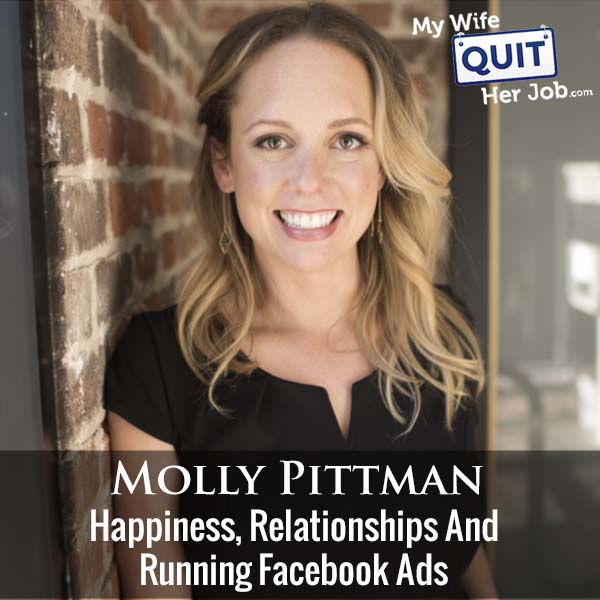
In this episode I spoke with Molly Pittman, CEO of Smart Marketer and former VP of Marketing at Digital Marketer, who has spent millions of dollars on paid traffic profitably. She also just released a book called Click Happy.
Below is everything: why interest research produces cheaper traffic, how to set a target cost per acquisition, why the cheapest ad set is not the one to optimize for, and how she recovered from burnout.
Get My Free Mini Course On How To Start A Successful Ecommerce Store
If you are interested in starting an ecommerce business, I put together a comprehensive package of resources that will help you launch your own online store from complete scratch. Be sure to grab it before you leave!
Table of Contents
Key takeaways
- Interest targeting is how you scale horizontally. Boom went from $15K to $30K a day partly on this.
- Nobody publishes the interest list. You find them only by typing into the targeting box.
- Your competitors are all bidding on the same broad audiences, which is why obscure interests are cheaper.
- Do not turn off the more expensive ad set if it is adding volume within your aggregate target.
- Boom targets $75 CPA and is genuinely profitable at $45 to $60.
- Lead with value, not the product. A pre-sell article of makeup tips outperforms a direct pitch.
- Lookalikes weakened after the Cambridge Analytica data changes and still work in some cases.
- Burnout came from optimizing for values she did not hold, not from hours alone.
Why burnout happens to successful entrepreneurs
Molly burned out leaving Digital Marketer at the end of 2017 and took two to three years to fully recover.
She names the cause as an addiction to success and hustle combined with no attention paid to herself.
Hours were part of it. She went through seasons working 16 to 20 hours a day continuously.
The larger factor was mental. Taking time away from work does not help if you do not allow yourself to be mentally away from the business.
The deeper problem was misalignment. She was optimizing for money, outward success, and vanity metrics, none of which were actually her highest values.
Her real values turned out to be happiness, fulfillment, and serving the world, with relationships, communication, adventure, and travel above money and success.
Working extremely hard toward things she did not care about is what made the exhaustion feel so bad.
What Molly Pittman changed to prevent burnout
Being intentional about time is the first mechanism, and she built it into her circumstances.
Living six hours ahead of the US east coast gives her six to eight hours each morning before her team or customers wake up, which effectively forces personal time into the calendar.
Smart Marketer runs half-day Fridays for the same reason, so the team has built-in time for themselves.
Nutrition and exercise required a different approach. After a knee injury ended her athletic career, she disregarded her body entirely, on the reasoning that it no longer had value if she was not competing.
Her fix was removing the mental blocks around exercise. Walking during calls that do not require video, and finding forms of movement like Pilates she genuinely enjoys.
The motivation shifted too. Exercise now serves self-love rather than performance, which is what makes it sustainable without a sport to train for.
What you need before you spend anything on ads
The offer comes first, and an offer is more than the product you sell.
The distinction Molly draws is between having something the market wants and having something that converts cold traffic.
Showing up in the newsfeed saying your product is great and people should buy it no longer works.
The format depends on your business. Physical products often use a pre-sell article, and information products use a lead magnet or webinar.
Boom’s example is a pre-sell article titled five makeup tips for women over 50. It delivers genuine educational value, like why powder makeup settles into wrinkles, before transitioning into the pitch.
Scale requires multiples. Boom does not run one pre-sell article, it runs many along with lead magnets, because relying on a single cold traffic offer limits how much of the market you can reach.
How to set a target cost per acquisition
Boom’s target CPA is $75 or lower, and the profitable range is well below that.
The bands are specific. $45 to $55 is excellent, $55 to $65 is good, $65 to $75 is acceptable, and above $75 does not work.
At $75 they are actually losing money on the front end, which is a decision rather than an accident.
Three things make that affordable. Upsells and cross-sells raising average order value, confidence in lifetime value from an established business, and regular promotions that bring customers back.
The number changed over time. When Ezra Firestone started buying ads the acceptable CPA was much lower, because none of those supports existed yet.
Information products run entirely different math. Smart Marketer will spend $750 to $1,000 to acquire a customer for a $3,000 mentorship.
Why single-product businesses struggle with paid ads
Cold traffic CPAs below $20 are rare at any consistent scale.
Molly’s example is a $40 notebook with a $20 margin. If acquisition costs $20 there is no profit, and a one-off product means no second purchase to recover on.
She has seen exceptions with viral t-shirts or free-plus-shipping offers landing between $5 and $10, and not consistently at scale.
The practical implication is that a business needs either high margins, high average order value, or genuine repeat purchase behavior for paid acquisition to work.
Why information products need lead generation first
Selling information directly to cold traffic rarely works, for two reasons.
The first is tangibility. Nobody needs makeup explained to them, and an information product has to be explained before it can be sold.
The second is authority. Trusting someone enough to buy their expertise is a higher bar than trusting them enough to buy skincare.
That means information funnels almost always start with a lead generation offer rather than a direct pitch.
The market size differs too. Boom can spend $30,000 to $40,000 a day marketing to women over 50 because there are millions of them, and a marketing education audience is far smaller.
The upside is that lead generation makes scaling conversations simpler. The daily question becomes whether a thousand leads at $2 each is good, rather than tracking purchases directly.
How to set cost per lead targets
Cost per lead depends entirely on what role that offer plays in your funnel.
Smart Marketer’s seven-day free Facebook ad class targets $1.50 to $3.50 per lead. It is attractive because access is immediate rather than scheduled, and the topic resonates strongly with their market.
At that cost they add two to three thousand people daily to the list, and only need four or five purchases to break even on a $1,500 product.
Webinars run five to ten dollars per registration and are treated completely differently. A webinar is less applicable to cold traffic and less scalable, and functions as a sales mechanism rather than a list builder.
Comparing the two is a mistake. They sit at different points in the funnel and serve different purposes, so a higher cost per lead on one is not a failure.
The timing difference explains the price gap. A webinar produces revenue quickly through urgency, and a dripped class converts weeks or months later.
Why interest targeting still matters
The prevailing advice is that Facebook has gotten smart enough for broad targeting and lookalikes, which is true and incomplete.
Boom is the case study. Before 2018 they had never used interest targeting at all, having started in 2012 when almost anything worked.
They were spending roughly $15,000 a day and could not scale further. Their reasoning was that Facebook already knew their customer, so targeting every woman over 50 worked fine.
Molly’s response was that it does work, and it caps how many people you can reach.
She spent five or six hours researching the audience. Calling her mother, reading Amazon reviews, going through forums, and produced 150 to 200 new interests.
The categories were specific. Clothing brands that speak to that generation, retirement, being a grandmother, actresses, movies, books, and blogs that signal age cohort.
That work contributed to Boom’s best year ever, and a later campaign generated 35,000 new customers.
Why obscure interests produce cheaper traffic
Facebook ads run as an auction, and who you compete against depends on who you target.
Top of the auction pays least and reaches most. Bottom of the auction pays most and reaches least.
Your competition in that auction is everyone targeting the same audiences you are.
Broad targeting and obvious interests are crowded by definition, because that is where every advertiser defaults.
There are hundreds of thousands and likely millions of interests inside the detailed targeting box, discoverable only by typing them in. No published list exists.
That is why the research pays twice. Better positioning in the auction, and access to people Facebook would not have shown your ad to otherwise.
Why you should not turn off your more expensive ad sets
The A/B testing instinct actively prevents scale.
The trained reflex is to find what performs best and turn off everything else.
Molly’s example makes the cost visible. Broad and lookalike audiences produce a thousand customers at $50 CPA, and interest-based ad sets produce another thousand at $65.
The instinct says kill the $65 ad sets because they cost more.
The result of that decision is halving your customer volume, when the aggregate CPA across both still sits comfortably under the $75 threshold.
The data contradicts the instinct anyway. Among the top ten ad sets from the 35,000 customer campaign, eight were interest-based by volume of customers acquired.
Why the same logic applies to creative
Molly rarely turns an ad off, even when it looks less profitable than others.
The reason is sequencing. Someone might see one ad, then a second, then convert on a third, and turning off the first two removes that path.
Leaving them running also gives Facebook more to work with, which delays creative fatigue.
She still watches performance closely, and uses it to create more ads resembling the winners rather than to prune the losers.
What changed with lookalike audiences
Lookalikes weakened after Facebook restricted data following the Cambridge Analytica period.
Molly’s assessment is that they still work acceptably for most brands, and are noticeably less powerful than they were.
Boom still uses them alongside interest targeting rather than instead of it.
The comparison she draws is direct. Interest targeting now outperforms lookalikes in her experience, which reverses the conventional advice.
Frequently asked questions
Does Facebook interest targeting still work?
Yes, and Molly Pittman argues it is now essential for scale. Boom relied entirely on broad and lookalike targeting until 2018, could not scale past $15,000 a day, and roughly doubled that after adding interest research.
How do you find good Facebook interests to target?
Research the audience directly. Molly calls family members in the demographic, reads Amazon reviews, and goes through forums. There is no published interest list, so you find them by typing candidates into the detailed targeting box.
Why is interest targeting cheaper than broad targeting?
Because the ad auction pits you against everyone targeting the same audiences. Broad and obvious interests are crowded by default, and obscure interests your competitors have not researched face far less competition.
Should you turn off ad sets with higher CPAs?
Not if the aggregate stays within your target. Killing a $65 ad set alongside a $50 one halves your customer volume when both together still sit under a $75 threshold, which is how the testing instinct blocks scale.
What should your target cost per acquisition be?
It depends on margins, upsells, and lifetime value. Boom targets $75, is genuinely profitable at $45 to $60, and accepts front-end losses because upsells and repeat purchases recover the difference.
Can you run profitable Facebook ads on a single low-priced product?
It is difficult. Cold traffic CPAs below $20 are rare at consistent scale, so a $40 product with a $20 margin and no repeat purchase leaves nothing. You need high margins, high AOV, or genuine repeat behavior.
Why do information products need a lead magnet first?
Information has to be explained before it can be sold, unlike a physical product people already understand. Buying expertise also requires far more trust, so a direct cold pitch rarely converts.
Do lookalike audiences still work?
Acceptably for most brands and less powerfully than before. Facebook restricted the data available to lookalikes following the Cambridge Analytica period, and Molly now finds interest targeting more effective.