Podcast: Download (Duration: 43:59 — 50.6MB)
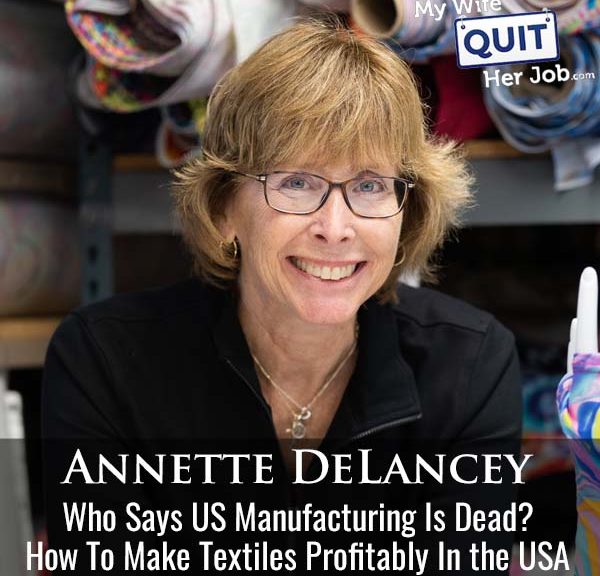
You absolutely can manufacture textile products in the USA profitably, and you do not need to be Nike to do it. The trick is picking the right kind of product (something with a custom element or a premium buyer), keeping minimum order quantities small, and running a labor-cost math that a US-based sewing contractor can actually meet. On this episode I invited my friend Annette DeLancey of She Makes Products back on to walk through her exact prototyping and production process, since I am literally one of her customers for the aprons and handkerchiefs I sell at Bumblebee Linens.
Annette runs CastCovers.com, where she manufactures more than 2,000 SKUs of orthopedic soft goods in the USA, and she now helps other product entrepreneurs do the same through She Makes Products. She dropped real numbers most people never publish: current US sewing labor of about $8 to $12 per unit for a standard t-shirt with a pocket, the 5x cost-of-goods rule she uses for retail pricing, and the state and county programs that will cover 50 to 90 percent of a new hire’s payroll while you train them.
This post covers what she said, what US textile manufacturing actually costs today, and the exact steps to take an idea from a paper mock-up to a production run in the States.
Key takeaways
- US sewing labor for a standard garment runs about $8 to $12 per unit, before fabric.
- Small US contractors will run 100 to 500 units per SKU, versus the 1,000+ MOQs common in China.
- Made in the USA still moves the needle. In a split test Annette ran on cast covers, the “Made in USA” page outsold the plain page 6 to 1.
- Custom or premium-positioned products are the ones that pencil out domestically, not commodity tees.
- Chambers of commerce and local Economic Development Councils will subsidize 50 to 90 percent of payroll for 6 to 12 months if you are hiring and training.
- Price at 5x your fully loaded cost of goods, or you are running a hobby and not a business.
- Mexico counts as near shore. It is worth quoting alongside US contractors for larger runs.
Can you manufacture textiles in the USA profitably?
Yes, you can manufacture textiles in the USA profitably, provided the product carries either a custom element or a premium price. A commodity blank t-shirt where the winning price is $6 will not survive US labor. A branded shirt with a signature pocket, a specialty fabric, or a custom label sold at a mid-to-high price point absolutely will.
Annette’s own business is proof. CastCovers.com sells more than 2,000 SKUs of orthopedic soft goods (cast covers, boot covers, arm sleeves) all made in the USA, and it survived what she calls “the Chinese invasion” on Amazon two years ago by leaning harder on quality and the “Made in USA” story instead of chasing the price.
The other proof is her customer roster at She Makes Products, which is now full of small brands who could not hit China’s MOQs, needed to launch fast, or wanted to keep production close so they could actually walk the floor.
What does US textile manufacturing actually cost?
US textile labor is roughly $8 to $12 per unit for a standard garment (a t-shirt with a pocket, properly sized), not including fabric. Fabric is quoted separately because it swings wildly, and the more custom the fabric (bamboo, technical knits, specialty blends), the more the labor cost climbs on top.
Two adjustments most first-time founders miss:
- Size matters. An XXL costs more to sew than a small, so contractors quote a range, not a flat number.
- Complexity matters more than size. A pocket with darts, a specialty seam, or a stretchy fabric can bump labor 20 to 40 percent.
If you are used to $0.50 per unit from a Chinese contract sewing factory, $10 per unit sounds insane. It only pencils if the retail price supports it. Which is why Annette anchors everything on a pricing rule.
The 5x cost-of-goods rule for pricing US-made products
Price your product at 5x your fully loaded cost of goods, or the numbers will not work. If labor and materials cost you $10, the retail price needs to be $50. Anything less, and by the time you cover payroll, ad spend, returns, platform fees, and your own paycheck, you are running a hobby and the IRS may eventually classify it as one (they consider a business unprofitable for three consecutive years to be a hobby).
That 5x multiple is not a markup goal, it is a survival threshold. Ecommerce founders routinely price at 2x or 3x cost of goods, feel great about revenue, and then wonder why they crossed $100k in sales while only bringing $6,000 home to the family. Annette hit that exact wall on cast covers before she rebuilt her pricing.
The multiple is easier to hit on US-made goods than on imports, because the “Made in USA” story lets you sell at the top of the category’s price band without apologizing for it.
How much does “Made in USA” actually help sales?
“Made in USA” measurably lifts sales, and the effect is not subtle. Annette ran a split test on one of her best-selling arm cuff covers where she published two product pages, identical except that one said “Made in USA” and the other did not. The Made in USA page outsold the plain page 6 to 1.
She also gets unsolicited notes from customers thanking her for producing domestically. One woman recently emailed to “bless” the business for being American made. Those notes are anecdotal, and they line up with the 6-to-1 data and with what shows up in her Amazon reviews.
The lift will not save a product with weak quality or a broken supply chain. It does, however, give you the pricing power to run US labor math without losing the sale.
How do MOQs compare between US contractors and China?
US sewing contractors will happily run 100 to 500 units per SKU, versus the 500 to 1,000+ unit MOQs most Chinese factories require to quote you a decent price. That single difference is why She Makes Products exists: a founder with $3,000 and an idea can start in the USA, and cannot start in China.
The tradeoff is per-unit cost. You will pay 10x to 20x the Chinese labor rate for those small runs, so the product needs to either be genuinely custom or aimed at a buyer who does not comparison shop on price. Annette specifically recommends starting domestic to test the market, then re-quoting China (or Mexico) only once you have proven demand and can hit their MOQs.
That test-first-domestic workflow also protects you from the classic import mistake: ordering 1,000 units of a design that turns out not to sell, and sitting on the inventory for two years.
Do you need a tech pack to manufacture in the USA?
You do not need a tech pack to start a small US production run. A US sewing contractor can work directly from a physical sample (even a paper-taped mock-up) and produce prototypes in whatever base fabric is on hand, usually black. What you do need is uniformity: consistent sizing, consistent stitch, and consistent finish from the first unit of a run to the last.
Tech packs matter when you scale. Once a client of Annette’s is running 1,000+ units per SKU or moving to a higher-volume contractor, she pulls in her marker and grader, produces a full tech pack, and the client keeps that pack “forever” to use with any future factory. It becomes portable production documentation.
The trap founders fall into is spending $2,000+ on a full tech pack before they have proven the product sells. Prototype first, test the market, and buy the tech pack when your numbers say you need it.
What is the process for taking a textile product from idea to production?
The typical prototype-to-production process for a US textile product runs through six stages. Annette walks every She Makes Products client through the same sequence.
- Vet the idea. Can you articulate the target customer, the price point, and what problem the product solves? If not, you are not ready.
- Bring a mock-up. A drawing, a paper-taped model, or a competitor product you want to improve on all count.
- Prototype in base fabric. The sewist produces a first sample in a plain black or white fabric so you can react to shape, fit, and construction without the color muddying your judgment.
- Iterate on materials. Once shape is right, swap in the real fabric, thread color, and trim. This is where most changes happen.
- Approve a production sample. Get a sew-off from the actual production run (not the prototype) and hold onto it. Never send it back. It is your reference if quality drifts.
- Run 100 to 500 units. Sell through, refine the product, then re-quote larger runs domestically, near shore in Mexico, or overseas.
The first prototype cycle usually takes two to six weeks, depending on the sewist’s queue and how many revisions you need. A full first production run typically ships four to eight weeks after prototype approval.
Near shore vs offshore: when Mexico beats both the USA and China
Mexico is the near-shore compromise for textile production that most US brands never seriously quote. It sits between US pricing (high per-unit cost, low MOQs, easy factory visits) and Chinese pricing (low per-unit cost, high MOQs, hard factory visits) on almost every axis.
Annette has a client with roughly 12 SKUs and 1,000 units per SKU (a children’s clothing brand) who is actively evaluating Mexico alongside China. The maths work out because at 1,000 units per SKU, Mexican labor is competitive with China once you factor in shipping, tariffs, and the ability to fly down and walk the floor in a day.
The rule she gives clients: visit your production floor at least once a year, no matter where it lives. If you cannot afford to do that in China, you probably cannot afford to catch the problems that show up (thinner fabric, substituted trim, missed spec) before a full container lands on your dock.
How to get 50 to 90 percent of your payroll subsidized
Your local chamber of commerce or Economic Development Council will often subsidize 50 to 90 percent of a new hire’s payroll for 6 to 12 months if you are hiring and training. Annette is using exactly this to open a new sewing shop in San Diego County, one of the most expensive labor markets in the country (California’s fast-food minimum wage sits at $20 an hour).
These programs are almost never advertised, so most product entrepreneurs never think to ask. The lever is that the county wants to keep skilled manufacturing jobs local and is willing to underwrite the training cost to make that happen.
If you are considering hiring a sewist, cutter, or shop assistant, a single phone call to your county’s economic development office can materially change the labor math. It also opens the door to shared training facilities and pre-vetted candidates.
What kinds of textile products actually work for US manufacturing?
The textile products that work best for US manufacturing share three traits: a custom element, a mid-to-high price point, and a buyer who cares about origin. Everything else is fighting Chinese labor arithmetic on a battlefield where China wins.
Products where domestic manufacturing routinely pencils out:
- Branded apparel with signature construction (specialty pockets, custom trims, unique labeling)
- Specialty performance or medical soft goods (like Annette’s cast covers)
- Kids’ clothing where safety, materials, and story matter to parents
- Sustainable or ethically produced lines, where the origin is the whole pitch
- Home textiles sold as gifts (aprons, handkerchiefs, tea towels, custom napkins)
- Small-batch fashion drops where speed to market beats price
Products where US manufacturing typically will not work:
- Commodity blank t-shirts and basics competing on price
- Fast-fashion styles with a 6-week shelf life
- Anything sold at a hard sub-$20 retail with heavy discounting
Frequently asked questions
How much does it cost to manufacture a t-shirt in the USA?
Sewing labor for a standard US-made t-shirt with a pocket runs about $8 to $12 per unit, before fabric. Add fabric, trim, labeling, and a small profit for the sewist, and you are typically at $15 to $22 all-in on a modest run of 100 to 500 units. That is why US-made shirts almost always retail at $35 or higher.
What is the minimum order quantity for US textile manufacturing?
Most independent US sewing contractors will run 100 to 500 units per SKU as an MOQ, which is 5 to 10 times lower than typical Chinese MOQs of 1,000 units or more. Some very small shops (including many one- or two-sewist operations) will do 25 to 50 units for a prototype or test run, especially if the design is straightforward.
Do I need a tech pack to manufacture apparel in the USA?
You do not need a tech pack for small US production runs. A physical sample and clear direction are enough for most independent sewing contractors. You will want a tech pack once you scale past a few hundred units per SKU or move to a higher-volume factory, because it documents your specs in a form any future factory can execute.
Is Made in USA really worth the higher cost?
Yes, if you sell to a buyer segment that values it. In a controlled split test Annette ran on cast covers (same product, two pages, one labeled Made in USA), the Made in USA page outsold the plain page 6 to 1. The lift lets you price at the top of the category and still convert.
How do I find a US textile manufacturer?
Start with the Makers Coalition, the American Apparel Producers Network, and your state’s manufacturing extension partnership office, all of which maintain vetted lists of independent sewing contractors. Local fashion incubators and Fashion Institute-affiliated programs in New York and Los Angeles also publish contractor directories. If you want a done-with-you option specific to textiles, Annette’s She Makes Products is built for exactly this problem.
How long does US textile production take?
A prototype cycle typically takes two to six weeks, and a full production run of 100 to 500 units usually ships four to eight weeks after prototype approval. That is 2 to 3 times faster than the equivalent China run (which adds 30 to 45 days of ocean freight on top of production), which is another reason “US-made” often wins on total time to market.
Can I mix US and overseas manufacturing?
Yes, and many established brands do exactly this. Run the custom, premium, or short-lead SKUs in the USA, and reserve overseas production (China or near-shore Mexico) for the high-volume, price-sensitive SKUs. The split lets you protect margin on the winners while keeping your best-selling basics competitive.
I Need Your Help
If you enjoyed listening to this podcast, then please support me with a review on Apple Podcasts. It's easy and takes 1 minute! Just click here to head to Apple Podcasts and leave an honest rating and review of the podcast. Every review helps!
Ready To Get Serious About Starting An Online Business?
If you are really considering starting your own online business, then you have to check out my free mini course on How To Create A Niche Online Store In 5 Easy Steps.
In this 6 day mini course, I reveal the steps that my wife and I took to earn 100 thousand dollars in the span of just a year. Best of all, it's absolutely free!