Podcast: Download (Duration: 50:12 — 57.7MB)
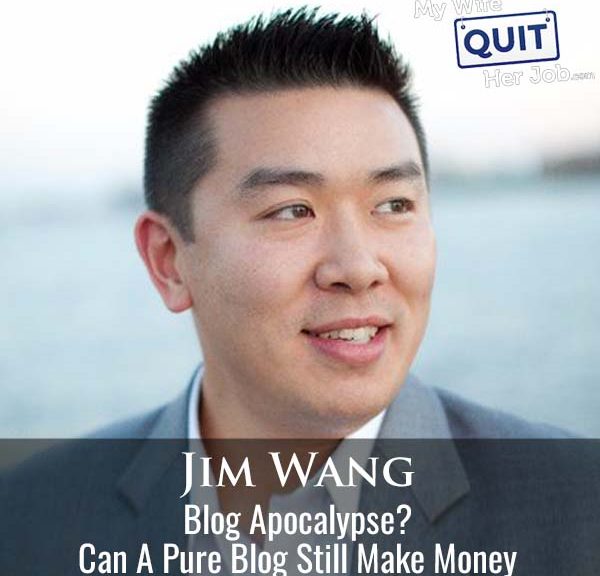
A pure blog can still make real money in 2024, but only with a long time horizon, a 3-bucket content strategy that mixes affiliate-money posts, traffic-magnet posts, and relationship posts, and a granular email-tracking stack that assigns real per-subscriber dollar values so you can prioritize acquisition sources by lifetime value. Jim Wang’s Wallet Hacks (his second seven-figure personal finance blog after selling Bargaineering in 2010) survived the October 2023 Google helpful content update with only a 20 percent traffic dip, largely because his site is built for humans and email subscribers first and Google rankings second.
In this episode of the My Wife Quit Her Job podcast, I bring Jim Wang back for the first time since 2014 to give his honest read on whether starting a personal finance blog today is still worth it, how AI content is changing the game, and the exact email-flow tricks (Woopra plus Link Clicky) his team uses to squeeze more affiliate revenue from a smaller list.
Here is the full breakdown: Jim’s 3-bucket content model, why he does not compete with NerdWallet on credit cards, the abandoned-cart-style flow he runs on affiliate clicks, and his honest take on what a new blogger should do differently in 2024.
Key takeaways
- Yes, a pure blog can still make money in 2024, but only for creators willing to work on a 3 to 5 year time horizon with no acute financial pressure to compress it.
- Jim’s 3-bucket content model: (1) money posts (affiliate reviews of banks, credit cards, fintech apps), (2) traffic magnet posts (broad topics that draw email signups), (3) relationship posts (opinion pieces, personal essays) that only get read when he emails them.
- Do not try to out-rank NerdWallet, Times, or Business Insider on the big money keywords (credit cards, mortgages, insurance). Pick smaller fintech apps with 10 to 20 dollar CPAs where the giants do not bother competing.
- Wallet Hacks publishes only 2 to 3 articles per week, not the tens of thousands programmatic AI content sites are pushing.
- The Woopra plus Link Clicky email stack tracks a subscriber’s clicks and affiliate behavior at the individual level, so each acquisition channel gets a specific lifetime value in dollars.
- Jim runs an abandoned-cart-style email flow on affiliate clicks: if a reader clicks an affiliate link but no lead is reported within a few hours, an email goes out asking what they thought.
- October 2023 Google core update dropped Wallet Hacks traffic 20 percent, driven by SERP loss on blood-plasma-donation articles to LinkedIn and Twitter bios. Jim’s take: do not panic, calm research beats reactive edits.
- If Jim were starting over today, he would not start another blog. He would start with video (probably YouTube shorts) instead.
Can a pure blog still make money in 2024?
Yes, a pure blog can still make real money in 2024, but only with a multi-year runway, low personal financial pressure, and a content strategy that goes beyond keyword-optimized affiliate reviews. Wallet Hacks is now roughly 8 years old, has been featured in Forbes, MarketWatch, CNBC, US News, and Business Insider, and remains a genuine seven-figure business built almost entirely on written content.
The reason it still works: Jim built Wallet Hacks specifically to sidestep the trap that killed most niche affiliate sites in the 2023 to 2024 Google updates. His site was never a laser-focused SEO play, so the big helpful-content-update penalties that hit thin, over-optimized affiliate sites did not hit him at anywhere near the same magnitude.
The hard truth is that the “start a blog in your side hustle time, quit your job in 12 months” pitch is gone. What still works is a slow, opinion-driven, relationship-building publication that also happens to earn affiliate revenue. That was always the higher-ceiling model, and now it is the only model.
The 3-bucket content strategy Jim uses on Wallet Hacks
Jim organizes every article on Wallet Hacks into one of 3 buckets, and the mix is the entire reason his site survived the recent Google updates. The 3 buckets are money posts (direct affiliate revenue), traffic magnet posts (broad topics that pull email signups), and relationship posts (opinion pieces and personal essays that build audience trust).
Bucket 1: money posts (affiliate reviews)
Money posts are keyword-focused affiliate reviews of banks, credit cards, and fintech apps, and Jim delegates most of these to a small team of freelance writers plus an editor. He specifically does not compete with NerdWallet, Times, and other massive commerce sites on high-payout keywords (credit cards at 150 to 200 dollars per approved application), because the SERP is unwinnable at his site’s authority.
Instead, Wallet Hacks targets smaller fintech apps where CPAs are 10 to 20 dollars but competition is far lower. That is the only defensible affiliate strategy for an independent blog in 2024: cede the giant-payout keywords, own the long tail of underserved fintech.
Bucket 2: traffic magnet posts (email signup fuel)
Traffic magnet posts are broad, discoverable articles that pull large volumes of email signups even when they do not directly monetize. These are how you grow the list that everything else depends on. Jim’s team runs pop-ups (a standard signup pop-up plus a “hey, you are back” second pop-up for repeat visitors who ignored the first) that quietly stack signups across every content type.
Bucket 3: relationship posts (opinion and essay)
Relationship posts are opinion pieces and personal essays that will never rank on Google and only get read when Jim emails them to his list. Two of his best-performing recent examples: “things I’ve learned tracking my net worth over 20 years” and “the boring middle is bullshit,” a takedown of the early-retirement-community trope that the wealth-accumulation phase has to be boring.
These posts do 2 things Google can never replicate. They generate real inbound links from other bloggers (nobody links to a bank review, but everyone links to a good opinion piece). And they build the parasocial relationship that turns a passive subscriber into a repeat clicker on your money posts.
The Woopra plus Link Clicky email stack that lifts affiliate revenue
Wallet Hacks runs a custom email-tracking stack built on Woopra (per-user behavior analytics), Link Clicky (affiliate redirect tracking with commission-event ingestion), and ActiveCampaign (email delivery), so each email subscriber gets a specific per-user affiliate lifetime value assigned to them. That granularity is what lets the team prioritize which acquisition sources to double down on.
Here is how the stack ties together. Link Clicky handles affiliate redirects and pulls commission events from Commission Junction, Publicis (Rakuten), Impact, and other affiliate networks via their APIs.
Those commission events flow into Woopra, which tags the corresponding user record. That tag then triggers an ActiveCampaign email flow tied to specific downstream actions.
The single highest-leverage flow they run: if a subscriber clicks an affiliate link and no lead event is reported by the merchant within a few hours, Wallet Hacks emails them and asks what they thought. This is functionally an abandoned-cart email for affiliate traffic, and it is unusual enough in the affiliate world that it produces meaningful incremental commissions.
What a per-subscriber dollar value unlocks
Assigning a specific dollar value per subscriber per acquisition source unlocks the ability to actually invest in acquisition. Every creator knows email is valuable in the abstract; putting a real number on it changes decision-making immediately.
A subscriber who signed up on a credit-card page may be worth 200 dollars over time. A subscriber who signed up on a side-hustle page may be worth 5 dollars. Once those numbers exist, the 200-dollar page gets more traffic investment, and the 5-dollar page either gets improved or dropped entirely.
How Jim survived the October 2023 Google core update
The October 2023 Google core update dropped Wallet Hacks traffic by roughly 20 percent, driven almost entirely by SERP losses on a set of blood-plasma-donation articles that lost their positions to LinkedIn and Twitter bios. Because those articles were traffic-magnet posts rather than money posts, the revenue impact was much smaller than the traffic impact.
Jim’s response was to research first, not react. Panicking and editing dozens of articles that were not actually affected would have wasted time and possibly hurt other posts. Once he understood the update was surfacing social profiles for company-name queries specifically, the only rational action was to leave the affected posts alone.
The wider lesson is a lesson in blogger emotional discipline. Every long-term site owner has been through a traffic crater at least once.
Jim’s Bargaineering site, back in 2007 or 2008, once went from about 4,000 daily visitors to about 200 for 3 days over a weekend before coming back on Monday. If you have not been through one yet, you will, and the correct move is almost always research before edits.
What Jim would do if he started over today
If Jim were starting over today with the option to build any content business from scratch, he would not start another pure blog. He would start with video, most likely YouTube shorts, because platform-based discovery in 2024 rewards video and short-form audio in ways that written content no longer does.
The reasoning is that the biggest content wins of the last 4 to 5 years have gone to creators who caught the right platform at the right growth curve (TikTok, YouTube Shorts, Instagram Reels), not to creators who invested more heavily in text. The blog stack is a mature technology in a decelerating channel; the growth is elsewhere.
The counterexample he cited is Rob Berger of Dough Roller, who has built a huge YouTube audience with a deliberately slow-cadence, conversational retirement-and-investing channel. Rob’s success shows that written-content creators can transition to video without adopting the frenetic MrBeast editing style; slow, conversational YouTube works for near-retirement financial audiences.
Why video is the last defensible content format
My view (Steve’s, from my own YouTube channel) is that video is going to be the last bastion of content the AI-generated flood cannot fully drown. Written content is trivially cloned by AI, audio is not much harder, and even faceless YouTube channels are proliferating. But a real face, a real voice, and a real personality on video is still a moat that AI has not crossed at scale.
Jim’s caution on video is that people go to YouTube for entertainment more than for deep answers to complex financial questions. Video is best for discovery and short-form learning. When someone needs to actually understand a Roth IRA withdrawal strategy, they still open Google and read.
How much time does Jim spend running Wallet Hacks?
Jim spends roughly 15 to 20 hours per week running Wallet Hacks, mostly in the mornings before his kids are up and between 9:15 a.m. and lunch. Afternoons are a mix of workouts, naps, and family time until his oldest child is home around 3:30 p.m.
His weekly work breaks down into keyword research, updating and optimizing older content, affiliate program management (compliance, negotiating new programs, upgrading commission rates), and email replies with merchants. There is no rigid structure. He fills the gaps of whatever the team is not covering that week.
That workload is the entire pitch for the pure-blog model as a lifestyle business. A team of a few freelance writers, one editor, one owner, and a well-tuned email stack, running under 20 focused hours a week, still produces a seven-figure business.
Frequently asked questions
Can you still make money blogging in 2024?
Yes, you can still make money blogging in 2024, but only with a long time horizon (3 to 5 years minimum), a diversified content mix, and a real email strategy. Sites built purely for SEO-optimized affiliate reviews have been hit hard by recent Google updates, while sites that mix affiliate content with relationship-building opinion posts have held up.
Is starting a personal finance blog still worth it?
Starting a personal finance blog is still worth it in 2024, but not as a way to compete on high-payout credit-card and mortgage keywords, since NerdWallet, Times, Business Insider, and other giants dominate those SERPs. The realistic play is to target smaller fintech apps with 10 to 20 dollar CPAs and build the audience relationship through opinion content and email.
How often should a blog publish?
Wallet Hacks publishes only 2 to 3 articles per week and remains a seven-figure business. Publishing frequency matters less than content quality, backlink acquisition, and email list growth. Programmatic sites publishing tens of thousands of AI articles are a different game with different (and increasingly punished) risk profile.
What is the best email tracking tool for affiliate blogs?
The stack Jim Wang uses on Wallet Hacks is Woopra (per-user analytics), Link Clicky (affiliate redirect tracking with commission-event API pulls from Commission Junction, Impact, and Rakuten), and ActiveCampaign (email delivery). Woopra is around 1,000 dollars a month, so this stack only makes sense for blogs with meaningful affiliate revenue to protect.
How do you recover from a Google core update traffic drop?
The best response to a Google core update traffic drop is to research first before making any edits, because reactive changes often hurt more than the update itself. Look at the specific queries and pages that lost rankings, understand what Google promoted in their place, and only edit content where the update reflects an intent-match issue you can genuinely fix.
Are opinion and relationship posts worth writing if they do not rank?
Yes, opinion and relationship posts are worth writing even if they do not rank in Google, because they generate real backlinks from other bloggers and build the parasocial trust that lifts click-through on your affiliate content later. They are essentially unrankable, unclonable content that AI cannot yet replicate at scale.
Should a new content creator start a blog or a YouTube channel in 2024?
If starting over today, Jim Wang and Steve Chou both lean toward YouTube (especially shorts) over a pure blog for a new content creator in 2024. Video benefits from platform-based discovery on TikTok, Instagram Reels, and YouTube Shorts, and video is still the format most resistant to AI-generated content flooding search results.
I Need Your Help
If you enjoyed listening to this podcast, then please support me with a review on Apple Podcasts. It's easy and takes 1 minute! Just click here to head to Apple Podcasts and leave an honest rating and review of the podcast. Every review helps!
Ready To Get Serious About Starting An Online Business?
If you are really considering starting your own online business, then you have to check out my free mini course on How To Create A Niche Online Store In 5 Easy Steps.
In this 6 day mini course, I reveal the steps that my wife and I took to earn 100 thousand dollars in the span of just a year. Best of all, it's absolutely free!