

Podcast: Download (Duration: 43:05 — 49.6MB)
The March 2024 Google core update did four big things at once: killed AI-generated content sites, killed expired-domain SEO plays, killed paid guest posts on Forbes-tier sites, and dramatically promoted Reddit, Quora, and LinkedIn to the top of the search results. My blog traffic is down roughly 25% and everyone in my SEO mastermind is worse. The counterintuitive fix is a return to the way blogging worked in 2015: real personal opinions, real stories, real experience.
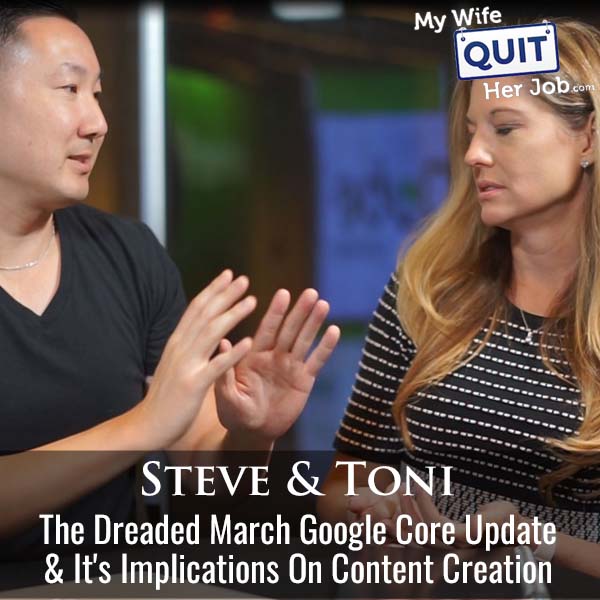
This is a Profitable Audience episode with my co-host Toni Herrbach, where I walk through what actually changed in the update, why some content creators got wiped out, and why I am oddly optimistic about writing on the internet again.
Here is what changed, why it broke so many affiliate sites, and what content creators should actually do next.
Get My Free Mini Course On How To Start A Successful Ecommerce Store
If you are interested in starting an ecommerce business, I put together a comprehensive package of resources that will help you launch your own online store from complete scratch. Be sure to grab it before you leave!
Table of Contents
Key takeaways
- The March 2024 update hit four categories at once: AI content, expired domain abuse, site reputation abuse (paid links on Forbes-tier sites), and low-quality content.
- Reddit, Quora, and LinkedIn now dominate the top of Google search. Reddit shows up in roughly 97.5% of product-review SERPs where its feature appears, per Glenn Allsopp’s analysis of 10,000 product review terms.
- The affiliate site playbook of the last eight years (short, keyword-optimized, opinion-free “just the answer” pages) is now underperforming original, opinionated, personal content.
- My blog dropped 25%. Some peers lost 90% plus. One friend went from 1M monthly visits to 11K.
- Google search quality is measurably worse for many product-review and how-to queries. Users are shifting to ChatGPT, Perplexity, TikTok, and Pinterest.
- Pinterest is quietly having a moment. Its fastest-growing demographic is 16-24 year olds.
What actually changed in the March 2024 Google core update?
The March 2024 Google core update targeted four specific abuse patterns and rebalanced who wins in the SERPs, and the rebalancing is where most legitimate site owners got hit. Google announced the update on March 5, 2024, and rollout was expected to take about a month. Here is what changed and how each piece affected real websites.
1. AI-generated content sites got deindexed
Sites whose entire content library was AI-generated and regurgitated (no original research, no first-hand experience, just paraphrased search results) got hit with manual penalties or dropped out of the index entirely. Google waffled on its AI policy for over a year (was AI content allowed if you “edited” it? unclear). This update ended the ambiguity: if the content is AI slop with no unique value, it is out.
Two related signals sit alongside this. Amazon is now asking sellers whether they used AI to write their listings. YouTube is rolling out a similar disclosure checkbox. Neither has confirmed what happens if you say yes, but neither is a good outcome. If you say no and Google (or Amazon, or YouTube) later detects otherwise, that is a self-inflicted trust penalty.
2. Expired domain abuse was penalized
Expired domain abuse is the practice of buying an aged domain with existing backlinks and rebuilding an entirely different site on top of that backlink profile. That trick has been around forever (I first learned about it years ago at FinCon), and it worked because Google was rewarding domain authority signals inherited from the domain’s previous life. Google is now specifically detecting and demoting sites that do this.
3. Site reputation abuse: paid Forbes/Business Insider links got killed
Site reputation abuse is the pattern where large publishers (Forbes, Business Insider, and similar) sell placements to third parties who then get to write articles under the publisher’s authority. If you have gotten those cold emails offering guaranteed Forbes placement “with a fee associated,” this is that market.
Google specifically targeted this pattern in the update. A friend of mine ran a legitimate large-scale guest posting operation (real, well-written articles that also linked to partner sites in his network) and had grown his site to 1 million visits per month. After this update, he is down to about 11,000. Total collapse.
This is worth understanding even if you never did paid Forbes placements, because the legitimate version (real guest posts, real reciprocity) is now also under suspicion in Google’s models.
4. Low-quality content in general got demoted
The broader theme is that content that regurgitates what everyone else says (the classic “skyscraper” playbook: find a ranking post, rewrite it longer) is now underperforming original, opinionated, experience-based content. That is a real reversal of the last eight years of SEO advice.
Why Reddit, Quora, and LinkedIn are now dominating Google search
The single biggest impact on most site owners is that Google dramatically promoted Reddit, Quora, and LinkedIn in the SERPs, which pushed everyone else down. Google’s public defense (from a senior search executive) was that Reddit has spent decades dealing with spam and its experienced users are quick to flag bad answers. So the logic is: these communities are self-moderating, therefore they must be reliable sources.
The problem: a great spam filter does not mean the people posting know anything. Those are two completely different things. A Reddit user with zero credentials can rank at the top for a medical, financial, or product query because they posted a comment three years ago.
Glenn Allsopp’s data on Reddit domination
Glenn Allsopp of Detailed.com ran a case study on 10,000 product review terms and found:
- Reddit.com was present in 7,500 of the 10,000 search results.
- Reddit appeared 14,000 times across those 7,500 results (many results included multiple Reddit threads).
- Where Reddit’s SERP feature was present, Reddit had a 97.5% chance of showing up, and on average occupied 1.9 of the 3 possible top listings.
- Of 122 individual Reddit URLs Glenn manually reviewed, 63 (52%) had a top comment with a self-promotional affiliate link, often added months after the original thread was created.
That last point is the gaming pattern. Post a legitimate question three years ago. Watch that thread rank in Google today. Add an affiliate link comment now. Collect commissions. Glenn’s conclusion: Google’s product review results are the worst he has ever seen.
The LinkedIn workaround one operator is using
Here is where it gets absurd. A friend saw his blog post drop in the rankings post-update, so he copied the same content word-for-word onto LinkedIn as a LinkedIn article. The LinkedIn version now ranks number one for the same keyword. He then set up a 301 redirect from his original blog URL to the LinkedIn article, which effectively hands Google the signal that LinkedIn is the authoritative version. His affiliate links live on the LinkedIn post and still earn.
I would not recommend this because you are building on rented land. But it is a real signal about where Google is currently placing trust.
Which categories of sites got hit hardest?
| Site type | Impact from March 2024 update |
|---|---|
| Pure AI-generated content sites | Deindexed or manual penalty. Some sites lost 100% of traffic. |
| Affiliate sites built on expired domains | Heavy demotion. |
| Sites reliant on paid Forbes/Business Insider placements | Heavy demotion. One friend went from 1M to 11K monthly visits. |
| Traditional affiliate review sites (short, keyword-optimized, no first-hand voice) | Moderate demotion. My blog dropped roughly 25%. |
| Ecommerce category and product pages | Mostly stable per Jeff Oxford’s portfolio. Roughly 10-15% of sites hit. Ecommerce blogs took the same hit as content sites. |
| Sites with strong original voice, personal stories, first-hand experience | Some outliers actually gained rankings. |
Why some sites with almost no SEO polish are winning right now
There is a small pattern in the outlier winners: sites that look like blogs from 2010. Photos, casual first-person “I bought this and here is what happened” writing, no keyword-optimized H2 stacks, no polished comparison tables. Google is promoting them because the content is unmistakably original and experiential, and the model can tell it was not stitched together from other search results.
This is a real reversal. For roughly the last eight years, Google effectively taught content creators to write like an encyclopedia: strip out your opinions, strip out your stories, get to the answer, keep it short. Every affiliate site optimizer (myself included) rewrote posts in exactly that direction.
Now the same platform is rewarding the opposite. If you kept your voice through the whole “just the facts” era, you got lucky. If you spent 18 months surgically removing your personality from your money pages (I did), the good news is WordPress has a revision history.
What content creators should actually do after the March 2024 core update
Concrete moves, roughly in priority order.
1. Add real experience back to your money pages
Go into your top-earning posts and add your actual opinions, actual test results, actual first-hand experience. Not “5 reasons X is great.” Real specifics: “I ran this tool for 8 months, here is what broke, here is what I would do differently.” That is the content Google is now rewarding, and it is also the content real humans want.
2. Diversify away from Google search
Every operator I trust believes Google search’s dominant era is running out, likely within a few years. Yahoo owned search until Google ate it in about 12 months. If Perplexity or ChatGPT search or whatever comes next becomes materially better, adoption can flip that fast.
Concrete diversification moves working right now:
- YouTube. My channel now dwarfs my blog for email subs and ad revenue. Video is where the growth is.
- Pinterest. Fastest-growing demographic is 16-24 year olds. My Pinterest and Google are typically one and two for traffic on a good month. Roughly 45 minutes per week of consistent effort produces meaningful traffic.
- Podcasts. First-party audience, direct download, no algorithm dependency.
- Email. Owned channel. Nothing between you and the reader.
3. Use AI as a drafting assistant, not a publishing engine
If you are going to use ChatGPT, pay for the plus tier. Toni tested free versus paid on the same task (email content ideas, birthday party creative) and the paid version was dramatically better. The free version is not accurate enough for commercial use, and on the free tier, you are the product.
The right AI workflow: outline ideas, first drafts, restructuring, script conversion from blog to video. Do not publish AI slop. Anything with your name on it needs your voice and your experience layered on top.
4. If you are in ecommerce, product pages are still mostly fine
Jeff Oxford (who focuses on ecommerce SEO) said only about 10-15% of the ecommerce sites in his portfolio got hit. Product pages, category pages, and collection pages held up better than blog content. My Bumblebee Linens blog got hit, but the money product pages were largely stable. If you run a store, prioritize your commerce URLs and watch your blog like everyone else has to.
Why the search results feel objectively worse right now
The user experience of Google today is measurably worse for a lot of common queries. Toni Googled a specific question about her American Express card yesterday. Historically the first result would have been the American Express help page. Instead she got a Reddit thread with the right keywords but no real answer, followed by more Reddit and Quora threads with no useful information, and ended up back on the Amex site digging manually. That is not an isolated case.
I did the same test on “which is better Shopify or BigCommerce.” Top result was Forbes (a paid review roundup), second was Shopify itself (obviously biased), third was a random Reddit thread titled “any advices for a Shopify BigCommerce new seller.” The intent-matching is broken.
This is why user behavior is shifting fast:
- Younger users are searching TikTok directly for how-to content and product recommendations.
- Pinterest is picking up younger search-intent traffic (16-24 year old demographic growing fastest).
- ChatGPT and Perplexity are absorbing informational queries.
- Traditional Google is losing the specific kinds of queries where AI answers are clearly better.
Frequently asked questions
What was the March 2024 Google core update?
The March 2024 Google core update was a large ranking algorithm change rolled out starting March 5, 2024, that targeted AI-generated content, expired domain abuse, site reputation abuse (paid links on major publishers), and low-quality regurgitated content. It also dramatically increased how often Reddit, Quora, and LinkedIn appear at the top of the search results. Rollout was expected to take roughly a month.
Why did my affiliate site lose traffic in the March 2024 update?
Most legitimate affiliate sites lost traffic because Reddit, Quora, and LinkedIn were promoted at the expense of independent content sites, not necessarily because your site was penalized. Additional demotions hit sites built on expired domains, sites that used paid guest posts on major publishers, and sites with short “just the answer” affiliate content lacking original opinion or first-hand experience. If your site dropped 20-30%, that is the average impact. Some peers lost 90% plus.
Should I remove AI-generated content from my site?
Yes, if the AI-generated content is generic, paraphrased, and adds nothing original. Google is actively deindexing or manually penalizing sites whose content library is AI slop. If you use AI as a drafting tool (outlines, first drafts, script conversion) and add real first-hand experience, opinion, and expertise on top, you are fine. The rule is whether the finished content adds something new to the web.
Is Reddit really ranking above real websites for most queries now?
Yes for a lot of product-review and how-to queries. Glenn Allsopp’s analysis of 10,000 product review terms found Reddit appeared in 7,500 of them, often occupying multiple top-three positions. Google publicly defended this because Reddit communities self-moderate spam. The problem is that self-moderation does not equal user expertise, so many Reddit answers ranking at the top are written by people with no credentials in the topic.
How do I write blog content that ranks after the March 2024 update?
Write content with real first-hand experience, real opinions, and specifics only you can provide. The eight-year run of short, keyword-optimized, opinion-free “here is the answer” posts is over. Google is now rewarding the style that worked in 2010-2015: personal stories, hands-on test results, actual expertise, real photos and screenshots. Add these back to your top-earning posts first.
Is Google search dying?
Google search dominance is likely running down over the next few years. User behavior is already shifting to ChatGPT and Perplexity for informational queries, TikTok for younger how-to and product queries, and Pinterest for visual and inspiration search. Search itself is not disappearing, but Google’s near-monopoly on it probably is. Diversify your traffic sources now.
Should content creators pivot to Pinterest and YouTube?
Yes if it fits your niche. Pinterest is having a real moment (fastest-growing demographic is 16-24 year olds) and roughly 45 minutes per week of consistent effort can produce meaningful traffic. YouTube is the highest-leverage single channel most content creators can build right now (my channel now generates more email subs and ad revenue than my blog). Both are owned-audience diversification away from Google search risk.

