Podcast: Download (Duration: 11:52 — 13.9MB)
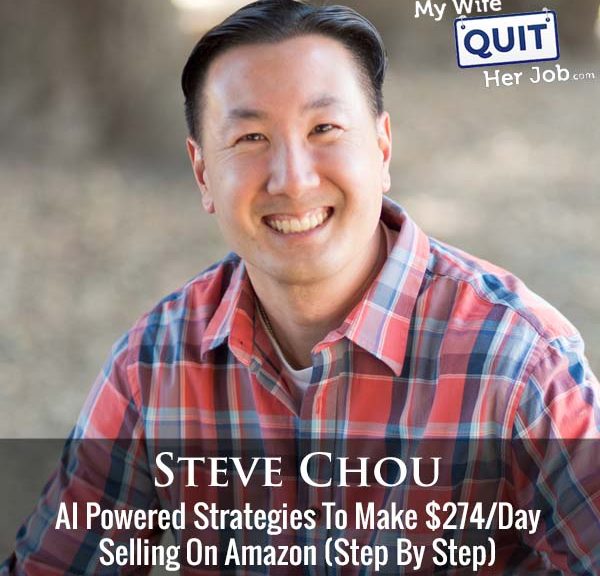
Use AI to sell on Amazon by running a five-step workflow: ask ChatGPT for product ideas inside a niche you already know, validate demand with Jungle Scout, ask ChatGPT how to differentiate the product, source with an Alibaba supplier that will build in your differentiators, then use ChatGPT (with the Amazon listing plugin) to write the title and bullets around the exact keywords Jungle Scout surfaced. This is the fastest path I know from zero to a live Amazon listing that can actually rank.
In this Family First Friday episode of the My Wife Quit Her Job podcast, I walk through each step with a real example (magnetic fishing wristbands) so you can see exactly what to prompt ChatGPT, what to look for in Jungle Scout, and how to structure a supplier ask on Alibaba.
Here is the full step-by-step AI workflow for starting an Amazon business.
Key takeaways
- Start in a category you already know or care about. My student Amanda Wittenborn sells millions in custom party supplies because she is a designer. Jesse Funk (episode 487) hit six figures selling card games because he plays them.
- When you are stuck, ChatGPT can generate 10 product ideas inside any niche in seconds. Then Jungle Scout tells you which of them actually sells (magnetic wristbands averaged $9,000+ per month per front-page seller in my check).
- Never sell a me-too product. Ask ChatGPT how to differentiate the winning product (design variants, better materials, stronger magnets, LED, personalization) before you go to Alibaba.
- On Alibaba, filter for Assessed Suppliers only, request quotes from many factories at once, pay for samples, and confirm defect rate before scaling.
- Use Brandsnap.ai to find a brand name with the domain, trademark, and social handles all available in one search.
- Use Jungle Scout Keyword Scout to pull the search terms buyers actually use (including foreign-language variants like Cinturon para Herramientas), then feed the keyword list to ChatGPT to write the title and bullets.
Step 1: Use ChatGPT to find a profitable Amazon product idea
The fastest way to find a product to sell on Amazon is to pick a niche you already know something about and prompt ChatGPT for a list of specific product ideas inside it. Most beginners get stuck brainstorming; ChatGPT breaks that block in seconds.
The prompt I use is very specific about the niche, the buyer, and what to exclude:
Give me a list of 10 products that avid fishermen will want to buy that are novel or unique that do not involve electronics or tech.
For that prompt, ChatGPT returned ideas like glow-in-the-dark fishing line, personalized hand-painted lures, magnetic wristbands for hooks and tackle, and an ergonomic multi-rod carrier sling. If none of the first ten fit, re-prompt with tighter constraints (price range, gift context, gender, use case) until you have three or four candidates worth validating.
Start with your unfair advantage
Your best product idea is almost always in the category where you already have taste, experience, or credibility. Amanda Wittenborn scales in party supplies because she is a designer, Jesse Funk sells card games because he plays and designs them, and my friend Bill sells drone phone holders because he flies drones professionally.
Your niche should give you the same kind of edge.
Step 2: Validate demand with Jungle Scout
Validate every ChatGPT idea with Jungle Scout before you spend a dollar on a sample. Search the product on Amazon with the Jungle Scout Chrome extension open, and read the average monthly revenue per front-page seller.
For magnetic wristbands, Jungle Scout showed the front-page listings averaging over $9,000 per month in sales each. That is a strong signal there is real demand, and it means the market can support a new entrant if the product is meaningfully different.
If the average front-page revenue is under $2,000 per month, either the category is too small or the winners are hoarding all the traffic. Kill the idea and go back to Step 1.
Step 3: Ask ChatGPT how to differentiate the product
Never ship a me-too product on Amazon. The moment you validate a product with Jungle Scout, ask ChatGPT how to make it different from the existing top listings. The prompt is literal:
If I wanted to sell magnetic wristbands, how could I make my product unique or different from everyone else?
For that prompt, ChatGPT proposed customization (colors, patterns, engraving), better materials, stronger magnets with published weight ratings, and additional features like a small non-magnetic pocket, a built-in LED for low-light work, or a hook for a fishing tool. Cross-check the current top listings for gaps. In the wristband case, none of the top sellers had an LED, none offered personalization, and multiple recent reviews complained the magnets were weak.
That is the unique value proposition, straight out of a five-minute AI session. Take those specific differentiators to your supplier ask.
Step 4: Source the product on Alibaba (with a specific brief)
Source the product on Alibaba by messaging as many Assessed Suppliers as possible with a specific brief built from your ChatGPT differentiation output. For the wristband example, my brief would ask for a magnetic wristband with a built-in LED and extra-strong magnets, printed with a custom fishing-themed design, quoted per piece at various MOQs.
Alibaba prices for magnetic wristbands run about $1 to $3 per piece. Filter for Assessed Suppliers only, ignore anyone who does not respond within a few days, and always pay for a sample before committing to a first order.
Alternative sourcing channels
Alibaba is the fastest channel, but two others are worth knowing. Attending a sourcing trade show like the Canton Fair puts you in front of manufacturers and lets you inspect quality in person (I went every other year pre-COVID). Hiring a sourcing agent trades a cut of the margin for someone who already knows which factories to trust in your category.
Set quality terms in writing before the first PO
Set delivery times, payment terms, returns, and a defect ratio in writing before your first order. For linens at Bumblebee Linens we require a defect ratio under 3 percent. Get your suppliers on WhatsApp or WeChat for real-time communication once production starts.
Step 5: Set up your brand and Amazon seller account
While the supplier manufactures your first batch, set up the seller side. Sign up for a Professional Amazon seller account (you will need the feature set if you are aiming for six figures), then pick a brand name.
The fastest tool for brand naming is Brandsnap.ai. Type in your product category and it returns dozens of available brand names where the .com domain, the trademark, and the matching social media handles are all open in one shot.
For the wristband example it surfaced FishingGearz.com (with a z) as an available bundle. Not my favorite, but you get the point.
Register the domain, grab the social handles, and go back to Amazon to start the listing.
Step 6: Pull the real Amazon search terms with Jungle Scout Keyword Scout
Amazon is a search engine, so ranking on Amazon starts with the exact keywords buyers type. Use Jungle Scout Keyword Scout to pull every variation of your product term along with monthly search volume.
For magnetic wristband, Keyword Scout returned about 4,900 monthly searches for the base term and 5,400 for “magnetic wristband for holding screws.” It also surfaced foreign-language variants like Cinturon para Herramientas that a native English speaker would never guess. Compile a list of every variant with meaningful volume; that list is the input to Step 7.
Step 7: Have ChatGPT write your Amazon listing around those keywords
Use ChatGPT (with the Amazon listing plugin installed) to write your Amazon title and bullet points around the Jungle Scout keyword list. If a similar product already exists on Amazon, feed ChatGPT its ASIN so the model pulls the current listing into context, then prompt it to write a new title and bullets using your specific keyword list.
The output is copy you can paste directly into Amazon Seller Central. Once your inventory arrives from the factory, make the listing active and you are selling.
The full AI Amazon workflow, end to end
Here is the entire workflow in one place so you can see how tightly the tools stack:
- Product idea: ChatGPT prompt inside your niche.
- Validate demand: Jungle Scout Chrome extension on the Amazon search page.
- Differentiate: ChatGPT prompt on how to improve the winning product.
- Source: Alibaba (Assessed Suppliers only) with a specific brief built from Step 3.
- Brand: Brandsnap.ai for a name with domain, trademark, and handles available.
- Keywords: Jungle Scout Keyword Scout for the real search terms buyers use.
- Listing copy: ChatGPT (Amazon listing plugin) writes the title and bullets from your keyword list.
That is a workflow that used to take weeks of manual research compressed into a couple of focused sessions.
Frequently asked questions
Can ChatGPT actually help you find a profitable product to sell on Amazon?
ChatGPT is excellent at generating product ideas inside a niche you know, and it is even better at suggesting differentiators for a product you have already validated with real sales data. It is not a substitute for demand validation. Always confirm with a tool like Jungle Scout before spending money on samples or inventory.
Which AI tools do you need to sell on Amazon?
The core stack I recommend is ChatGPT (with the Amazon listing plugin) for ideation, differentiation, and listing copy, Jungle Scout for demand validation and keyword research, Alibaba for supplier sourcing, and Brandsnap.ai for brand naming with an available domain, trademark, and social handles.
How much money do you need to start selling on Amazon in 2026?
Realistic first-order costs run a few thousand dollars for a small trial batch of a differentiated product, plus a Professional Amazon seller account (about $40 per month) and Jungle Scout access. Do not over-order on your first batch. Prove the listing converts, then scale the reorder.
Do you need a website to sell on Amazon?
You do not need a website to launch on Amazon, but you should still register a domain when you pick your brand name so you own it later. Amazon Brand Registry requires a trademark, and having the matching .com from day one makes the eventual off-Amazon expansion much smoother.
What is the biggest mistake new Amazon sellers make?
The single biggest mistake is selling a me-too product identical to the top listings and hoping to compete on price. On Amazon that race always ends at the bottom. Use ChatGPT to design in real differentiators (better materials, features the top listings do not have, personalization) before you place the first PO.
How do you find the right keywords for an Amazon listing?
Use Jungle Scout Keyword Scout to pull every variation of your product term along with monthly search volume, including foreign-language variants a native English speaker would miss. Then feed the full keyword list to ChatGPT and have it write the title and bullets to weave the terms in naturally.
I Need Your Help
If you enjoyed listening to this podcast, then please support me with a review on Apple Podcasts. It's easy and takes 1 minute! Just click here to head to Apple Podcasts and leave an honest rating and review of the podcast. Every review helps!
Ready To Get Serious About Starting An Online Business?
If you are really considering starting your own online business, then you have to check out my free mini course on How To Create A Niche Online Store In 5 Easy Steps.
In this 6 day mini course, I reveal the steps that my wife and I took to earn 100 thousand dollars in the span of just a year. Best of all, it's absolutely free!