
Podcast: Download (Duration: 46:34 — 53.6MB)
You can effectively eliminate Amazon FBA fees on your first million dollars in sales by stacking five specific programs and audits: (1) the New Seller Incentive that returns 5% of your first $1M in revenue, (2) the Brand Referral Bonus program that returns 10% on all external traffic you drive to Amazon, (3) reducing your product weight and dimensions to move down a fulfillment tier, (4) running an FBA reimbursement audit that recovers 1-3% of annual revenue in miscounted shipments and misweighed products, and (5) auditing your listing weight-and-dimension data to stop overcharges before they happen. Yoni Mazor of Getida walked me through all five, plus the exact steps to run each audit yourself.
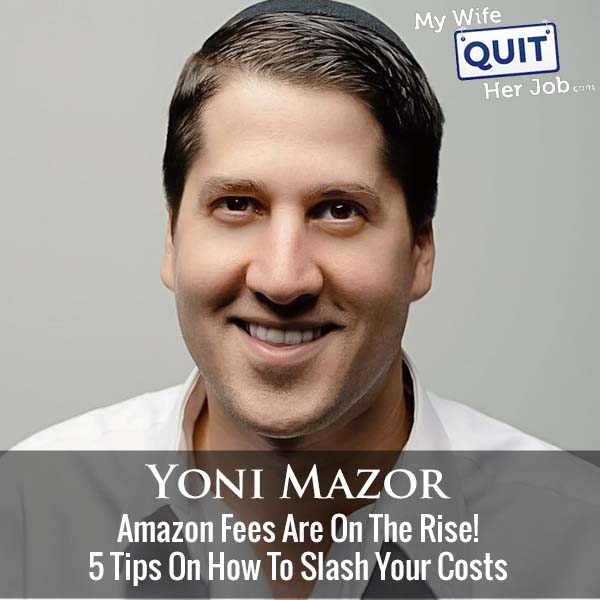
Yoni Mazor is the founder of Getida, an FBA reimbursement platform that has recovered discrepancies for sellers doing anywhere from a few hundred dollars a month up to over $1B a year on Amazon FBA. He is at nearly every major Amazon event, so he has a real pulse on what is working right now. In this episode of the My Wife Quit Her Job podcast we cover the Amazon fee hikes and Small and Light program shutdown, the specific new-seller and brand-referral incentives that offset them, and step-by-step how to audit your own account for missing inventory and weight-based overcharges.
Below you will find the five tactics laid out with real numbers, a comparison of what each one is worth on a $1M store, and a step-by-step guide to running your first FBA reimbursement claim in Seller Central.
Get My Free Mini Course On How To Start A Successful Ecommerce Store
If you are interested in starting an ecommerce business, I put together a comprehensive package of resources that will help you launch your own online store from complete scratch. Be sure to grab it before you leave!
Table of Contents
Key takeaways
- Roughly 50% of all Amazon global sales come from China-based sellers, and their AI-assisted listings are consistently outperforming US sellers on image quality, bundling, and value perception.
- The Amazon New Seller Incentive returns 5% of your first $1M in sales as a bonus if you have Brand Registry, which effectively cuts a 15% referral fee down to 10%.
- The Brand Referral Bonus program pays back 10% (uncapped) on external traffic you drive to your Amazon listing through influencers, TikTok, YouTube, Instagram, or email.
- Stacked, those two programs return $150,000 on your first $1M, which effectively wipes out Amazon selling fees on your first year of sales.
- Brand Registry is now table stakes. Selling without it exposes you to hijackers and image-swap attacks, and locks you out of the two incentive programs above.
- FBA reimbursement discrepancies typically run 1-3% of annual revenue. On a $1M store that is $10,000 to $30,000 in recoverable money most sellers never claim.
- Weight-and-dimension errors on your listing (real, accidental, or from a competitor attack) can silently overcharge you thousands per year on FBA fulfillment.
- Getida charges 25% of what they recover (20% above $10M/year revenue), and there is a $400 free reimbursement offer for My Wife Quit Her Job listeners at mywifequitherjob.com/getida.
Who is Yoni Mazor of Getida?
Yoni Mazor is the co-founder of Getida, a technology platform that audits Amazon seller accounts for FBA reimbursement discrepancies (lost inventory, damaged units, misweighed products, fulfillment overcharges) and files the recovery claims on the seller’s behalf. Getida works on performance only. They charge 25% of what they recover and $0 otherwise.
Yoni is a fixture at essentially every major Amazon conference in the world, from AMZ Innovate to the Sellers Summit, which gives him an unusually broad view into what tactics are actually moving the needle across thousands of FBA sellers right now.
Why Amazon fees are rising and what changed in 2023
Amazon raised FBA fulfillment fees again in 2023 and eliminated the Small and Light program, which had provided cheaper fulfillment for lightweight, low-priced items under specific weight and dimension limits. The net effect is that sellers of small, cheap trinkets got hit hardest, and margins across most categories tightened by several percentage points overnight.
Yoni’s take from talking to sellers at every major event is that most are handling it by raising prices while also optimizing their listings to project more value at the higher price point. The listings work matters as much as the pricing work. A product at a higher price with a better image stack often converts better than the old price with the old images.
The counter for small-item sellers is to attack the weight-and-dimension math directly. Shrinking your packaging even slightly can drop you into a lower FBA tier and offset the hike.
The 5-step framework to slash Amazon FBA fees
Below is the exact five-step framework Yoni walked through on the episode: two incentive programs to stack on new revenue, one packaging optimization, and two audit workflows to reclaim money Amazon already owes you. Applied in order, they compound.
| Tactic | Estimated value on $1M in sales | Requires |
|---|---|---|
| 1. New Seller Incentive (5%) | ~$50,000 | New account + Brand Registry |
| 2. Brand Referral Bonus (10% uncapped) | Up to $100,000 | Brand Registry + external traffic |
| 3. Weight/dimension optimization | Variable (drops fulfillment tier) | Physical repackaging or SKU redesign |
| 4. FBA reimbursement audit | $10,000-$30,000 (1-3% of revenue) | Seller Central access, 18-month history |
| 5. Fulfillment-fee audit (weight/dimension corrections) | Prevents 4-figure overcharges | Tape measure, scale, one Seller Central case |
Step 1: Get Brand Registry and claim the 5% New Seller Incentive
Amazon’s New Seller Incentive returns 5% of your first $1M in revenue as a bonus when you have Brand Registry on your account, which is a $50,000 credit on that first million and effectively cuts the standard 15% referral fee down to 10% net. It is available for new accounts in the US, UK, Germany, France, Italy, and Spain, with no time expiration on the bonus (so speed matters if you want to hit the full million).
The categories that most benefit are the ones with the highest referral fees. Standard 15% categories drop to 10% net, electronics at 8% drop to 3% net, and jewelry at 20% drops to 15% net.
Cross-marketplace sellers should pay attention. If you already sell in the UK or Europe and want to expand to the US, you get 5% back on the first $1M in the new market. Same in reverse.
To qualify you must have a real trademark and Brand Registry on the account. As Yoni put it, Brand Registry is now the “social security” of Amazon selling. Without it you are exposed to hijackers, image-swap attacks, and locked out of every meaningful Amazon seller program.
Step 2: Sign up for the Brand Referral Bonus program (10% back on external traffic)
The Brand Referral Bonus program pays Brand Registered sellers 10% back (with no cap) on any sales generated through a special Amazon Attribution link when you drive external traffic to your listing from influencers, TikTok, YouTube, Instagram, email, or your own site. On $1M in external-traffic-driven sales, that is $100,000 back on top of the 5% New Seller Incentive.
Setting it up takes minutes. In Seller Central, search “Brand Referral Bonus Program” and apply. You need Brand Registry to qualify, which is why Step 1 comes first.
Stacked with the New Seller Incentive, you are looking at 15% back on your first million dollars in external-traffic-driven sales, which functionally offsets the entire 15% Amazon referral fee. That is what Yoni means when he says you can “sell on Amazon for free” on that first million.
Do not just rely on Amazon’s internal search. Real leverage lives in owning some slice of consumer attention off-platform and directing it into Amazon at a 10% rebate. Yoni’s framing is worth repeating: attention is the most valuable resource in commerce today, and the sellers who can generate it independently of Amazon get paid to do so.
Step 3: Optimize weight and dimensions to drop a fulfillment tier
The single biggest lever inside FBA fulfillment fees is the packaging tier your product falls into, so shrinking a SKU’s dimensions by even a fraction of an inch can drop it into a smaller tier and permanently cut your per-unit fulfillment cost. With Small and Light gone, this optimization is now the only real way for cheap, lightweight sellers to defend margin.
Talk to your factory or sourcing agent about tightening the poly bag, using shrink wrap instead of loose plastic, or slimming the retail box. Run the exact revised dimensions through Amazon’s FBA revenue calculator before you commit.
Yoni’s warning: loose plastic wrap and unnecessary internal packaging can push you into a higher tier on Amazon’s Cubic Scan measurement. That is a permanent fee you pay on every future unit sold.
Step 4: Run an FBA reimbursement audit (recover 1-3% of annual revenue)
Getida’s data across thousands of accounts shows FBA reimbursement discrepancies typically run 1-3% of annual revenue on the average seller, and Amazon lets you go back up to 18 months to file claims on missing inventory, damaged units, and misweighed products. On a $1M store that is $10,000 to $30,000 in recoverable money that most sellers never claim.
How to file your first FBA shipment reimbursement claim
- Log into Seller Central and go to Inventory > Manage FBA Shipments.
- Scroll through the shipment log and open any shipment where the “Received” count is less than the “Shipped” count.
- Use the drop-down to select “I shipped these units, please investigate.”
- Provide the requested documents: supplier invoice, packing slip, and proof of delivery to the FBA warehouse.
- Amazon typically responds within 24 hours to 5 days. Approved reimbursements hit your account within that same window.
Yoni’s warning on shipment reimbursements: if Amazon reimburses you and later “finds” the inventory, they will reverse the credit. The only defense is a strong listing that sells the recovered inventory through fast.
The seven categories worth auditing are: shipment discrepancies, customer returns not returned to inventory, damaged inbound units, damaged in-warehouse units, lost inventory, weight-and-dimension overcharges (see Step 5), and inventory that was removed but never showed up.
Step 5: Audit your weight-and-dimension data to stop fulfillment overcharges
Amazon calculates FBA fulfillment fees off the weight and dimensions stored in your listing, and any incorrect data (a decimal-place typo, a competitor attack, or a Cubic Scan misread from a returned item) silently overcharges you on every future unit sold. The recovery window is 90 days on overcharges, so this one is time-sensitive.
How to audit your FBA weight and dimensions
- Pull the current fulfillment fee Amazon is charging you for the ASIN from the FBA revenue calculator.
- Note the weight and dimensions Amazon shows for the product.
- Measure the actual product with a tape measure and scale. Compare it to what Amazon has on file.
- If there is a discrepancy, open a Seller Central case, provide the correct measurements, and request a “bin check and re-measurement.”
- Once Amazon corrects the data, they stop overcharging going forward and refund up to 90 days of overcharges.
Two specific ways this happens that most sellers miss. First, returned items sometimes come back with add-on components (a handbag returned with the strap attached) and get re-scanned at inflated dimensions, breaking the ASIN math for every future unit. Second, a competitor can list your ASIN under their own Seller Central account and change the stored weight and dimensions themselves, silently jacking your fees while pocketing better margin on the same price.
How much can you actually save? A $1M FBA seller example
A $1M FBA seller who does all five steps typically doubles their net margin, going from roughly 20% ($200K) to 40%+ ($400K), because the fee recovery and incentive stack returns roughly $180K to $200K they would otherwise have paid to Amazon. Yoni’s math on the episode was $150K in stacked incentives plus $10-$30K in reimbursements plus permanent fulfillment savings from Step 5.
| Line item | Impact on $1M store |
|---|---|
| New Seller Incentive (5%) | +$50,000 |
| Brand Referral Bonus (10% on external traffic) | Up to +$100,000 |
| FBA reimbursement audit (1-3%) | +$10,000-$30,000 |
| Weight/dimension fee corrections | Variable, often 4 figures per year |
| Estimated total recovery/incentive value | ~$160,000-$180,000 |
Yoni is careful to note this is an idealized scenario. It assumes you actually hit the full $1M, drive meaningful external traffic through the Brand Referral link, and have real discrepancies to recover.
The order of the stack matters. Get Brand Registry first or none of the incentive money is available to you.
Should new Amazon sellers still start selling on FBA in 2026?
Yes, launching a new Amazon FBA business is still a strong path in 2026 because the New Seller Incentive and Brand Referral Bonus programs (worth up to $150K on your first million) create a meaningful head start that established sellers cannot access. Combined with lower-cost private-label sourcing and AI-generated listings, the on-ramp is arguably better today than it was in the mid-2010s.
The competitive picture is harder. Roughly half of Amazon’s global sales now come from China-based sellers with tighter cost structures, better-optimized listings, and disciplined iteration, and AI has closed the language and design gap that used to protect US sellers.
Your competitive edge has to come from brand, direct-to-consumer, and better product selection instead of generic private label.
Frequently asked questions
How do I reduce my Amazon FBA fees in 2026?
You can cut your effective Amazon FBA fees close to zero on your first $1M in sales by combining the New Seller Incentive (5% back), the Brand Referral Bonus program (10% back on external traffic), packaging optimization to move down a fulfillment tier, an FBA reimbursement audit for missing inventory, and a weight-and-dimension audit to correct listing data that inflates your per-unit fulfillment fee. All five require Brand Registry to work as intended.
What is the Amazon New Seller Incentive and who qualifies?
The Amazon New Seller Incentive is a promotional program that returns 5% of your first $1M in revenue as a bonus for new accounts in the US, UK, Germany, France, Italy, and Spain, provided you have Brand Registry on the account. There is no time expiration on the bonus, so speed to hit the full million is the main constraint.
What is the Amazon Brand Referral Bonus program?
The Amazon Brand Referral Bonus program pays Brand Registered sellers 10% back (with no cap) on any sales generated through a special Amazon Attribution link when you drive external traffic to your listing from influencers, TikTok, YouTube, Instagram, email, or your own website. You apply through Seller Central by searching “Brand Referral Bonus Program.”
How do I file an FBA reimbursement claim myself?
To file an FBA shipment reimbursement claim, go to Inventory > Manage FBA Shipments in Seller Central, open any shipment where Received is less than Shipped, use the drop-down to select “I shipped these units, please investigate,” and upload your supplier invoice, packing slip, and proof of delivery. Amazon typically responds within 24 hours to 5 days.
How far back can I file FBA reimbursement claims?
Amazon lets sellers file reimbursement claims for issues going back up to 18 months from the current date, which is why running your first audit typically recovers a meaningful lump sum of historical discrepancies. Fulfillment-fee overcharges from incorrect weight and dimensions are a shorter 90-day window.
Why is Amazon overcharging me on FBA fulfillment fees?
Amazon calculates FBA fulfillment fees off the weight and dimensions stored on your listing, so any incorrect data (a decimal-place typo, a Cubic Scan misread from a returned item, or a competitor attack changing your ASIN’s stored dimensions) silently overcharges you on every unit sold. Correcting the data through a Seller Central case stops future overcharges and refunds up to 90 days.
Is Brand Registry required to sell on Amazon in 2026?
Brand Registry is not technically required to list on Amazon, but selling without it locks you out of the New Seller Incentive, the Brand Referral Bonus, IP enforcement tools, and A+ Content, and exposes you to listing hijackers and image-swap attacks. Yoni Mazor calls Brand Registry the “social security” of Amazon selling for that reason.
How much does Getida cost?
Getida charges 25% of the reimbursements they recover on your behalf, drops to 20% for sellers above $10M in annual revenue, and $0 if they do not recover anything. There is a My Wife Quit Her Job listener offer for the first $400 in reimbursements at mywifequitherjob.com/getida.