
Podcast: Download (Duration: 41:22 — 47.6MB)
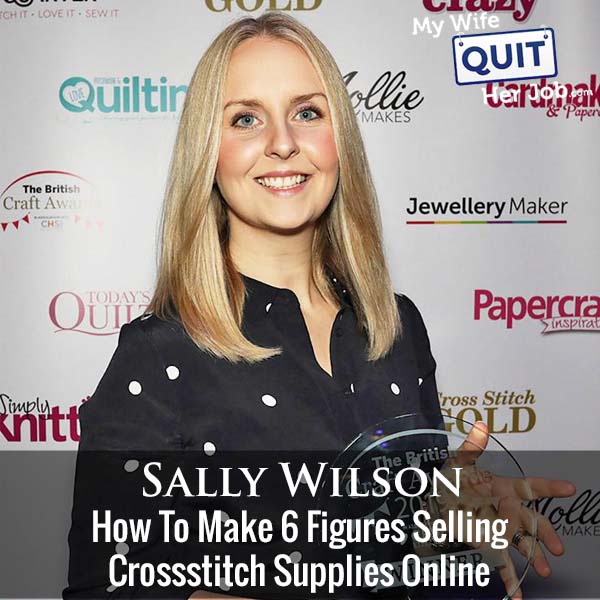
Selling craft supplies online works by serving a passionate community rather than chasing a broad market. Sally Osborne started Caterpillar Cross Stitch for under 1,000 pounds and built it to six figures on entirely original designs, with roughly 50% of sales coming from Facebook and a 5,000-member group she runs herself.
Sally is a student in my Create A Profitable Online Store course, based in the UK, and she trained and practiced as a lawyer for eight or nine years before this. She took the course during her maternity leave, working through it at every nap time.
This episode covers how she validated a niche on feel plus numbers, sourced enamel needle minders from China, built the Facebook group, and structured a nine-email welcome funnel that keeps open rates at 40%.
Get My Free Mini Course On How To Start A Successful Ecommerce Store
If you are interested in starting an ecommerce business, I put together a comprehensive package of resources that will help you launch your own online store from complete scratch. Be sure to grab it before you leave!
Table of Contents
Key takeaways
- Startup cost was under 1,000 pounds, including the course, pattern software, a camera, and small material orders.
- Every design is original and exclusive, which removes direct competition on the exact product.
- Traffic splits roughly 50% Facebook, 30% Instagram, 10% YouTube, plus email and Google search.
- Pruning unengaged subscribers every four months holds open rates near 40%.
- She validated the niche by counting the community: 50+ Facebook groups, seven magazines, many YouTube channels.
- Pre-orders fund production and let her skip samples on small, low-cost items.
- The Facebook group is mostly not about selling. Sales come far down the line.
- Resilience is the real skill. Anything practical can be learned from Google or YouTube.
What Caterpillar Cross Stitch sells
The product line covers modern cross stitch kits, patterns, magnetic needle minders, project bags, and pins.
The full kit is the core offering. Threads, needle, fabric, and pattern together, so a buyer has everything needed to start.
Sally designs everything herself and nothing is white labeled, which takes longer and is the stated unique selling proposition.
The exclusivity is the strategic point. Other cross stitch retailers sell the same brands as each other, and her designs exist only on her site.
The team is Sally working what amounts to full-time hours across three days, plus three part-time workers including her husband, who has kept his engineering job.
How Sally Osborne validated the cross stitch niche
She had a year of maternity leave and treated it as a deadline for figuring out what to do next.
She worked through six different business ideas, spending significant time on keyword research before settling.
The decisive research was community counting. She found 50 or more Facebook groups dedicated to cross stitching, seven cross stitching magazines, and a large number of YouTube channels, called floss tube in the community since floss is the American term for the thread.
She also tested demand directly by selling printed patterns on eBay, which sold well despite not being her target audience or her intended full-kit product.
Her conclusion was that the community was underserved and genuinely passionate, and she sat with that feeling for about three months before committing.
Why repeat purchase made this niche worth entering
Cross stitch buyers come back, which is what separates it from a one-off product.
A project takes one month to six months to complete, then hangs in the buyer’s house or gets given as a gift.
Those finished pieces become heirloom works of art rather than disposable purchases.
Having finished one, the stitcher returns for the next design.
How to design products without a design background
Sally’s background is art and graphic design at school and college, plus a long-standing love of crafts.
She tested early designs on Reddit’s cross stitch community for feedback before starting the business, since selling there is not permitted.
Her market research found everything available was broadly the same style and somewhat old-fashioned, which created the opening.
The launch collection was five designs in three colorways each, all baby birth samplers, since a child’s birth is one of the traditional reasons people take up cross stitch. She offered personalization on top.
Four years of feedback taught her what sells: bright colors, animals, and cute subjects, kept modern without tipping into twee.
How to source enamel needle minders from China
Sally found suppliers on Alibaba, contacting five or six companies and screening on reviews and trading history.
Her approach follows the course guidance: be persistent, communicate precisely, and be extremely specific on design and spec, since detail gets lost in translation.
The material specification is where it went wrong. Needle minders are enamel over a brass alloy of a certain thickness with a magnet on the back, and the alloy cannot contain other metals or the piece itself becomes magnetic and defeats its own purpose.
She received 1,200 wrong units in England. The supplier replaced them all, and it cost a month.
A separate batch of about a thousand had magnets that detached, and she only discovered it after shipping to customers, so she absorbed replacement and postage costs herself.
Why she stopped ordering samples
Sally no longer requests samples before production runs.
The reasoning is unit economics. These are small items rather than $50 or $100 products, and her suppliers replace defective goods for free.
Speed is worth more than certainty at that price point. Faster turnaround means getting products advertised, sold, and out the door sooner.
Pre-orders reinforce that. Customers buy needle minders upfront and receive them three weeks later, which funds the production run.
Communication with all suppliers happens over email, and she has never visited the factories.
How much it costs to start a craft supplies business
Total startup investment came in under 1,000 pounds.
The line items were the course, a camera at roughly 400 to 500 pounds that she admits she wanted rather than needed, pattern design software at about 150 pounds, and Shopify at roughly $25 a month.
Initial materials cost under 100 pounds, deliberately ordered in very low quantities.
Her husband’s supportive-but-cautious framing was that they could always sell things on eBay if it failed, which is roughly the level of risk involved.
Why she abandoned coding her own website
Sally started out planning to code the entire site herself.
She quickly worked out that path would consume two years.
The realization was about allocation. Identify what you are good at, find someone else for everything else, and do not waste the time.
Shopify was straightforward to set up and she has been happy with it since.
How to build a Facebook group around a craft brand
Sally set up the Facebook page, Facebook group, Instagram account, and YouTube channel simultaneously, well before launch.
Her early tactics came largely from Rachel Miller’s free resources and her Facebook group.
She practiced photography and shared other people’s content constantly, including memes. The reliably popular ones are jokes about buying craft supplies and hiding them from your husband.
The posting cadence was about three times a day in varied formats: an image, a video, a question.
Questions are deliberately specific rather than open-ended. For a vacation-themed design called Seize The Day, she asked about people’s best vacations rather than how their day was going.
The group now has around 5,000 members with Sally plus two admins active in it.
Why the group is not primarily about selling
Sally’s stated approach is remembering people’s names and having real conversations, including with people who have never bought anything.
Members talk about their children and whatever happened in their day, and that is welcomed rather than redirected.
The result is a support community where sales sit far down the line, and where loyalty comes from members knowing her personally.
Content gets tailored between page and group. The page is more personalized, and the group is where she asks more questions.
The charity products illustrate how it functions. Members vote on which cause to support, they chose the Australian bushfires, she designed a koala needle minder, and members pre-ordered it so the money could go out immediately. Previous rounds supported cancer research and the UK mental health charity Mind.
How Sally Osborne runs Facebook ads
She avoided paid ads in the early years, since getting your head around them takes time.
Facebook assigned her a marketing expert through Business Manager who calls monthly to review campaigns.
Her structure runs up to two campaigns with three ad sets inside each.
One ad set stays broad to find new people. One handles retargeting. The third is narrowly specific, targeting people who interacted with an Instagram post or watched about 25 seconds of a Facebook video without buying.
What to put on a craft business YouTube channel
The content is tutorials and community documentation rather than product promotion.
Tutorials cover how to cross stitch, how to use a hoop, needle types, and which fabrics work, since you can stitch on nearly anything.
Time-lapses perform well. Fixing the camera in place and capturing stop-motion style footage while stitching produces genuinely watchable results.
Vlogs cover craft conventions, stitching markets, and her own in-person events, which serves the many members who could not attend.
The channel converts through the description box rather than a hard sell. Links point to a free ebook of five cross stitch patterns spanning the year, and viewers who watch at least half a video sign up at a high rate.
The sequencing is deliberate. Join the group and sign up for the newsletter comes before any suggestion to shop.
How the welcome email funnel works
The welcome sequence runs about nine emails.
The first arrives roughly 24 hours after signup with the free pattern ebook and 10% off.
Subsequent emails deliver tutorials and useful blog posts before any ask, and only then invite people to join a stitch-along project or buy a new product.
Her list is smaller than many and deliberately concentrated. Every four months she identifies subscribers who have not opened or clicked recently, sends two final emails, and removes those who still do not engage.
That pruning keeps open rates around 40% on nearly everything she sends.
How to generate repeat purchases from a craft community
Emails go out with every new blog post and every new YouTube video, not only with product releases.
The Stitcher of the Month feature is the standout. A member wins a store voucher and tells their full story, covering how they learned to stitch and their favorite project, which does not have to be one of Sally’s designs.
Those emails sell despite not being sales emails, because members read them and get inspired.
Post-purchase, a follow-up asks whether the customer likes the product and offers help completing the project, since some people need support finishing despite the included instructions. Reviews follow from that.
Stitch-alongs run three times a year and function like a subscription. Buy the materials once, then receive a new pattern each month.
Sally Osborne’s advice for people on the fence
Her diagnosis is that what stops people is fear rather than any practical obstacle.
Practical problems are all solvable. Anything about a website can be found on Google or YouTube, and nothing is too difficult if you stay focused.
The real challenge is self-doubt from working alone. You have gone from a team with a boss who acknowledges good work and colleagues to ask for help, to being in the house by yourself all day.
Her answer is resilience and laser focus. Believe in yourself without looking to anyone else for reassurance or a pat on the back.
She also recommends preparing for other people’s reactions. She has received patronizing comments over the years and mostly does not discuss the business with people outside it.
The payoff she describes is freedom over your working life, which she considers one of the most fulfilling things available.
Frequently asked questions
How much does it cost to start a craft supplies business?
Sally Osborne started Caterpillar Cross Stitch for under 1,000 pounds, covering a course, pattern design software at about 150 pounds, a camera, Shopify at roughly $25 a month, and under 100 pounds of initial materials.
How do you validate a craft niche?
Count the community. Sally found 50 or more dedicated Facebook groups, seven magazines, and many YouTube channels, then tested demand by selling printed patterns on eBay before committing.
Do you need a design background to sell original designs?
Not a formal one. Sally has school and college level art and graphic design, and tested early designs for feedback in Reddit’s cross stitch community before launching.
How do you find suppliers for enamel craft products?
Alibaba, contacting five or six companies and screening on reviews and trading history. Be extremely specific on material spec, since needle minders require a particular brass alloy that will not itself become magnetic.
Should you order samples before a production run?
It depends on unit cost. Sally skips samples on small inexpensive items because her suppliers replace defects free and faster turnaround is worth more than certainty at that price point.
How do you build a Facebook group for a craft brand?
Post about three times a day in mixed formats, share other people’s content and memes, ask specific rather than open-ended questions, and treat it as a support community where sales come far down the line.
How do you keep email open rates high?
Prune the list. Sally identifies subscribers who have not opened or clicked in months, sends two final emails, then removes them, which holds her open rates near 40%.
What should a craft business put on YouTube?
Tutorials on technique, materials, and tools, plus time-lapse stitching footage and vlogs from craft events. Link to a free pattern ebook in the description rather than pushing the shop directly.