Podcast: Download (Duration: 52:21 — 60.2MB)
Selling jewelry online works through emotion and story rather than product specs, because jewelry is nearly impossible to differentiate on features alone. Angela Li built Azura Jewelry to six figures on organic Instagram traffic with no paid advertising, 75% margins, and under $1,000 of startup capital.
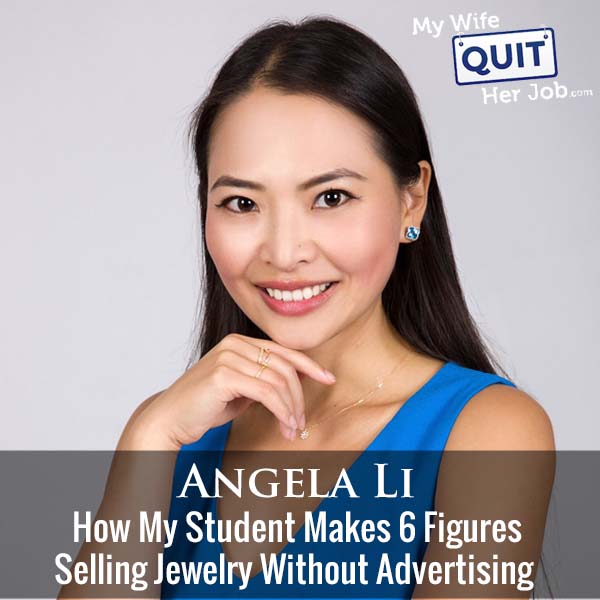
Angela Li is a student in my Create A Profitable Online Store course and runs AzuraJewelry.com. Jewelry is one of the hardest categories to sell online because the internet is saturated with makers and getting lost in the noise is the default outcome.
This episode covers how she grew from zero to 72,000 Instagram followers, her hashtag research method, the influencer program that finally worked after a failed first attempt, and how she gets featured in major magazines with cold outreach.
Get My Free Mini Course On How To Start A Successful Ecommerce Store
If you are interested in starting an ecommerce business, I put together a comprehensive package of resources that will help you launch your own online store from complete scratch. Be sure to grab it before you leave!
Table of Contents
Key takeaways
- 70% of Azura’s traffic comes from Instagram, and all of it is organic.
- Startup cost was under $1,000: $400 to $500 in inventory plus Shopify themes and packaging.
- Margins run 75% at a price point between $80 and $150.
- Target medium hashtags of 500k to 700k posts rather than saturated ones like #jewelry.
- Her viral Explore-tab post got over 15,000 likes and added 2,000 followers.
- Half her early nano-influencers took free jewelry and vanished. The ambassador program fixed it.
- Magazine editor outreach converts at 60% to 70% after a month of genuine engagement first.
- All lifestyle and Instagram photos are shot on an iPhone in about 90 minutes a month.
What Azura Jewelry sells and why
Azura Jewelry launched in New York in 2017 to bridge the gap between fine jewelry and disposable fashion jewelry.
Fine jewelry uses gold and diamonds and starts over $500. Fashion jewelry is cheap and does not last. Azura sits between them at $80 to $150.
The materials are the differentiator. Authentic natural gemstones, ethically and eco-sourced sterling silver, plated in 14 karat gold.
Angela’s own path to jewelry runs through a difficult family history. Her family was politically persecuted in China during the Cultural Revolution, and she grew up being told to keep her head down, blend in, and voice no opinions.
The specific moment came before her first job interview, when her mother gave her a pair of earrings with a white topaz center enclosed by six stones like a blooming flower. Putting them on made her sit taller and walk out the door with confidence, and that reaction became the business.
She moved to the US in 2011 for an MBA at Georgetown, started a Wall Street private banking career, and started Azura on the side in 2017. She went full time at the end of 2018.
Why validating your niche comes before launching
Angela’s biggest mistake was launching without validating the niche at all.
She spent roughly a year in stagnation, trying everything and moving nothing forward. That is what led her to join my course after listening to the podcast for six months.
Her turning point came in the first office hours, when a student asked about selling jewelry on Amazon. My answer was that jewelry is hard to categorize, hard to rank, hard to differentiate, and hard to articulate a functional benefit for, so selling it requires emotion and stories.
Azura had been a me-too brand until then, indistinguishable from competitors.
How to differentiate a jewelry brand with story
The fix was putting her story and her face behind the brand, which was uncomfortable and necessary.
She then wrote five distinct value propositions explaining why customers should buy from Azura rather than a competitor.
The product content changed alongside it. Product titles and descriptions now carry spiritual meaning, covering each gemstone’s meaning, healing properties, and powers, plus what inspired the design.
Her business only started taking off after those changes.
How to grow an Instagram account for a jewelry brand
Angela’s first sale came from Instagram to a customer in Denver, from cold traffic rather than friends and family.
She deliberately skipped marketing to her own network, since it is neither sustainable nor a source of honest feedback.
Her launch tactic was posting roughly two pages of content in a single day, so nobody landing on a two-photo profile would dismiss it as brand new.
The first 10,000 followers came from manual follow/unfollow targeting competitors’ followers in 2017. She does not recommend it today, because Instagram detects the behavior and effectively turns the account into a zombie with no organic reach.
Ten thousand followers was the credibility threshold. Everything from there to 72,000 has been organic, currently growing about a hundred followers a day.
How to create share-worthy Instagram content
Instagram favors visually appealing images, and shares are what expand reach beyond your own followers.
Angela creates for her audience’s audience’s audience rather than just her followers.
Her research method is competitor analysis. When most competitors’ posts get a thousand to two thousand likes and 30 comments, a post with over a thousand likes and over a hundred comments is the outlier worth studying.
She analyzes the pattern across those viral posts: what images they use, what hashtags, what captions. Once her own account had enough data, Instagram Insights took over as the guide.
Her biggest hit made the Explore tab with over 15,000 likes and generated about 2,000 followers, an amethyst ring collection in a lavender setting.
Three visual patterns hold across her winners. Multiple pieces of jewelry beat a single piece, a light background with a pop of gemstone color beats alternatives, and bird’s-eye view beats other angles.
How to research Instagram hashtags for your niche
Angela started by throwing large hashtags like #jewelry and #goldrings at every post, hoping something stuck.
She later had an intern run comprehensive research to find the hashtags most relevant to her niche, her followers, and her products, based on search volume and competitor usage.
Size is the key filter. Anything like #jewelry is far too competitive, and her target range is medium hashtags of roughly 500,000 to 700,000 posts.
That range scales with your account. Early on she used small specific tags like #amethystrings and #bluetopazring, and now targets broader ones like #GemstonesJewelry while keeping the specific tags to rank in narrow categories.
Each post gets its own mix. Gemstone-specific tags for whatever is in the photo, plus general ones like #jewelryoftheday and #ringoftheday.
Keyword logic applies too. She considers what people would type into Google about a piece, because those phrases often work as hashtags.
Why her first influencer strategy failed
At around 10,000 followers, Angela offered similar-sized influencers two or three pieces of jewelry for a shout-out. She describes it as a nightmare.
Roughly 50% took the free jewelry and posted nothing, despite repeated follow-ups.
The cause is the low barrier to entry. Anyone can call themselves an influencer on Instagram, and the nano-influencers she approached largely were not serious about it.
The ones who did post made no measurable difference to sales.
How the Azura ambassador and affiliate program works
The replacement program splits into two tiers based on follower count.
Ambassadors have over 50,000 followers, and affiliates have roughly 20,000 to 50,000. Passing a follower threshold correlates with taking the work seriously and sticking to commitments.
Each participant gets a unique coupon code and earns a percentage of sales generated through it, with ambassadors earning the higher rate.
The jewelry differs by tier. Ambassadors get three pieces quarterly via a 100% off coupon code emailed at the start of each quarter, while affiliates receive jewelry once and get dropped from the program if they generate no conversions.
Quarterly resupply exists because posting frequency drives results. Posting once converts poorly, and posting weekly or three times a month converts far better.
How to get your jewelry featured in magazines
Angela’s answer is that she keeps bugging the editors, and her hit rate runs 60% to 70%.
The sequence starts with engagement rather than a pitch. She follows accessory editors at major magazines, comments on their stories, and is deliberately among the first commenters on their posts so they notice her.
After about a month of that, she sends a brand introduction email covering who Azura is and what the unique value proposition is, closing with a request to be kept in mind for future stories.
Several weeks later she follows up with a package of pieces fitting whatever theme is current, then asks a week after that whether they have questions or want more samples.
Relationship maintenance continues past the ask. She sends flowers on birthdays she sees posted, and emails editors to compliment articles she genuinely liked.
Email addresses come from pattern-matching the magazine’s format, usually firstname.lastname or an initial plus last name at the publication’s domain. Addresses for packages come from editors’ email signatures.
Timelines vary widely. Some editors respond after one or two touches, and some have not replied after six, seven, or eight pitches.
How to photograph jewelry with an iPhone
Every lifestyle photo on the site and Instagram is shot on Angela’s iPhone. Only the white-background product shots use a professional photographer.
Jewelry is easier to shoot than apparel in one respect. A table setting, a prop, a hand, and a background is the whole production, with no models, makeup, or location changes required.
The hard part is light. Gemstones reflect it differently, and getting it wrong loses the authentic color and texture.
Her solution is timing. She shoots only in natural light between 11:30 and 1:30, spending about 90 minutes a month to produce roughly 30 photos.
Editing takes seconds. A single filter applied on her phone, often while waiting in line at Starbucks.
How Instagram traffic converts to jewelry sales
About 70% of Azura’s traffic comes from Instagram, tracked in Google Analytics.
Captions direct people to the profile link, and every product in a photo is tagged through the Shopify Instagram integration so a tap leads straight to the product page.
Influencer posts tag the Azura page, so followers click through to the profile and then the link. Instagram stories link directly to the website.
Stories run one to two per day, mixing user-generated content and customer tags, new launch announcements, and motivational quotes that fit the spiritually uplifting positioning.
Stories are also her research tool. Surveys asking which gemstones or designs people prefer remove a lot of guesswork from product decisions.
How to vet influencers for fake followers
Angela uses Social Blade to spot irregular follower growth. Five hundred new followers one day and three the next indicates purchased boosts rather than organic growth.
Her main check is the comment section. Some influencers belong to engagement pods where bloggers comment on each other’s posts to game the algorithm.
If the comments and likes come predominantly from other influencers rather than followers or customers, she does not work with them.
She deliberately avoids a likes-to-followers threshold, because likes and comments can both be bought, so quality of engagement matters more than any ratio.
Content quality is the final filter. Somebody who never posts stories is not serious, while consistent stories, IGTV, product reviews, and professional photography signal someone who is.
How Azura handles fulfillment, reviews, and email
Fulfillment splits by volume. Popular high-volume designs go to a New Jersey 3PL that charges about $1.80 per order plus $0.20 per additional unit in the same order.
New designs stay in her house. Testing runs of 30 to 50 pieces do not justify the 3PL’s storage costs until she knows they will move.
She found the 3PL when they reached out in a Shopify Facebook group after she posted about international shipping problems.
Reviews started with outreach offering a $10 coupon on the next order in exchange for a review. Once the site had enough reviews to look credible, she switched to automated sequences through Stamped.io.
Email marketing on Klaviyo is the weak spot she acknowledges, running automated flows plus campaigns every two weeks with low performance.
Paid advertising is nearly absent. Some Facebook retargeting runs, and cold paid traffic is the project for the coming year.
Angela’s advice for new store owners
Avoid shiny object syndrome, which is what cost her the first year.
She tried affiliate marketing, influencer marketing, and Facebook ads simultaneously, and none of them worked. Diving deep on one channel beats scratching the surface of a hundred.
Her second piece of advice is documenting systems from day one. She did customer service herself for ten months while documenting every question, categorizing them, and building email templates.
She screen-recorded every process: uploading products to Shopify, handling returns and exchanges, answering common questions.
That documentation let her hand the entire function to a full-time hire in two days. Her goal this year is removing herself from day-to-day work entirely to focus on marketing.
Frequently asked questions
Is jewelry hard to sell online?
Yes, because it is hard to categorize, hard to rank, and hard to differentiate on features. Selling it successfully requires leading with emotion, story, and meaning rather than product specifications.
How much does it cost to start a jewelry business?
Angela Li started Azura Jewelry for under $1,000, including $400 to $500 of inventory, roughly $280 in Shopify themes, and jewelry boxes.
Can you sell jewelry without paid ads?
Yes. Azura Jewelry reached six figures with all-organic traffic, about 70% of it from Instagram, running only limited Facebook retargeting.
What size hashtags should you target on Instagram?
Medium hashtags of roughly 500,000 to 700,000 posts. Massive tags like #jewelry are too competitive, and the workable range scales up as your own following grows.
Do nano-influencers work for jewelry brands?
Poorly in Angela Li’s experience, with about half taking free product and never posting. An ambassador program for accounts over 50,000 followers, with coupon-code commissions, performed far better.
How do you get a jewelry brand into magazines?
Engage with accessory editors on social media for about a month first, then send a brand introduction email, then follow up with product samples. That sequence converts at 60% to 70%.
Do you need professional photography to sell jewelry?
Only for white-background product shots. Every lifestyle and Instagram photo for Azura is shot on an iPhone in natural light between 11:30 and 1:30, about 30 photos in 90 minutes a month.
How do you spot fake influencer followers?
Check Social Blade for irregular follower spikes, then read the comments. If likes and comments come mainly from other influencers rather than real followers, the engagement is not genuine.