
Podcast: Download (Duration: 52:16 — 72.1MB)
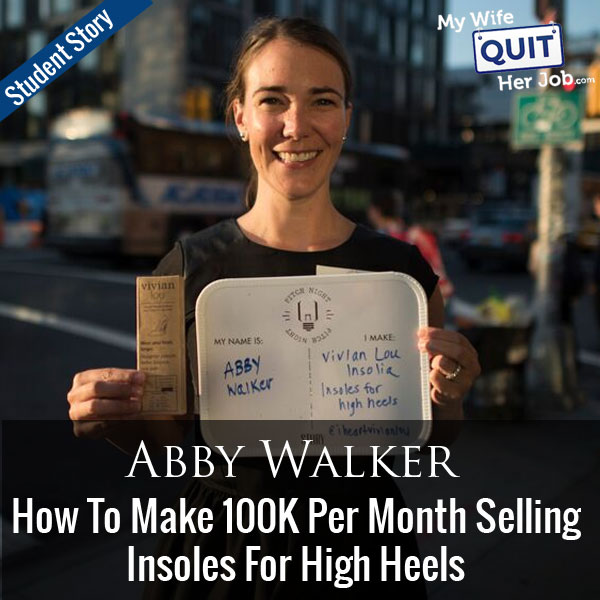
Abby Walker sold 1,200 two-packs in ten minutes on HSN, three separate times. Then she did 2,565 orders in a single day on The View.
The chain started because she signed up for a retail newsletter and applied to a pitch night meant for New York artisans. She flew in, pitched for three minutes, and the CEO of HSN took off her Louboutins and asked for a pair.
Abby is a student in my Create a Profitable Online Store course. She runs vivianlou.com, selling weight-shifting insoles that let women wear high heels four times longer without pain.
This episode covers how she became an exclusive distributor by making one phone call, why she raised her price twice, what actually moved sales versus what only looked impressive, and the two Facebook ads returning six times her spend.
Get My Free Mini Course On How To Start A Successful Ecommerce Store
If you are interested in starting an ecommerce business, I put together a comprehensive package of resources that will help you launch your own online store from complete scratch. Be sure to grab it before you leave!
Table of Contents
Key takeaways
- Call the company behind a product you love and ask why nobody knows about it.
- Raising price twice cost her two complaint emails and improved positioning substantially.
- Use a fulfillment center from day one rather than shipping from your garage.
- Print magazine features produced almost no lasting sales despite the prestige.
- Online features and television drove far more revenue than print.
- Two simple Facebook ads at $4 to $5 per conversion return six times daily spend.
- Test age brackets separately, since older buyers converted far better here.
- Scale ad spend only as fast as your fulfillment can handle the orders.
How do you become a distributor for an existing product?
Call the company and ask why you have never heard of them. Abby found Insolia mentioned in a forum, phoned the CEO, and offered to market it to women.
Her opening pitch was a revenue share. She proposed taking a cut of any increase in sales.
Their priorities made the deal possible. They were focused on manufacturing insoles built into shoes rather than selling direct to consumers.
She became exclusive distributor for the US and Canada. The product ships unbranded and sells as Vivian Lou.
Her credibility was genuine interest. She wore high heels daily and wrote a blog about them, and their team was men marketing to women.
The first order was 1,000 insoles. Her husband gave her $7,500 to build a website, order product, and find fulfillment.
Should you use a fulfillment center when you are small?
Yes, and Abby credits that decision with enabling everything after it. Shipping from a basement caps how far the business can go.
Most warehouses would not talk to her. A thousand units is too small for large fulfillment operations.
She called until one said yes. Google searches and phone calls found a partner willing to take a small account with potential.
The technical requirement mattered. She needed an app syncing with Shopify to pull orders and push tracking automatically.
Costs are modest as a share of revenue. Storage monthly, roughly 60 to 75 cents per order, plus per-item picks and shipping.
They handled assembly too. That removed the packaging work entirely.
Should you raise your prices?
Abby doubled her price on a consultant’s advice and received two complaint emails. She later took it from $19.95 to $29 per pair.
Her original price positioned her wrong. It placed a scientifically designed product alongside generic drugstore insoles.
The product justified the premium. Four sizes, clinical backing, and a design that shifts weight rather than adding cushioning.
She softened the first increase. Existing customers kept the old two-for price for six months.
The second increase came with a relaunch. New packaging, a new website, and the higher price all landed together.
Bundles preserve value perception. Multiple pairs come at meaningful discounts.
How do you get your product on television?
Put yourself in rooms where retail buyers are, even when the event was not meant for you. Abby applied to a New York pitch night after joining a store owner’s newsletter.
She was one of 34 accepted. The pitch ran three minutes.
The HSN CEO was in the audience. She tried the product on the spot and asked for it in her own shoes.
A call came a week later. HSN wanted to test the product on a show.
She appeared on air herself. All three appearances sold out, roughly 1,200 two-packs in ten minutes each.
The same network produced the next opportunity. Returning to the pitch night as alumni, she met Oprah Magazine’s creative director, which led to The View.
What are the terms for selling on HSN?
They purchase through purchase orders and take upwards of 60%. Abby ships inventory to their warehouse and they handle fulfillment and customer service.
Margins were thin. They sold at a two-for-one price on top of the wholesale discount.
She treated it as advertising. Making some money per unit while gaining exposure justified the terms.
You get no customer data. HSN keeps emails and customer information entirely.
The View worked differently. They ran a two-day flash sale at 50% off through their own storefront, taking a percentage.
Does print magazine coverage drive sales?
Barely, in Abby’s experience. Her September Oprah Magazine feature produced a first-week bump that did not sustain.
Online features performed better. A RealSimple.com mention drove significantly more traffic and sales than the Oprah print issue.
Television dominated both. The View produced 2,565 orders in one day.
The prestige still has value. It builds credibility even when the direct sales impact is small.
What makes a Facebook ad convert for a physical product?
A clear image of the product in use with copy naming the problem directly. Abby’s ads show high heels with the line “wear high heels four times longer without pain.”
The primary text names the pain. “Love high heels but hate the pain” opens it.
She sends traffic to her home page. It functions as a sales page rather than requiring a separate landing page.
Two variations run against the same audience. One uses a different shoe image and the headline “high heels without the hurt.”
Conversion costs $4 to $5. Daily spend returns roughly six times.
How do you target Facebook ads for a niche product?
Test age brackets separately and cut whatever underperforms. Abby targets English-speaking women in the United States, aged 38 and up, with a shopping interest.
Demographic research pointed there. The manufacturer’s study showed older buyers dominated.
Testing confirmed it. She ran younger and older brackets and the older group converted far better.
She turned the younger targeting off completely. Younger buyers tolerate the pain or spend the $29 on shoes instead.
Instagram placements can surprise you. The same untouched ads suddenly took off there months after launch.
How fast should you scale ad spend?
Only as fast as your fulfillment can process the orders. Abby holds at roughly $500 a day because her warehouse cannot handle more.
Inventory sets the other limit. She reduced spend after The View to avoid selling stock she did not have.
Spend maps directly to revenue. Moving spend $50 in either direction visibly changes daily orders.
The dependence concerns her. Facebook algorithm changes could end it, which is why she is building Amazon and Canadian fulfillment.
What should you do when you do not know how to start?
Admit it and ask people who do. Abby knew nothing about manufacturing, contracts, or ecommerce when she began.
She learned enough HTML to size photos. That got the Shopify site working.
She asked for help reading contracts. Distribution agreements and fulfillment terms both needed outside eyes.
Her advice is not to compare your beginning to someone else’s middle. She was embarrassed by her first website, which communicated the value proposition perfectly well.
Frequently asked questions
How do you get a product on HSN?
Get in front of retail buyers through pitch events and industry connections. Abby was seen by HSN’s CEO at a New York pitch night open to small business owners.
What percentage does HSN take?
Upwards of 60%, and they retain all customer data. Many sellers treat it as paid advertising rather than a profit center.
Does being in a magazine increase sales?
Print does surprisingly little. Abby’s Oprah Magazine feature produced a brief bump, while an online RealSimple.com mention drove far more traffic and sales.
Should you raise your product prices?
Often yes. Abby went from $19.95 to $29 and received only two complaints, while the higher price positioned the product correctly against cheaper alternatives.
Do you need a landing page for Facebook ads?
Not if your home page functions as one. Abby drives all ad traffic to a home page built around the value proposition.
How do you target Facebook ads by age?
Test brackets separately and turn off what underperforms. Abby found buyers 38 and older converted far better and stopped targeting younger women entirely.
How much should you spend on Facebook ads?
As much as your fulfillment and inventory can support. Abby caps at $500 daily despite a 6X return, because her warehouse cannot process more orders.
Should you use a fulfillment center from the start?
Yes. Abby credits partnering with one at 1,000 units as the decision that let her handle 2,565 orders in a day later.