
Podcast: Download (Duration: 40:41 — 46.9MB)
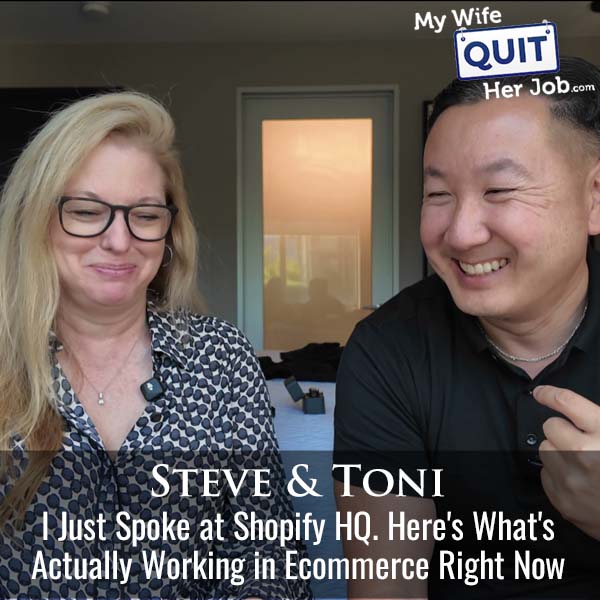
What is actually working in ecommerce right now, in one line: unpolished UGC beats produced ads, a real brand story ties every channel together, differentiated products with a moat outperform generic Amazon listings, and FAQ schema on collection pages is quietly winning the AI-search game. That is the through-line from the Shopify HQ Merchant Mastery event I just spoke at with my co-host Toni for the My Wife Quit Her Job podcast, recorded live from Soho after a day of sessions and unfiltered founder conversations.
Almost none of the merchants in the room were relying on Amazon as their main channel. They were Shopify-first brand builders, and the tactics they said were actually moving revenue right now were consistent across the room.
Below is the full breakdown: the UGC pattern that flipped for me, the brand-story exercise Scott Cunningham runs, the AI-search FAQ approach I use on my own store, the shipping-cost trap most sellers fall into, and my updated criteria for choosing which ecommerce events are worth your time and money.
Get My Free Mini Course On How To Start A Successful Ecommerce Store
If you are interested in starting an ecommerce business, I put together a comprehensive package of resources that will help you launch your own online store from complete scratch. Be sure to grab it before you leave!
Table of Contents
Key takeaways
- Unpolished, phone-shot UGC is outperforming produced ads. The best-performing ads at the event were the ones sellers almost did not run because they thought the quality was too low.
- A real brand story is now table stakes. The same story feeds ad copy, email, sales pages, and social so every message reinforces the others.
- Generic products are dying. Buyers under 35 want differentiated, story-driven products they can hunt down; tick-tockable products win.
- Two AI-search strategies work right now: one FAQ per blog post, or every FAQ stacked on the category/collection page with FAQ schema markup. I use the collection-page version and it is working.
- Always price ecommerce shipping EXW and let your own freight forwarder handle it. FOB and DDP quotes from your supplier often pad the shipping cost and hide your real cost of goods.
- Renegotiate FedEx and UPS every 3 months, not once a year. Rates keep climbing and carriers will move if pushed.
- The best events are small, the attendees are open about numbers, and there is a live community around the event before you ever show up in person.
What is actually working in ecommerce right now
The four moves working across the Shopify-first brands at Merchant Mastery were unpolished UGC, a codified brand story, differentiated products with a real moat, and a Q&A content layer built for AI search. Every seller I talked to was leaning on some combination of those four, not on generic Amazon-style listings or hyper-produced brand videos.
The common thread is authenticity that scales. Buyers can now spot AI-produced polish in a second, so raw, real, and specific is what converts.
Everything below is a deeper look at each of those four, plus the shipping and event tactics that came up in the same conversations.
Why unpolished UGC is outperforming produced ads
Unpolished, phone-shot UGC is beating produced ads right now because AI has flooded feeds with over-polished content and authentic content stands out by contrast. About half the attendees at the event brought their products and spent the afternoon filming rough UGC for each other with lapel mics and phones, no lighting rigs and no editing suites.
The clearest example came from Mary, one of the attendees. Her group on the pre-event Zoom calls kept pushing her to run one specific ad she hated and refused to publish. She finally caved, ran it, and it became her single best-performing ad.
The pattern repeats across the room. The video a seller almost did not ship is often the one that hits.
Toni and I ran into the same wall when we launched our Profitable Audience podcast. I re-shot the first three videos at least five times because they were filmed in a hotel and I thought they looked unacceptable. We never used any of them, and the ones that eventually performed were the least produced.
If you are sitting on content you think is not “good enough,” publish it. The less produced it looks, the more likely it is to work.
How to build a brand story that ties every channel together
A brand story is a written document that captures your value propositions and origin, then feeds every piece of marketing copy you produce so the message stays consistent across ads, email, sales pages, and social. Scott Cunningham opened the Merchant Mastery day by walking the room through a GPT he built that extracts the story out of you with a structured questionnaire.
I teach the same exercise to students in my class. The first time I ask a founder what is special about their product, the answer is almost always “I do not know.” The exercise is really about extracting information the founder already has but has never written down.
Here is how I use it inside a real ecommerce business.
Before we run any launch or promotion with one of my clients, we write a marketing brief for the product. Inside the brief is the specific product story. Then every touchpoint for that campaign, ad copy, email copy, social captions, sales-page copy, and follow-up emails, pulls from the same brief so the message compounds instead of contradicting itself.
Once you have the raw brand story down, you can hand it to Claude or ChatGPT and generate the campaign assets in minutes instead of days. The hard part is the initial brain-dump. Everything after that is automation.
Why generic products are dying and what to sell instead
Generic products are losing because a younger buyer would rather hunt down a differentiated product with a story than one-click a generic version on Amazon. Almost every product at Merchant Mastery was either genuinely unique, personalizable, or tick-tockable, and it is the reason those brands are outperforming the alphabet-soup Amazon sellers.
I saw the buyer shift firsthand in the comments on a recent YouTube video I posted that hit 1.3 million views in three days. The dominant sentiment across thousands of comments: shoppers are tired of the identical products from Chinese factories that fill Amazon search results under a rotating cast of random-letter brand names.
That signal changes what “product research” should look like today. Before you commit to a SKU, ask two extra questions.
Is the product tick-tockable? Meaning: can a real customer hold it up on camera and instantly show why it is different or fun? A shot ski, a magnetic weekly pill holder, an old-fashioned cocktail tea bag, and a story-building card deck were all in the room; every one of them films well without a script.
Does it have a moat? At Sellers Summit this year, Chuck from Quiet Light gave a quiz on which business had the highest sale multiple, and the correct answer was always the one with the strongest moat when everything else was factored in.
Personalization, a proprietary design, a genuine brand, or a physical process no one else runs are all moats. A generic reseller listing is not.
How to rank in AI search: FAQ schema on collection pages vs one FAQ per blog post
Two strategies are working for ranking in AI search right now: one FAQ per dedicated blog post, and every FAQ stacked on the collection or category page with FAQ schema markup. The Merchant Mastery session on AI search used the blog-post-per-question approach. I use the collection-page approach on Bumblebee Linens.
Here is the exact workflow I use on a collection page like Bumblebee’s baptism handkerchiefs page.
Step 1: pull the questions. I ask Claude or ChatGPT to give me every question people ask about the parent topic (in this case, baptism gifts, because “baptism handkerchiefs” alone has little search volume).
Step 2: build the FAQ block. I take those questions, write short answers, and add them to the collection page with FAQ schema markup so search engines and AI models can extract the Q&A cleanly.
Step 3: put the FAQ near the bottom. Products stay above the fold so you do not push your buy buttons under a wall of text. The FAQ sits below and does its job for search.
The trade-off between the two approaches is real. The blog-post-per-question route is more classic SEO and gives each question a dedicated URL, which can rank for more query variations. The collection-page route sends AI-search clicks straight to a page full of products instead of a blog post where you have to bounce the reader over to your store.
If you have the resources, do both. If you have to pick one, I lean toward the collection-page version because the click already lands on a page that can convert.
How to price ecommerce shipping: EXW vs FOB vs DDP
The safest way to price ecommerce shipping from an overseas supplier is EXW, which means the supplier hands the goods off at the factory and your own freight forwarder handles everything from there. FOB (supplier ships to the port, you cover it from the port) and DDP (supplier handles the whole delivery end to end) are both convenient, but suppliers routinely pad the shipping line to make margin on the freight and hide the real cost of goods.
Barack, who runs the freight forwarder Forceget, walked the room through this at Merchant Mastery, and it lined up with what I have seen in my own supply chain.
| Incoterm | Who handles shipping | Main risk |
|---|---|---|
| EXW (Ex Works) | You / your freight forwarder, from the factory door | You manage more logistics, but you see your true cost of goods and true shipping cost separately. |
| FOB (Free On Board) | Supplier ships to port; you cover port-to-warehouse | Supplier can pad the port-side leg into your unit cost. |
| DDP (Delivered Duty Paid) | Supplier handles everything, including customs | Convenient, but shipping and duties are usually padded, and you cannot claim tariff refunds later. |
Two extra shipping moves that came out of the same session.
Always keep two active suppliers on any core SKU. Once a supplier knows switching costs are high, they will raise prices every year, and unless you have a real alternative you cannot push back. A second supplier is your leverage.
Renegotiate FedEx and UPS every 3 months, not once a year. I have been doing it once a year, and Barack does it quarterly. Carriers have been raising prices aggressively (a recent USPS fuel surcharge plus roughly 6% base increases from UPS and FedEx), and quarterly renegotiation is now the baseline if you ship real volume.
My criteria for which ecommerce events are worth attending
An ecommerce event is worth your time and money if it is small enough to actually meet everyone, the attendees are open about their real numbers, and it is built around a live community you can plug into before and after the event, not just a firehose of sessions. Merchant Mastery hit all three, which is why the conversations were as valuable as anything on stage.
Here are the three filters I use before I book a flight now.
Small and intimate. If the event is too big, you never get past small talk. At Merchant Mastery I sat down at a table and attendees started volunteering their revenue and profit numbers without being asked, because the group was small enough that they already trusted the room.
Open attendees. This is the hardest one to screen for from the outside. Ask around: do people at this event actually share numbers, or does everyone play their cards close to the chest?
The former is worth the ticket. The latter is not.
A real community around the event. Scott’s attendees had been on twice-weekly Zoom calls for months before flying in, so they walked in as friends. The Sellers Summit event I run has a Discord community that runs year round for the same reason.
If an event has no community layer, join whatever community exists (a Facebook group, Discord, Circle space) and be active in it for at least a month before you show up. Skipping that step wastes most of your ticket cost.
The pendulum is swinging back toward real human connection precisely because AI has flooded every channel with content, so events and communities are getting more valuable, not less.
Frequently asked questions
What is actually working in ecommerce in 2026?
Right now the winning combination is unpolished UGC ads, a written brand story that feeds every channel, differentiated products with a real moat, and an FAQ layer on your key pages built for AI search. Generic Amazon-style listings, over-produced brand videos, and one-off blog posts with no distribution are all underperforming.
Why is unpolished UGC outperforming produced ads?
Because AI has flooded feeds with polished content, so raw phone-shot UGC now stands out and reads as authentic. The clearest sign it is working: sellers keep reporting that their best-performing ads are the ones they almost refused to publish because they thought the video quality was too low.
How do I create a brand story for my ecommerce business?
Start with a structured questionnaire (or a GPT built for the exercise) that pulls out your origin, your value propositions, and the specific reasons your product exists. Then write a short marketing brief for each product and reuse the same story across ad copy, email, sales-page copy, and social so the message compounds across every channel.
Should I use FAQ schema on collection pages or write a blog post per question?
Both work for AI search. Collection-page FAQ with schema markup sends clicks straight to a page full of products, which converts better; a blog-post-per-question strategy gives each question its own URL and can rank for more query variations. If you can only do one, put the FAQ on the collection page and put it near the bottom so it does not push your products below the fold.
What shipping term should I use with a Chinese supplier: EXW, FOB, or DDP?
EXW is the safest default because it makes your supplier’s true cost of goods and your true shipping cost visible as separate line items. FOB and DDP quotes routinely pad the shipping leg, so you end up overpaying without knowing it, and DDP also blocks you from claiming tariff refunds.
How often should I renegotiate FedEx and UPS rates?
Every 3 months if you ship real volume, and at minimum once a year. Carriers have been raising rates aggressively, so quarterly renegotiation is now the working baseline for high-volume ecommerce sellers.
What makes an ecommerce event worth attending?
Three things: the event is small enough that you can actually meet everyone, attendees are open about their real revenue and profit numbers, and there is an active community around the event you can plug into before and after. If the event has no community layer, it is mostly a session firehose and the ROI drops fast.