
Podcast: Download (Duration: 50:26 — 58.0MB)
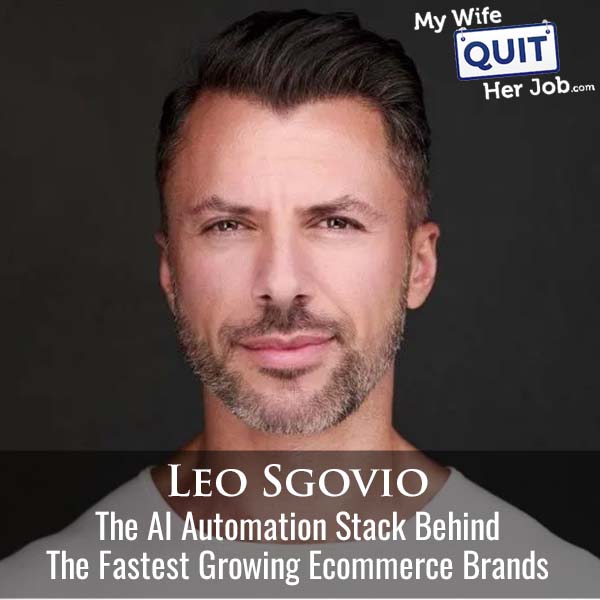
The AI automation stack behind the fastest-growing ecommerce brands right now, in one paragraph: an AI-scored influencer outreach agent (email plus TikTok DMs) that filters real creators on 100+ data points, an n8n workflow chaining Gemini plus NanoBanana plus Suno plus VO3 plus FFmpeg to clone any winning meta ad with your product dropped in, and a meta-ad-to-landing-page-to-Amazon funnel that lifts conversion and slashes click cost. That is the exact stack Leo Sgovio used to sell out 5,000 units of a Q4 game before Christmas without giveaways, and he walked through it end to end on this episode of the My Wife Quit Her Job podcast.
Leo runs Spliced.io, an influencer and affiliate platform for TikTok Shop and Instagram, and Combomat, a marketing automation tool for sellers. He is also a decade-plus Amazon operator who was head of innovation at Viral Launch, so his stack is what he actually runs on his own products, not theory.
Below is the full breakdown: the influencer outreach system that beats spam bots, the AI ad-cloning workflow anyone can copy, TikTok Shop launch economics you can actually trust, why AI clones for product claims just got banned, and the meta-to-Amazon funnel that is quietly outperforming direct-to-listing traffic.
Get My Free Mini Course On How To Start A Successful Ecommerce Store
If you are interested in starting an ecommerce business, I put together a comprehensive package of resources that will help you launch your own online store from complete scratch. Be sure to grab it before you leave!
Table of Contents
Key takeaways
- Leo sold out 5,000 units of a new Amazon game in Q4 with no giveaways, using only creator content and Amazon PPC.
- Most influencer outreach tools spam creators. The differentiator is scoring each creator on 100+ data points before sending an invite so your message reaches people likely to say yes.
- You can clone any winning meta ad with an n8n workflow: Gemini analyzes the video, Suno generates music, NanoBanana generates frames, VO3 generates 8-second video segments, FFmpeg stitches everything together.
- Launching on TikTok Shop plus Amazon at the same time creates a halo effect that lifts Amazon sales dramatically. One of Leo’s competitors sold 70,000 units in Q4 running this exact play.
- TikTok Shop banned AI clones from making product claims (skincare, physical goods) in late 2025. AI is still fine for informational content and general social proof.
- The winning funnel is meta ad -> landing page -> Amazon, not meta ad -> Amazon direct. The landing page warms the buyer so the Amazon click converts instead of getting poached by cheaper competitors on the product page.
- Google Ads to a landing page runs at 15-20 cent clicks. The same traffic sent to an Amazon listing costs roughly triple.
- Amazon reported its lowest number of new sellers this year and just started charging developers $1,400/year to use its APIs. Fewer sellers means less competition for those willing to stay profitable.
The AI automation stack behind the fastest-growing ecommerce brands
The AI automation stack that fastest-growing ecommerce brands run in 2026 has three layers: AI-scored influencer outreach for TikTok Shop and Instagram, an n8n-based ad-cloning workflow that produces meta-ready video from any winning competitor ad, and a meta-to-landing-page-to-Amazon funnel that lifts conversion while cutting click cost. Together, the stack lets one operator do the work of four or five marketers.
Leo’s own results are the case study. His Q4 game launch sold 5,000 units and sold out before Christmas without giveaways, driven almost entirely by creator content and AI-produced ad video. The AI automation freed him to run marketing at that scale without hiring a team.
The rest of this post walks through each layer of the stack in order.
How to run influencer outreach at scale without spamming creators
Run influencer outreach at scale by scoring every prospective creator on 100+ data points (GMV, number of active brand deals, average video earnings, audience match, timing signals) before sending an invite, so your messages reach creators who are likely to engage instead of ignoring one more spam DM. Leo’s Spliced.io platform uses this scoring layer as its main differentiator against outreach tools that just blast creator databases.
The volume math is real. You can send about 1,000 messages per day on TikTok Shop or via Instagram email, and the tools that will let you send that many are the same tools that get creator inboxes ignored. Creators receive so many templated pitches that a generic message is dead on arrival.
The fix is to filter the API results yourself. When you query TikTok Shop or Instagram creator databases, you get back a list that “matches” your criteria (region, category, GMV band). That list still includes creators who are wrong for your product: a family-games creator whose audience is toddlers when your game is 5-12, or a $10K/month affiliate whose economics will not accept your 20% commission.
Score the returned list before you invite. That is the entire moat.
How much to offer TikTok Shop and Instagram affiliates
The right offer for a TikTok Shop or Instagram affiliate is one that matches or beats their current per-video earnings on comparable products, because they will not replace something that is already making them money with an offer that pays less. Leo’s rule: if a creator averages $10 commission per product video today, your offer needs to be in that neighborhood or above, especially when your storefront has no conversion history yet.
The cold-start problem on TikTok Shop mirrors the cold-start problem on Amazon a decade ago. Established affiliates want to see that your shop converts before they will spend a video slot on your product. Without a track record, you are competing against products with proven per-click earnings.
Leo runs a 3-phase creator strategy based on brand size:
- Phase 1 (small brand): micro-influencers only. Goal is to unlock the first $2,000 GMV milestone that lifts your weekly message cap on TikTok Shop.
- Phase 2 (past $2K GMV): open your message cap to 5,000/week and start hunting mid-tier affiliates. Use “open collaborations” so creators apply to you instead of you DMing every one.
- Phase 3 (past $50K GMV): 50,000 messages/week unlocked. Go after the top affiliates who now see you as an established shop.
To speed the cold start, some sellers use refundable-sample purchases: the creator buys the product, you refund them, the purchase still counts toward your GMV milestone. Combined with friends-and-family purchases (with more than one unit each), you clear the $2K threshold faster.
The initial cold-start phase can last a couple of months. That is normal.
How to clone any winning meta ad with n8n, Gemini, NanoBanana, Suno, and VO3
The n8n workflow to clone a winning meta ad chains 5 tools: Gemini analyzes the source video and generates a script, NanoBanana renders your product into the first and last frames, Suno generates on-theme music, VO3 generates the 8-second video segments the script calls for, and FFmpeg stitches all segments together into the final ad. Everything runs inside n8n with an Airtable interface for inputs, and the final video lands in Airtable ready to review.
Leo demoed the workflow live on stage at Sellers Summit with two cloned ads that were arguably better than the originals.
Example 1: he took a Secret deodorant ad (with the disco-ball raspberry finish), swapped in his own deodorant (an old Amazon product he sold in Canada), rendered a 3D product image through NanoBanana, and asked the workflow to keep the choreography but re-theme the color to match his brand’s green and flowers. The output was cleaner than Secret’s original.
Example 2: he took an Alo Yoga leggings ad (two girls eating popcorn in a mountain cottage), swapped in a different leggings brand’s model and logo on the popcorn box, and the workflow produced a near-identical ad end to end. No script writer, no video editor.
Here is the flow in plain steps:
- Feed the source video URL and your product image into Airtable.
- Gemini analyzes the source video, extracts the script beats and pacing, and outputs a scene-by-scene script.
- Suno generates on-theme background music matching the video’s mood and length.
- NanoBanana takes each scene beat plus your product image and renders the first and last frame of each 8-second segment.
- VO3 generates each 8-second video segment using those frames as anchors.
- FFmpeg stitches segments and the music track into the final MP4.
- Airtable surfaces the final video for review.
Where this matters most: sellers currently paying scriptwriters and video editors can produce ready-to-run meta creative in a single pass, at a cost that is a rounding error against media spend. Leo has been giving the workflows away free on LinkedIn.
What TikTok Shop’s new AI-clone ban means for your ads
TikTok Shop banned AI clones from making product claims in late 2025, which means an AI avatar (even one built from your own likeness) is no longer allowed to say “these glasses are comfortable” or “this cream cleared my skin.” AI-generated informational content and general social proof are still allowed; AI-generated product endorsements are not.
The rule closes what was, until recently, the loudest AI ecommerce loophole: mass-producing “creators” who sell your product. Because AI outputs are now nearly impossible to distinguish from real people, TikTok classified the practice as deceptive.
Two things you can still legally do with AI on TikTok:
- Informational or educational content in your brand voice: “how to build a skincare routine,” “how to pick a family game.” No product claim, no direct sell.
- General social proof on your owned website: AI-generated testimonials as marketing copy, understanding that other platforms and jurisdictions have their own rules on advertorials and disclosure.
Meta has not (as of publication) enforced the same restriction on AI product claims, so ad-cloning workflows like Leo’s (which use no avatar, only product plus animation) remain within policy. Meta requires an AI disclosure flag when creative is AI-generated; check that setting before you spend.
The meta ad to landing page to Amazon funnel that outperforms direct-to-listing
The funnel that consistently outperforms direct-to-Amazon is meta ad to landing page to Amazon, because the landing page warms the buyer before they hit a product page full of competing ads, cheaper alternatives, and distractions. Cold traffic sent straight to an Amazon listing frequently gets poached by a competitor’s sponsored ad on your own detail page.
Leo also runs Google Ads on the same landing-page pattern. The click math is dramatic: Google Ads to a landing page costs roughly 15-20 cents per click, and the same Google traffic sent directly to an Amazon listing costs about triple.
The landing page functions as an advertorial. It explains why the product is right for this buyer, sets expectations on price, and produces a click to Amazon that is already convinced. When that pre-warmed click hits the listing, they buy instead of clicking away to the sponsored competitor above the fold.
The reason not to just send the sale to your own Shopify checkout is category-dependent. If you sell exclusively on Amazon, external traffic to a warmed listing helps ranking and lifts organic sales. If you have a Shopify store, sending the sale to your own site captures the email and the customer relationship, which is almost always the better long-term play.
Why launching on TikTok Shop and Amazon together beats either channel alone
Launching on TikTok Shop and Amazon at the same time creates a halo effect: TikTok Shop drives discovery, buyers research on AI or Google, and then most of them actually buy on Amazon because the checkout is familiar. One of Leo’s competitors sold 70,000 units in Q4 running exactly this dual-launch strategy, most of the revenue landing on Amazon even if the TikTok Shop side ran near-break-even.
The attribution problem is real. Most brands claim they see the halo effect and try to prove it with Amazon’s attribution API, but the API misses the most common shopping pattern: buyer sees the product on TikTok, opens Google, finds the Amazon listing, clicks the ad, buys. That path has no attribution trail.
Practical implication: do not try to make TikTok Shop economics pencil in isolation. Measure the combined lift on Amazon during the launch window and evaluate the two channels together.
Where Amazon is headed in 2026 (and why it might be a better opportunity, not a worse one)
Amazon reported its lowest number of new sellers this year, which counterintuitively makes Amazon a better opportunity for operators willing to stay profitable, because less competition means more room to rank and less bidding pressure on ads. Fees are still rising (advertising, FBA, AWD, and a new $1,400/year developer API fee), so profitability is harder, but the seller pool is shrinking.
Two forces are pulling sellers away. Guru marketing has swung heavily toward TikTok Shop, which is drawing new sellers there instead. And OpenAI and Google’s commerce protocols are trying to move product transactions inside their own AI answer engines, which will eventually pull some purchase intent out of Amazon entirely.
Amazon’s response so far is defensive. They blocked most AI crawlers from indexing Amazon and are pushing Rufus (their own AI shopping assistant) to keep the shopping conversation on-platform. That is not a growth strategy for sellers; it is a moat strategy for Amazon.
The developer-fee move is the more worrying signal. Tools like Helium 10 and Jungle Scout are what taught the last generation of sellers how to research products, and choking those partners with API fees slows the entire ecosystem’s ability to innovate on top of Amazon.
How Leo launched a new Amazon product with only creators and PPC (no giveaways)
Leo’s Q4 game launch used only creator content and Amazon PPC, no giveaways, and sold out 5,000 units before Christmas. The strategy leans on 3 factors that stack in Q4: existing category demand for gifts, external traffic from TikTok and Instagram creators, and semi-broad Amazon PPC campaigns that catch the resulting search volume.
Why no giveaways: giveaways used to be a ranking hack, but Amazon’s algorithm now weights genuine relevance and external traffic more than the pure velocity that a giveaway produced. Creator content produces both external clicks and genuine reviews, which is what the algorithm actually rewards.
For non-seasonal products, the same 3-factor stack works but the “demand tailwind” comes from you: paid meta plus creator content plus AI-generated variations rather than Q4 gift-buying pulling the market up.
Frequently asked questions
What is an AI automation stack for ecommerce?
An AI automation stack for ecommerce is the set of AI-powered tools and workflows a brand chains together to run marketing, creator outreach, ad production, and fulfillment with a smaller team. The current 2026 core is scored influencer outreach (Spliced.io or similar), an n8n-based meta-ad-cloning workflow (Gemini + Suno + NanoBanana + VO3 + FFmpeg), and a meta-to-landing-page-to-Amazon funnel.
How do I do influencer outreach on TikTok Shop without getting ignored?
Score every prospective creator on multiple data points (GMV band, active brand deals, audience match, per-video earnings, timing) before you send an invite, and only message creators whose economics will actually accept your offer. Generic mass-DM outreach is dead because creators receive too many templated pitches; targeted, scored outreach is what still works.
Can I clone a Facebook ad with AI and drop in my own product?
Yes, using an n8n workflow that chains Gemini (analyzes the source video), Suno (music), NanoBanana (frame rendering with your product), VO3 (8-second video generation), and FFmpeg (stitching). Leo Sgovio built and demoed this exact workflow at Sellers Summit and gives it away free on LinkedIn.
Are AI-generated ads still allowed on TikTok Shop and Meta?
TikTok Shop banned AI clones from making product claims in late 2025, including your own AI clone endorsing a product you have used. Informational AI content is still allowed. Meta allows AI ad creative with an AI disclosure flag; ad-cloning workflows that use no avatar (only product plus animation) currently remain within policy.
Should I send meta ads directly to my Amazon listing?
No. Send meta traffic to a warming landing page first, then to Amazon, because the landing page reads as an advertorial that pre-sells the buyer so they check out on Amazon instead of getting poached by a cheaper sponsored competitor on the detail page. Google Ads clicks also cost roughly one-third as much when they land on a landing page instead of an Amazon listing.
Is TikTok Shop or Amazon better for a new product launch?
Launch on both at the same time. TikTok Shop drives discovery and creator-led social proof; Amazon captures the actual purchase because most buyers still check out there. One of Leo’s competitors sold 70,000 units in Q4 running this dual-launch playbook.
Is Amazon still worth it as an ecommerce channel in 2026?
Yes for operators willing to prioritize profitability. Amazon reported its lowest new-seller count this year, which means less competition to rank, but fees are climbing across the board (advertising, FBA, AWD, and a new $1,400/year developer API fee). Amazon plus a discovery channel (TikTok Shop, meta, or Google) still outperforms most other single-channel setups.